

Solar-powered security camera systems solve a simple problem, you want outdoor coverage without running fresh wiring across the yard, driveway, or side gate. That matters most for homes with awkward corners, detached sheds, long fences, or rental situations where drilling is a headache. The seven picks below cover compact two-camera setups, wide 360-degree kits, and larger home systems, so you can match the hardware to your property instead of forcing a one-size fit.
Quick Look At The Shortlist
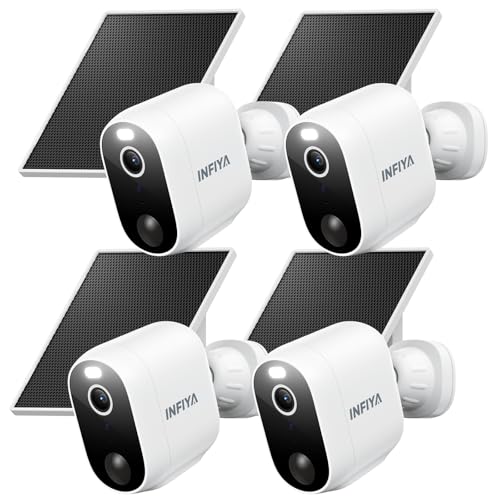
INFIYA Wireless Outdoor Solar & Battery Cameras 4-Pack

eufy SoloCam E30 4-Cam Kit, 2K Solar Security Camera

eufy SoloCam E42 4-Cam Kit, 4K Solar Security Camera

aosu T2 Ultra 4K Wireless Outdoor Security Camera

REOLINK 2K+ 4G LTE Cellular Security Camera

Hiseeu 4MP Solar Security Camera with 10-Inch Touchscreen

Hiseeu Solar Security Cameras Wireless Outdoor System 8-Cam Kit
More Details On Our Top Picks
Four cameras give you broad perimeter coverage without turning the setup into a wiring project. The solar-plus-battery design is the practical part here, since it suits side yards, garages, and front entries that do not sit near outlets.
The listing leans on human detection, instant alerts, a light, a siren, color night vision, two-way talk, and SD storage, so you get a fairly complete outdoor package in one kit. It’s a solid match for busy homes that want visible deterrence and simple day-to-day monitoring, though the 2.4G Wi-Fi requirement keeps it tied to a specific network type.
Strong Points
- Four-camera coverage helps you split monitoring across doors, driveways, and the back fence.
- Solar and battery power reduce the need for frequent manual charging.
- Color night vision gives you more usable detail after dark than plain monochrome footage.
- Two-way talk fits quick driveway or porch check-ins.
- SD storage keeps recording local, which suits homes that prefer simpler on-device handling.
Things To Consider
- 2.4G Wi-Fi only means it will not work with 5GHz-only setups.
- The feature stack is broad, so first-time setup can take a little patience.
- Solar placement still matters, especially on shaded walls or narrow eaves.
Feature Snapshot
Who It Suits Best
Homes that want a broad, straightforward outdoor kit with local storage will get the most from this one.
A Better Fit Elsewhere
aosu T2 Ultra suits you better when a single camera with 360-degree tracking matters more than a four-camera spread.
Compared with the fixed INFIYA set, this E30 kit trades bulk coverage for motion flexibility. Pan and tilt mean you can swing the view across a wider area without physically relocating the camera, which helps on porches, patios, and driveways.
The 2K capture level gives you a step up from basic outdoor feeds, and the built-in local storage keeps recording self-contained, with capacity listed up to 16TB. That makes it a cleaner fit for homes that want fewer recurring pieces to manage, though the more capable motion system also means you’ll want to spend a bit more time on placement and app setup.
Highlights
- Pan and tilt coverage reduces the chance of leaving a blind edge in frame.
- 2K clarity gives you a useful middle ground between basic and ultra-high-detail capture.
- Local storage keeps the setup independent of a monthly service model.
- The four-camera kit suits homes that need several viewpoints without mixing brands.
Worth Noting
- Motorized movement adds setup choices, which can slow the first install.
- The feature set is richer than Item 1, so placement planning matters more.
- Local storage capacity depends on how you configure the system, so footage habits still matter.
At A Glance
Who Will Love This
Homeowners who want flexible coverage with local storage and a cleaner all-in-one package should put this near the top.
Look Elsewhere When
INFIYA fits better for simpler, more fixed coverage across several outdoor points.
Item 3 is the step-up version of the E30, and the difference is clear in the feature list. 4K video, facial recognition, motion tracking, a strobe light, and pan-and-tilt control push it into a more detailed, more reactive category.
That extra capability is most useful on properties where you care about identifying what’s happening rather than just seeing that something moved. It suits a front approach, long driveway, or side path with changing activity, though the richer toolkit also brings more setup decisions than the simpler INFIYA set.
Bright Spots
- 4K capture gives you the highest stated detail level in this group.
- Facial recognition adds a more selective way to sort familiar movement from unknown activity.
- Motion tracking helps the camera follow a subject across a wider section of space.
- Pan and tilt keep the viewing angle adaptable.
- Built-in local storage up to 16TB gives the system substantial recording room.
Minor Gripes
- The extra functions make it a more involved setup than a basic fixed camera.
- Feature density can mean more time spent tuning notifications and motion zones.
- The higher-detail approach makes sense most when your property has active sightlines to cover.
Core Details
The Right Fit
You’ll appreciate this most when sharp detail and active subject tracking matter more than keeping the package simple.
Swap It Out When
eufy SoloCam E30 makes more sense for you if 2K coverage is enough and you want a little less complexity.
The aosu T2 Ultra stands apart because it combines 4K clarity with a broader detection stack than the eufy kits. Radar, PIR, and AI work together here, and PIR means passive infrared, the motion sensing method that reacts to heat movement.
That mix suits larger yards or active front areas where you want the camera to react with more context. The detachable solar panel also helps with mounting flexibility, which is handy around odd rooflines or shaded walls, though the richer feature set brings more to configure than a simpler outdoor camera.
Upsides
- 4K UHD gives you the strongest stated image detail in this group.
- True color night vision is useful when you want better scene recognition after dark.
- Radar, PIR, and AI detection create a layered motion approach.
- 360-degree auto tracking helps a subject stay in frame across a wide area.
- The detachable solar panel makes placement easier in less-than-perfect sun exposure.
Areas To Watch
- The detection stack is powerful, but it also means more setup choices.
- Wide-area tracking works best where the camera has room to move.
- Its strengths are most obvious on larger properties, not tight entry points.
Feature Rundown
Built With In Mind
You should look here first when you want wide coverage and the most detailed video in a solar-powered outdoor setup.
Reach For A Different Pick When
REOLINK 2K+ 4G LTE is the cleaner match for remote spots that do not have dependable Wi-Fi.
This REOLINK pick changes the usual solar-camera logic because it does not depend on home Wi-Fi. With 4G LTE, a SIM card, and the included 32GB SD card, it suits places where the network is the weak link rather than the camera.
That makes it a practical choice for cabins, workshops, rural gates, or any spot where running internet is more trouble than it’s worth. The 360-degree pan-tilt design and color night vision round out the package, though data service adds another ongoing piece to think through.
Reasons To Buy
- 4G LTE connectivity keeps the camera working away from a home router.
- The included SIM and 32GB SD card simplify the starting setup.
- 360-degree pan and tilt help cover broad outdoor areas.
- Color night vision gives better context than plain black-and-white footage.
- Solar power supports long-term placement in remote locations.
Points To Note
- Cellular use adds a service layer that home-Wi-Fi cameras do not need.
- Remote mounting still depends on a decent solar position.
- The feature mix is more location-driven than the eufy models earlier in the list.
Details At A Glance
Whose Shelf It Belongs On
You’ll get the most value from this when the camera has to work in a place without dependable Wi-Fi.
Where A Sibling Pick Shines
aosu T2 Ultra makes more sense for a Wi-Fi-rich home that wants higher-end detection and 4K detail instead.
The built-in 10-inch touchscreen changes the feel of this system right away. Instead of managing everything only through a phone, you get a more direct control point, which is handy in a garage, utility room, or a home office corner where the system hub can live.
Dual-lens hardware, auto tracking, 2.4 and 5GHz Wi-Fi Pro, two-way audio, and a 500GB HDD make it much more of a monitoring station than a single outdoor camera. That depth suits you best when you want hands-on control and local recording capacity, though the larger hub-style design takes up more room than the simpler INFIYA or eufy kits.
Positives
- The 10-inch touchscreen makes day-to-day control feel more direct.
- Dual-lens coverage adds flexibility for watching different angles.
- 5GHz support joins 2.4GHz, so the system fits more router setups.
- The 500GB HDD gives you local recording space from the outset.
- Two-way audio helps with quick back-door or driveway conversations.
Softer Spots
- The hub-style layout takes more shelf or counter space than compact outdoor kits.
- The system feels more involved than a basic single-camera setup.
- Owners who want a minimalist install may find the touchscreen hub a bit much.
Quick Facts
Made For
Homes that want a control hub with local storage and a more involved monitoring setup should look closely here.
Another Choice May Suit
Hiseeu Solar Security Cameras 8-Cam Kit fits better for sprawling properties that need more exterior coverage points.
Eight cameras put this system in a different category from the smaller kits above. That scale suits a larger house, a multi-building property, or a place with several exterior zones that need coverage without mixing devices from different product lines.
The 3K color night vision, dual-band Wi-Fi, 1TB HDD, and expandable 10-channel design give it a more complete home-system feel. It’s the strongest match for people who want to centralize a lot of camera coverage, though the size and scope make it more system-minded than the leaner REOLINK or eufy options.
Best Bits
- Eight-camera coverage handles larger properties and multiple outdoor angles.
- 3K color night vision provides more detailed low-light viewing than basic outdoor feeds.
- 2.4GHz and 5GHz Wi-Fi support broadens compatibility with home networks.
- 1TB HDD gives you substantial local recording room.
- Expandable to 10 channels, it leaves space for future growth.
Small Caveats
- The system takes more planning and mounting time than a compact kit.
- It makes the most sense only when you truly need multiple cameras.
- Storage management matters more with a larger camera count.
- The footprint is broader than the 4-camera picks, so it suits dedicated setups better.
Core Details
Who Should Grab It
You should put this on your shortlist when a large property needs a single, centralized camera system.
Where A Sibling Pick Shines
REOLINK 2K+ 4G LTE is the smarter choice for a remote setup where cellular connectivity matters more than camera count.
How To Choose The Right Solar Powered Security Camera Systems
Coverage First, Then Camera Count
Start with the shape of your property, not the number on the box. A four-camera kit like INFIYA or the eufy E30/E42 options fits a front entry, driveway, side path, and back door; an eight-camera system like the Hiseeu 8-cam kit suits larger lots with more corners and outbuildings.
Motion style matters just as much as camera count. A fixed bullet camera is simple and predictable, while pan-and-tilt units like the eufy and REOLINK models let you shift the view without moving hardware.
Storage And Connectivity Matter More Than Shoppers Expect
Local storage changes the ownership experience in a big way. An SD card, built-in local storage, or an HDD means the system records on-site, while larger capacities such as the Hiseeu 500GB HDD or the eufy storage ceiling up to 16TB give you more room before you need to manage files.
Connectivity should match your property, too. 2.4GHz Wi-Fi covers many homes, 2.4 and 5GHz support broadens compatibility, and 4G LTE like the REOLINK model solves the harder problem of remote locations with no dependable router.
Solar Setup Works Best With Real Sun Exposure
Solar power sounds simple, but mounting position decides how smooth the experience feels. A detachable panel, like the aosu T2 Ultra uses, helps when the camera body and the sunniest spot do not line up neatly.
Shade from overhangs, trees, or deep soffits can limit how well a solar setup keeps up. That’s why homes with partial shade often do better with a battery-assisted model, while open yards and fence lines are easier territory for solar-only or solar-first designs.
Match Features To The Job You Actually Need
Human detection, AI tracking, facial recognition, and dual-lens layouts sound similar until you look at the job. Detection helps reduce noise from harmless motion, tracking keeps subjects in frame, and dual-lens designs broaden what the camera can watch at once.
For everyday porches, simpler tools are usually enough. For long driveways, busy gates, or wide acreage, the extra logic in the aosu, eufy E42, or Hiseeu systems earns its keep.
A Quick Reality Check Before You Choose
Common Shopping Slip Ups
A common mistake is buying for camera count before thinking about sightlines. A big kit still fails if the mounting spots point at walls, eaves, or heavy shade.
Another trap is overlooking network support. A 5GHz-only household, a weak router, or a remote cabin with no internet changes the field fast, and that’s where the REOLINK 4G LTE model makes more sense than a Wi-Fi-only kit.
What The Higher Tier Buys
Higher-priced systems usually spend the extra money on movement, image detail, storage, and broader sensing. That’s why 4K video, pan-and-tilt motors, dual-lens designs, large HDDs, and layered detection show up more often as you move up the list.
The upgrade pays off when your property has active zones, long sightlines, or a need to review details after the fact. For a modest porch or small yard, a simpler 2K or 4MP system can already be enough.
Frequently Asked Questions
Do Solar Powered Security Camera Systems Need Direct Sun?
Direct sun helps, but many setups can still work with strong daylight and a sensible mount. Shade-heavy spots make battery support or a detachable solar panel more useful.
Is 2.4GHz Wi-Fi Enough For Outdoor Cameras?
For many homes, yes. It is common for security cameras because it reaches farther than 5GHz, though 5GHz support helps in more modern networks.
What’s The Difference Between 2K, 3K, And 4K Here?
Those numbers describe image resolution, or how much visual detail the camera can capture. Higher resolution usually helps with identifying faces, vehicles, and small scene details.
Does Local Storage Beat Cloud Recording?
Local storage suits you when you want recordings kept on the system itself. Cloud-style handling can be convenient, but on-device storage keeps the setup more self-contained.
Which System Fits A Remote Property Best?
REOLINK 2K+ 4G LTE fits that job most cleanly because it uses cellular data instead of home Wi-Fi. That makes it better for cabins, gates, and other places beyond the router’s reach.
Closing Thoughts
The right solar-powered camera system depends less on the marketing list and more on your property layout. A small porch needs different hardware than a wide yard, and a remote cabin has different network needs than a townhouse. The strongest picks here each solve a distinct problem, from simple four-camera coverage to 4G LTE for off-grid spaces. Match the system to the site first, and the rest becomes much easier.
