

Solar setups on an RV work best when the controller matches the battery bank, panel size, and travel style. A compact weekend rig has different needs from a coach that sits off-grid for days, and the wrong controller can feel like the control panel in a storm, busy but not useful.
These nine picks cover PWM and MPPT options, small current ratings for light setups, and heavier-duty choices for larger arrays. You’ll also see waterproof builds, flush-mount layouts, USB output, and battery-type support that matters in real cabins, trailers, and vans.
Quick Look At The Shortlist

Renogy Adventurer 30A PWM Solar Charge Controller

Renogy Voyager 20A PWM Solar Charge Controller

SOLPERK 10A Waterproof PWM Solar Charge Controller

Bateria Power SunRock 10 MPPT Solar Charge Controller

SOLPERK 8A 12V IP67 Waterproof Solar Charge Controller
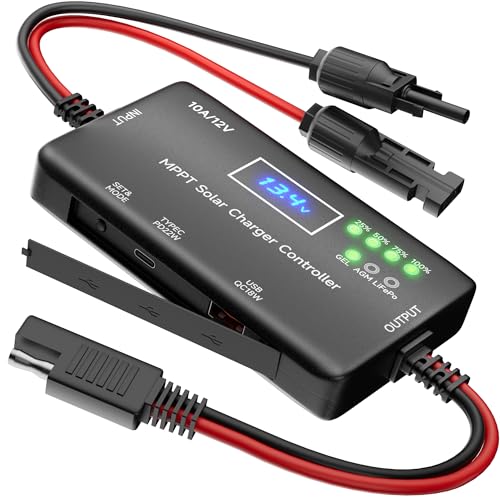
SUNAPEX 12V 10A MPPT Solar Charge Controller

Renogy 60A MPPT Solar Charge Controller

AeternaSol 12V 20A PWM Solar Charge Controller
AeternaSol 40A 12V/24V MPPT Solar Charge Controller
More Details On Our Top Picks
The flush-mount layout makes this Renogy a tidy fit for RV control panels, especially in coaches where you want the screen visible without extra clutter. It supports 12V and 24V systems, and the LCD gives you a direct read on charging status, which helps on long trips where battery checks happen in quick glances.
Compared with the smaller SOLPERK options below, this one has more breathing room for mixed battery needs, including sealed, gel, flooded, and lithium modes. The USB 2.4A port is handy for phone charging at camp, though the manual lithium setting means you’ll want to pay attention during setup.
Strong Points
- Flush-mount design keeps the dash or wall install neat.
- LCD display makes battery status easier to read at a glance.
- Automatic support for AGM, gel, and flooded batteries reduces setup friction.
- Manual lithium mode gives you broader battery flexibility.
- USB 2.4A output adds a practical charging point for small devices.
Points To Note
- Manual lithium selection asks for a little more attention during installation.
- Flush mounting works best where you have a prepared panel space.
- PWM charging suits many RV setups, though it is less advanced than MPPT for some larger arrays.
Feature Rundown
Who It Suits Best
You’ll get the most from this pick in an RV with a dedicated interior panel space and a mixed battery setup that needs clear status feedback.
A Better Fit Elsewhere
Renogy 60A MPPT Solar Charge Controller suits larger off-grid rigs with higher panel counts and a stronger need for conversion efficiency.
The Voyager leans into wet environments, and that makes it useful for RV owners who also split time on boats or in exposed compartments. Its 12V and 24V support keeps it flexible, while the IP67 rating signals a sealed build that handles dust and temporary water exposure far better than a typical interior controller.
Compared with the Adventurer, this one gives up the flush panel look and USB convenience, but it trades that for tougher placement freedom. In a damp storage bay or marine-style install, that trade makes sense, even though you’ll still want sensible mounting and wire routing.
What We Like
- IP67-rated housing suits exposed or damp mounting locations.
- Works with 12V and 24V systems for broad compatibility.
- Compact form factor fits tighter marine and RV spaces.
- Renogy’s controller line has a familiar layout for repeat installers.
Small Caveats
- You give up the built-in LCD convenience of the Adventurer model.
- It is less about dashboard style and more about rugged placement.
- Owners still need careful cable sealing during installation for best results.
Details At A Glance
Who Should Grab It
Boaters, wet-camp users, and RV owners mounting a controller in a tougher exterior area will get the best fit here.
Where A Sibling Pick Shines
Renogy Adventurer 30A PWM Solar Charge Controller is the better call for a clean interior install with an LCD display and USB output.
This SOLPERK model stays small and simple, which suits a light RV electrical system or a backup charging setup on a boat or utility trailer. The LED display keeps the basics visible without adding clutter, and the 12V or 24V support covers many modest battery banks.
Against the Renogy Voyager, it feels more like an everyday utility choice than a rugged specialty unit. That’s a good thing for campers who want basic monitoring and waterproof confidence without extra controls to learn.
Upsides
- Waterproof design fits exposed or weather-prone mounting spots.
- LED display gives you a quick status check.
- 12V and 24V support broadens use across small RV systems.
- Simple control layout keeps setup approachable for first-time installs.
Things To Consider
- 10A capacity suits lighter loads more than larger solar arrays.
- Plastic housing care matters during storage and cable routing.
- It offers less headroom than the 20A and 30A picks above.
Core Details
Who Will Love This
New RV owners and weekend campers with a modest panel setup will find this easier to live with than more complex controllers.
A Better Fit Elsewhere
SunRock 10 from Bateria Power suits you better for a small system that can benefit from MPPT charging rather than basic PWM control.
This SunRock 10 moves into MPPT territory, which means it’s built to wring more useful charging from a solar panel than a basic PWM unit in many setups. That matters most in smaller RV systems where every amp-hour counts, especially when you’re running lithium or looking to keep a compact battery bank topped up.
Compared with the SOLPERK 10A above, you’re paying for smarter charging behavior rather than just a simpler box. The trade-off is that the system ceiling is still modest, so it fits small to mid-light arrangements better than larger coach arrays.
Reasons To Buy
- MPPT design is better suited to squeezing value from limited panel space.
- Supports lithium and lead-acid battery families.
- Max PV 150W and 30Voc give you a clear sizing target.
- Small footprint works well in compact RV electrical bays.
Softer Spots
- 10A capacity keeps this in the small-system lane.
- It’s best matched to carefully sized panel setups.
- Owners with large rooftop arrays will likely outgrow it.
Technical Sheet
Perfect Match For
Small RV owners with a lithium or lead-acid battery bank and a carefully sized panel setup will find the sizing and feature set easy to fit.
Swap It Out When
Renogy 30A 12V/24V PWM Solar Charge Controller suits you better when you need a flush-mount interior controller with more current headroom.
The 8A rating keeps this one focused on lighter charging jobs, and the IP67 housing makes it appealing where moisture is part of the routine. That combination suits small RV battery maintenance, utility setups, or a boat compartment where you want a simple controller that doesn’t demand much space.
Compared with the 10A SOLPERK above, you give up a little current capacity, but the sealed design is still the main reason to look here. For storage charging or low-draw use, that smaller capacity is usually enough, and the simplified build helps keep installation straightforward.
Bright Spots
- IP67 construction is well matched to damp or exposed locations.
- 8A output suits small maintenance charging tasks.
- 12V compatibility fits many compact RV battery setups.
- Battery-regulator style layout keeps the use case simple.
Areas To Watch
- Low current output limits it to small panel systems.
- It is less suitable for larger roof-mounted arrays.
- Sealed housings still need tidy cable handling during install.
Feature Snapshot
Whose Shelf It Belongs On
This fits neatly with a small trailer or camper battery that only needs modest solar maintenance and a weather-tough case.
Look Elsewhere When
Renogy Voyager 20A PWM Solar Charge Controller is the stronger match for wet environments that also need more current headroom.
This SUNAPEX controller stands out for the small extras that matter in day-to-day RV use, like Type-C and USB outputs paired with an LCD readout. The zero battery drain claim is especially relevant for rigs that sit between trips, because idle draw can quietly matter more than people expect.
Compared with the Bateria Power SunRock 10, this one leans harder into convenience features, not just charging logic. The trade-off is still a 10A class controller, so it suits compact systems where the built-in ports and status display will actually get used.
Positives
- MPPT design suits compact systems that need efficient charging.
- Type-C and USB outputs add useful device charging options.
- LCD display keeps voltage and current visible.
- Supports LiFePO4, AGM, and gel batteries.
- Zero battery drain is useful for seasonal RV storage.
Honest Caveats
- 10A output keeps it in the smaller-system category.
- Extra features add value, but they also add a little setup attention.
- It makes the most sense where the USB ports will actually be used.
Core Details
Built With In Mind
Weekend campers and van users who want charging plus device power in one compact controller will get the most out of this layout.
Another Choice May Suit
Bateria Power SunRock 10 MPPT Solar Charge Controller is the cleaner fit for a compact system that cares more about panel charging than extra USB output.
Large roof arrays or a serious off-grid build are where this Renogy starts to make sense. It supports 12V, 24V, 36V, and 48V systems, plus a 150V solar input ceiling, which gives you room for bigger planning than the smaller 10A and 20A units in this roundup.
The honest read is that this is more controller than many casual RV owners need, but that’s the point for a coach, workshop, or cabin with growth in mind. Compared with the Adventurer, it trades compact convenience for much more capacity and a wider system range.
Highlights
- 60A capacity suits larger solar and battery systems.
- Supports 12V through 48V, which broadens installation options.
- 150V input ceiling gives you planning room for larger arrays.
- MPPT charging is a strong match for higher-value panel setups.
Room For Improvement
- It is more controller than a small camper usually needs.
- Setup can feel more involved than with a basic PWM model.
- Space and cable planning matter more at this capacity.
Quick Facts
The Right Fit
You should look here for an expanded RV, cabin, or workshop system that needs genuine headroom.
Where A Sibling Pick Shines
Renogy Adventurer 30A PWM Solar Charge Controller is the better match for a smaller RV that wants an easier flush-mount install.
This AeternaSol controller mixes a 20A PWM charging stage with everyday convenience features that matter in a travel rig. The Type-C PD 20W and USB QC 18W outputs are useful for phones, tablets, and small gear, so the controller does a little more than just manage battery input.
Compared with the simpler SOLPERK 8A and 10A options, it gives you more current capacity and more charging flexibility without jumping into a larger MPPT package. The trade-off is still the familiar PWM ceiling, but for many RV setups that’s enough, especially when you want built-in device ports.
Best Bits
- 20A output gives more room than the smaller controllers in this list.
- Type-C PD and USB QC ports add real campsite convenience.
- LCD voltage and current display keeps system checks simple.
- Supports LiFePO4, AGM, and gel battery types.
- Zero idle drain helps reduce unnecessary draw between trips.
Minor Gripes
- PWM design is simpler than the MPPT models above.
- Built-in ports matter most when your devices need regular charging.
- The extra feature set makes placement and cable management worth planning well.
Feature Card
Whose Shelf It Belongs On
This is a natural fit for RV owners who want one controller to manage charging and basic device power in the same spot.
Reach For A Different Pick When
SUNAPEX 12V 10A MPPT Solar Charge Controller makes more sense for a smaller rig that values MPPT charging over higher current and port variety.
This AeternaSol model sits in a useful middle zone for RV, boat, and cabin setups that need more capacity than a small controller but do not need the size of the 60A Renogy. The 12V and 24V auto-detection keeps the install simpler, and the adjustable LCD with timer gives you more control over how the system behaves.
Compared with the 20A PWM AeternaSol above, this one is the stronger match for users who want MPPT efficiency and more output room. The dual USB ports are a nice extra, though the main appeal is the broader battery support and the more flexible controller logic.
Best Bits
- 40A capacity suits mid-sized RV solar systems.
- MPPT charging is a strong fit for efficient panel use.
- 12V and 24V auto-detection simplifies setup.
- Adjustable LCD with timer adds useful control.
- Dual USB ports add convenience for small device charging.
Things To Consider
- It asks for a more deliberate setup than a basic PWM unit.
- Timer and display features matter most when you want active control.
- Large rigs still have room to step up to the 60A Renogy.
Spec Overview
Built With In Mind
RV owners with a mid-sized solar setup and a preference for clearer control over charging behavior will appreciate this layout.
Skip It When
Renogy 30A 12V/24V PWM Solar Charge Controller is a tidier fit for a smaller interior install that values simplicity over extra control features.
How To Choose The Right Solar Charge Controllers For Rv
Match The Controller To Your Battery Bank
Battery chemistry matters more than many first-time installers expect. AGM, gel, flooded lead-acid, and lithium all want different charging behavior, and the product page should clearly show whether the controller handles them automatically or needs a manual lithium setting.
PWM controllers are usually the straightforward route for smaller RV systems, while MPPT models make more sense when panel space is limited or the array is more valuable. You do not need the most advanced unit on the shelf, you need the one that fits your battery type and your roof layout.
Size The Current Rating To The Real Load
Current rating tells you how much charging the controller can handle, so a 10A unit belongs with small setups and a 40A or 60A unit suits much larger ones. Oversizing is not the issue here, undersizing is, because a controller that runs too close to its limit leaves little room for expansion.
Think in terms of how the RV is used. A weekend camper with one modest panel and a small battery bank usually does fine with 8A to 20A, while a full-time off-grid setup or a larger coach needs more headroom.
Look Closely At Mounting And Environment
Placement changes the whole experience. A flush-mount controller like the Renogy Adventurer feels at home inside a cabinet or dash panel, while IP67 sealed units fit better in marine spaces, exterior compartments, or damp storage bays.
The trade-off usually comes down to convenience versus toughness. Displays, USB ports, and timers are useful, but a sealed housing can be the smarter choice when weather or spray is part of the routine.
Decide Which Extra Features You’ll Actually Use
LCD readouts, USB outlets, Type-C ports, and timer controls are handy only when they solve a daily problem. For some RV owners, that means charging phones at camp or checking voltage without opening a battery compartment; for others, those extras just add clutter.
Focus on the features that match your trip style. A seasonal camper and a full-time traveler rarely need the same controller, even if both use solar.
A Quick Reality Check Before You Choose
Wrong Turns To Avoid
One common slip is matching the controller to the panel count but not the battery chemistry. Another is choosing a current rating that leaves no room for growth, which can box you in sooner than expected.
Installation details matter too. Flush-mount units need the right cutout space, and sealed housings still need careful cable routing so water and vibration do not create nuisance problems later.
The Case For Spending Up
Higher-tier models usually cost more because they add MPPT charging, wider voltage support, stronger input ceilings, or better display and control features. Those parts are useful when your RV system is larger, your roof space is tight, or your battery bank is more sensitive to charging behavior.
Spending up makes sense for full-timers, bigger coaches, and off-grid setups that run a more demanding electrical load. For a small weekend rig, a simpler PWM controller often covers the job without extra complexity.
Frequently Asked Questions
What size controller suits a small RV?
A compact RV often fits well with an 8A to 20A controller, depending on panel output and battery size. Larger solar arrays need more headroom, especially once you move beyond basic maintenance charging.
Is MPPT always better than PWM?
MPPT usually offers better charging efficiency, especially with limited panel space or higher-value solar input. PWM still makes sense for simpler, lower-cost RV setups where the array is small and direct.
Can you use a lithium battery with these controllers?
Several picks here support lithium, but some require a manual setting while others support it alongside AGM and gel. You should match the controller menu or mode selection to the battery chemistry before installation.
Do waterproof controllers matter in an RV?
They matter most in exterior compartments, marine use, and places that see moisture or dust. Inside a dry cabinet, a waterproof rating is less essential, though it still adds peace of mind.
Which features are most useful for travel?
An LCD display, USB output, and zero idle drain are practical for travel days and storage gaps. A timer and auto-detection can also make the system easier to live with on the road.
Closing Thoughts
The right solar controller for your RV should feel like it belongs to the rest of the electrical setup, not like an afterthought. A small camper, a wet marine install, and a larger off-grid coach each ask for something different, so the best match comes from your battery type, panel size, and mounting space. The Renogy and AeternaSol options give you room to scale, while the SOLPERK and SUNAPEX picks keep smaller systems simple. Choose the layout that fits your trips, and the rest tends to stay easier.
