

Choosing a home solar setup gets easier once you match the system to the job. A compact RV kit, a mid-size backup station, and a whole-house array solve very different problems, even when they all live under the same “home solar systems” search term. The right pick depends on your roof space, battery needs, and how much of your daily load you want to cover. This roundup keeps that distinction front and center.
You’ll see small starter kits, expandable portable power stations, and full off-grid packages with inverters, controllers, and batteries already bundled. That mix matters because a system that feels perfect for cabin weekends can be underbuilt for a busy household, while a large home array can be more than you need for a simple backup plan. The goal here is a cleaner match, not a bigger spec sheet.
Quick Look At The Shortlist

Renogy 400 Watt 12 Volt Premium Solar Kit

Jackery HomePower 3600 Plus Portable Power Station

ECO-Worthy 1.6KWH Complete Solar Panel Kit 400W 12V
[Ultra] ECO-WORTHY 1200W 24V 5.52KWH Lithium Battery Solar System

ECO-Worthy 7.168KWH 800W Solar Panel Kit for RV Off Grid
ECO-WORTHY 200 Watt 12V Complete Solar Panel Starter Kit

ECO-WORTHY 4.68KWH Solar Power Complete Kit 1200W 48V

ECO WORTHY 10000W Output Complete Off-Grid Solar Panel Kit for Home
More Details On Our Top Picks
This kit feels aimed at straightforward 12V projects, especially small cabins, utility sheds, and RV-style setups that need a clean bundle instead of piecing parts together. The 400W panel layout, 40A MPPT controller, Bluetooth module, fuse, brackets, adaptor kit, and tray cables give you a fairly complete starting point. That makes it easier to plan a tidy install without chasing extras from different product pages.
The honest trade-off is scale, because this is still a modest system compared with the battery-heavy kits lower in the list. For daily light loads, though, it can make a lot of sense, and the included mounting hardware should help keep the installation less fussy than a loose-parts build. You’ll likely appreciate it most when your goal is a simple, organized first setup.
Strong Points
- Four 100W panels spread output across a familiar 12V layout.
- The 40A MPPT controller helps match panel output to the battery side more efficiently than a basic PWM unit would.
- Bluetooth monitoring adds convenient status checks from your phone, which is handy in a garage or on a roof-mounted install.
- Brackets, cables, fuse, and adaptor pieces reduce the need for extra parts shopping.
Things To Consider
- The system is better for modest loads than for powering a whole household.
- Panel placement and cable routing still matter, so the install asks for some planning.
- You may want to budget for additional mounting or battery-side gear depending on the rest of your setup.
Feature Snapshot
Who It Suits Best
Beginner-friendly off-grid projects and small RV or cabin setups fit this kit well.
A Better Fit Elsewhere
Jackery HomePower 3600 Plus Portable Power Station suits you better when portability and plug-and-play backup matter more than building a fixed panel system.
Portable backup changes the game a bit, because this unit is built for the moments you want power without a fixed installation. The 3600W AC output and 3584Wh lithium iron phosphate, or LFP, battery put it in a serious home-support class, while the two 200W panels help you recharge from sunlight instead of relying only on the wall. For apartment storage, emergency closets, or an RV garage, that flexibility carries real weight.
The expandable design is the standout here, since the system can grow far beyond the base setup. That makes it a smarter long-term lane than the simpler Renogy kit above, though the trade-off is a bigger upfront footprint and a product that feels more like a power station than a traditional panel kit. You may find that convenience worth it when backup power needs to stay portable.
What We Like
- 3600W AC output supports a broader range of household devices.
- 3584Wh of storage gives you meaningful runtime for essential loads.
- The two included 200W panels make solar recharging more practical during extended outages or RV travel.
- LFP battery chemistry tends to suit frequent cycling better than many older battery styles.
- Expandable capacity up to 21kWh gives you room to grow without starting over.
Worth Noting
- The form factor is substantial, so storage and transport need planning.
- Expansion makes sense only when you expect to add more capacity later.
- The listing includes a lot of capability, which can feel like more system than a casual backup user needs.
Core Details
Who Will Love This
Homeowners and RV users who want portable backup with real expansion headroom fit this unit best.
Where A Sibling Pick Shines
ECO-WORTHY 10000W Output Complete Off-Grid Solar Panel Kit for Home suits you better for a fixed whole-house solar build.
This ECO-WORTHY package stands out because it bundles the solar side and storage side together, which saves you from matching batteries after the fact. You get four 100W panels, a 40A MPPT controller, two 12V 100Ah lithium batteries, a 2000W inverter, and Bluetooth support, so the system reads like a full off-grid starting point rather than a piecemeal project. For RV life or a weekend cabin, that’s a lot of structure in one box.
Compared with the Renogy kit, this one is less about a starter array and more about immediate usable capacity. The trade-off is bulk and complexity, because you’re managing batteries and inverter gear along with the panels. That’s not a flaw, just the reality of a more complete build, and it suits you best when you want a bigger foundation from day one.
Highlights
- The included lithium batteries give the kit real stored power, not just collection hardware.
- Bluetooth support makes status checking easier during travel or campsite use.
- The 2000W inverter broadens what you can run from the stored energy.
- Everything is bundled for a more direct off-grid setup.
Points To Note
- The bundle is more involved to install than a simple panel-and-controller kit.
- Battery placement takes planning, especially in smaller trailers or tight utility spaces.
- The size of the package can feel like overkill for light-duty power needs.
Details At A Glance
Made For
RV owners and cabin users who want a bundled solar-and-storage kit will get the most from this setup.
Look Elsewhere When
ECO-WORTHY 200 Watt 12V Complete Solar Panel Starter Kit suits lighter entry-level needs and simpler installs.
Once you move past starter territory, a 24V system like this starts to make more sense for larger cabins and heavier household loads. The package includes six 195W panels, two 12.8V 280Ah batteries, a 60A MPPT controller, and a 3000W pure sine wave inverter, which is a smoother output type that suits many electronics and home devices. That combination gives you more stored energy and a sturdier operating lane than the smaller 12V kits above.
The trade-off is that this is not a casual weekend add-on. Battery weight, wiring planning, and mounting space all matter more here, but the payoff is a system that feels built for sustained use rather than occasional charging. You’ll likely appreciate it most in a place where power demand keeps growing.
Reasons To Buy
- 24V architecture helps support a more capable off-grid layout.
- Two large batteries give the system a substantial storage base.
- The pure sine wave inverter is a better match for many sensitive electronics than rougher inverter types.
- Six panels spread solar collection across a stronger array.
Softer Spots
- The kit asks for more installation space than the smaller sets.
- Wiring and component placement may feel involved for first-time installers.
- Storage and transport are less convenient because of the larger battery package.
Core Details
Best Suited To
Cabins, workshops, and larger off-grid spaces fit this kit better than compact RV-style setups.
Another Choice May Suit
ECO-Worthy 7.168KWH 800W Solar Panel Kit for RV Off Grid is the gentler fit for travelers who want a simpler stored-power package.
This package splits the difference between compact kits and the larger home-focused systems, which is exactly why it feels useful for extended RV stays or a small off-grid cabin. You get four 195W panels, a 3000W UPS inverter charger, two 12.8V 280Ah lithium batteries, a 60A MPPT controller, and Bluetooth support. The setup offers a lot of storage, but it still stops short of the scale of the 10kW home array later in the list.
That middle-ground feel is its real strength. It gives you more headroom than the 400W and 200W kits, yet it avoids the size jump of a whole-house build, so the system stays more manageable for mixed travel and backup use. For most off-grid lifestyles, that balance can be the sweet spot.
Plus Points
- The 7.168kWh storage figure gives you a strong reserve for nights and cloudy stretches.
- The UPS inverter charger adds a useful layer for power continuity.
- Bluetooth support makes monitoring more convenient during travel or at a remote site.
- The system feels better suited to extended use than a small starter kit.
Areas To Watch
- The bundle is still substantial, so mounting and transport take planning.
- It sits above casual needs, which may leave light users with more system than they need.
- Battery and inverter space should be measured carefully before installation.
Feature Rundown
Whose Shelf It Belongs On
Travelers, cabin owners, and off-grid hobbyists who want a heavier stored-power bundle will get the best fit here.
Skip It When
ECO-WORTHY 200 Watt 12V Complete Solar Panel Starter Kit is the easier choice for very small projects and simpler wiring.
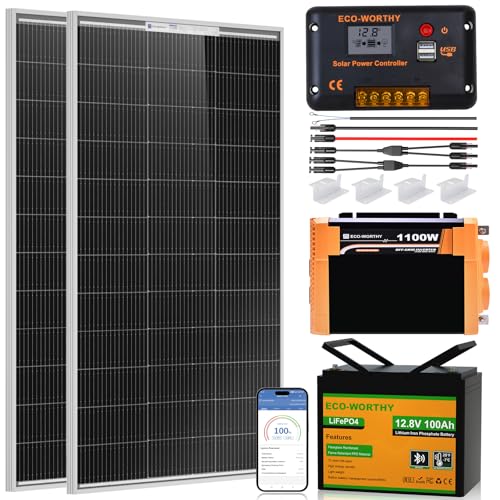
This is the kind of starter package that helps you get your footing without a huge parts list. The kit includes two 100W panels, a 30A charge controller, a 100Ah lithium battery, and a 1100W inverter, so you can think of it as a compact solar starter with the essentials already matched. For a small trailer, tiny workshop, or first off-grid project, that simplicity is a real advantage.
Compared with the ECO-Worthy bundles above, it keeps the load lighter and the install easier to picture. The trade-off is obvious: less stored energy and less output headroom. Still, for modest weekend use, that can be exactly the point, because you get a lower-pressure setup without extra system sprawl.
Best Bits
- The parts list stays short and approachable for first-time setup.
- The included battery and inverter make it more complete than a panel-only starter.
- The 12V design suits common small-scale off-grid needs.
- Storage demands stay manageable in tighter spaces.
Room For Improvement
- Output is modest compared with the larger kits in this roundup.
- The 1100W inverter fits lighter use better than appliance-heavy demands.
- You may outgrow it sooner if your power needs climb.
Quick Facts
The Right Fit
Beginners and light-duty RV users will get the most from this compact starter package.
Reach For A Different Pick When
Renogy 400 Watt 12 Volt Premium Solar Kit suits you better once you want more panel capacity and a fuller mounting bundle.
For a home backup setup that needs more balance than the portable stations and more structure than the small RV kits, this one lands in a useful middle zone. The package includes six 195W N-type bifacial panels, a 48V 50Ah battery, and a 3500W solar charger inverter, so you get a cleaner home-oriented layout than the 12V bundles. Bifacial panels can collect light from both faces in the right placement, which can help in reflective installs or open mounting spaces.
That 48V architecture is the big clue here, because it usually means a more efficient path for larger systems than a small 12V build. The trade-off is that the setup expects a more serious installation plan, and the battery capacity is smaller than the huge storage packs lower in the list. Still, for many homes, that balance between power and footprint is exactly what makes sense.
Positives
- 48V design suits a more home-like backup setup.
- N-type bifacial panels can make better use of open mounting conditions.
- The 3500W inverter gives you a stronger AC side than the compact kits.
- The package feels more adaptable for room backup than the RV-focused sets.
Minor Gripes
- The 48V battery capacity is smaller than the larger whole-house packages.
- Installation planning matters more than it does with the simpler starter kits.
- It suits a home backup lane better than portable casual use.
Spec Overview
Built With In Mind
Homeowners who want a mid-tier fixed backup system with a 48V structure will find this the most natural fit.
Not Your Match When
Jackery HomePower 3600 Plus Portable Power Station suits you better when portability and storage flexibility matter more than a fixed install.
This is the big-home option in the group, and the spec sheet makes that clear fast. You get a 10kW split-phase inverter with 120V/240V output, 48V 314Ah storage rated at 16.1kWh, and 2,950W of solar panels, which puts it in true whole-house territory rather than backup-light territory. For larger homes, that kind of architecture can cover more circuits and feel far closer to a full off-grid plan.
The trade-off is just as large as the output. You need meaningful space, a serious install plan, and a home that can actually use this scale, because it makes little sense for a tiny cabin or casual RV setup. Still, for a house that wants a long-range off-grid foundation, this is the most substantial system in the roundup.
Bright Spots
- The 10kW inverter gives this kit a very different level of household reach.
- Split-phase 120V/240V output suits more home circuits than a single-voltage setup.
- 16.1kWh of storage gives you a serious reserve for extended use.
- Nearly 3kW of panels supports the kind of input a larger home system needs.
Honest Caveats
- The system is far larger than most small homes or RVs need.
- Installation space and planning become major factors.
- It fits best where the whole property is being treated as a solar project.
Technical Sheet
Who Should Grab It
Large-house off-grid projects and serious whole-property backup plans suit this system best.
Swap It Out When
ECO-WORTHY 4.68KWH Solar Power Complete Kit 1200W 48V is the easier move for a home that needs a smaller footprint and simpler install.
How To Choose The Right Home Solar Systems
Match Voltage To The Job
Voltage sounds technical, but the practical idea is simple, higher-voltage systems usually suit larger, more structured installs, while 12V kits stay friendlier for small trailers, sheds, and starter projects. A 12V package like the Renogy kit or ECO-WORTHY 200W starter works well for light loads and shorter cable runs. A 24V or 48V layout, like the ECO-WORTHY 1200W 24V system or the 4.68KWH 48V kit, makes more sense once your power needs and wiring distance grow.
Think In Stored Energy, Not Just Panel Wattage
Panel wattage tells you how fast you can gather energy, but battery capacity tells you how long you can keep using it. That’s why a portable power station like Jackery HomePower 3600 Plus feels so different from a panel-only bundle, and why the 16.1kWh home system sits in another class entirely. For outage backup, storage often matters more than extra panel names on the box.
The useful question is what you want to run after sunset. Lights, routers, and small appliances need a very different setup than a refrigerator, pump, or multi-room home load.
Check The Inverter Against Your Appliances
The inverter changes stored DC power into household AC power, and its size shapes what you can realistically run. A 1100W inverter is fine for modest gear, while 3000W and 3600W units give you a broader operating lane for more demanding devices. The 10kW split-phase inverter in the largest ECO WORTHY kit belongs in a much larger home environment where 120V/240V output is actually useful.
Match the inverter to the appliances you care about most, not the most dramatic number in the listing. That keeps the setup grounded and saves you from oversizing a system that never gets used to its full potential.
Plan For Installation Space And Maintenance
Panel kits need room for mounting, cable routing, and controller placement, and battery-heavy bundles need even more. The more complete the package, the more you should think about ventilation, access, and where you’ll actually store the components. A clean installation is easier to live with and easier to service later.
For homeowners, that often separates a satisfying solar project from a frustrating one. A compact kit can be a neat weekend addition, while a whole-house array deserves a proper layout plan before anything gets bolted down.
Things Worth Knowing First
Wrong Turns To Avoid
A common mistake is sizing the system by panel count alone and forgetting about batteries, inverters, and storage. Another is choosing a big home kit for a small use case, then dealing with space, weight, and wiring that never feel justified.
It also helps to avoid mixing a fixed roof plan with a portable-use mindset. Those jobs look similar on paper, but they live very differently in real use.
The Upgrade Payoff
Higher-tier systems usually cost more because they bring larger batteries, stronger inverters, and more complete control over output. They also ask for better hardware and more careful integration, which is why the jump from a 400W kit to a 10kW whole-house system feels so dramatic.
Spending up makes sense when you need longer runtime, cleaner AC output, or a setup that can support more of the house. For casual weekend power, that extra scale is overkill, but for serious backup planning it can be the difference between comfort and constant rationing.
Frequently Asked Questions
What size home solar system works for a small cabin?
A 200W to 400W kit can fit light-duty cabin use, especially for lighting and small electronics. The Renogy 400W kit and the ECO-WORTHY 200W starter give you two different entry points.
Do portable power stations count as home solar systems?
Yes, for backup and emergency use they can absolutely sit in the same conversation. Jackery HomePower 3600 Plus is the clearest example in this roundup.
Why do some kits include batteries while others do not?
Kits with batteries store power for later use, which matters when the sun goes down. Panel-only sets are simpler and lighter, but they depend on the rest of your system for storage.
What does MPPT mean?
MPPT stands for maximum power point tracking, a controller method that helps panels charge more effectively as conditions change. It shows up in several of these kits because it suits solar charging better than basic control methods.
Is a 48V system better than a 12V system?
48V usually makes more sense for larger, more serious home builds because it supports stronger output with less current strain. 12V is still useful for smaller and simpler setups.
Closing Thoughts
The best home solar system for you depends on how much space you have, how long you want power to last, and whether you need a fixed install or a portable backup. Small 12V kits solve starter problems well, mid-size battery bundles handle more serious off-grid routines, and the large 10kW system belongs with whole-house planning. That’s the cleanest way to sort the field without getting lost in panel counts. Match the system to your daily life, and the choice gets much easier.
