

Your fridge hums along for years, then one bad power event takes out the compressor and you’re out a serious chunk of change. That’s the reality behind every surge protector on this list: voltage spikes, brownouts, and sudden drops wear down sensitive electronics quietly, and the protection you skip today is the repair bill you face tomorrow. I pulled together nine surge protectors that handle everything from a single freezer in the garage to a workshop full of tools, each matched to a specific kind of home setup. You’ll find the heavy-duty workhorses, the slim plug-in defenders, and a few smart options for tight spaces, all written so you can match the right level of protection to the appliances you actually own.
The Shortlist At A Glance

CCCEI 12 Gauge Long Extension Cord with Multiple Outlets, Yellow, 50FT

BSEED Electronic Surge Protector for Refrigerators and Freezers

BSEED Surge Protector Power Strip for Home Appliance, 3 Outlet

BSEED Surge Protector Home Appliance, Single Outlet

Amazon Basics 16-Outlet Heavy Duty Metal Surge Protector
Amazon Basics 6-Outlet Surge Protector Power Strip
CCCEI 12 Gauge Heavy Duty Surge Protector, Yellow, 6FT

CCCEI Magnetic Heavy Duty Surge Protector, 12 Gauge, 6FT

CCCEI 12 Gauge Heavy Duty GFCI Power Strip, 8 Ports, 6FT
Taking A Closer Look At The Options
The CCCEI 50-foot yellow cord is built for situations where the outlet sits far from the work and you still want heavy-gauge wire carrying the load. I think of it as the garage and shed option first, especially when a compressor, table saw, or freezer sits at the back of the space. The 12-gauge wire handles higher draw than the cheap 16-gauge strips you find everywhere, which matters when you’re pushing tools that cycle on and off hard.
Eight outlets and an overload-protected circuit give you room to spread out, and the bright yellow jacket stays visible in a cluttered shop. Unlike the BSEED single-outlet protectors reviewed later, this one is about reaching the power, not guarding a specific appliance.
Strong Points
- 50-foot reach handles detached garages and yard workshops without extension chaining.
- 12-gauge wire keeps voltage steady across the full length, which protects motor-driven tools from weak starts.
- Eight outlets plus a master switch let you power down an entire bench without unplugging anything.
- Bright yellow jacket resists scuffs and stays visible on a busy floor.
Trade Offs
- Bulkier than a basic six-foot strip, so it needs a real spot to land when coiled for storage.
- Not weather-rated, so leaving it outside in rain invites corrosion on the plug ends over time.
Key Specs
Who It Suits Best
Shop owners, weekend woodworkers, and anyone powering a freezer or compressor at the far end of a detached garage.
Consider Something Else When
Homeowners protecting a single kitchen fridge will do better with the BSEED Electronic Surge Protector for Refrigerators and Freezers, which guards brownouts specifically.
Refrigerators and freezers suffer most from brownouts, those brief drops where voltage sags below safe levels before stabilizing. A regular surge strip ignores that. The BSEED single-outlet protector watches the line and cuts power when voltage strays too high or too low, then waits before re-engaging so the compressor doesn’t restart against a bad current.
Plug it into the wall, plug the fridge into it, and forget it. For households in areas with unstable grid power, this kind of voltage cutoff is the kind of thing that pays for itself the first time the lights flicker during a thunderstorm.
A Few Highlights
- Brownout protection stops the compressor from cycling under low voltage, which is the most common fridge killer.
- Single-outlet design keeps the setup simple and foolproof.
- Handles up to 1800 watts, covering full-size refrigerators and stand-alone freezers comfortably.
Points To Keep In Mind
- Onboard labeling ships in Spanish, which can slow initial setup for English-only households.
- Single outlet means no room to chain in a second appliance without another protector.
Made For
Kitchens, garages, and basements where one major appliance, like a fridge or upright freezer, deserves its own dedicated voltage watchdog.
Skip It When
You need to protect several appliances in the same room, in which case the BSEED Surge Protector Power Strip with three outlets gives you the same brownout logic across a small cluster.
Step into a laundry room and you usually find a washer, a dryer, and maybe a utility sink setup competing for outlets. The BSEED three-outlet brownout protector extends that voltage-monitoring logic to a small group of appliances, which is handy when everything runs on the same wall circuit.
It works in the same way as the single-outlet BSEED reviewed above, watching for high and low voltage events and pausing before reconnection. The trade-off is shared capacity: three appliances on one monitored line means you need to be smart about which ones you combine.
Real Benefits
- Brownout monitoring covers three appliances from a single wall outlet.
- LED indicators for normal, high, low, and delay states tell you what the unit is doing at a glance.
- Surge and spike protection layer on top of voltage monitoring for complete coverage.
Worth Bearing In Mind
- Total draw across all three outlets cannot exceed the rated capacity, so avoid stacking heavy loads.
- Like its single-outlet sibling, the printed instructions arrive in Spanish.
Right Fit For
Laundry rooms, garage corners, and small kitchen appliance clusters where two or three devices share a wall outlet.
Look Elsewhere When
You only need to protect one appliance and want the simplest possible install, in which case the BSEED Single Outlet Protector keeps things more compact and costs a bit less.
Sometimes the only thing standing between your appliance and a wall outlet is an inch of clearance behind a refrigerator. The BSEED single-outlet compact protector is built for exactly that problem, a small block that hangs off the wall and gives you voltage protection without shoving the fridge away from the wall by three inches.
Same brownout and surge logic as the larger BSEED units, just trimmed down to one outlet for tight installations. It feels like the right pick when form factor matters more than outlet count.
Well-Handled Touches
- Compact body fits behind refrigerators and tight entertainment centers where strips cannot sit.
- Brownout cutoff at 1440 watts makes it a safe match for smaller appliances and countertop units.
- Surge and spike defense layered on top of voltage monitoring.
Soft Spots
- One outlet only, so multi-device rooms need additional units.
- The Spanish-only instructions can confuse first-time installers.
Whose Shelf It Belongs On
Apartment dwellers, dorm rooms, and anyone squeezing a microwave or compact fridge into a snug kitchen nook.
Swap It Out When
You have a free wall outlet with clearance for a strip and want to protect a fridge plus something else, in which case the BSEED three-outlet version handles a cluster with the same logic.
When your media wall has a receiver, a console, three streaming boxes, and a soundbar all stacked together, an ordinary six-outlet strip simply is not enough. The Amazon Basics 16-outlet metal rack accepts that chaos with wide spacing that fits chunky plugs and wall warts without blocking neighbors. The aluminum housing also helps the strip shed heat under sustained load.
The 600-joule rating is moderate, meaning it covers everyday spikes but is not designed for industrial-scale surges. For most home media and office setups, that’s the right fit. Compare it to the CCCEI heavy-duty workhorses reviewed later, which trade outlet count for thicker wire and individual switches.
What Earns Its Place
- Sixteen outlets eliminate the daisy-chain of strips behind a TV stand.
- Wide-spaced layout fits oversized adapters without wasting the neighboring socket.
- Metal housing with mounting holes supports under-desk or on-wall installation for clean cable runs.
- LED indicator confirms surge protection is active at a glance.
Honest Caveats
- 600-joule rating is on the lighter side for protecting high-value electronics against big spikes.
- The bulk takes up real desk or shelf real estate, so it suits permanent installations more than portable use.
Quick Facts
Built With In Mind
Home entertainment systems, recording studios, and home offices with many wall-wart power supplies competing for space.
A Better Fit Elsewhere
Workshops running heavy bench tools need the CCCEI 12 Gauge Heavy Duty Surge Protector with 12-gauge wire and individual outlet switches.
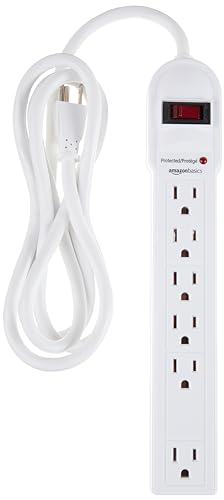
Most homes just need a reliable six-outlet strip behind the nightstand or the kitchen counter, and this Amazon Basics unit has filled that role for a long time. Six outlets, a 790-joule rating, and a 15-amp circuit breaker handle the basic job without trying to be anything fancy.
The white housing blends into walls and baseboards, which is a quiet kind of usefulness. One transformer outlet accepts a chunky wall wart, and the rest take standard plugs cleanly. For protecting lamps, phone chargers, and a small kitchen appliance cluster, it does the work without drawing attention to itself.
What Helps Most
- 790-joule rating offers solid everyday spike protection for low- to mid-value electronics.
- Built-in circuit breaker trips on overload, protecting both the strip and your appliances.
- Red LED confirms surge protection is active so you know when it’s time to replace the unit.
- Six-foot cord reaches a wall outlet across a room without needing an extra extension.
Less Ideal Details
- Plastic housing runs warmer than the metal-bodied 16-outlet Amazon Basics unit reviewed earlier, so leave breathing room around it.
- Only one transformer-friendly outlet means wall warts can crowd the strip quickly.
Best Suited To
Bedrooms, living rooms, and small kitchens where the appliance count sits between four and six devices.
Reach For A Different Pick When
You need more than six outlets or want brownout-specific protection for a fridge, in which case the Amazon Basics 16-outlet metal unit or any BSEED brownout protector fits the bill.
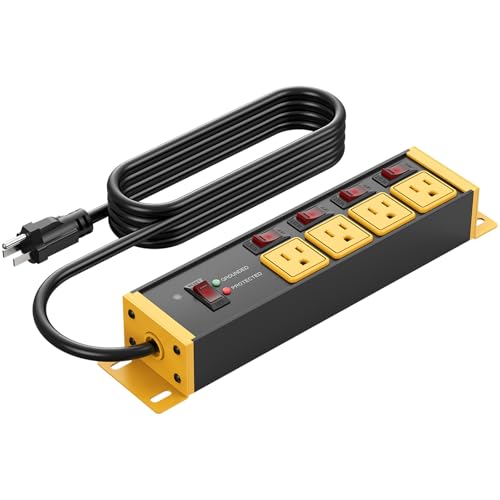
The CCCEI wall-mount surge protector leans into workshop and garage life. Four outlets, individual switches for each, and a 12-gauge cord that resists voltage drop when a heavy tool kicks on. The yellow jacket and wall-mount design make it a natural pick for a pegboard or shop wall.
The real story is the individual switches. A homeowner running a compressor, a sander, and a work light can shut off the tools without cutting power to the lamp. Compared to the longer 50-foot CCCEI earlier, this one is the closer-range, more controlled version.
A Strong Showing
- Individual switches let you control each outlet independently without unplugging.
- Wall-mount design keeps cords off the bench and outlets at hand height.
- 12-gauge cord handles motor-driven tools that draw hard on startup.
Practical Considerations
- Four outlets is a tight count for a busy bench with many small tools.
- Not weatherproof, so outdoor installs need a covered spot.
Feature Snapshot
Who Should Grab It
Workshop owners and serious hobbyists who want each bench tool on its own switch and prefer mounted installs over floor strips.
Another Choice May Suit
Shoppers needing the same heavy-gauge wire but with more reach should look at the CCCEI 50-foot extension cord reviewed first.
Metal shelving and steel workbenches are everywhere in garages, and the CCCEI magnetic surge protector clings to them directly. The built-in magnet on the back holds the strip securely, so the strip ends up exactly where the tools are, no mounting hardware, no drilling, no falling onto a concrete floor mid-project.
It carries four outlets, individual switches, a master switch, and the same 12-gauge wire as its sibling above. The trade-off is obvious: it only works on iron-bearing surfaces. Aluminum shelving or wood won’t hold it.
The Helpful Details
- Magnetic back attaches to steel shelving, tool cabinets, and iron workbenches without hardware.
- Master switch plus individual outlet switches give layered control over a small tool cluster.
- 12-gauge cord keeps voltage steady under demanding motor loads.
- Bright orange jacket stays visible in dim workshop lighting.
A Few Limitations
- Magnet will not grip aluminum, plastic, or wood surfaces.
- Four outlets is on the slim side for a packed bench.
Perfect Match For
Shop owners with steel shelving, metal tool cabinets, or iron-surfaced workbenches who want tool power right at hand level.
Where A Sibling Pick Shines
Wood or drywall installations call for the wall-mount CCCEI 12 Gauge Heavy Duty Surge Protector instead, since a magnet has nothing to grab.
A GFCI (ground-fault circuit interrupter) is the safety layer that watches for current leaking to ground and cuts power before a person becomes the path. Adding that protection to a power strip turns the strip into a safer choice for damp basements, garage corners, and covered outdoor kitchens where water and electricity might meet.
The CCCEI GFCI strip gives you eight outlets, a 12-gauge cord, and a 20-amp switch on top of that ground-fault cutoff. It’s the most layered protection here, useful when the room is not entirely dry.
Bright Spots
- Built-in GFCI trips fast on ground faults, cutting risk in damp locations.
- Eight outlets support a full basement or outdoor kitchen appliance cluster.
- 12-gauge cord keeps voltage delivery solid for high-draw equipment.
- Overload and grounding protection layers reinforce the GFCI function.
Factors To Consider
- Heavier and bulkier than a standard strip, so it wants a permanent spot rather than frequent moves.
- Test and reset buttons require occasional checking to confirm GFCI function is active.
Quick Facts
Who Will Love This
Homeowners with finished basements, detached workshops, or covered outdoor appliance setups where ground-fault safety matters most.
Not Your Match When
You’re protecting dry living-area electronics, where a basic surge strip like the Amazon Basics 6-Outlet Surge Protector Power Strip handles everyday spikes without the extra GFCI complexity.
Factors To Consider When Choosing Surge Protectors For Appliances
Match The Protection To The Appliance, Not The Wall
The first decision is which appliances actually need voltage monitoring. Refrigerators, freezers, and anything with a compressor care about brownouts as much as surges, so a brownout-protecting unit like the BSEED single-outlet or three-outlet models fits better than a plain joule-rated strip. For sensitive electronics in dry rooms, a standard surge protector with a joule rating handles the spike side of things well enough. Heavy-draw tools in a workshop are a different story: you want 12-gauge wire and individual switches, which is the CCCEI territory.
Understand Joule Ratings, Outlets, And Cord Gauge
A joule rating tells you how much spike energy a surge protector can absorb before it wears out. Higher numbers mean longer protection life, though exact lifespan depends on the size and frequency of the events. Outlet count is a planning exercise: count the devices, then add two for future additions, then pick a strip that matches. Cord gauge matters most for long cords and high-draw tools. A 12-gauge cord carries current with less voltage drop than a 16-gauge cord, which is why the CCCEI units reviewed above favor it for workshop use.
Decide Between Fixed Wall Plug, Strip, And GFCI
Single-outlet wall-huggers like the BSEED compact protector make sense behind tight furniture where a strip cannot fit. Standard strips handle bedrooms and kitchens with a handful of devices. Workshop and garage use calls for heavier-duty strips, ideally wall-mounted or magnetic. Damp locations, including basements and outdoor kitchens, benefit from a GFCI-equipped strip like the CCCEI GFCI unit reviewed last.
Plan For Replacement Over Time
Surge protectors wear out as they absorb spikes, so any unit should be checked occasionally and replaced when the protection indicator stops lighting. Some manufacturers quietly retire the joule rating after a major event. Buying the right capacity upfront is helpful, but expecting to replace the unit every few years is realistic ownership behavior, especially in areas with frequent storms or unstable grid power.
Smart Spending Across This Category
Mistakes Worth Dodging
The most common slip is grabbing a cheap power strip and assuming it offers surge protection. Basic strips without a joule rating only expand outlet count, they do nothing for voltage spikes. Another trap is sizing by outlet count alone and ignoring cord gauge, which leaves long runs underpowered and tools starved of voltage during startup. Finally, many shoppers forget that surge protectors wear out: a five-year-old strip with a dim or dead protection indicator is essentially a power strip with extra outlets and no surge defense left.
Where The Extra Money Goes
Spending up in this category usually buys three things. First, brownout protection, which a basic strip does not offer. Second, thicker cord gauge, which keeps voltage steady on long runs and high-draw tools. Third, ground-fault protection, which adds a real safety layer for damp rooms. None of those upgrades matter for every home, but when the room or appliance calls for them, they pay back quickly in the equipment they keep alive.
Frequently Asked Questions
Do Surge Protectors For Appliances Really Make A Difference?
Yes, for appliances with compressors or sensitive electronics, a surge protector can stop the kind of spike or brownout that quietly wears down components over time. The protection is invisible until it is needed.
What Is A Brownout Protector And Why Is It Useful?
A brownout protector watches for voltage dropping below safe levels and cuts power before the appliance tries to run on weak voltage. That matters most for refrigerators and freezers, since their compressors can overheat when starting under low voltage.
How Many Joules Do Surge Protectors For Appliances Need?
For most household appliances, ratings in the 600 to 1000+ joule range handle everyday spikes comfortably. Higher joule ratings extend protection life, especially in storm-prone areas, though the right number depends on how much you want to future-proof the strip.
Can A Surge Protector Handle Large Appliances Like A Refrigerator?
Yes, but choose a brownout-aware unit with a single outlet dedicated to that appliance. Multi-outlet strips can work, but a dedicated single-outlet protector removes the temptation to overload the line with extra devices.
How Often Should Surge Protectors For Appliances Be Replaced?
A reasonable expectation is every three to five years, or sooner if the protection indicator has dimmed. Surge protectors absorb energy over time, and an old unit can look fine while offering no real protection.
Closing Remarks
Pick by appliance, not by outlet count. A fridge wants brownout protection, a workshop wants heavy-gauge wire, and a damp basement wants GFCI. Match the protector to the room and the equipment will quietly do its job for years.
