

Solar-powered trail cameras make more sense when you want fewer battery swaps and cleaner placement on a fence line, tree, or backyard post. For deer scouting, property checks, or keeping an eye on a feed area, the main question is still the same: which model balances image detail, power reserve, and connection options without becoming fussy in daily use. The seven picks below focus on that balance, from single-camera setups to twin-pack options that suit wider coverage.
The Shortlist At A Glance

Assark Solar Trail Camera 48MP 30FPS

Assark Trail Camera 64MP 4K Fixed Solar Panel
MAXDONE 2Pack Solar Trail Camera 4K WiFi Bluetooth
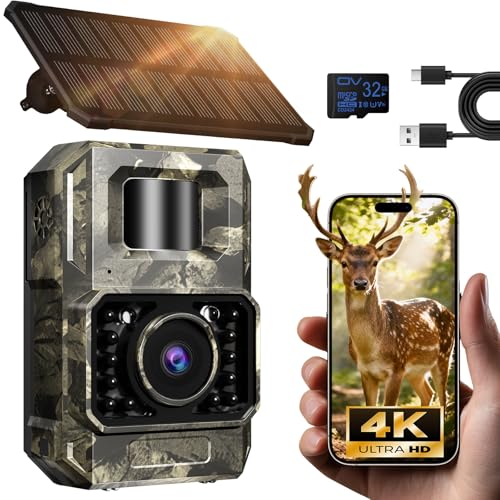
MAXDONE Solar WiFi Trail Camera 4K 64MP
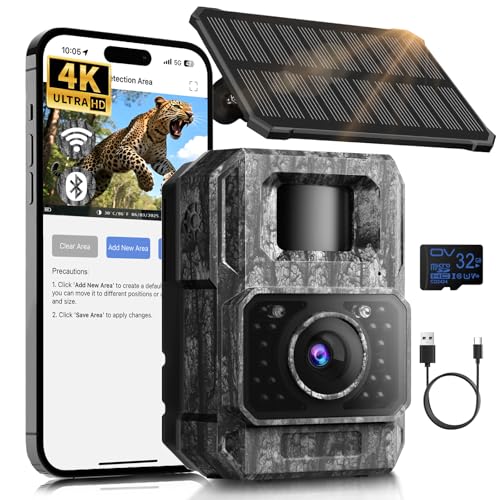
MAXDONE Solar Trail Camera 4K 64MP 6000mAh

MAXDONE Solar Trail Camera 2 Pack 4K 64MP

MAXDONE Solar Trail Camera 2 Pack 4K 64MP
More Details On Our Top Picks
Assark’s 48MP model suits you when quick reaction matters more than headline specs alone. A 0.2-second trigger means the camera is built to respond fast as movement enters frame, which is useful on trails, feeders, and fence crossings where brief passes are easy to miss.
WiFi and Bluetooth give you two ways to manage the camera without handling it constantly, and the included 32GB micro SD card helps you get started with less setup friction. The IP66 weather rating points to dust and water resistance for outdoor placement, though it still rewards a smart mount position and periodic lens cleaning.
Strong Points
- Fast trigger timing suits moving wildlife.
- WiFi and Bluetooth support flexible access.
- 48MP capture gives you detailed stills for later inspection.
- Includes a 32GB micro SD card, which shortens setup time.
- IP66 construction fits exposed outdoor spots.
Things To Consider
- The 30FPS video spec is useful, but not as high as the 4K-focused models below.
- Single-camera coverage makes sense for one lane or one feeder, less so for wider property sweeps.
- Like most trail cams, the lens and housing still need occasional wiping after weather.
Feature Snapshot
Who It Suits Best
You fit this camera well when you want a straightforward single unit for scouting game trails, checking a backyard edge, or monitoring one narrow area.
Where A Sibling Pick Shines
MAXDONE Solar Trail Camera 4K 64MP 6000mAh suits you better when higher-resolution footage and bigger onboard power matter more than speed alone.
This Assark model moves toward a more set-and-forget setup, thanks to its fixed solar panel and 6000mAh battery. That combination matters most on remote stands, barn corners, or outbuildings where constant attention is inconvenient.
The 64MP still-image ceiling and 4K video place it above the 48MP Assark above on capture detail, so you get more room to inspect fine movement and scene context. The trade-off is a more committed install, since a fixed panel gives you less placement flexibility than a separate-panel design.
Upsides
- Fixed solar panel simplifies placement.
- 6000mAh battery supports longer unattended runs.
- 4K video and 64MP stills suit detail-focused monitoring.
- WiFi support helps with remote access.
Room For Improvement
- Fixed-panel design is less flexible than a detachable solar setup.
- The more advanced feature set can feel like overkill for a single narrow path.
- Outdoor glass and panel surfaces still need routine cleaning for clear image capture.
Core Details
Who Will Love This
You suit this pick best when you want stronger capture specs and a more permanent outdoor install.
Look Elsewhere When
Assark Solar Trail Camera 48MP 30FPS is the cleaner choice for simpler setups that need less hardware commitment.
Two cameras change the math fast for property coverage, and that’s the main reason this MAXDONE pack stands out. It fits a setup where you want one unit on a main trail and another on a second approach, instead of moving a single camera from place to place.
WiFi and Bluetooth make the pair more convenient to manage, while the included 32GB card helps each unit get into service sooner. The 4K label also gives you a step up from the Assark 48MP model when your priority is clearer motion review, though your real payoff comes from spreading coverage across more than one angle.
Highlights
- Two-camera pack stretches coverage across more ground.
- 4K video suits detail-conscious monitoring.
- WiFi and Bluetooth support easier access.
- 32GB card included, so startup is simpler.
- Good fit for split locations like feeder and trail.
Minor Gripes
- Two units mean more mounting and more labeling to keep organized.
- Wireless convenience still depends on your placement and signal conditions.
- For a single small yard, the second camera may sit unused.
Quick Facts
Right Fit For
You fit this set well when you need two monitoring points, such as a feeder and a crossing line.
Another Choice May Suit
MAXDONE Solar Trail Camera 4K 64MP 6000mAh works better for a single, more permanent location that needs extra battery reserve.
This MAXDONE model sits in the middle of the lineup in a useful way, with 4K video, 64MP still capture, WiFi, and Bluetooth all in one body. That gives you a lot of control without forcing you into the two-pack format used by the next MAXDONE options.
For mixed setups, such as a backyard edge that also catches passing wildlife, the balance is appealing. The IP66 casing keeps it in the same outdoor durability lane as the other cameras here, but the feature mix is what makes it feel more complete than the simpler Assark 48MP unit.
What We Like
- 4K and 64MP coverage supports detail-focused review.
- WiFi plus Bluetooth gives you flexible access.
- Single-camera format keeps installation straightforward.
- IP66 design fits exposed outdoor mounts.
Points To Note
- It does not bring the dual-camera reach of the two-pack MAXDONE options.
- Feature density can be more than you need for a simple gate line.
- Lens and panel maintenance still matter in dusty or rainy spots.
Details At A Glance
Built With In Mind
You fit this camera well when you want a single, feature-heavy unit for scouting, backyard monitoring, or general wildlife tracking.
Where A Sibling Pick Shines
MAXDONE Solar Trail Camera 2 Pack 4K 64MP makes more sense for larger properties that need two separate sight lines.
This MAXDONE variant is the quiet middle ground in the group, with a 6000mAh power reserve, 4K video, 64MP stills, and wireless support all bundled into one body. It fits daily backyard monitoring especially well, where you want enough power and image detail without stepping up to a two-camera setup.
The 32GB included card trims some setup friction, and the motion-activated design keeps the camera focused on movement rather than constant recording. The honest read is that its strength lies in balance, not in one dramatic feature, which is often exactly what a home perimeter setup needs.
Positives
- 6000mAh capacity helps reduce frequent charging.
- 4K and 64MP support clear scene review.
- Included 32GB card makes first setup easier.
- WiFi and Bluetooth support practical handling.
- Motion-activated recording helps manage storage use.
Small Caveats
- Single-camera coverage suits one zone better than broad property scanning.
- Like similar trail units, the housing will need occasional cleaning to stay clear.
- Battery reserve helps, but sun exposure still matters for long-term placement.
Core Details
Whose Shelf It Belongs On
You fit this model well when you want a dependable everyday trail camera for a backyard edge, driveway line, or feeder area.
Skip It When
MAXDONE Solar Trail Camera 2 Pack 4K 64MP is the better call when you need two monitoring points right away.
A two-pack with 4K video and 64MP still capture gives you more coverage flexibility than any single-camera option in this group. That matters on larger yards, hunting edges, or rural property lines where one camera often leaves a blind spot.
WiFi, Bluetooth, 6000mAh power, and the included 32GB card round out a setup that feels built for practical ownership rather than constant tinkering. You still need to label and place the cameras carefully, though, because two units are only useful when each one has a clear job.
Reasons To Buy
- Two-camera format expands coverage quickly.
- 4K and 64MP help preserve detail.
- 6000mAh power supports longer field time.
- WiFi and Bluetooth make the pair easier to manage.
- 32GB card included lowers the setup hurdle.
Areas To Watch
- Two-camera ownership means two mounting jobs and two placement decisions.
- For a single patio or feeder, the second camera may be more than you need.
- Outdoor performance still depends on keeping the housing and lens clean.
Feature Rundown
Who Should Grab It
You fit this pack well when your property has two active lanes, such as a trail junction and a feeder zone.
Reach For A Different Pick When
Assark Trail Camera 64MP 4K Fixed Solar Panel is a neater fit for a single long-term station.
This second MAXDONE two-pack tracks very close to the previous model, so the difference is more about fit than headline specs. For a homeowner who wants one camera at the front and another at the back, it solves the basic coverage problem without adding complexity.
It carries the same 4K, 64MP, WiFi, Bluetooth, 6000mAh, and 32GB formula, which keeps the decision simple. That sameness is not a drawback for every setup, since matching cameras can be easier to manage than mixing models across a property.
Best Bits
- Matching pair keeps deployment consistent.
- Two cameras suit front-and-back monitoring.
- 4K and 64MP are strong for detail review.
- WiFi and Bluetooth keep access flexible.
- Included 32GB card helps get both units running sooner.
Worth Noting
- Very close to the previous MAXDONE two-pack, so the real choice is placement preference.
- Two-camera ownership still asks for more organizing than a single camera.
- For compact yards, one unit may be enough.
Spec Overview
The Right Fit
You fit this set best when you want a matching two-camera system for straightforward household coverage.
Swap It Out When
MAXDONE Solar Trail Camera 4K 64MP 6000mAh is the cleaner choice for a single monitoring point with the same feature family.
How To Choose The Right Solar Trail Cameras
Match The Power Setup To The Location
The solar side matters most where access is awkward, such as a wooded edge, high fence line, or remote shed wall. A fixed solar panel, like the Assark 64MP model, is easier to live with in a permanent install, while a two-pack makes more sense when you need coverage across separate spots. The trade-off is flexibility, since a more integrated charging layout can be less forgiving during placement.
Choose Resolution For The Kind Of Review You Need
4K video and 64MP stills help when you want finer scene detail, especially for identifying movement patterns, deer size, or exact approach paths. The Assark 48MP option is still sensible for quicker scouting, but the higher-detail models are better suited to property owners who inspect footage closely. Higher resolution also asks more from storage management, so the benefit is clear only when you really use the extra detail.
Consider Connection Style And Daily Handling
WiFi and Bluetooth are useful for reducing how often you physically pull the camera down. That convenience matters in wet ground, brushy corners, or any setup where you would rather not handle the unit every few days. The catch is simple, the more remote the spot, the more placement and signal conditions influence how smooth the experience feels.
Think In Terms Of Coverage, Not Just One Camera
A single camera works well for a feeder, a lane, or one backyard entry point. Two-pack options fit larger properties, split trails, or front-and-back monitoring where you want matched hardware and less swapping around. For most households, the best choice is the one that matches the number of active zones instead of chasing the biggest feature list.
What To Weigh Before You Click
Traps First Timers Fall Into
Small yards often tempt you into overbuying a two-pack when one unit would do the job. Another common miss is focusing on image resolution alone, then overlooking mounting, access, and how often you’ll need to check the camera. A cleaner plan is to start with the number of zones you actually need to watch.
Placement errors matter too, especially under heavy branches or in spots that collect rain and dust. Solar gear still needs a sensible position, and the lens area works better with occasional cleaning than with neglect.
Where The Extra Money Goes
Higher-tier solar trail cameras usually spend more on stronger image capture, larger batteries, and broader connection options. That matters when your camera sits far from easy access or when you want detail from one awkward angle instead of rough proof of movement. You also tend to get more consistent ownership comfort, not just a prettier spec sheet.
The upgrade makes sense for long-term placements, larger properties, or anyone who reviews footage seriously. For a simple backyard edge, the simpler Assark unit can be the more sensible stop.
Frequently Asked Questions
Do Solar Trail Cameras Need Direct Sun All Day?
No, they usually work best with regular sun exposure rather than constant direct light. Shade-heavy spots can still work, but battery reserve becomes more important there.
Is 4K Worth It On A Trail Camera?
It helps most when you want clearer motion detail or need to inspect a scene later. For basic yard monitoring, 4K can be more than you strictly need.
Why Choose WiFi Or Bluetooth?
Those connections reduce how often you have to handle the camera directly. They’re especially handy for settings, clip access, and routine checks.
Are Two-Pack Models Better For Every Property?
No, they suit split coverage better than a single small zone. A compact yard or one feeder often works fine with one camera.
What Makes IP66 Relevant Here?
IP66 indicates stronger protection for outdoor placement against dust and water exposure. It supports rough weather use, but it doesn’t remove the need for sensible mounting and maintenance.
Closing Remarks
Your best solar trail camera depends on how many zones you need to watch, how much detail you want from each clip, and how far the camera sits from easy access. The Assark 48MP model keeps things straightforward, the fixed-panel Assark leans into longer unattended use, and the MAXDONE two-packs make sense when coverage matters more than simplicity. For most homes and hunting setups, matching the camera to the property layout beats chasing the biggest spec line.
