

Going solar at home used to mean a contractor, a crew, and a multi-day install. The current crop of home solar panel kits flips that script: most arrive as a complete package you can mount, plug in, and start collecting energy from before lunch. I put this list together for anyone who wants to generate real power without the hard-sell salesperson, from RV travelers keeping a fridge cold to homeowners trimming their monthly bill one panel at a time.
An Overview Of The Picks

Renogy Bifacial 590W Solar Panel 2PCS (N-Type)

Renogy 100W 12V Solar Starter Kit with PWM

Greenmagic 400W Flexible Solar Panel Kit (2x200W)

Renogy 100W N-Type Solar Panels 2PCS (16BB)

Mighty Mule FM123 10W Solar Panel Kit

Greenmagic 200W Flexible Solar Panel Charger
Greenmagic 800W Portable Foldable Solar Panel (2x400W)

Greenmagic Portable 400W Foldable Solar Panel

Renogy 640W N-Type Solar Panels (18BB)
Greenmagic 200W Portable Foldable Solar Panel Kit
A Deeper Look At The Lineup
The Renogy bifacial 590W pair is the heavyweight on this list, built for homeowners who want one of the most powerful rigid kits per square foot of roof space. Bifacial simply means the panel can harvest light from both faces, so a snowy or reflective surface underneath quietly adds to the daily yield.
Compared to the entry-level Renogy 100W starter kit below, this is a much bigger commitment in size, weight, and wiring. Owners planning a fixed rooftop array, a ground-mount bank, or an off-grid cabin build will find the 16BB cell layout (16 thin conductive busbars per cell, which boosts current flow) a meaningful upgrade over older 9BB or 10BB designs.
Features That Help
- 25% module conversion efficiency, well above the older 17% to 19% panels many people are replacing.
- Bifacial back sheet that can add 5% to 30% extra yield depending on what sits behind the panel.
- A+ grade N-type cells, which tend to lose less output as temperatures climb through summer afternoons.
- Reduced hot spot risk, which protects the panel when partial shading hits one section of the array.
- Two panels at 590W each means a serious daily harvest for whole-home offset or a deep battery bank.
Trade-Offs Worth Considering
- These panels are large and rigid, so a van roof or curved surface is the wrong fit; a flat rooftop or ground rack works much better.
- Getting the most out of the bifacial rear face requires careful mounting height and a light-colored ground surface beneath.
- The kit ships as panels only, so a charge controller, inverter, and racking need to be sourced separately for a working system.
Key Specs
Best Match For
Homeowners with a sizable rooftop, a ground-mount area, or a workshop who want serious energy output from a single kit purchase.
Where Another Pick Suits Better
Van lifers and tent campers should look at the Greenmagic 800W foldable kit instead, since that one is built for portability rather than permanent mounting.
The Renogy 100W starter kit is the kit I recommend to anyone who has never wired a solar panel before. It bundles a 100W rigid panel, a 30A PWM charge controller (a device that regulates how much current flows from the panel into the battery, protecting it from overcharge), and the basic cables you need, which removes the usual guesswork of figuring out what extra parts to buy.
Where the 590W bifacial pair above targets permanent rooftop systems, this one is sized for a small shed, a gate battery, a small RV setup, or a first-time homeowner experiment. Daily output hovers around 500Wh in good sun, which is enough to top off phones, run LED lights, and keep a small battery bank healthy.
Practical Advantages
- All-in-one packaging means no separate charge controller shopping.
- PWM controller is simple to wire and forgiving for first-timers learning the basics.
- Compact 100W footprint fits on sheds, small roofs, and ground frames without structural worry.
- Each panel is EL tested (electroluminescence inspection, a flashlight-like scan that catches microcracks invisible to the eye) before shipping, so hidden defects are unlikely.
- 22.5% cell efficiency keeps the panel competitive even though it’s the smaller rigid option.
Points To Keep In Mind
- PWM controllers are less efficient than MPPT (maximum power point tracking, which squeezes more usable power out of the same panel), so owners planning a larger array eventually will outgrow it.
- Single 100W output is modest for any whole-home goal, and daily yield drops sharply in cloudy or winter conditions.
- Rigid aluminum-framed panel needs solid mounting points, not just zip ties.
Core Details
Who Should Grab It
First-time solar owners who want a forgiving, complete package to learn the basics before investing in a bigger array.
Skip It When
Homeowners ready to power a fridge and lights daily should step up to the Renogy 100W 2PCS N-Type pair instead, which doubles the wattage and modernizes the cell tech.
The Greenmagic 400W flexible kit earns its spot by solving a problem rigid panels can’t: a curved RV roof, a teardrop trailer, or a boat cabin where a flat-framed glass panel simply will not sit. Each panel bends up to 260° and weighs only 8.5 pounds, so two of them together still feel manageable to lift and route.
Unlike the Renogy 590W bifacial pair, this kit trades long-term brute output for shape flexibility. Most owners use it to top up a portable power station or run a 12V battery through a charge controller, and the 23% efficiency means each panel pulls more watts per square foot than older 17% poly panels.
A Few Highlights
- 0.11-inch thickness keeps the panel low-profile, which matters on vehicles where wind drag adds up.
- MC4 connectors (the most common solar plug type, so named for their manufacturer) make it drop-in compatible with most power stations and charge controllers.
- Two panels at 200W each give meaningful daily harvest without committing to a permanent roof rack.
- IP67 junction box rating means the panel shrugs off rain and brief splashes during outdoor use.
- Polymer construction tolerates the gentle flex of a van roof without micro-cracking the way rigid glass panels sometimes do.
Honest Caveats
- Flexible panels typically run a few degrees hotter than glass panels in direct sun, which slightly trims peak output.
- No mounting hardware is included, so a strong adhesive or careful cable routing is part of the install plan.
- Two thin panels stacked side by side need thoughtful wiring to avoid shading one from the other.
Whose Setup It Belongs On
RV and van owners with curved roofs who want real wattage without drilling mounting holes into glass panels.
Consider Something Else When
Anyone with a flat residential rooftop should grab the Renogy 590W bifacial pair for higher daily yield and longer panel life.
The Renogy 100W N-Type 2-pack is a tidy middle ground: more modern cell tech than the older Renogy starter kit, but in a manageable rigid form factor that fits small homes, sheds, and cabins. Two panels at 100W each put out roughly 20W more than standard 100W panels of similar design, which adds up across a full summer.
Compared to the bifacial 590W pair higher up, this one is much friendlier for a first roof-mount. The 25% conversion efficiency and 16BB cell layout give it longevity, and it’s easy to add a third or fourth panel later as a budget allows.
The Helpful Details
- A+ grade N-type cells resist light-induced degradation better than older P-type cells.
- 25% conversion rate puts it among the most efficient rigid 100W panels available.
- EL-tested at the factory, which means the panels arrive free of hidden micro-cracks.
- Standard size and mounting holes match common Renogy Z-bracket and tilt-mount kits.
- Two-panel kit doubles output versus the single 100W starter option at a modest jump in complexity.
Where It Is Less Suited
- Like all rigid glass panels, these are heavy enough that a roof mount needs solid structural support underneath.
- No charge controller or inverter included, so those parts need separate purchase.
Right Fit For
Homeowners building a mid-sized fixed array on a shed, garage, or cabin roof who want modern N-type cells without going all-in on bifacial.
Swap It Out When
Full-time off-grid households with high daily demand should look at the Renogy 640W N-Type kit instead for a much higher per-panel output.
The Mighty Mule FM123 is not a typical home solar kit; it’s a purpose-built 10W trickle charger designed to keep an automatic driveway gate opener powered through sun and weather. If a homeowner has a Mighty Mule or compatible GTO/Pro gate operator at the end of a long driveway, this small panel is the cleanest way to avoid running an extension cord through the yard.
Compared to the Renogy 100W panels above, the FM123 lives in a different category entirely. It’s tiny, lightweight, and not meant to run a fridge or charge a phone. It’s meant to keep a 12V gate battery topped up, especially during power outages.
Benefits That Matter
- Built specifically as a Mighty Mule accessory, so wiring and mounting line up with their operator systems.
- 10W trickle output keeps a gate battery healthy without needing a dedicated AC circuit.
- Compact size makes it easy to mount on a small post or the gate operator housing itself.
Possible Compromises
- 10W is far too small to run household loads, so the use case is narrow by design.
- It’s most useful when paired with a Mighty Mule system, since the connector and bracket are tuned to that hardware.
Built With In Mind
Homeowners with a Mighty Mule or compatible GTO/Pro automatic gate opener who want a quiet, off-grid charging solution at the driveway.
A Better Fit Elsewhere
Anyone trying to power indoor appliances should grab the Renogy 100W starter kit instead, which is the most accessible entry-level whole-panel system on this list.
The single Greenmagic 200W flexible panel is the right scale for someone who needs real wattage in a thin, bendable package. At 8.5 pounds and just 0.11 inch thick, it conforms to a marine deck, a cabin roof, or a van body without forcing the owner to build a glass-rack frame.
It carries the same 23% efficiency and MC4 connector setup as the 400W 2-pack higher up, just in a more compact package. Owners looking at marine use will appreciate the IP67 waterproof junction box, which is a meaningful upgrade over basic panels when salt spray is in play.
Points In Its Favor
- Bends up to 260°, fitting surfaces a rigid glass panel simply cannot.
- 200W capacity is enough to noticeably recharge a portable power station in a few hours of midday sun.
- Lightweight polymer body is easier to reposition than aluminum-framed glass panels.
- 12V power voltage with 17A current rating makes it compatible with most RV and marine controllers.
- IP67 rating handles rain and salt spray better than many entry-level panels.
Small Limitations
- One panel means a longer recharge time versus the 400W 2-pack version.
- Adhesive or strap mounting must be planned in advance since hardware isn’t included.
Perfect Match For
Boat owners and cabin dwellers who want a single, manageable flexible panel that won’t fight a curved surface.
Reach For A Different Pick When
Anyone planning to run higher-demand appliances should grab the Greenmagic 800W portable kit instead, which delivers four times the wattage in a still-portable form.
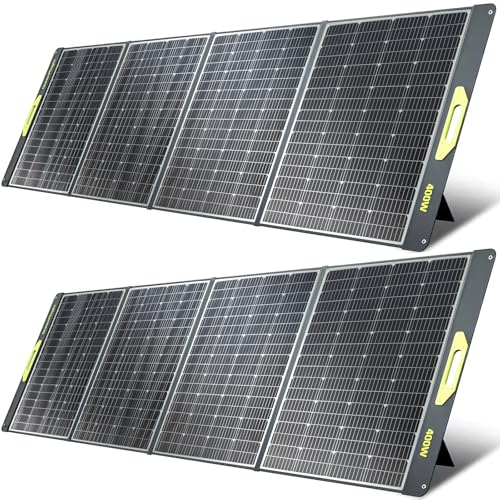
The Greenmagic 800W foldable kit is the most ambitious portable option on this list. Two 400W panels fold into a carrying case, prop up with adjustable kickstands, and push serious wattage into a portable power station or RV battery bank without anyone needing to mount anything on a roof.
Where the Renogy 590W bifacial pair above assumes a permanent install, this one assumes the owner is chasing the sun at a campsite or worksite. The 23% efficiency and 39V open-circuit voltage (the voltage the panel produces with no load attached, which matters for matching charge controllers) make it a strong match for today’s high-capacity 40V-class portable power stations.
Everyday Wins
- 800W of combined output is enough to meaningfully recharge a 2,000Wh power station in a few sunny hours.
- Adjustable kickstands let the user angle the panels toward the sun without improvising a frame.
- Foldable design fits in the back of an SUV or pickup bed when not in use.
- IP67 waterproofing handles unexpected rain or dew during overnight camping.
- Smart sunlight alignment via the Suncast app, depending on your station’s compatibility, helps the user fine-tune panel angle.
Things To Weigh Up
- At 20 pounds combined, it’s portable but not featherlight, so backpackers may prefer a single smaller panel.
- Open-circuit voltage of 39V means a compatible charge controller or station, and a basic PWM unit won’t handle this safely.
The Right Fit
Campers, RV travelers, and worksite users with a high-capacity portable power station who want to recharge it fast off-grid.
Where A Sibling Pick Shines
Homeowners wanting a permanent rooftop install will find the Renogy 640W N-Type pair a more durable long-term solution.
The Greenmagic 400W foldable is the lighter, more manageable sibling of the 800W kit. Owners who want real wattage but don’t need to lug around two full-size 400W panels will find this single-fold design easier to set up at a campsite, a tailgate, or a day at the lake.
Compared to the Greenmagic 200W flexible panel above, this one is rigid and foldable rather than bendable, which usually means longer panel life but less shape versatility. The 21.5% to 23.5% efficiency range and 39V output keep it well-matched to most 40V-class portable stations on the market.
Bright Spots
- 400W capacity is a sweet spot for recharging a mid-size power station in a few hours of good sun.
- Foldable form protects the cells during transport, which matters for frequent travelers.
- Compatible with most 40V portable power stations, including popular 1,000Wh to 2,000Wh models.
- Monocrystalline cells handle midday heat better than older polycrystalline panels in many real-world setups.
- Supports parallel and series wiring for owners who eventually add a second panel.
Practical Considerations
- 39V open-circuit voltage requires a compatible MPPT controller, so a basic PWM controller is not a safe pairing.
- Folded size is manageable, but the unfolded footprint still needs decent open space.
Built With In Mind
Road-trippers and tailgaters who want enough wattage to recharge a power station without setting up a permanent rooftop array.
Where Another Pick Suits Better
Rooftop home installs will get more long-term value from the Renogy 100W N-Type 2PCS kit, which is built for permanent mounting.
The Renogy 640W N-Type 18BB pair is the workhorse option here, built for barns, workshops, and larger off-grid homes where the roof or ground-mount can handle the weight of two high-output rigid panels. The 18BB cell layout is a step up from the 16BB design seen elsewhere on this list, which translates into slightly cleaner current flow and lower internal resistance.
Compared to the smaller Renogy 100W N-Type pair, this kit quadruples the per-panel wattage and roughly triples the daily yield under ideal sun. For homeowners running a well pump, a chest freezer, or a small workshop’s worth of tools, that extra output changes the conversation about whether solar alone can carry the load.
What Stands Out
- 25% conversion efficiency keeps the panels competitive even at this larger size.
- Multi-layered lamination helps the panels handle hail, wind, and years of UV exposure.
- EL-tested at the factory, so micro-cracks at shipment are unlikely.
- Higher 18BB busbar count (those thin metal lines you can see on the cells, which carry the electricity) means better performance under partial shade than older 9BB or 10BB designs.
- Two-panel kit pushes combined output well into whole-home offset territory for many households.
Less Ideal Details
- Larger and heavier than the 100W pair, so a sturdy roof structure or engineered ground mount is necessary.
- No inverter, controller, or racking included, so the system needs separate sourcing for a complete install.
Whose Setup It Belongs On
Owners of barns, large workshops, or off-grid homes with the roof structure to support heavy rigid panels and a daily energy appetite to match.
Look Elsewhere When
Travelers and RV owners should grab the Greenmagic 400W foldable kit instead, since portability matters more than peak output in that use case.
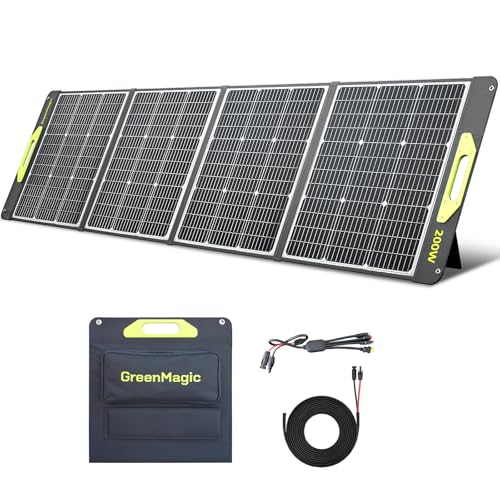
The Greenmagic 200W foldable rounds out the list by solving one of the most common frustrations with portable panels: connector compatibility. It ships with DC, XT60, MC4, and Anderson outputs, which covers the most common plugs on the market today without forcing the user to buy adapter cables separately.
Where the Greenmagic 400W foldable above aims at heavy-duty camping use, this one targets a wider range of smaller needs: a farm gate, a workshop backup, a chicken coop light, or a small RV fridge. The 23.5% efficiency and IP67 rating are right in line with what most shoppers expect at this size.
Reasons It Performs
- Multiple output connectors mean it pairs with most popular power stations and battery banks right out of the box.
- 23.5% conversion rate is at the high end for portable panels of this size.
- IP67 waterproof rating handles rain and brief splashes during outdoor deployment.
- Foldable design protects the cells and makes storage easier in a garage or truck bed.
- PET lamination (a tough polyester film layered over the cells) helps the surface resist scratches and weathering over time.
Some Limits To Know
- 200W is modest for anyone trying to recharge a 2,000Wh power station in a single afternoon.
- No carrying case is included, so a soft bag or blanket is needed during transport.
Who Will Love This
Farm owners and homeowners with mixed gear who want one portable panel that can plug into nearly any station or battery on the property.
Not Your Match When
Full-time off-grid households should grab the Renogy 640W N-Type pair instead, since a foldable panel is a poor substitute for permanent rooftop wattage.
What Matters Most Before Choosing Home Solar Panel Kits
Total daily energy demand is the number one filter. Add up the watt-hours your home or RV actually pulls in a day, then size the kit to roughly cover that figure in average sun. A homeowner running a fridge, lights, and a laptop needs a very different kit than someone trickle-charging a gate battery.
Portability versus permanent mounting is the next fork. Rigid glass-framed panels like the Renogy 590W and 640W pairs last longer and tend to produce slightly more power, but they need a roof or ground frame. Flexible and foldable panels like the Greenmagic kits trade some longevity for the ability to chase the sun or store in a closet between trips.
Charge controller type matters more than most first-time buyers realize. PWM controllers are simple and affordable, but MPPT controllers extract measurably more usable power from the same panel, especially in cold or low-light conditions. Kits that include a controller are easier on day one, while panel-only kits give experienced installers more flexibility.
Connector compatibility is a quiet headache. MC4 is the industry standard for permanent installs, while portable power stations often use XT60, Anderson, or DC barrel plugs. Matching the panel’s connector to the station or controller ahead of time saves a pile of adapter cables.
Cell technology and efficiency shape long-term yield. N-type cells resist light-induced degradation better than older P-type cells, and panels at 22% to 25% efficiency produce more watts per square foot than 17% to 19% poly panels of the same size.
Key Considerations Across These Picks
Traps First Timers Fall Into
Many first-time solar shoppers underestimate their real daily energy use and end up with a kit that’s too small by half. I usually recommend logging actual appliance wattage for a week before picking a kit size, since a fridge cycling on and off uses far more than most people guess. Another common slip is buying a flexible or foldable panel expecting rigid-panel output. They’re close, but the gap shows up in extreme heat or partial shade, where rigid glass panels hold up slightly better.
Why Top Tier Costs More
Higher-wattage kits earn their price through bigger N-type cells, more busbars per cell, and tougher lamination that survives years of weather. The jump from a basic 100W kit to a 590W bifacial pair isn’t just more watts; it’s longer service life, better partial-shade behavior, and stronger frames. For a permanent home install that you want to last 20-plus years, the upgrade pays back in the form of slower degradation and fewer replacement panels over time.
Frequently Asked Questions
How many solar panels do I need to power a home? It depends on your daily energy use and your location’s average sun hours, but a small efficient home typically needs between 2,000W and 5,000W of panels to cover basics like lighting, refrigeration, and electronics.
Are flexible solar panels less efficient than rigid ones? Modern flexible panels are close to rigid panels in conversion efficiency, but they tend to run a bit hotter in direct sun and usually have a shorter service life. They’re best for curved surfaces where rigid panels won’t fit.
Can a solar panel kit work without a battery? Yes, in grid-tied setups the panels feed power directly into your home’s electrical system through an inverter. For off-grid use, a battery is essentially required to store energy for nighttime and cloudy periods.
What’s the difference between PWM and MPPT charge controllers? PWM is simpler and cheaper but wastes some potential power, while MPPT adjusts electrically to extract the maximum usable wattage from the panel, especially in cold or low-light conditions.
Do solar panels work in cloudy weather? They do, but output drops significantly, often to 10% to 25% of their rated capacity. That’s why most homeowners size their kits based on average daily yield, not peak output.
Wrap Up
The right home solar panel kit comes down to matching wattage, mounting style, and connector type to the way you actually live. RV owners chasing the sun will get the most mileage from a foldable or flexible panel, while full-time homeowners chasing lower electric bills will get more value from a rigid rooftop array. Pick the kit that fits your real daily energy use, and the rest of the system falls into place.
