

A great pair of speakers only sounds as good as the cables feeding them. I still remember the first time I upgraded my living-room setup, swapped bare wire for proper banana plugs, and instantly stopped dreading the back of my receiver. The right connector makes a small but meaningful difference in signal clarity, connection stability, and how often you actually unplug and re-plug your gear without a struggle.
This list rounds up solid options across price tiers, from budget-friendly everyday choices to right-angle solutions for tight AV cabinets. A banana plug is the small metal pin (usually 4mm wide) that slides into the binding post on your speaker or amp, locking your wire in place so it can’t fray, slip, or short against a neighboring post. I’ll walk you through what each one does well, where it falls short, and who should actually buy it.
Your Options, Compared

Sewell Deadbolt Flex Pin Banana Plugs (12 Pairs)

Sewell Deadbolt Banana Plugs 6-Pairs (SW-29863-6)

Nakamichi GrubLock Excel Series 24k Gold Banana Plugs

onelinkmore BNC Male to Dual Banana Female Adapter (2 Pack)

Sewell Deadbolt Right-Angle Banana Plugs (6 Pairs)
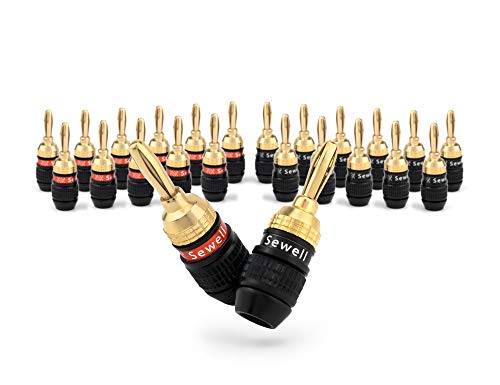
Sewell SW-29863-12 Deadbolt Banana Plugs (12 Pairs)

zhenyu 4mm Banana Jack Panel Mount Sockets (10 Pack)

Sewell Deadbolt Right-Angle Banana Plugs (12 Pairs)
WJSTN Speaker Cable Extension with Right Angle Banana Plugs

bnafes 4mm Banana Plug Binding Post Sockets (4-Pack)
What Each Pick Brings To The Table
Older receivers and a handful of bookshelf speakers still rely on spring-clip terminals, the kind that squeeze a bare wire between two metal tabs. Standard banana plugs often won’t seat in those clips at all, which is exactly the problem the Sewell Deadbolt Flex Pin design was built around. The flexible pins compress just enough to slip into a spring terminal and then expand for a snug fit that won’t pop loose when you nudge the cable.
Compared to the standard Sewell Deadbolt below, this set trades the rigid pin for a springier contact, so it sacrifices some of the “rock-solid” feel in binding posts but gains access to a wider range of terminals. The 24K gold-plated copper weave keeps resistance low and the contact clean over time. For anyone reviving a vintage receiver, this is the most forgiving connector on the list.
Where It Helps
- Slides into spring-clip terminals that reject standard banana pins
- Accepts wire up to 10 AWG, which is thicker than most budget plugs handle
- Gold plating over copper helps fight corrosion over years of use
- 12 pairs cover a full 5.1 or 7.1 install in one pack
Things To Consider
- The flex pin feels less rigid in standard binding posts than a straight plug would
- Only useful if you actually own spring-clip gear, otherwise it’s wasted flexibility
Who It Suits Best
Anyone with an older receiver, vintage amp, or compact bookshelf speaker running spring-clip terminals who wants a proper connector without replacing the whole setup.
Consider Something Else When
If your gear uses binding posts rather than spring clips, the Sewell Deadbolt Banana Plugs 6-Pairs (SW-29863-6) below will seat more firmly and look tidier behind your cabinet.
The Sewell Deadbolt design is the connector most audio hobbyists picture when they think “banana plug,” and for good reason. Self-crimping teeth bite into the bare wire as you screw the housing closed, so there’s no soldering iron, no separate crimp tool, and no loose strands peeking out to short against the next post. The whole assembly sits about 1.6 inches proud of the binding post, which is short enough that you can shove most receivers back against a wall without bowing the cables.
This is the everyday pick because it works well for stereo systems, modest home theaters, and the common case of “I just bought a real speaker and want a clean install.” It lacks the locking screw of the Nakamichi entry further down, so it leans on friction alone to stay put, but in normal home listening conditions that grip holds for years.
Features That Help
- Self-crimping teeth grip bare wire without tools or solder
- Low 1.6-inch profile keeps cables close to the wall
- Gold plating keeps the contact surface from oxidizing in humid rooms
- Six pairs cover a basic 5.1 system with spares left over
Worth Noting
- Holds by friction rather than a locking collar, so repeated plugging and unplugging can loosen the grip over time
- Not designed for spring-clip terminals like the Flex Pin version above
Made For
First-time upgraders moving from bare wire to proper connectors on a stereo or mid-size surround setup with standard binding posts.
Look Elsewhere When
Anyone wiring a full seven-channel room or a custom install should step up to the Sewell SW-29863-12 (12-Pairs) further down to avoid running out mid-project.
The GrubLock design steps away from the spring-tooth concept and uses a small screw-down collar to clamp the wire in place, similar to how a binding post itself works. You strip the cable, slot the strands into the barrel, and tighten the grub screw until the wire is locked solid. That mechanism is harder to mess up than crimping, and it makes the connection feel genuinely permanent once seated.
Nakamichi builds these for wire gauges from 10 to 18 AWG, so they cover everything from beefy in-wall runs to thin satellite-cable wire. The 24K gold plating is real cosmetic and functional polish, since gold doesn’t oxidize the way bare copper does. Compared to the Sewell Deadbolt above, this is the choice for someone who plans to unplug rarely and wants zero wiggle.
A Favorable Mix
- Grub screw locks the wire so it can’t be pulled out or twisted loose
- Wide 10 to 18 AWG compatibility for any standard speaker cable
- 24K gold-plated contact surface resists tarnish over time
- Available in 1-pair or 2-pair packs to match your scope
Trade Offs
- A small hex key is usually required for the grub screw, adding a step to every install
- Higher cost per pair than friction-fit alternatives
Best Suited To
Reference home theater owners and serious two-channel listeners who want the most mechanically secure connector available and don’t mind the extra install step.
Skip It When
Casual listeners running a simple stereo should save the cash and grab the Sewell Deadbolt Banana Plugs 6-Pairs (SW-29863-6) above, which gets most of the way there with less fuss.
This one isn’t a banana plug for speaker wire. It’s the opposite, an adapter that turns a BNC connector (a small bayonet-style coax plug common on oscilloscopes, frequency generators, and QRP ham-radio gear) into a pair of standard 4mm banana jacks. That makes it useful when you want to feed a signal from bench test equipment into gear that only accepts banana plugs, or to wire up a dipole antenna using standard banana-terminated leads.
I included it because the roundup otherwise misses a real category: hobbyists and tinkerers who need a banana-style interface for non-speaker projects. It’s a niche pick, and most home audio shoppers can skip it entirely. If you’re building a four-terminal test network or bridging an oscilloscope to a banana-equipped device, this small adapter earns its spot on the bench.
What Stands Out
- Converts BNC test equipment outputs into dual 4mm banana jacks
- Useful for QRP rigs, oscilloscopes, and dipole antenna setups
- Two-pack covers both signal and ground paths in a typical test
- Solid isolation between the four-terminal network it bridges
Honest Caveats
- Not a speaker cable connector, so it has no role in a home audio install
- Designed for low-voltage test signals, not high-current amplifier outputs
Who Will Love This
Amateur radio operators, electronics hobbyists, and bench technicians who need to bridge BNC test gear with banana-jack equipment on a regular basis.
A Better Fit Elsewhere
Anyone wiring actual speakers should ignore this adapter and start with the Sewell Deadbolt Banana Plugs 6-Pairs (SW-29863-6) above for a normal home audio install.
Standard banana plugs stick straight out of the binding post, which is fine until you try to mount a speaker flush against a wall or slide a receiver back into a tight cabinet. The 90-degree bend on these Sewell plugs redirects the cable sideways, dropping the overall depth by a couple of inches. That’s the difference between a clean install and one where the cables bow out and yank on the posts.
The connection side uses the same self-crimping Deadbolt mechanism as the straight version above, so you give up nothing in grip. The trade-off is that the bend adds a small amount of bulk right at the post and makes the cable direction fixed, which is a minor inconvenience when you’re trying to route around other connectors.
Real-World Strengths
- 90-degree bend lets gear sit closer to the wall or cabinet back
- Same self-crimping Deadbolt teeth as the straight version
- Gold plating keeps the contact surface corrosion-resistant
- Six pairs cover a standard 5.1 setup without leftovers
Points To Keep In Mind
- Bend direction is fixed, so plan your cable routing before installing
- Slightly heavier at the post than a straight plug, depending on wire gauge
The Right Fit
Apartment dwellers, wall-mounted TV owners, and anyone with a shallow AV cabinet who has fought bent cables for too long.
Another Choice May Suit
If clearance isn’t an issue, the Sewell Deadbolt Banana Plugs 6-Pairs (SW-29863-6) above cost less and offer the same connection quality with more routing flexibility.
This is essentially the same Deadbolt plug as the 6-pair version, just doubled up to twelve pairs so you can wire a full multi-room setup in one pass. For anyone running a 7.1 home theater, a four-zone whole-home audio system, or just a long stretch of in-wall speaker wire, twelve pairs means you won’t run out mid-project and end up with one mismatched connector from a different brand.
The Fast Lock mechanism with self-crimping teeth handles most wire gauges cleanly, and the low-profile housing keeps everything tidy behind the rack. It’s the safer bulk buy for installers and serious hobbyists who want one consistent connector across every speaker in the house.
What Helps Most
- Twelve pairs cover a full 7.1 install plus spares for future expansion
- Self-crimping teeth mean no soldering or extra tools
- Compact 1.6-inch body works in shallow cabinets
- Gold plating for long-term corrosion resistance
Small Caveats
- More pairs than a simple stereo needs, which adds cost up front
- Still held by friction rather than a screw-down collar like the Nakamichi above
Whose Shelf It Belongs On
Custom installers, whole-home audio projects, and anyone wiring more than a basic 5.1 setup who values connector consistency across all speakers.
Reach For A Different Pick When
A small two-channel system is better served by the 6-pair Sewell SW-29863-6 above, since you won’t have a dozen spare plugs sitting in a drawer.
These aren’t plugs at all, they’re jacks, the female side of the connection that you mount into a chassis or custom speaker plate. If you’re building a DIY amplifier, replacing broken binding posts on a vintage speaker, or wiring a custom project box with proper inputs, this is what reaches the panel. The set ships in five colors (two each of red, black, blue, yellow, and green), which is genuinely handy for marking positive and negative, or for separating multiple channels.
The PA66 nylon body handles heat better than cheap plastic alternatives, and the copper nickel-plated contacts are sized for either wire soldering or 4.8mm Faston tabs. They’re not what you reach for to terminate speaker cable, but for any project that needs a banana-ready input on a back panel, the price per jack is hard to beat.
Positive Points
- Ten-pack covers a full multi-channel build with color-coded options
- PA66 nylon housing tolerates higher temperatures than plastic
- Accepts both wire solder and Faston tab connections for flexible wiring
- Standard 12mm panel cutout fits most DIY chassis templates
Worth Bearing In Mind
- Not a speaker cable termination, so wrong tool for typical home audio jobs
- Requires a 12mm mounting hole drilled into your project enclosure
Perfect Match For
DIY amp builders, repair techs, and custom speaker cabinet makers who need reliable panel-mount banana inputs in mixed colors.
Swap It Out When
You’re terminating speaker cable rather than building a back panel, in which case the Sewell Deadbolt Banana Plugs 6-Pairs (SW-29863-6) above is the right tool for the job.
Take everything good about the 6-pair right-angle version a few spots above, then double the count and you get this bulk pack. It’s the right-angle form factor most whole-home and multi-room installers need, because tight cabinet space is the rule rather than the exception once you start wiring multiple zones. Twelve pairs cover a 5.1 theater plus a stereo zone, or a single 7.1 room, with a couple of spares.
The mechanical quality matches the smaller Sewell packs on this list, and the self-crimping teeth work the same way. The honest read is that this is the bulk buy for people who already know they want right-angle plugs and don’t want to mix brands across rooms.
Practical Advantages
- Twelve pairs of right-angle plugs for full multi-room installs
- 90-degree bend keeps gear flush against walls and cabinet backs
- Same Deadbolt self-crimping mechanism as the rest of the line
- Consistent branding across zones simplifies future replacements
Points To Note
- Overkill for anyone running a single two-channel system
- Fixed bend direction means planning cable runs in advance
Who Should Grab It
Multi-room audio installers and AV hobbyists running several zones where every connection benefits from the right-angle form factor.
Where A Sibling Pick Shines
For a single-room theater, the Sewell SW-29863-12 Deadbolt Banana Plugs (12 Pairs) above is the same bulk count in a straight form factor and easier to route in open spaces.
Instead of buying plugs and crimping them yourself, this is a pre-terminated one-foot extension cable with a right-angle banana plug on one end and a banana jack on the other. It uses 12 AWG oxygen-free copper, which is the heavy-gauge wire you’d want for long runs anyway. The right-angle end solves the depth problem behind a wall-mounted speaker or a receiver that’s been pushed back into a cabinet.
The trade-off is that you’re paying for a finished cable rather than a bag of plugs, so per-connection cost is higher. The win is no assembly and a guaranteed clean termination. It’s a smart choice when one specific connection needs a quick extension and you’d rather not strip wire and crimp at 10pm.
Everyday Advantages
- Pre-terminated 12 AWG cable saves install time and tool hassle
- Right-angle plug end handles tight-clearance installs
- Oxygen-free copper conductor for low-resistance signal transfer
- Banana plug to banana jack design acts as a flexible extension
Possible Compromises
- Costs more per connection than terminating your own plugs
- One-foot length only fits specific short-extension situations
Built With In Mind
Anyone who needs a quick, clean extension for a single speaker, especially wall-mounted surrounds or rear-channel speakers with awkward outlet placement.
Consider Something Else When
For a whole-room install, the Sewell Deadbolt Banana Plugs 6-Pairs (SW-29863-6) above lets you cut and terminate cable to any length, which is more efficient at scale.
The bnafes sockets are panel-mount binding posts designed for amp and speaker chassis, similar in role to the zhenyu entry earlier but with a transparent plastic cover that shows off the gold-plated copper interior. That cover is mostly cosmetic, but it does add a layer of insulation and a custom-shop look that DIY builders appreciate. The terminal accepts 4mm banana plugs, spade lugs, or bare wire, which makes it the most versatile jack on the list.
The four-pack size suits a stereo amp or a single speaker rebuild rather than a full multi-channel project. If you’re putting one together for a garage workshop or a vintage receiver restoration, these are tidy, well-finished posts at a reasonable price for a four-piece set.
Bright Spots
- Accepts banana plugs, spade terminals, and bare wire for flexible wiring
- Transparent plastic cover shows the gold-plated copper contact
- Copper and alloy construction with 24K gold plating resists oxidation
- Compact body fits standard amplifier chassis cutouts
Where It Is Less Suited
- Only four posts, so you’ll need a bigger pack for multi-channel amps
- Plastic cover requires careful handling during soldering to avoid melting
Right Fit For
Hobbyists rebuilding a vintage amplifier or building a small two-channel amp who want binding posts that look as good as they perform.
Where A Sibling Pick Shines
For a multi-channel build needing more colors or more pieces, the zhenyu 4mm Banana Jack Panel Mount Sockets (10 Pack) above is the better match.
Choosing Connectors That Actually Fit Your Gear
The first thing to check is the terminal style on your speakers and amplifier. Binding posts (the round, screw-down type that accepts a banana plug, a spade lug, or bare wire) are the most common and the easiest to work with. Spring clips (small tabs that pinch the wire) reject standard banana plugs entirely, which is why the Sewell Flex Pin entry exists. Picking the wrong style means a connector that simply won’t seat, so this single decision saves most of the headaches.
Next, match the wire gauge. Most plugs accept somewhere between 10 and 18 AWG, but the exact range matters for thicker in-wall cable. Buying connectors that can’t fit your wire forces you to either downsize the cable or fold strands back, both of which compromise signal quality.
Build quality and plating are worth a brief mention. Gold plating doesn’t improve conductivity over copper, but it does resist corrosion in humid rooms or unheated basements. For most home setups, gold plating is insurance rather than a must-have, but the price difference is usually small enough that it’s worth choosing when given the option.
Finally, think about form factor. Straight plugs work everywhere but stick out behind the cabinet. Pre-built extensions like the WJSTN cable trade flexibility for convenience. Panel-mount jacks only matter if you’re building gear, not wiring it.
Key Considerations Across These Picks
Where Shoppers Go Wrong
The single biggest mistake is buying standard banana plugs for spring-clip terminals and wondering why nothing fits. Check your gear before you order. The other common slip is buying a 6-pair pack for a 7.1 room and ending up with mismatched connectors from a second brand. Count your channels first, add one or two spares, and buy everything in one pack.
Where The Extra Money Goes
Premium options like the Nakamichi GrubLock cost more because they use a screw-down mechanism rather than friction-fit teeth. That added mechanical security pays off when you rarely unplug anything and want a set-and-forget connection. For casual setups that get touched occasionally, the standard Sewell Deadbolt performs nearly as well at a fraction of the price.
Frequently Asked Questions
Do banana plugs actually improve sound quality?
Not directly. They give you a cleaner, more consistent connection than bare wire and prevent frayed strands from shorting against adjacent posts. The audible benefit, when there is one, comes from a more reliable contact rather than any change in the signal itself.
Will any banana plug fit my receiver?
Only if your receiver has binding posts that accept a 4mm banana plug. Spring-clip terminals reject most standard plugs entirely, which is where the Flex Pin design earns its keep.
Can I reuse banana plugs if I upgrade my speakers?
Yes, in most cases. Self-crimping designs like the Sewell Deadbolt can usually be unscrewed and re-crimped onto new wire. Screw-down designs like the GrubLock release cleanly with a hex key.
What wire gauge do I need?
Most home speaker wire is 14 or 16 AWG, both of which fit nearly every plug on this list. Use 12 AWG for long runs over 50 feet or high-power setups, and 18 AWG only for short, low-power connections.
Are gold-plated connectors worth the cost?
For most rooms, the gold plating is cheap insurance against oxidation rather than a performance upgrade. In damp basements or unheated garages, the corrosion resistance is more meaningful.
Closing Remarks
The right banana plug depends less on brand hype and more on the terminals already sitting on the back of your gear. Match the connector style first, then the wire gauge, then the form factor. Get those three right and even an entry-level plug will give you a clean, stable connection that lasts for years.
