

Banana connectors sound like one of those small details nobody thinks about until they actually need one. Whether you’re wiring up a new home theater, terminating speaker cable for the first time, or hooking an RC battery to a charger with the right plug, the right connector makes the job faster and the connection more reliable. I pulled together seven options that cover audio setups, hobby batteries, and DIY panel builds so you can find the right fit without sorting through dozens of listings.
The Choices Worth Comparing

OliRC EC5 to 4mm Banana Adapter Cable 12awg 30cm

Goaycer 24K Gold Plated Banana Plugs (12 Pairs/24 pcs)

Goaycer Right Angle Banana Plugs 6 Pairs (12Pcs)
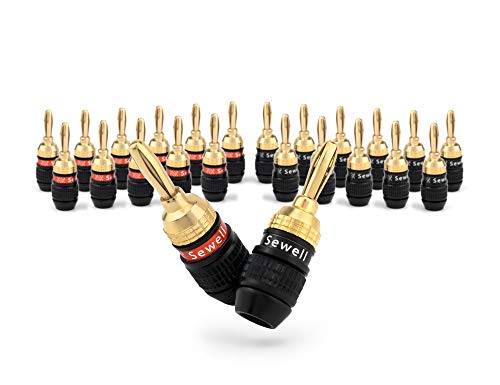
Sewell SW-29863-12 Deadbolt Banana Plugs 12-Pairs

zhenyu 10 Pcs 4mm Banana Jack Panel Mount Sockets

Sonew 10pcs 4mm Solderless Stackable Banana Plugs J.10026

Sonew 10pcs 4mm Solderless Banana Plug Stackable Type
More On The Choices That Made The List
If you charge LiPo packs at a workbench, you’ve probably hit the wall where the charger only takes 4mm banana plugs while the battery only speaks EC5. This cable solves that mismatch in the simplest possible way. It’s a short jumper with an EC5 male on one end and a 4mm banana male on the other, ready to bridge the two without soldering.
The 12awg silicone jacket keeps resistance low and stays flexible in cold weather, which matters when you’re reaching into a battery case. Two cables come in the pack, so most hobbyists can charge two packs in parallel without buying a second set.
What Stands Out
- Direct EC5 to 4mm banana plug conversion, no adapter stack needed
- 12awg silicone wire handles high-current charging without sagging voltage
- Two-pack gives you a spare or a parallel charging option out of the box
- 30cm length stays tidy on a crowded bench without excessive slack
Things To Consider
- Only fits EC5 batteries, so it won’t help with Deans or XT60 packs without another adapter
- Silicone jackets attract dust over time, though a quick wipe handles it
Who Will Love This
RC pilots and LiPo hobbyists running chargers with 4mm banana inputs who need a clean, no-solder path to EC5 batteries.
Swap It Out When
Anyone wiring speakers at home will find the Goaycer 4mm plugs more useful than this charging adapter.
Straight banana plugs remain the workhorse of home audio, and this Goaycer set keeps the format simple. Each plug uses 24k gold-plated brass (a brass core with a thin gold coating that resists corrosion) for the contact, which helps the connection stay clean over years of plugging and unplugging.
You get 24 plugs in 12 pairs, enough for a 7.1 surround setup with spares left over. Compared to the OliRC adapter cable above, this is firmly in speaker-wire territory, not battery-charging gear.
Real-World Strengths
- Gold plating keeps oxidation off the contact, which matters in humid rooms
- Wide compatibility with speakers, wall plates, and A/V receivers saves buying multiple plug styles
- Twelve pairs cover full surround setups without a second order
Trade Offs
- Straight design sticks out behind a wall-mounted amp, so a right-angle version like the next Goaycer set fits tighter spaces
- Brass body adds a little weight compared to all-plastic plugs
Quick Facts
Right Fit For
First-time home audio builders who want a single bulk pack that covers every speaker run in the room.
Look Elsewhere When
Shelf depth behind the amp is tight, since the Sewell Deadbolt plugs sit lower profile against the wall.
When the back of an amp is jammed against a wall, straight banana plugs become a problem. The cable bends sharply, the connector sticks out, and the whole setup looks messy. This right-angle Goaycer set solves that with a 90° plug that hugs the terminal.
Six pairs is enough for a stereo pair or a small 5.1 setup, though larger systems might need a second pack. The dual-screw design clamps bare wire firmly without soldering.
Benefits That Matter
- Low-profile 90° body keeps speaker cable flush against the wall or rack
- Two-screw clamp holds wire tight and reduces the chance of a loose strand shorting across terminals
- Works with bare wire, spades, or other banana plugs, so swapping one connector type is easy
- 10–18AWG range covers nearly every residential speaker wire gauge on the market
Points To Keep In Mind
- Six pairs only fills a small-to-mid system, so a 7.1 setup needs another pack
- The enclosed plastic boot can feel snug during initial installation in cold rooms
Built With In Mind
Anyone mounting gear close to a wall or inside a shallow AV cabinet where straight plugs push the equipment outward.
A Better Fit Elsewhere
Larger multi-channel rooms will get more value from the 12-pair Goaycer straight set covered earlier.
Sewell’s Deadbolt design drops the screws entirely and replaces them with self-crimping teeth. You insert the speaker wire, twist the body closed, and the teeth bite down to lock the conductor in place. For anyone who has fumbled with tiny set screws at the back of a media console, that single feature justifies the plug.
The 1.6-inch body sits low enough to push a speaker or receiver close to a wall. Twelve pairs cover a full surround array, and the gold plating keeps the contact clean over time.
Strengths Worth Knowing
- Self-crimping teeth remove the need for screws, making installs faster and more reliable
- Low-profile right-angle body keeps gear close to the wall without cable strain
- Twelve pairs handle full 5.1 or 7.1 systems with one purchase
- No soldering or special tools required beyond a wire stripper
Room For Improvement
- Re-opening the plug to reposition wire is harder than a screw-down design
- Larger gauge wire (below 14AWG) needs more crimp force to seat fully
Feature Snapshot
Made For
DIY home theater installers who want a clean solder-free install and don’t want to mess with tiny set screws at the back of a cabinet.
Skip It When
Battery and charger hookups are the goal, since the OliRC adapter cable above is built for that role.
Banana jacks are the female side of the same 4mm family, and they show up wherever you want a clean panel-mounted test point or speaker terminal. This zhenyu set gives you ten jacks in five colors, two of each, which keeps polarity and signal type easy to identify at a glance.
The nylon PA66 body tolerates more heat than standard plastic, useful for soldering rigs that get warm. A 12mm mounting hole and 6mm panel max thickness fit most project boxes and DIY faceplates.
Key Advantages
- Five color options (red, black, blue, yellow, green) make polarity and channel labels easy
- Nylon PA66 shell holds up to soldering iron heat better than cheap plastic housings
- Nickel-plated copper contacts keep resistance low across repeated mating cycles
- Ten-piece count suits a small bench project with spares for mistakes
Honest Caveats
- Soldering or Faston tab crimps are required, so this isn’t a no-solder option like the Sonew plugs later
- Panel thickness over 6mm won’t accept the mounting collar
Feature Card
Best Suited To
Electronics hobbyists building test boxes, breakout panels, or DIY speaker terminals who want color-coded, panel-mounted 4mm sockets.
Reach For A Different Pick When
You need a plug to terminate speaker wire, where the Sewell Deadbolt set covered earlier is the better tool.
Stackable banana plugs let you chain multiple connections off a single 4mm jack, which is the kind of feature you don’t appreciate until you need to patch two leads into one test point. This Sonew set ships ten plugs with a brass core and ABS shell, sized to standard 4mm jacks.
The open-ended screw design means no soldering iron is required, which keeps the install fast for bench work. Compared to the right-angle Goaycer audio plugs, this is a different beast built for test rigs rather than living-room speakers.
The Value In It
- Stackable design lets you daisy-chain extra leads from one jack without a splitter
- Brass and ABS construction keeps the plug rigid enough for repeated insertion
- Solderless screw termination speeds bench repairs and quick swaps
Practical Considerations
- Stacked plugs can crowd a small panel and block neighboring jacks
- ABS shell tolerates moderate heat but not the same range as nylon panel-mount jacks
Whose Shelf It Belongs On
Electronics technicians and lab tinkerers who frequently branch a single 4mm output into multiple test leads.
Consider Something Else When
You want a tidy home theater install, since the Sonew is utilitarian rather than furniture-friendly.
This Sonew set is the more audio-focused sibling of the J.10026 above, built to original-spec standards so it can drop into a repair job without sizing surprises. It’s still a solderless, stackable 4mm plug, but the brass content is tuned a touch higher, which the maker notes as a small sonic benefit.
The pack includes 10 plugs without tiny head screws, so you’ll need to supply your own set screws if you’re swapping them onto custom leads. For most people, that just means reusing screws from old plugs.
What Pays Off
- Original-spec sizing means a worn plug swaps straight out without rewiring
- Brass core is positioned as an audio quality plus, even if the gain is subtle in most systems
- Stackable body still allows branching leads for testing
- Solderless install makes it approachable for first-time repair work
Less Ideal Details
- Set screws aren’t included, an easy miss for first-time shoppers
- Documentation on wire gauge range isn’t published, so users may need to test fitment
Perfect Match For
Anyone replacing worn or damaged stock plugs on consumer audio gear without pulling out a soldering iron.
Where Another Pick Suits Better
Color-coded panel work benefits more from the zhenyu mount sockets covered earlier.
What Matters Most When Choosing Banana Connectors
The word “banana” refers to the slightly curved pin shape of a 4mm connector, originally standardized for test leads and now common in audio and hobby use. Knowing that makes the category easier to navigate.
Match the connector to the job. Audio plugs, battery adapters, and panel jacks all share the 4mm format but serve different roles. A battery adapter like the OliRC cable isn’t useful behind a speaker, and a panel jack won’t help you terminate speaker wire. Pick the form factor that fits the actual install.
Mind the wire gauge. Speaker plugs are usually rated for 10–18 AWG. If your in-wall wire is thicker or thinner than the plug range, the mechanical connection suffers, and over time, oxidation creeps in at the loose contact.
Decide between solder, screw, and crimp. Screw-down plugs like most on this list are the easiest for first-timers. Self-crimping plugs like the Sewell Deadbolt are faster still but harder to reopen. Soldered connections are most durable but require an iron and a steady hand.
Check the clearance behind the gear. A straight plug adds an inch or more behind the receiver. Low-profile right-angle designs like the Sewell or Goaycer right-angle plug let furniture sit closer to the wall, which matters more than people expect during the install.
Key Considerations Across These Picks
Pitfalls Shoppers Hit
A common miss is buying 4mm plugs for a binding post that takes a different style. Some amps use spring clips that only accept bare wire or a banana plug of slightly different diameter. Owners of older gear occasionally find their posts are banana-incompatible without an adapter.
Another slip is choosing a pack of six plugs for a seven-channel system. Counting channels matters more than counting speaker pairs, since each terminal needs its own plug. Leaving room for a future center channel or Atmos add-on saves a second order.
What Separates Premium From Basic
The jump from budget plugs to nicer ones usually shows up in the contact plating, the mechanical clamp, and the body material. Gold plating on brass resists corrosion far longer than bare nickel or tin, which matters in humid basements or closed AV cabinets. A screw-down or crimp body that’s solid under finger pressure will outlast a loose-fitting shell by years.
Frequently Asked Questions
What does a banana connector actually do? A banana connector is a 4mm pin that slides into a matching jack to make a quick, removable electrical connection. It shows up most often behind speakers and on test leads.
Are all banana plugs the same size? Most modern plugs and jacks follow the 4mm standard, which makes them interchangeable across brands. A few vintage binding posts or specialty test gear use slightly different dimensions, so it’s worth checking before you buy.
Can I use these for things other than speakers? Yes. The same 4mm format handles battery leads, lab test equipment, and DIY panel builds. The OliRC cable and zhenyu jacks on this list lean into those non-audio uses.
Do I need to solder anything? It depends on the plug. The Sewell Deadbolt, the Goaycer sets, and the Sonew plugs are all solderless. The zhenyu panel jacks require either soldering or a Faston crimp, so they take a bit more prep.
Will gold plating really matter? Gold plating resists corrosion, which keeps the contact stable over years of plugging and unplugging. In a dry living room the difference is small, but in humid spaces the gold finish noticeably outlasts bare metal.
Closing Verdict
Banana connectors are a small category where the right pick depends almost entirely on what you’re plugging into. Home audio builders will get the most from the Goaycer or Sewell options, while hobbyists and bench tinkerers will find the OliRC cable, zhenyu jacks, and Sonew stackable plugs more useful day to day. The honest read is that any plug on this list does its job well; the only mistake is grabbing one designed for the wrong kind of project. Pick the form factor that fits your gear, and the connection will hold up for years.
