

Stranded copper ends that fray after one strip, spring terminals that pinch instead of grip, and a tangle of wires hanging behind the receiver. I’ve been there, and the fix is almost always the same: terminate the speaker wire properly. A good set of banana plugs makes hookups faster, keeps bare copper away from corrosion, and turns a gear swap from a wrestling match into a five-minute job. This roundup covers nine solid options for different setups, from legacy spring-clip gear to tight-wall installs and DIY amp builds.
The Lineup, Simplified

Sewell Deadbolt Flex Pin Banana Plugs for Spring Loaded Terminals

Sewell Deadbolt Banana Plugs 6-Pairs SW-29863-6

Nakamichi GrubLock Excel Series 24k Gold Banana Plugs

onelinkmore BNC Male to Dual 4mm Banana Adapter

Sewell Deadbolt Right-Angle Banana Plugs 6 Pairs
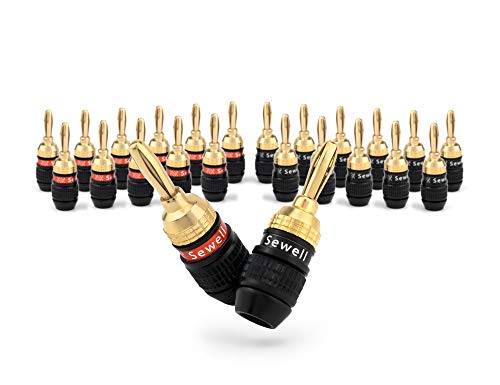
Sewell SW-29863-12 Deadbolt Banana Plugs 12-Pairs

zhenyu 4mm Banana Jack Panel Mount Sockets (10 Pcs)
WJSTN 12 AWG Right Angle Banana Cable Extension 2-Pack

bnafes 4mm Gold Binding Post with Clear Cover (4-Pack)
What Each Pick Brings To The Table
Older receivers and many bookshelf speakers still use spring-clip posts that grip bare wire, and a standard rigid banana plug often refuses to seat. Sewell’s Flex Pin deadbolt design solves that with a sprung pin that compresses on insertion, then expands to lock into the terminal. The 24K gold plating over a copper core keeps oxidation at bay, which matters in humid basements and home theaters running warm for hours. Twelve pairs cover most two-channel setups, with extras waiting for the next cable upgrade.
For anyone restoring a vintage Pioneer or Marantz stack, this set is the most forgiving option I’ve seen for older gear. Spring-clip terminals also show up on many active monitor speakers, so studio owners running small desks benefit too.
Positive Points
- Flex pin design actually seats into spring-clip terminals that reject standard banana plugs
- Gold-plated copper resists corrosion, helpful in basements and closed cabinets
- Twelve pairs cover a full multi-zone install with spares for mistakes
- Accepts wire up to 10 AWG, leaving room for thicker in-wall runs
- One-step self-crimp teeth speed termination without soldering or screws
Things To Consider
- The flex pin sits slightly proud of the body, so clearance behind a wall-mounted speaker can be tight
- Owners commonly report that very thin 18 AWG wire needs an extra fold before the teeth grip cleanly
Key Specs
Who Will Love This
Anyone wiring older receivers, vintage hi-fi gear, or active speakers with spring-clip binding posts benefits most from this set.
A Better Fit Elsewhere
Homeowners with modern 5-way binding posts should reach for the Sewell SW-29863-12, which uses a standard straight plug better suited to new gear.
The classic Deadbolt shape has been a familiar sight on AV forums for years, and the six-pair pack hits the sweet spot for a stereo pair plus a small surround setup. Self-crimping teeth bite into the conductor when you close the collar, so termination takes a few seconds per plug with no soldering iron on the bench. The body sits low at about 1.6 inches, which keeps it from crowding adjacent terminals on a crowded receiver back panel.
For first-time DIYers terminating speaker wire for the first time, the no-tools approach removes the usual friction. The gold plating over a copper core is the same approach Item 1 uses, but in a straight body that fits standard 5-way binding posts.
Well-Handled Touches
- Self-crimping collar means no soldering, no set screws to lose
- Compact 1.6 inch body keeps adjacent speaker posts accessible
- Gold-over-copper plating matches what premium cables use
- Six pairs cover a 5.1 system plus extras for repair
Room For Improvement
- Re-opening the collar to re-crimp can weaken the grip after a few cycles
- Six pairs runs short for a full 7.1 or multi-room install
- The straight body can collide with spring-clip terminals on some vintage amps
Best Suited To
Stereo and 5.1 home theater owners on modern receivers who want a clean, tool-free termination will find this set easy to live with.
Reach For A Different Pick When
Vintage hi-fi collectors dealing with spring-clip terminals should grab the Sewell Deadbolt Flex Pin set instead, since this straight body won’t always seat.
Nakamichi’s GrubLock uses a screw-down collar that tightens around the bare conductor, which feels more deliberate than a friction-fit crimp. The 24K gold plating over brass keeps the surface tarnish-resistant, and the body accepts anything from 10 to 18 AWG. That’s a wider range than most consumer plugs offer, so the same pack works for a beefy in-wall run or a thin satellite speaker lead.
Available in single or two-pair quantities, this option suits a mid-range home theater build where gauge consistency matters across the front stage. I find the screw-down approach reassuring when running wire behind drywall where future service is painful.
What Helps Most
- Screw-down collar gives a more secure, repeatable termination than friction fits
- 10 to 18 AWG range covers both in-wall and satellite runs from a single pack
- 24K gold plating over brass holds up in warm, enclosed AV cabinets
- Two-pair option suits front left and right without buying surplus
Honest Caveats
- Requires a small hex tool, adding a step compared to crimp-only designs
- Body diameter is wider than the Sewell Deadbolt, so closely spaced binding posts may crowd
Perfect Match For
Mid-range home theater builders who run mixed wire gauges and want one reliable plug for the whole front stage benefit most here.
Skip It When
Anyone wiring legacy spring-clip gear should pick the Sewell Deadbolt Flex Pin set, since this screw-down body won’t always seat in those terminals.
This isn’t a speaker wire termination at all, but it belongs on the list because ham radio operators, antenna builders, and bench techs reach for it constantly. The adapter takes a single BNC male plug and splits it into two 4mm banana jacks, which lets you tap into test equipment, QRP rigs, and oscilloscopes without rewiring. It also provides a useful bridge for four-terminal network isolation setups.
For a home audio enthusiast this won’t apply, but anyone running a dipole antenna or a small lab bench will see the value immediately. Two adapters come in the pack, which matches the channel-pair nature of most measurements.
What It Does Well
- Converts a single BNC feed into dual banana jacks cleanly
- Useful for QRP rigs, oscilloscopes, and frequency generator probing
- Supports four-terminal network isolation for precise measurements
- Two-pack covers a typical transmit and receive channel pair
Points To Keep In Mind
- Not a speaker wire termination; specific to test and radio benches
- Owners commonly report the binding posts loosen slightly with frequent swap cycles and benefit from a gentle re-tighten
The Right Fit
Amateur radio operators and electronics hobbyists who bridge BNC gear to banana-jack instruments get the most use out of these adapters.
Look Elsewhere When
Home audio shoppers should pick the Sewell Deadbolt Banana Plugs instead, since those are built for speaker wire rather than RF test signals.
When a speaker sits flat against the wall and a straight banana plug would protrude into the drywall, the right-angle body earns its place. Same self-crimping collar as the classic Sewell, but the 90-degree exit routes cable flush along the wall, which keeps things tidy behind a wall-mounted Atmos module. Six pairs cover a surround bed of four plus the front heights with two to spare.
Anyone mounting speakers close to the wall, or running cable along a baseboard where a straight plug would create a visible bulge, will appreciate this geometry. The gold plating matches the rest of the Sewell lineup, so mixing and matching across the system stays visually consistent.
What Works In Its Favor
- 90-degree exit lets cable hug the wall instead of sticking out
- Same reliable self-crimp teeth as the standard Deadbolt
- Gold plating matches the rest of the Sewell family for consistent finish
- Six pairs handle a 5.1.2 or 5.1.4 bed without leftovers
Practical Considerations
- Right-angle exit means cable direction is fixed; plan routing before crimping
- Thick 10 AWG wire puts more stress on the bend, so 14 or 16 AWG is the comfort zone
Key Specs
Built With In Mind
Wall-mounted Atmos or surround speakers with millimetres of clearance benefit most from this low-profile geometry.
Where A Sibling Pick Shines
Floor-standing speakers on open stands should grab the standard Sewell Deadbolt Banana Plugs, since straight plugs route more cleanly with no tight bend.
Twelve pairs is the right count when wiring a whole house or a 7.1.4 Dolby Atmos setup with extras in the drawer. The SW-29863-12 is the same trusted Deadbolt design as the six-pair pack, just scaled up so a single purchase finishes the job. Self-crimping teeth bite into the conductor, and the low body keeps adjacent posts accessible.
For households running speaker wire across multiple rooms, this pack keeps the install consistent and avoids mismatched connectors from two different orders. The gold-over-copper build matches the rest of the Sewell family, so a refresh on one zone doesn’t introduce a new look.
Strengths Worth Knowing
- Twelve pairs cover a full multi-room or 7.1.4 install in one purchase
- Self-crimp collar matches the proven Sewell Deadbolt design
- Low body height keeps binding posts accessible on crowded back panels
- Consistent finish across zones when mixing with the six-pack and right-angle variants
Worth Noting
- Straight body may not seat in some spring-clip terminals on vintage gear
- Bulk pack is overkill for a simple stereo pair, leaving spare plugs to store
Made For
Whole-home audio installers and serious home theater builders who need a generous count and uniform finish across the entire system.
Swap It Out When
Anyone with only two speakers to terminate will find the six-pair Sewell SW-29863-6 a more comfortable fit, without extras going to waste.
These aren’t speaker wire terminations either, but rather panel-mount banana sockets designed to be built into an amplifier chassis, speaker cabinet, or breakout box. The pack includes ten color-coded jacks, two each in red, black, blue, yellow, and green, which makes polarity and channel labelling straightforward on a busy panel. Nylon PA66 housing handles more heat than typical plastic, and the nickel-plated copper contacts accept standard 4mm banana plugs.
For DIY amp and custom speaker projects, these sockets are a tidy way to add removable rear-panel connections. Mount hole is 12mm with a 6mm panel thickness limit, so they’re best matched to thinner face plates.
Useful Strengths
- Color-coded jacks make polarity and channel mapping easy on the back panel
- Nylon PA66 housing tolerates more heat than typical plastic sockets
- Ten-pack supports a multi-channel custom build without leftovers
- Nickel-plated copper contacts accept standard 4mm banana plugs
Trade Offs
- Wiring requires soldering or Faston crimps rather than tool-free termination
- 6mm panel thickness limit rules out thicker amplifier face plates
The Right Fit
DIY amplifier builders and custom speaker cabinet makers who want removable rear-panel connections get the most value from this pack.
Not Your Match When
Homeowners terminating speaker wire at a receiver should pick the Sewell Deadbolt or Nakamichi GrubLock sets, which terminate cable rather than mount to a chassis.
Sometimes the speaker wire is already run and terminated, but the receiver is pushed into a cabinet and needs an extra foot to reach the binding posts. That’s exactly where a pre-terminated extension cable earns its place, and WJSTN ships a 12 AWG oxygen-free copper cable with right-angle banana plugs on each end. The 90-degree geometry keeps the cable flush to the back of the gear, which matters when the cabinet door closes.
For installers who want to avoid buying bulk cable, strippers, and a crimp tool just for a short reach extension, this is a sensible shortcut. The two-pack covers a stereo pair at a time.
Practical Advantages
- Pre-terminated cable skips strip, crimp, and tool steps for short extensions
- 12 AWG oxygen-free copper keeps resistance low over the one-foot run
- Right-angle plugs route flush against the back of crowded AV cabinets
- Two-pack covers a stereo pair at once
Some Limits To Know
- One-foot length only helps with shallow cabinet reach, not long runs
- Fixed length means you can’t tailor the run to odd distances
Feature Snapshot
Who Should Grab It
Homeowners with a recessed receiver cabinet who need a short reach extension without buying a full reel of speaker wire.
Consider Something Else When
Anyone running new wire across a room should pick bare speaker cable plus a set of Sewell Deadbolt plugs, since a one-foot extension can’t replace a full run.
Another chassis-mount option, but with a different design philosophy. The bnafes binding post uses a transparent plastic cover that insulates the post and lets you see the connection at a glance, which is handy when debugging a custom build. The 24K gold plating over a copper-alloy core resists oxidation, and the post accepts 4mm banana plugs, spade terminals, or bare wire for flexibility.
For hobbyists building a Class-D amplifier or refurbishing an old receiver with crispy original posts, this four-pack covers a stereo pair of channels. The transparent cover also helps prevent accidental shorts against a metal chassis, which matters in tighter builds.
The Case For It
- Transparent cover provides insulation plus visual confirmation of the connection
- Accepts banana plugs, spade terminals, or bare wire for flexible termination
- 24K gold plating over copper-alloy core resists oxidation
- Compact insulated post suits crowded custom face plates
A Few Limitations
- Four-pack only covers a single stereo channel pair, so multi-channel builds need extras
- Requires soldering or spade lugs rather than tool-free termination
Whose Shelf It Belongs On
Hobbyists refurbishing vintage receivers or building custom amplifiers who want insulated, clearly visible binding posts benefit most from this pack.
Where Another Pick Suits Better
Anyone just terminating speaker wire at the back of a modern receiver should grab the Sewell Deadbolt or Nakamichi GrubLock sets, which terminate cable without chassis work.
Picking The Right Banana Plug For Your Setup
Match The Plug To The Terminal
The single biggest factor in choosing banana plugs is the binding post on the receiver or speaker. Spring-clip terminals, common on older gear and many active monitors, often refuse a standard rigid pin, so a flex-pin design like the Sewell Deadbolt Flex Pin earns its place. Modern 5-way binding posts accept a standard banana plug, which opens the door to most options on this list. Right-angle bodies make sense when the speaker sits flush against a wall and a straight plug would push the cabinet off the surface.
Gauge And Conductor Size
Speaker wire is sold in AWG (American Wire Gauge), and a lower number means a thicker conductor. Most home runs sit between 14 and 16 AWG, but in-wall installs often jump to 12 AWG to limit resistance over long distances. The Nakamichi GrubLock’s wide 10 to 18 AWG range covers both ends of that spectrum, while the Sewell Deadbolt family focuses on the common 12 to 16 AWG band where most listeners live.
Plating And Material Choices
Gold plating over copper or brass resists corrosion, which matters in basements, closed cabinets, and outdoor zones where humidity swings. The plating is thin, so it isn’t there for audio magic, just to slow oxidation on the contact surface. Nickel-plated copper, like the zhenyu panel sockets use, is more about heat tolerance than signal purity, which suits chassis-mount work.
Quantity And Project Scope
A simple stereo pair uses four plugs, a 5.1 system uses twelve, and a 7.1.4 Atmos bed burns through twenty. The Sewell six-pack suits a starter setup, the twelve-pack covers whole-home runs, and the right-angle six-pack handles flush-mounted surrounds. Picking the right count up front keeps the install consistent and avoids mismatched finishes from two different orders.
Key Considerations Across These Picks
Common Shopping Slip Ups
The most frequent mistake is buying a beautiful straight banana plug and discovering it won’t seat in spring-clip terminals on a vintage receiver. The second is underestimating wire gauge; a plug rated only to 18 AWG won’t accept the 12 AWG in-wall run you’re trying to terminate. Third is assuming gold plating is a quality signal by itself, when the real durability comes from the crimp mechanism and the body geometry.
Why Top Tier Costs More
Premium options like the Nakamichi GrubLock charge more for screw-down collars and wider gauge ranges, which translate to repeatable terminations and flexibility across project types. Specialty adapters like the onelinkmore BNC-to-banana carry their cost in the niche RF application they serve rather than mass-market volume. Panel-mount sockets look simple, but the nylon PA66 housing and color-coded body in the zhenyu pack command a modest premium over generic plastic jacks.
Frequently Asked Questions
Do banana plugs improve speaker sound?
No, banana plugs do not change the audio signal in any meaningful way. They keep bare copper away from air and humidity, which slows corrosion over years of ownership, and they make swaps faster.
Will any banana plug fit any speaker terminal?
Most modern 5-way binding posts accept a standard 4mm banana plug. Spring-clip terminals on vintage gear and some active monitors often reject standard plugs, which is why a flex-pin design exists.
What wire gauge should I use with banana plugs?
Most home speaker wire is 14 to 16 AWG, and the Sewell and Nakamichi options on this list accept those gauges cleanly. In-wall runs over long distances often jump to 12 AWG, which the Nakamichi and WJSTN extension accept comfortably.
Can I reuse banana plugs after crimping?
Sewell’s self-crimp design can be reopened, though the teeth lose some grip after a few cycles. Screw-down plugs like the Nakamichi GrubLock are fully reusable as long as the threads stay clean.
Do I need special tools to install banana plugs?
Self-crimping plugs need no tools beyond a wire stripper. Screw-down designs require a small hex key, and panel-mount sockets require soldering or Faston crimps plus a drill for the mounting hole.
Closing Remarks
A solid set of banana plugs turns speaker wire hookups from a chore into a quick, repeatable job, and the right pick depends on your gear, your gauge, and your wall clearance. Match the plug to the binding post first, gauge second, and finish consistency third. That ordering alone filters this list to the option that suits your install, whether it’s a vintage receiver revival or a flush wall-mounted Atmos bed.
