

Off-grid setups have a quiet kind of pressure to them. A cabin fridge that drops into low-voltage sleep, a fish-finding trolling motor that won’t start the morning of a tournament, an RV battery bank that drains faster than expected during a weekend in the pines, those are the small frustrations that nudge people toward 24 volt solar panels. The right panel turns those moments into non-events, and the wrong one keeps you babysitting charge levels.
I focused this roundup on four panels that handle the realities of mobile and remote power: trickle-charging duty, full-time off-grid loads, curved RV roofs, and grab-and-go camping. Each one solves a different version of the same problem, keeping batteries topped off without plugging into the wall.
The Main Contenders

SUNER POWER 24V 30W Solar Panel with MPPT Charge Controller

ECO-WORTHY 200W 12V/24V Solar Panel Kit with PWM Controller

BougeRV Arch Pro 200W Anti-Shading Flexible Solar Panel
Greenmagic 800W Portable Foldable Solar Panel Kit
More Details On Our Top Picks
Maintenance batteries are the silent losers of any off-grid setup. A boat in winter storage, a camper trailer between trips, a generator sitting in a shed, they all bleed voltage slowly while nobody’s watching. SUNER POWER’s 30W panel is built specifically for that job. The built-in MPPT controller (MPPT stands for Maximum Power Point Tracking, a smart way of squeezing the most energy out of a panel at any given moment) does the regulating in the box, so there’s no extra wiring to think about.
It also accepts AGM (Absorbent Glass Mat, a sealed lead-acid battery type), standard lead-acid, and LiFePO4 chemistries, which covers nearly every storage battery I see in cabins and trailers. Mount it, plug it in, walk away. Where the ECO-WORTHY kit on this list is sized for daily living, this one is sized for keeping things from going flat.
A Strong Showing
- All-in-one design: panel plus charge controller in a single unit, so installation is mostly cable and a battery clamp.
- Multi-chemistry support means a single panel can move between vehicles and battery banks without a controller swap.
- Waterproof construction allows outdoor mounting without a custom enclosure.
- 30W is plenty for keeping a 50–100Ah battery topped up during weeks of inactivity, in our view.
Things To Consider
- 30 watts won’t run anything meaningful, so this only earns its place as a maintenance tool, not a primary charger.
- Compact size limits real-world output on cloudy days; positioning matters more than with larger panels.
Right Fit For
Someone storing a boat, RV, or tractor over the winter who wants batteries alive in spring without hauling them inside.
Reach For A Different Pick When
Daily cabin or RV living is the goal, and the ECO-WORTHY 200W Kit is the better match for steady household loads.
First-time solar shoppers tend to want one box that handles everything, and ECO-WORTHY leans into that. The kit pairs a 200W monocrystalline panel (made from a single silicon crystal, which generally converts more sunlight per square inch than cheaper multi-crystalline cells) with a 30A PWM charge controller (PWM, or Pulse Width Modulation, is a simpler, lower-cost way to regulate charging than MPPT), plus the cabling needed to hook up an RV, camper, or small off-grid cabin.
It runs at both 12V and 24V, which gives shoppers flexibility if their battery bank changes later. Compared to the SUNER POWER 30W trickle panel, this is a real working system, sized to actually move meaningful watt-hours onto a battery bank each day. It’s also a rigid aluminum-framed panel, so it expects a roof rack, a ground mount, or a flat surface, not a curved van roof.
Benefits That Matter
- 200W handles realistic daily loads like LED lighting, phone charging, and a 12V fridge fan in modest setups.
- Dual 12V/24V compatibility means the same panel can serve either battery architecture.
- Monocrystalline cells deliver higher output per square foot, useful when roof space is tight.
- Comes with a controller and cabling, removing the guesswork for first-time installers.
Points To Keep In Mind
- PWM controllers are less efficient than MPPT, so some wattage never makes it to the battery, especially in cool or shaded conditions.
- Rigid aluminum frame adds weight and rules out curved mounting surfaces, where the BougeRV Arch Pro on this list has the edge.
- Owners commonly report that the included instructions are minimal, so some wiring comfort helps.
Quick Facts
Built With In Mind
RV owners, weekend campers, and cabin dwellers who want a complete first solar kit without piecing components together.
Swap It Out When
The install surface is curved or shaded, where the BougeRV Arch Pro flexible panel handles the geometry better.
Rooftops in the real world aren’t flat. Van tops curve, Airstream shells arc, and boat decks slope in ways a rigid frame can only dream about. BougeRV’s Arch Pro is built for those surfaces: a fiberglass-reinforced flexible panel that bends along its length instead of fighting the shape underneath it.
The anti-shading design uses built-in bypass diodes (small electrical gates that reroute power around shaded cells so one shadowed section doesn’t kill the whole panel’s output), which helps in tree-filtered campsites and partial-roof setups. N-type 16BB cells are the underlying tech: “N-type” refers to the silicon doping used in the cell, and “16BB” means 16 thin conductive busbars printed onto each cell, both choices that generally push conversion efficiency higher. Where the ECO-WORTHY kit is a flat-roof classic, this one is the answer for shapes that don’t cooperate.
Practical Advantages
- Flexible fiberglass body conforms to curved van, RV, and boat surfaces that reject rigid panels.
- Built-in bypass diodes reduce the productivity loss from partial shading, a real benefit under trees or near obstructions.
- N-type 16BB cell layout lifts conversion efficiency above standard flexible panels, in most lighting conditions.
- Lower profile than framed panels, which helps with clearance on low garages and parking structures.
Honest Caveats
- Flexible panels run hotter than framed ones when mounted close to a roof, which trims output over a long sunny day.
- Adhesive mounting is permanent; moving the panel to a new vehicle is rarely clean.
- Does not include a charge controller, so buyers need to factor that into the total kit cost.
Whose Shelf It Belongs On
Van lifers, Airstream owners, and marine users who need solar that bends with their roofline.
A Better Fit Elsewhere
Someone on a flat-roof RV who values the all-in-one convenience of the ECO-WORTHY 200W Kit instead.
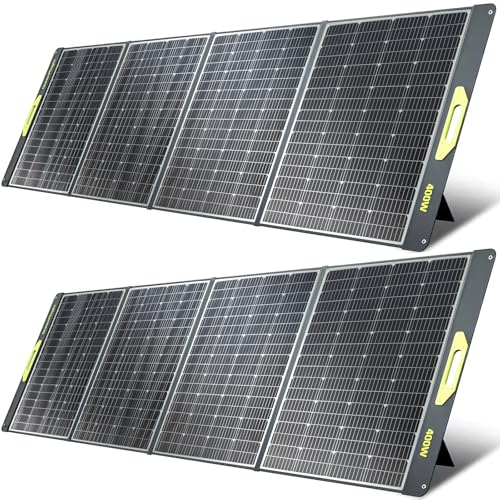
Some people don’t want solar bolted to their roof. They want solar that lives in a compartment, unfolds in a parking lot, and chases the sun while they make lunch. Greenmagic’s 800W kit, two 400W panels that fold into a carry-friendly shape, fits that lifestyle.
The 23% conversion efficiency comes from SunPower-backed cells (SunPower is a well-known premium cell manufacturer whose name has appeared on many high-efficiency residential panels), and the IP67 rating (an international dust-and-water resistance standard where “6” means dust-tight and “7” means survivable temporary immersion) handles the inevitable rain shower at a trailhead. Adjustable kickstands let users angle toward the sun rather than laying flat. Where the BougeRV Arch Pro stays put once installed, this one travels, packs, and goes home at the end of the trip.
What Pays Off
- 800W total output dramatically shortens generator runtime for portable power stations.
- Foldable design with adjustable kickstands means real portability for campers without roof mounting options.
- IP67 weather rating holds up to rain, dew, and dusty trailhead conditions.
- Smart sunlight alignment via the Suncast app helps users reposition for the best midday angle.
Worth Bearing In Mind
- At roughly 20 pounds per panel, the kit is portable but not light; it takes up real cargo space.
- Folding panels have more connection points than rigid ones, so owners should check plugs and hinges periodically.
- Needs an MPPT controller or compatible power station to actually use the 39V output, which adds to the system cost.
Feature Snapshot
Best Suited To
Campers and RV travelers who want serious solar output without committing to a permanent rooftop install.
Look Elsewhere When
Permanent, hands-off rooftop charging is the priority, and the SUNER POWER 30W panel handles long-term battery maintenance for less.
Picking 24 Volt Solar Panels That Actually Fit
Matching a panel to a real-world use case matters more than chasing wattage on paper. Before choosing, think through three questions: what is the battery bank chemistry and voltage, where will the panel physically live, and how much daily energy does the load actually need.
Rigid framed panels, like the ECO-WORTHY 200W kit, make sense on flat RV roofs or ground-mount frames. Flexible panels, like the BougeRV Arch Pro, bend with curved surfaces but run hotter when stuck close to a roof. Portable foldables, like the Greenmagic 800W, work for short trips and shifting sun angles, but they take up cargo space and want a compatible power station or MPPT controller on the other end.
Charge controller type quietly affects real-world output. MPPT controllers generally squeeze more usable energy out of a panel, especially in cool or variable light, while PWM controllers cost less but leave some wattage on the table. For a trickle-charging panel, the built-in controller is enough. For a primary living system, controller choice adds up over the years.
Key Considerations Across These Picks
Where Shoppers Go Wrong
The most common mistake is buying a panel sized for ideal sunshine. Real rooftops get partial shade, dirty surfaces, and low winter sun, all of which cut output. Aim slightly above the calculated daily need rather than exactly at it.
Another slip is assuming any charge controller will work. Matching controller type to panel voltage and battery chemistry protects both. A mismatch doesn’t just waste energy; it can shorten battery life over months of use.
When Paying More Pays Off
Spending more tends to buy three things in this category: higher cell efficiency, better build materials, and smarter charge electronics. The premium on a high-efficiency N-type cell panel pays back over years of stronger output, especially in low-light seasons.
For shoppers who camp occasionally, a budget trickle panel keeps batteries alive for less. For daily off-grid living, the upgrade to a higher-output kit, like a 200W monocrystalline panel with proper MPPT regulation, generally earns its keep within a couple of seasons through fewer generator hours and longer battery cycles.
Frequently Asked Questions
What does “24 volt solar panel” actually mean? It means the panel is wired or designed to feed a 24V battery bank, common in larger off-grid systems, or to be combined with others to reach 24V.
Can I use a 24V panel to charge a 12V battery? Usually not directly, since the open-circuit voltage exceeds what a 12V charge controller expects. A proper MPPT controller or a panel sized for 12V is the safer path.
How much solar do I need for an RV? Light weekend use often runs fine on 100–200W. Full-time RV living with refrigeration and electronics typically wants 300–600W or more, depending on climate and battery size.
Do I still need a charge controller? Yes, in almost every case. Without one, a solar panel can overcharge a battery and damage it over time. Even panels with built-in controllers expect a battery as the load.
How long do solar panels actually last? Most modern panels hold useful output for 20–25 years. Wiring, connectors, and charge controllers usually need attention sooner than the panels themselves.
Closing Thoughts
The right 24 volt solar panel depends on where it lives and what it feeds. Trickle chargers keep stored batteries alive, rigid kits power daily off-grid loads, flexible panels bend with curved roofs, and portable foldables chase the sun on camping trips. Match the panel shape to the surface, the wattage to the load, and the controller to the battery, and the rest tends to take care of itself.
