

A dead battery is one of those small frustrations that can ruin an afternoon. Maybe it’s the boat you haven’t touched since spring, the classic car parked in the garage, or the RV sitting at storage waiting for the next trip out. Solar trickle chargers quietly fix that, sipping sunlight and keeping everything topped off. The picks below cover a range of needs, from gentle maintenance on a rarely used vehicle to a full off-grid charging setup.
The Shortlist At A Glance
SUNER POWER 20W 12V Solar Battery Charger & Maintainer Ultra

POWOXI 12V 1.7W Solar Panel for Deer Feeder Battery

SUNER POWER 30W 12V Solar Battery Charger Maintainer

SUNER POWER 10W 12V Solar Battery Charger Maintainer
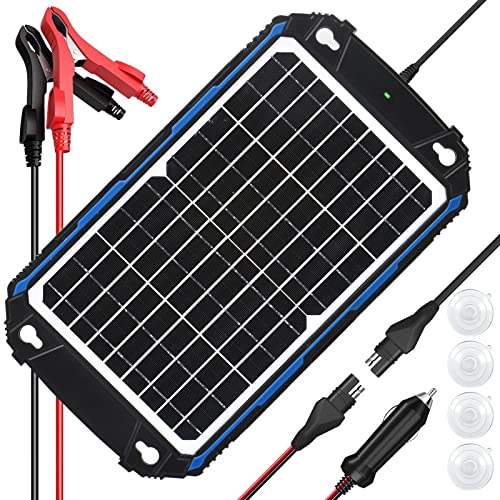
SUNER POWER 12W 12V Solar Battery Charger & Maintainer Pro

SUNER POWER 50W 12V Solar Battery Charger Maintainer

Renogy 400W Premium Solar Kit with 40A MPPT Controller
The Details Behind The Selections
I think of this 20W panel as the sweet spot for most people who just want their vehicle or boat battery alive between uses. MPPT (Maximum Power Point Tracking) controllers are a step above the older PWM style, squeezing more usable energy out of the same sunlight, which matters on cloudy days or short winter windows. SUNER POWER fits that MPPT tech into a compact, weather-resistant frame with an adjustable mount bracket and clear visual charge-level indicators.
Compare it to the smaller 10W sibling later in this list, and the 20W gives you roughly twice the daily energy harvest without a dramatic price jump. For a single car, motorcycle, or small boat battery, the 20W Ultra sits right where most needs meet most budgets.
Notable Gains
- Built-in MPPT controller improves conversion efficiency over basic PWM panels, meaning more stored energy per hour of sunlight
- Three-stage charging (Bulk, Absorption, Float) protects battery health and extends service life
- Visual charge-level LEDs at 25/50/75/100% let you check status without a multimeter
- Automatic on/off cycling means true set-and-forget maintenance once installed
- Adjustable mount bracket helps angle the panel toward the sun across seasons
Things To Consider
- 20W won’t recover a deeply discharged large battery quickly, it works best as a maintainer
- Owners in heavily shaded driveways may notice reduced daily input
Who It Suits Best
Anyone storing a car, boat, RV, or trailer for weeks at a time and wanting a hands-off battery tender that simply works.
Consider Something Else When
Heavier draw from a large battery bank points to the SUNER POWER 50W panel instead, which handles deeper recovery needs.
This one breaks the pattern of the list, and that’s exactly why it’s here. The POWOXI 1.7W panel is purpose-built for the small 12V battery that powers a deer feeder’s timer and motor, a job that doesn’t need 20 or 50 watts but does need a panel that sits outside all year. The included mounting bracket and waterproof construction match the realities of remote hunting land.
A pack of three covers multiple feeder locations or gives you spares. For a homesteader running two or three feeders, this kind of matched setup can save countless trips to swap dead batteries. In our view, this is the most specialized pick in the roundup, but specialization matters when the use case is this narrow.
A Few Strong Suits
- Compact monocrystalline panel keeps weight low on pole or post mounts
- Weather-sealed design handles rain, snow, and summer heat
- Pack of three covers multiple feeders or backup units
- Mounting bracket included for fast field installation
Honest Caveats
- 1.7W output is far too small for vehicle or RV batteries, this is feeder-specific
- Slow charge rate means a deeply depleted feeder battery may take several sunny days to recover
- Limited usefulness outside its intended feeder application
Made For
Hunters and landowners running 12V-powered deer feeders in remote spots without grid power.
Skip It When
You need a panel for a car, boat, or RV battery, where the SUNER POWER 10W or 20W models are better suited.
The 30W version steps up from the 20W Ultra with noticeably more daily energy harvest, enough to keep a mid-sized RV house battery or a small off-grid cabin bank topped off through shoulder seasons. It carries the same Ultra-Smart MPPT controller and three-stage charging algorithm that defined the smaller unit, so the upgrade is mostly about raw wattage rather than a feature rewrite.
Where the 20W Ultra feels right for a single car or boat, the 30W starts to make sense when you have a second battery, a trolling motor, or a small appliance load to support. You may find the extra wattage gives you margin on cloudy stretches when a smaller panel would fall behind.
Bright Spots
- 30W output handles larger battery banks than the 10W or 20W models
- Same MPPT and three-stage charging protections as the rest of the SUNER POWER lineup
- Adjustable mount bracket helps optimize sun angle seasonally
- Waterproof build rated for permanent outdoor mounting
Points To Note
- Physical size grows with wattage, plan mounting space accordingly
- Still a maintainer first, not a fast charger for deeply dead batteries
Right Fit For
RV owners with a house battery or anyone maintaining two batteries at once who needs a step up from entry-level panels.
Look Elsewhere When
You only need to maintain a single small battery, where the SUNER POWER 20W Ultra is a better match.
The 10W is the smallest of the SUNER POWER MPPT lineup, and for many users that is exactly the point. A compact panel fits where larger ones cannot, on a motorcycle, inside a small boat cockpit, or tucked against a garage window. It carries the same Ultra-Smart MPPT controller and three-stage charging logic as its bigger siblings, so you don’t sacrifice battery protection for size.
For someone maintaining a single lawn tractor, a motorcycle, or a small trolling motor battery, 10 watts under full sun is plenty of daily input. The honest read is that this is the entry-level pick with proper engineering, not a stripped-down version.
Notable Upsides
- Smallest footprint in the lineup fits tight spaces and smaller vehicles
- Same MPPT and three-stage protections as higher-watt SUNER POWER models
- Adjustable bracket included for aiming at the sun
- Waterproof construction handles permanent outdoor mounting
Softer Spots
- 10W output is too small to recover a deeply discharged larger battery
- Performance drops noticeably in heavy shade or short winter days
Best Suited To
Motorcycle, lawn tractor, and small boat owners who want a low-profile maintenance panel.
Not Your Match When
You need to maintain an RV house battery or a deep-cycle bank, where the SUNER POWER 30W or 50W is a stronger fit.
Sitting between the 10W and 20W, the 12W Pro gives up only a few watts of daily harvest in exchange for a design pitched squarely at permanent outdoor exposure. It runs the same Ultra-Smart MPPT charging algorithm and waterproof housing as the rest of the family, and the Pro branding hints at refinement in sealing and connector quality for long-term weather duty.
Compared to the 10W entry model, this Pro version offers a small bump in input power plus a tougher weather stance. I see it as the sweet option for someone who wants low-fuss long-term mounting without oversizing for the job.
Advantages To Know
- 12W output covers small to mid battery maintenance comfortably
- MPPT controller and three-stage charging match the broader SUNER POWER family
- Sealed waterproof design suited to year-round outdoor mounting
- Adjustable bracket included for seasonal angle tweaks
Worth Bearing In Mind
- Only marginally more output than the 10W for a higher entry cost
- Still a maintainer, not a recovery charger for deeply discharged banks
Who Should Grab It
Shoppers who want a slightly more weatherproof option than the 10W and don’t need the jump to 20W or 30W.
A Better Fit Elsewhere
Those running larger battery banks should reach for the SUNER POWER 50W instead.
This is the heavyweight of the SUNER POWER trickle lineup, and where the smaller panels keep things topped up, the 50W starts to actually refill deeper cycles. Its compatibility spans SLA, AGM, deep-cycle, and LiFePO4 batteries, which covers nearly every chemistry a vehicle or off-grid setup might throw at it.
Compare it to the 30W, and the 50W adds meaningful recovery headroom for banks that see real draw rather than just parasitic loss. Depending on your setup, that extra wattage can mean the difference between a battery that struggles to start and one that’s comfortably charged by midday.
The Good Stuff
- 50W output handles deeper recovery than smaller trickle panels
- Works with SLA, AGM, deep-cycle, and LiFePO4 battery chemistries
- UltraSmart MPPT controller and three-stage charging algorithm
- Waterproof housing and adjustable bracket for permanent outdoor installs
Practical Considerations
- Physical footprint grows with wattage, plan your mounting location
- Overkill for a single lightly used vehicle battery
Whose Shelf It Belongs On
Anyone maintaining a deep-cycle battery bank, a solar shed setup, or a frequently used RV needing real charge current.
Reach For A Different Pick When
A single car or small boat battery only needs gentle topping off, where the SUNER POWER 20W Ultra is the better fit.
The Renogy 400W kit is a different animal from the rest of this list. Where the SUNER POWER panels and the POWOXI feeder panel are trickle chargers, this is a real generating system aimed at cabins, RVs with serious power needs, and off-grid setups where a maintainer simply isn’t enough. The included 40A MPPT charge controller handles the higher current and brings professional-grade conversion efficiency to the table.
Compared to every other pick here, the jump in capacity, weight, and installation effort is significant. Assuming you have roof space, a proper mount, and a real battery bank to feed, this kit moves from maintenance into meaningful daily power production.
Strengths Worth Knowing
- 400W output produces real daily energy for off-grid loads
- 40A MPPT charge controller supports larger battery banks with high conversion efficiency
- Premium kit from an established solar brand with a wide accessory ecosystem
- Scales well for cabin, RV, or shed solar builds
Where It May Fall Short
- Much heavier and larger than any other pick on this list
- Installation requires mounting hardware, wiring, and a proper battery bank
- Excessive capacity for anyone who only needs a battery tender
Built With In Mind
Off-grid homesteaders, cabin owners, and serious RV solar users who need daily power production rather than a maintenance trickle.
Swap It Out When
You only want to keep a vehicle or boat battery topped off, where the SUNER POWER 20W Ultra is a far simpler and lighter choice.
Factors To Consider When Choosing 12 Volt Solar Battery Chargers
Wattage and Battery Size
The wattage of a solar panel determines how much energy it can harvest per hour of full sun, and that figure needs to match the battery you want to maintain. A small motorcycle or lawn tractor battery can stay healthy with 5 to 10 watts, while a deep-cycle RV or marine bank may need 30 watts or more to keep up with parasitic loads. In our view, oversizing a panel slightly is more forgiving than undersizing it, especially in winter.
Controller Type: MPPT vs PWM
MPPT (Maximum Power Point Tracking) controllers convert a higher percentage of incoming solar energy into usable charging current, while older PWM (Pulse Width Modulation) controllers waste some of that potential as heat. MPPT costs more but pays back in shorter charging times and better low-light performance. Most modern panels in this category, including every SUNER POWER pick here, use MPPT for that reason.
Weatherproofing and Mounting
Any panel living outdoors needs UV-stable encapsulation, sealed junction boxes, and a bracket that lets you aim it at the sun across the seasons. Year-round outdoor mounting demands more robust weatherproofing than a panel that lives on a garage dashboard. Mount location matters too, since shade can drop output dramatically.
Smart Spending in the Solar Charger Category
Where Shoppers Go Wrong
A common slip is picking a panel based on wattage alone without checking the controller. A 30W panel with a PWM controller can underperform a 20W panel with a quality MPPT controller in real-world conditions. Another mistake is mounting the panel flat against a wall instead of angling it toward the sun, which can cut daily harvest in half during shoulder seasons.
When Paying More Pays Off
Higher-tier models earn their keep through better MPPT controllers, tougher weatherproofing, and broader battery chemistry support. For someone maintaining a single car, that upgrade isn’t necessary. For a deep-cycle bank or an off-grid system, the extra spend buys longevity and fewer headaches.
Frequently Asked Questions
How long does it take a solar charger to recharge a dead battery?
A 20W trickle panel typically needs several days of full sun to bring a deeply discharged 12V battery back to a useful charge, and smaller panels take even longer. These are maintainers, not fast chargers.
Can a solar charger overcharge my battery?
Modern MPPT panels with three-stage charging algorithms stop pushing current once the battery reaches full, so overcharging is not a typical concern with the picks above.
Do I need direct sunlight for a 12V solar charger to work?
Direct sun delivers the rated output, but panels still produce meaningful current on cloudy days, just at a reduced level. Shaded mounting locations will noticeably limit daily harvest.
What’s the difference between a trickle charger and a solar panel kit?
A trickle charger is a small panel designed to offset parasitic battery drain, while a full solar kit like the Renogy 400W is built to actively recharge larger banks and run loads.
Is a higher wattage solar panel always better?
Not necessarily. Oversizing means paying for capacity you won’t use and dealing with a heavier, larger panel. Matching wattage to the battery size and usage pattern is the better approach.
Closing Remarks
A good 12V solar charger pays for itself the first time it saves a battery replacement. Match the panel to your battery size, double-check the controller type, and you’ll have a quiet piece of equipment that just works, season after season.
