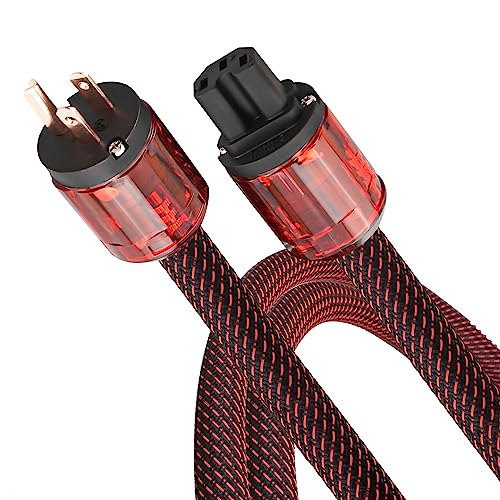
Most setups look tidy until you notice the cables snaking across the floor, tangling behind the desk, or pulling loose because the jacket is already fraying. A braided power cord fixes more than the mess; it adds strain relief, keeps the bend radius safer over time, and gives your gear a cleaner, finished look. I pulled together ten solid options across home offices, entertainment centers, and audio rigs, so the right cable reaches the right outlet without drama.
The Philips flat-plug extension is the kind of cord that disappears behind a media cabinet and stops being a problem. Its low-profile plug hugs tight to the wall, so the unit sits flush against baseboards and behind bookshelves where a chunky plug would never fit.
For most living rooms, eight feet is the sweet spot: long enough to reach a floor outlet from a wall-mounted TV, short enough that you do not have to bundle excess cable behind furniture. Owners commonly route this along a TV stand, behind a reading lamp, or under a window-mounted AC, and the grounded three-outlet end lets you consolidate a lamp, a router, and a console on one switched line.
What Makes Sense
✓Built-in surge protection guards sensitive electronics against voltage spikes during storms or grid hiccups.
✓The flat head sits almost flush against the wall, freeing up clearance for tight furniture placements.
✓Eight feet handles most living-room and bedroom runs without leaving dangerous slack loops on the floor.
✓Three grounded outlets replace a single receptacle, which is plenty for a lamp, a clock, and a small appliance.
Things To Consider
•Three outlets fill up fast in entertainment centers; count your plugs before relying on it solo.
•Surge protection has a finite lifespan and may need replacement after a major electrical event.
•Not rated for outdoor use, so keep it indoors and away from any moisture exposure.
Key Specs
Feature
Specification
Why It Matters
Length
8 feet
Reaches most wall-to-furniture gaps without coiled slack
Outlets
3 grounded
Replaces one receptacle with three usable connections
Protection
Built-in surge
Shields TVs and routers from voltage spikes
Best Suited To
Households consolidating lamps, routers, and small electronics into a single grounded, surge-protected run behind a media cabinet or nightstand.
Consider Something Else When
Anyone needing a longer reach or a 360° rotating plug for awkward outlet positions should look at the SURAIELEC 20Ft Flat Plug Extension Cord with Rotating Plug.
The SURAIELEC cord is built for the awkward outlet: the one behind a heavy dresser, the one tucked inside a window seat, or the one with a second receptacle blocked by a piece of furniture. The rotating plug pivots a full 360°, so the cord exits in whatever direction works for your room rather than the direction the wall dictates.
Twenty feet covers almost any room-to-room span I can think of, from a living-room TV to a hallway outlet, and the 16/3C gauge wire is a sensible rating for everyday household loads like lamps, fans, and small electronics. The flat head also keeps the wall profile low when you do not need the rotation.
Good Reasons To Consider
✓The 360° rotating plug solves the classic “furniture blocks the second outlet” problem.
✓Twenty feet of reach covers most bedrooms, offices, and dorm setups without chaining multiple cords.
✓Flat profile option keeps things tidy when the rotation is not in use.
✓Three grounded outlets run multiple devices from a single wall receptacle.
Worth Noting
•Twenty feet is overkill for a small room, and you will need to manage excess slack.
•16/3C gauge is fine for lamps and chargers, but high-draw appliances may push the rating.
Made For
Renters and homeowners dealing with awkwardly placed outlets behind heavy furniture or in tight corners where a standard plug simply will not angle in.
Not Your Match When
Anyone needing a surge-protected run for a sensitive entertainment center should consider the Philips 3-Outlet Flat Plug Extension Cord instead.
The TPLTECH cord is a two-prong figure-8 replacement, and that single detail matters more than people realize. Many TVs, soundbars, and current-generation consoles use that small cloverleaf-style connector, and the original cable often arrives too short for a wall-mounted setup or gets damaged during a move.
Eight feet lands in the middle of practical: long enough for a wall-mounted display reaching a low outlet, short enough to keep cable runs neat behind a console. The wide compatibility list covers Samsung, LG, TCL, Sony, Insignia, Sharp, Toshiba, JVC, and Hisense TVs, plus PS5, PS4, Xbox Series X, and Xbox Series S consoles, so it doubles as a universal shelf spare.
Positive Points
✓Two-prong figure-8 (IEC C7) fits most modern TVs, soundbars, and game consoles.
✓Eight-foot length reaches from a wall-mounted display down to a typical low outlet.
✓UL safety listing offers assurance that the cable meets recognized electrical standards.
✓Works across a wide range of TV brands and console generations, so one cable covers multiple devices.
Honest Caveats
•Two-prong only; grounded appliances need a different cord entirely.
•No surge protection, so a power strip is still recommended for expensive displays.
Right Fit For
Anyone replacing a lost or short figure-8 cable for a wall-mounted TV, soundbar, or current-generation console and wanting a single shelf spare that works across brands.
Skip It When
Outlet-extension needs at a workstation or desk call for the StarTech 10ft Power Extension Cord instead.
The StarTech PAC10110 is a plain extension cable, and that is exactly its strength. The 16AWG conductor, 13A rating, and 125V capacity cover typical workstation and home-office loads without strain, while the standard NEMA 5-15P to NEMA 5-15R (the standard three-prong household plug and receptacle) ends drop into any outlet or device in the US.
Ten feet is the most useful length in the category for me, because it bridges the gap between a wall receptacle and a desk or bench without leaving enough cable to coil into a hazard. Indoor-rated, the cord handles monitors, printers, lamps, and bench tools on a 15A household circuit.
Bright Spots
✓16AWG wire handles 13A loads comfortably for monitors, printers, and bench tools.
✓Ten-foot length bridges most desk-to-wall distances without excess coil.
✓Standard NEMA connectors fit every common US outlet and appliance plug.
✓Sturdy molded ends resist cracking where cheaper cords typically fray first.
Trade Offs
•No surge protection; sensitive gear still needs a dedicated power strip.
•Indoor rating only, so it cannot live outside or in a damp basement corner.
•Plain black jacket is functional but does not match a styled entertainment setup.
Key Specs
Feature
Specification
Why It Matters
Length
10 feet (3m)
Covers most desk and bench setups in one run
Gauge
16AWG
Carries 13A comfortably without voltage drop
Connectors
NEMA 5-15P to NEMA 5-15R
Fits standard US household outlets and devices
Voltage Rating
125V at 13A
Matches typical 15A household circuits
Who Will Love This
Workstation and home-office users who need a no-nonsense, full-gauge extension for monitors, printers, and bench tools on a standard 15A circuit.
A Better Fit Elsewhere
Anyone chasing the cleanest-looking cord for an audio rack should consider the Audiocrast HiFi Power Cord with Braided Sleeve instead.
Audiocrast’s braided-sleeve power cord reads as soon as you pick it up, because the cable is heavy. The 10AWG conductor is thicker than anything else in this roundup, and the 17mm outer diameter signals a real shielded build rather than a marketing-only braid.
For an integrated amplifier, a high-current DAC, or a power conditioner, that heft translates into lower resistance and better rejection of electromagnetic interference (EMI), which is electrical noise from nearby cables and devices that can muddy audio signals. At 4.9 feet, the run is short, and that is by design; long cables in audio setups can pick up noise that shorter runs avoid.
Real-World Strengths
✓10AWG conductor handles high-current amplifiers without strain.
✓Braided sleeve resists scuffs and abrasion around the back of a heavy rack.
✓5N OFC (oxygen-free copper) conductors support stable current flow during demanding passages.
Points To Keep In Mind
•The 17mm thickness makes it stiff, so tight bends behind a crowded rack require planning.
•4.9-foot reach is short; long-distance rack placements need a longer cable or an extension.
•Heavier gauge raises cost compared to slim everyday cords.
Key Specs
Feature
Specification
Why It Matters
Conductor
10AWG, 5N OFC
Carries high current with minimal resistance
Diameter
17mm OD
Reflects heavy shielding and robust insulation
Connectors
US plug to IEC C13
Standard fit for most amplifiers and source components
Shielding
Multi-layer
Reduces EMI that can color audio playback
Perfect Match For
Audiophiles upgrading the stock cord on a high-current integrated amplifier, power amplifier, or power conditioner where a heavier-gauge shielded cable fits the rack layout.
Look Elsewhere When
Anyone seeking PTFE (polytetrafluoroethylene) insulation and 9AWG conductors for reference setups should check the Viborg MBU1501 Audiophile Power Cable.
Most desktop power strips are ugly plastic bricks, and this one is not. The GE 3-Outlet Power Strip wraps a short braided jacket around a low-profile plug and a small grounded outlet cluster, so the cord reads more like an accessory than a utility.
At roughly five inches of cord (the combo pack covers a longer companion cable too), it is built for the tight reach between a wall and a nightstand, a laptop charger, or a desk lamp. Three grounded outlets are enough for a phone charger, a clock, and a small lamp, and the flat plug keeps the strip flush against the wall.
Advantages To Know
✓Short braided cord keeps a desktop or nightstand setup looking intentional.
✓Three grounded outlets cover a phone, a lamp, and a clock from one wall receptacle.
✓Flat plug sits tight against the wall for hidden-behind-furniture installs.
✓The combo pack gives a matching longer cord for a secondary location.
A Few Limitations
•Short cord length will not bridge a desk-to-outlet gap on the opposite side of a room.
•Three outlets fill quickly if you add a laptop brick plus a monitor.
•No surge protection rating is called out, so it works best for low-risk devices.
Feature Snapshot
Feature
Specification
Why It Matters
Outlets
3 grounded
Replaces one receptacle with three usable plugs
Style
Braided jacket
Looks cleaner than a bare plastic cord
Plug
Flat profile
Sits flush against the wall behind furniture
Whose Shelf It Belongs On
Design-conscious users with a nightstand, side table, or compact desk who want a tidy braided cord and three grounded outlets within arm’s reach.
Another Choice May Suit
Anyone needing 20 feet of reach for a room-spanning run should consider the SURAIELEC 20Ft Flat Plug Extension Cord with Rotating Plug instead.
Viborg’s MBU1501 sits at the heavier end of the audio-cable spectrum. Two 9AWG conductors are paired with PTFE insulation (a high-grade plastic that resists heat and signal loss better than standard PVC) and 16 strands of multiplex copper, all wrapped in an aluminum-shelled connector at each end.
That combination is aimed at reference audio systems where the owner has already invested in the source and amplification, and the power cord is the next variable to chase. Five feet is a comfortable length for most rack positions, and the IEC C15 connector handles the higher-temperature ratings expected of valve amplifiers and high-current Class A designs.
The Good Stuff
✓2x9AWG conductors deliver very low resistance for demanding amplification.
✓PTFE insulation resists heat and helps preserve signal purity at the cable boundary.
✓Aluminum-housed connectors provide a stable mechanical and electrical connection.
✓Compatible with US-style plugs and IEC C15 inputs for broad hi-fi coverage.
Some Limits To Know
•Thick, semi-rigid cable is harder to route in tight rack corners.
•Premium construction raises the cost compared to entry HiFi options.
•IEC C15 (the higher-temperature variant of the standard C13 inlet) does not fit devices expecting a standard C13 inlet without checking the gear.
Built With In Mind
Reference-system owners who have already optimized source and amplification and want a heavy-gauge PTFE-insulated power cable as the next upgrade.
Swap It Out When
Listeners seeking a lighter, more flexible cable for a smaller desktop DAC should consider the Audiocrast HPC01 HiFi Power Cable instead.
The HPC01 is the everyday workhorse of the Audiocrast HiFi line. The 17mm diameter feels substantial in the hand, but the cable stays flexible enough to wrap behind a small integrated amp without fighting the routing.
Three-point-three feet (1 meter) suits a typical desk or shelf placement, where the amp sits close to the wall outlet. The IEC connector at the equipment end is a standard fit, and the 125V/15A rating matches US household circuits for any source component or small power amp.
✓17mm diameter gives a sturdy feel without becoming overly rigid in tight bends.
✓Short length suits desk and shelf placements close to the wall outlet.
✓Replaces worn stock cables that often ship with budget integrated amps.
Possible Compromises
•3.3 feet is too short for rack-to-wall distances longer than a meter.
•Standard-gauge conductor will not satisfy high-current monoblock amplifiers.
•Connectors lack the aluminum shell of more premium Audiocrast siblings.
The Right Fit
Desktop-audio users with a small integrated amp, DAC, or turntable power supply placed close to a wall outlet who want a clean upgrade over a stock cord.
Reach For A Different Pick When
A high-current monoblock or power amplifier that benefits from a heavier 10AWG cable points to the Audiocrast HiFi Power Cord with Braided Sleeve instead.
Powered subwoofers often ship with thin, generic cords, and the two-tone braided sleeve on this Audiocrast cable feels like a deliberate upgrade rather than a replacement. The 17mm jacket sits cleanly along a baseboard or behind a sub cabinet without tangling, and the fold-resistant braid handles the constant plug-and-unplug that comes with rearranging a home theater.
Three-point-three feet matches most subwoofer placements, which usually live close to a wall outlet anyway. Copper shielding aims at reducing line noise that can creep into a low-frequency driver, which matters when the sub sits on the same circuit as the rest of the rack.
What Stands Out
✓Two-tone braided sleeve resists scuffs along baseboards and under furniture.
✓Copper shielding helps reduce line noise reaching the subwoofer amplifier.
✓Short 3.3-foot length suits subwoofer placement near a wall outlet.
✓IEC C15 connector handles higher-temperature sub amp electronics.
Less Ideal Details
•3.3 feet may fall short if the sub sits across the room from the outlet.
•No specific surge protection, so a power conditioner is still recommended for high-end subs.
Who Should Grab It
Home-theater owners with a powered subwoofer placed near a wall outlet who want a more durable, better-shielded cable than the stock cord.
Where Another Pick Suits Better
Anyone running a longer sub-to-outlet span should look at the GE 3-Outlet Power Strip with Braided Cord for a tidy multi-outlet companion instead.
For most first-time hi-fi owners, this cable is the entry point that matters. The IEC C13 connector (the most common inlet on consumer audio gear) covers the widest range of source components, and the 17mm braided jacket feels a step up from the generic black cord that ships in the box.
Three-point-three feet fits the typical shelf placement where a DAC, CD player, or streamer sits close to a wall outlet, and the 125V/15A rating covers household circuits without strain. It is a no-fuss upgrade for someone who wants the braided look and a cleaner cable without committing to the heavier-gauge tiers above.
Strong Points
✓IEC C13 connector fits the broadest range of consumer audio components.
✓17mm braided jacket resists scuffs around a busy shelf or rack.
✓Short 3.3-foot length suits desk and shelf placements close to the outlet.
✓Entry-level price point makes it easy to step up from a stock cord.
Where It May Fall Short
•Standard conductor gauge will not satisfy high-current monoblock amplifiers.
•3.3-foot reach is too short for a rack on the opposite side of the room.
Right Fit For
First-time hi-fi owners with a DAC, CD player, or network streamer who want a clean, braided cable as a noticeable step up from the stock cord.
Where A Sibling Pick Shines
Anyone chasing PTFE insulation and 9AWG conductors for a more demanding amp should consider the Viborg MBU1501 Audiophile Power Cable.
What To Weigh Before Choosing Braided Power Cords
Length and Routing
Measure the actual run from outlet to device, then add a foot of slack for strain relief. Cords that are too short tug at the plug; cords that are too long coil into trip hazards or wrap around rack furniture. Eight to ten feet covers most rooms, while twenty feet is a specialty run for outlets on the opposite wall.
Outlet Type and Connector Fit
Three-prong grounded (NEMA 5-15) ends cover almost every household appliance. Two-prong figure-8 (IEC C7) ends fit most modern TVs and consoles, while IEC C13 and C15 connectors are the audio-component standard. Match the connector to the device inlet before anything else, because the wrong end wastes the whole cord.
Gauge, Rating, and Safety
For everyday household electronics, 16AWG at 13A handles the load comfortably. Heavy audio amplifiers and power conditioners step up to 10AWG or 9AWG for lower resistance and steadier current. Look for UL or ETL safety listings on anything carrying meaningful current, especially long-run or high-draw cables.
Where The Braided Sleeve Helps
A braided jacket is not just decoration. It adds abrasion resistance along baseboards, softens the bend radius at the strain relief, and resists the kind of cracking that bare PVC develops over years of foot traffic or rack rearrangement. For an audio rack or a frequently moved entertainment center, that extra durability is the actual reason to pay the small premium over a plain cord.
Key Considerations Across These Picks
Common Shopping Slip Ups
Counting outlets without checking plug size is the most common miss; a chunky wall wart can swallow two of three slots and leave you short. People also underestimate length, buying a “long enough” cable that arrives two feet short of the run. Measure twice, count plugs twice, and double-check the connector style against your device inlet.
Where The Extra Money Goes
Higher-tier audio cables invest the cost in heavier conductors, PTFE insulation, and multi-layer shielding rather than thicker plastic. Those choices lower resistance and reject electromagnetic noise that can color playback. The payoff is real in a high-resolution system; on a budget desktop DAC, the gap is much smaller and the stock cord may already do the job.
Frequently Asked Questions
QWhat is the actual benefit of a braided power cord?
The braid adds abrasion resistance and softens the bend radius at the strain relief. It also resists the cracking and scuffing that bare PVC develops over years of foot traffic.
QCan I use a figure-8 cord for a grounded appliance?
No. Figure-8 cords carry only two conductors and no ground path, so they are limited to double-insulated devices like most modern TVs and game consoles.
QAre heavy-gauge audio cables worth the upgrade?
For high-current amplifiers and reference systems, lower resistance and better shielding can matter. For a small desktop DAC or streamer, the audible difference is usually smaller than the price gap suggests.
QHow long should an extension cord actually be?
Match the cord to the measured run plus a small slack margin. Avoid chaining two shorter cords together, because each connection adds resistance and a potential failure point.
QIs surge protection built into every braided cord?
No. Surge protection is a separate feature found on specific power strips and a handful of extension cords. Always check the product listing rather than assuming.
The Takeaway
For living-room and bedroom reach, the Philips or SURAIELEC cords cover almost any practical layout. For a TV or console replacement, the TPLTECH figure-8 is the most useful shelf spare. For audio, the Audiocrast and Viborg tiers scale from an entry-level upgrade to a reference build. Pick the one that matches your gear, your room, and the gauge your components actually need.