

I’ve wired up enough temporary panels to know that the right enclosure turns a sketchy jobsite into a calm one. Whether you’re running power to a workshop, setting up RV hookups, or upgrading a residential load center, picking the right box with breaker makes daily work safer and code inspectors happier. The ten options below cover construction power, residential load centers, and outdoor-rated setups, so you can match the gear to your project without buying twice.
An Overview Of The Picks

JINDOUZI Power Distribution Box 110V with Meter

Siemens TL137US Talon Temporary Power Outlet Panel
THQL 12-Space 125A Indoor Load Center
THQL 8-Space 125A Indoor Load Center
THQL 4-Space 125A Indoor Load Center

Square D Homeline 100A Outdoor Load Center

JINDOUZI 80A Outlet Box IP54 Rated

JINDOUZI 110V Wall-Mount Distribution Box

Siemens TL137US Talon Panel with 125A Main

Square D Homeline 100A Indoor 24-Space Panel
More On The Choices That Made The List
I think of this box as the middle child of the JINDOUZI lineup, sized for crews that need a meter and real breaker protection without overcommitting on amperage. The 60A main feed paired with four 20A branch circuits handles table saws, dust collectors, and a handful of work lights running at the same time, which covers most home-shop setups. The NEMA 5-20 outlets (a standard 20-amp household-style receptacle) are familiar to anyone who’s plugged in a heavy-duty tool, so there’s no adapter dance.
The IP54 rating means the shell shrugs off splashing water and dust, a real-world comfort if your shop floor sees sawdust or the box lives outdoors under an awning. You will want a licensed electrician on this one, though: the high-current feed and meter wiring aren’t a beginner-friendly hookup.
Where It Helps
- Built-in meter lets you track consumption without buying a separate unit.
- Four IP44-protected outlets give you enough branches for a small crew.
- ABS plastic body stays light on the wall and resists corrosion.
- Compact 9.8 by 6.7 by 5.1-inch shell fits tight shop corners.
- IP54 outer rating tolerates splashes and dust in everyday shop conditions.
Things To Consider
- Professional installation is required, which adds to total project cost.
- 60A main feed caps how many high-draw tools can run at once.
Key Product Details
Built With In Mind
Mid-tier contractors and serious home-shop owners who want metered power and don’t mind scheduling an electrician for install.
Where Another Pick Suits Better
The Siemens TL137US Talon Temporary Power Outlet Panel is a stronger fit if you need a 50A receptacle for an RV or large compressor instead of 20A outlets.
The TL137US is one of those panels I keep coming back to for jobsite temporary power, and it earns that reputation through sheer versatility. It ships with three receptacles already installed: a 20A, a 30A, and a 50A, so you’re not buying breakers and boxes separately. The 50A outlet alone handles most RV hookups and mid-size welders without complaint, which is a real advantage on day one.
The aluminum Type Rx conduit hub is rated for outdoor use and pairs with a padlock-friendly cover to discourage tampering when the panel sits on an open site. UL Listing adds the paperwork peace of mind that many inspectors look for, and surface or pole mounting means you can drop it onto a temporary post without pouring a pad.
Notable Upsides
- Three preinstalled receptacles cover 20, 30, and 50-amp tools in one box.
- Outdoor-rated aluminum hub resists corrosion in exposed locations.
- Padlock-friendly cover keeps curious hands off the breakers.
- UL Listing supports code-compliance paperwork on inspected jobs.
- Surface or pole mount adapts to whatever temporary setup you’re building.
Trade Offs
- Unmetered design means no built-in consumption tracking.
- Bundled with a Type Rx conduit hub, you may want a different size on hand.
- Larger footprint than a simple residential sub-panel.
Feature Snapshot
The Right Fit
Active construction sites and contractors who want one panel that handles three amperage tiers and meets inspection paperwork.
Look Elsewhere When
The Square D Homeline 100A Outdoor Load Center is the better choice if you want a permanent outdoor panel rather than a temporary outlet station.
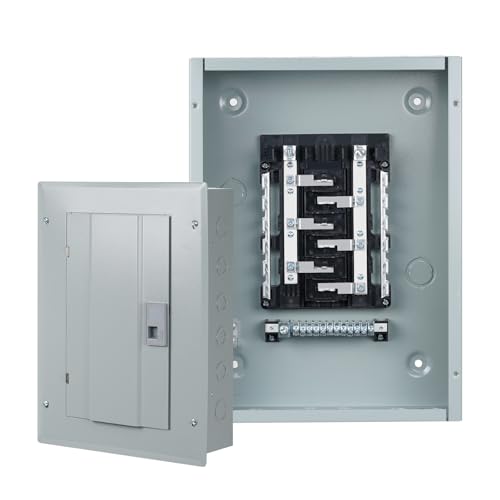
For homeowners tackling a mid-sized rewire, the twelve-space THQL sits in a sweet spot that doesn’t leave you breaker-hungry or paying for circuits you’ll never use. 125A is a comfortable capacity for many light-commercial and larger residential setups, supporting 120V/240V distribution through a main lug configuration (a wiring setup where the panel connects to a separate upstream breaker rather than housing its own disconnect).
The NEMA 1 steel enclosure is an indoor-rated design, meaning it’s built to keep fingers and falling debris out but isn’t sealed for wet locations. In a dry basement or utility room, that tradeoff is exactly what you want: rugged without overkill.
Real-World Strengths
- Twelve spaces give breathing room for kitchen, bath, and addition circuits.
- Steel NEMA 1 enclosure holds up to dust and casual contact.
- 125A rating covers most light-commercial and large-home loads.
- Main lug setup allows flexible upstream breaker configuration.
Worth Noting
- Indoor-rated only, so it can’t sit on an exterior surface.
- Lacks UL approval stamp, which some inspectors may flag.
- Heavier than plastic alternatives, plan a wall stud or backing.
Best Suited To
Homeowners rewiring mid-sized properties who need a dozen circuits and aren’t installing in a damp environment.
Skip It When
The Square D Homeline 100A Indoor 24-Space Panel is the smarter pick if you want UL Listing and room for future expansion.
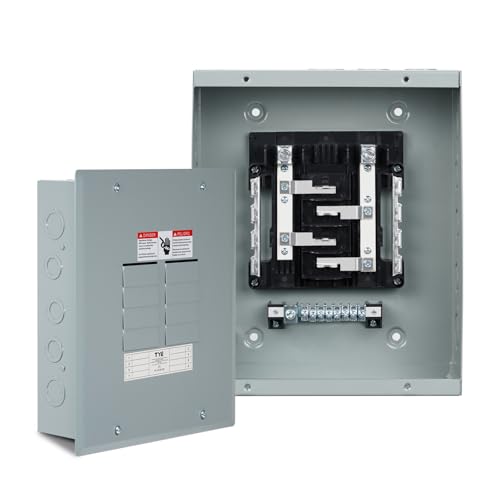
The eight-space variant feels right-sized for a garage sub-panel or a modest addition, where the full twelve-space unit would just leave empty breaker slots you paid for. Same 125A rating carries over, so capacity isn’t the limiting piece, breaker count is. You give up future expansion room, which is the honest trade-off.
Like the larger sibling, this is an indoor NEMA 1 steel box that doesn’t want to live on a damp exterior wall. The main lug configuration keeps the wiring side flexible for upstream disconnects.
Practical Advantages
- Eight spaces hit a comfortable size for most garage sub-panel needs.
- Steel enclosure offers real durability against bumps and contact.
- 125A capacity matches the larger THQL models.
- Footprint stays modest on the wall, leaving room for storage nearby.
Points To Note
- Not UL Listed, so check local inspection expectations.
- Fewer slots mean less room to grow into.
- Indoor rating only, no outdoor mounting.
Feature Rundown
Whose Shelf It Belongs On
Garage workshops and addition projects where eight circuits comfortably covers lights, outlets, and a small appliance circuit.
Consider Something Else When
The THQL 12-Space 125A Indoor Load Center is a smarter buy for homeowners who expect to add circuits in the coming years.
Most folks don’t actually need a four-space panel for their primary home, but as a shed sub-panel or detached workshop feeder, the 4-space THQL punches well above its weight. 125A of capacity through just four circuits means each one can be a high-amperage branch, perfect for a small workshop feeder or a welder circuit in an outbuilding.
The catch is that there is no UL approval stamp here, which I’ll mention because it’s the first thing a strict inspector asks about. For DIY outbuildings on private property, this is usually a non-issue.
What Makes Sense
- Compact body fits in sheds and small utility rooms.
- 125A headroom leaves each branch free to handle heavy loads.
- Steel enclosure costs less than fancy plastics and lasts.
- Main lug design adapts to common upstream disconnects.
Room For Improvement
- No UL approval, so double-check local code acceptance.
- Only four circuits, so expansion requires swapping the whole panel.
- Indoor-rated NEMA 1 only.
Made For
Shed, barn, or workshop sub-panel use where four circuits comfortably covers lights, outlets, and a single appliance.
Another Choice May Suit
The Square D Homeline 100A Outdoor Load Center is the smarter match if the box will live on an exterior wall and needs weather resistance.
Square D’s Homeline is the panel most electricians reach for when an outdoor disconnect matters, and the HOM612L100RBCP version delivers that pedigree in a manageable six-space package. The NEMA 3R enclosure (a rainproof rating that handles rain, sleet, and ice) is the headline feature: this box lives on an exterior wall without complaint, even on the side of a garage that takes direct weather. The tin-plated aluminum bus bar and welded steel enclosure are built to last decades.
Six circuits will feel tight for whole-home use, but as a detached garage feeder or outbuilding sub-panel, it carries the load comfortably. UL Listing makes it inspector-friendly across most jurisdictions.
Features That Help
- NEMA 3R rainproof enclosure tolerates direct weather exposure.
- Tin-plated aluminum bus bar resists corrosion over years of service.
- Welded sheet steel construction stands up to physical wear.
- UL Listing smooths the path through electrical inspection.
- Square D Homeline is a widely supported breaker ecosystem.
Honest Caveats
- Six spaces limit how many circuits you can land.
- 100A capacity caps total load for larger outbuildings.
- Heavier than plastic enclosures, plan mounting hardware accordingly.
Quick Facts
Who Will Love This
Detached garage and outbuilding owners who want a brand-name outdoor panel with broad breaker compatibility.
A Better Fit Elsewhere
The Siemens TL137US Talon Temporary Power Outlet Panel is the better match if you need receptacles already mounted rather than a breaker sub-panel.
This is the more affordable sibling in the JINDOUZI outlet-box family, and it targets light-duty shop use where you want metered power without paying for high-amperage capacity you won’t use. The 80A meter circuit handles smaller shop loads comfortably, and four NEMA 5-20 outlets cover the usual mix of power tools and chargers.
The ABS plastic shell and IP54 outer rating deliver the same dust and splash protection as the more expensive box, which is a real plus for shops that aren’t climate-controlled. The trade-off is amperage headroom and the same professional-installation requirement that comes with metered setups.
The Good Stuff
- Built-in electricity meter at a friendlier price tier.
- ABS plastic body stays light and corrosion-resistant.
- Four IP44-protected outlets for typical shop tools.
- IP54 outer rating tolerates dust and water splash.
Worth Bearing In Mind
- 80A capacity may bottleneck larger tool collections.
- Professional installation required for the metered feed.
- ABS plastic, while tough, won’t take the same abuse as steel.
Perfect Match For
Light-duty shop owners and home garages running smaller tool collections who want metered power without high-amperage expense.
Reach For A Different Pick When
The JINDOUZI Power Distribution Box 110V with Meter is a smarter buy if your shop regularly pulls more than 80A across tools.
The wall-mount version of the JINDOUZI distribution box is for shops where floor space is sacred and the panel needs to live flat against a wall. The form factor matches the metered 60A box, so the four NEMA 5-20 outlets and IP54 protection carry over. The difference is the wall-mount body, which makes sense in tight garage bays where a free-standing box would be in the way.
Same caveat applies: the metered feed and 60A main require a licensed electrician for the install, which adds to the project but isn’t unusual in the category.
Good Reasons To Consider
- Wall-mount body saves floor space in tight shop layouts.
- Four IP44 outlets cover typical shop tool counts.
- ABS plastic shell keeps the unit light and corrosion-resistant.
- IP54 rating handles splashes and dust on the shop wall.
Points To Keep In Mind
- Same 60A cap as the comparable metered JINDOUZI box.
- Wall-mount install needs secure backing or stud anchoring.
- Professional electrician required for the metered feed.
Specs Overview
Who Should Grab It
Tight-shop owners where the box needs to mount flat against a wall and free up valuable floor square footage.
Where A Sibling Pick Shines
The Square D Homeline 100A Outdoor Load Center wins for outdoor applications since the JINDOUZI is meant for sheltered walls.
This is the Talon with the 125A main breaker built in, and that one feature changes how the panel fits into a site. Instead of relying on an upstream disconnect, the panel handles its own 125A main protection, which streamlines installation on RV pedestals and long-term jobs where the panel stands alone.
Same three-receptacle layout as the unmetered Talon: a 20A, 30A, and 50A, all preinstalled. Owners commonly rely on this combination for RV parks where multiple amperage tiers serve different coaches on the same loop.
What It Does Well
- Built-in 125A main breaker eliminates the need for a separate upstream disconnect.
- Three preinstalled receptacles cover common amperage needs.
- UL Listing supports code-compliant installation.
- Outdoor-rated aluminum body tolerates exposed mounting.
Practical Considerations
- Heavier and bulkier than the unmetered Talon variant.
- Unmetered design means no consumption tracking.
- Best suited to RV and long-term site layouts, not portable use.
Right Fit For
RV park owners and contractors running long-term job sites who need a self-contained panel with built-in main protection.
Swap It Out When
The Square D Homeline 100A Indoor 24-Space Panel is the better choice for permanent residential service upgrades.
For whole-home rewires, the Homeline 24-space panel is one of the more popular choices for good reason. Twenty-four spaces supporting 48 circuits give you serious headroom for a kitchen remodel, an EV charger addition, or a finished basement, all without swapping the panel. The plug-on neutral design (a bus bar configuration that snaps breakers directly onto a neutral rail, eliminating the pigtail wire) saves install time and reduces wiring clutter.
The baked enamel gray coating and welded steel enclosure are built for decades of indoor service. UL Listing and the Square D breaker ecosystem keep parts and inspection paperwork easy across the panel’s life.
The Practical Payoff
- 24 spaces and 48-circuit capacity for large home rewires.
- Plug-on neutral design speeds installation and reduces wiring mess.
- Welded sheet steel enclosure with baked enamel gray coating.
- UL Listed and broadly accepted by inspectors.
- Square D Homeline breakers are widely stocked.
Trade-Offs To Consider
- Indoor rating only, so no outdoor mounting without a separate enclosure.
- 100A main may be undersized for very large all-electric homes.
- Heavier and bulkier than smaller sub-panels.
Key Attributes
Who It Suits Best
Homeowners doing whole-house rewires or service upgrades who want ample circuit headroom from a brand-name panel.
Not Your Match When
The Siemens TL137US Talon Temporary Power Outlet Panel is the better fit if you need receptacles rather than a residential breaker panel.
What Matters Most Before Choosing Boxes With Breaker
Start with where the box will live, because indoor NEMA 1 and outdoor NEMA 3R enclosures aren’t interchangeable, and forcing an indoor panel onto a porch invites trouble. For jobsites and RV pedestals, an outdoor-rated panel with a padlock-compatible cover makes daily life easier and inspection paperwork simpler. For shop floors and home interiors, an indoor NEMA 1 steel box offers plenty of protection at lower cost.
Next, match amperage to your real load, not your worst-case daydream. A 60A or 80A distribution box covers most home-shop tool collections, while a 125A load center supports whole-home or light-commercial service. Breaker space count is the third lever: count the circuits you need today, then add two or three for future room additions, EV chargers, or finished basements. Buying one tier up on space is cheaper than swapping the whole panel in five years.
UL Listing and NEMA ratings matter most when an inspector will see the install. Private outbuilding work tolerates more flexibility, but residential service upgrades and commercial jobs usually require listed equipment. Match the breaker brand to the panel brand where possible, since mixing ecosystems can complicate parts sourcing later.
Key Considerations Across These Picks
Pitfalls Shoppers Hit
The most common mistake is choosing a panel based on amperage alone and ignoring breaker space count, which forces an early replacement when the first room addition lands. Another is buying an indoor-rated box for a damp exterior wall and discovering moisture intrusion the first hard rain. Match the NEMA rating to the actual environment.
Where The Extra Money Goes
Premium panels earn their cost through UL Listing, larger breaker ecosystems, and tougher enclosures like welded steel with baked enamel finishes. The upgrade pays off when inspectors are involved, when the panel will live through decades of service, and when breaker replacement parts need to stay available. For temporary light-duty use, the budget tier delivers what most people actually need.
Frequently Asked Questions
What is a NEMA rating and why does it matter?
A NEMA rating describes how well an enclosure keeps solids and liquids out. NEMA 1 is indoor-rated against dust and contact, while NEMA 3R adds rainproofing for outdoor walls. Choosing the right rating prevents moisture damage and inspection failures.
Can I install a breaker panel myself?
Most jurisdictions require a licensed electrician for service-entrance and metered work, especially anything pulling from a 60A or higher feed. Sub-panel installs after an existing main panel may be more flexible, but local code still rules. When in doubt, check with your inspector before opening a panel.
How many circuits do I need in a home panel?
Most modern homes use 20 to 30 active circuits, so a 24-space panel covers a typical rewire with room to grow. Count major loads like kitchen appliances, HVAC, water heater, dryer, and EV charger first, then add general lighting and outlet circuits to estimate your minimum.
What is a main lug load center?
A main lug load center connects to a separate upstream breaker rather than housing its own main disconnect. This setup is typical for sub-panels fed from a larger service panel, where the upstream breaker handles overcurrent protection for the whole run.
How do plug-on neutral panels differ from standard panels?
Plug-on neutral panels accept breakers that snap directly onto an integrated neutral bus bar, eliminating the pigtail connection that older panels require. This design simplifies wiring, reduces installation time, and produces a tidier breaker lineup inside the enclosure.
Bottom Line
The right box with breaker depends on whether you’re running temporary jobsite power, feeding an outbuilding, or upgrading a residential service. Match NEMA classification to the environment, count your circuits with future growth in mind, and lean on UL Listed options whenever an inspector will see the work. Pick from the ten above based on those three filters, and you’ll end up with gear that fits both today’s project and tomorrow’s.
