

A bench power supply quietly becomes the most-used tool in any electronics workspace. Hobbyists building Arduino projects, ham radio operators running mobile rigs, and repair techs reviving laptop boards all reach for the same thing: a clean, controllable DC source. I put this list together for anyone setting up a home lab, replacing a tired old transformer-style unit, or stepping up from a fixed 12V wall wart to something genuinely adjustable.
A Side-By-Side Look

Jesverty SPS-50II 50A Bench Power Supply
BTECH RPS-30PRO 30A Bench Power Supply

Pyramid PS9KX 5A Linear Bench Power Supply

SKY TOPPOWER 0-30V 0-10A Bench Power Supply

WANPTEK 0-32V 0-10A Bench Power Supply
WANPTEK 30V 10A Bench Power Supply
SKY TOPPOWER 0-60V 0-5A Lab PSU
SKY TOPPOWER 0-30V 0-5A Bench Power Supply

Hyelec 30V 5A Switching Bench Power Supply

WANPTEK 0-30V 0-10A Bench Power Supply
A Deeper Look At The Lineup
The Jesverty SPS-50II sits at the top of the lineup for sheer current output, and that alone changes who it suits. It converts standard AC wall power into a regulated DC output that can swing anywhere from 9 to 15 volts, with a fixed 13.8V mode that mirrors what mobile radios expect to see from a vehicle electrical system.
For ham operators running a 100-watt HF rig, CB base stations, or any load that pulls hard for long sessions, the 50-amp headroom removes the usual worry about tripping a smaller supply. The screw-type main terminals handle thick gauge wire without fuss, and an internal cooling fan keeps temperatures sensible under sustained draw. Compared to the BTECH unit that follows, this one trades accessory variety for raw current capability.
Real Benefits
- 50-amp capacity covers most home-shack radio setups without derating.
- Fixed 13.8V mode matches automotive voltage expectations for mobile equipment.
- Cooling fan manages heat so output stays stable during long transmissions.
- Screw-type terminals accept heavier wire gauges cleanly and securely.
Trade Offs To Consider
- Bulkier chassis than lower-current units, so smaller desks may feel crowded.
- Front panel is functional rather than refined, which may bother cosmetic-minded shoppers.
Who It Suits Best
Radio operators and electronics hobbyists running high-draw DC loads that smaller bench supplies simply cannot feed reliably.
Skip It When
The BTECH RPS-30PRO is a tighter match for anyone who prioritizes connector variety and a more compact footprint over peak current.
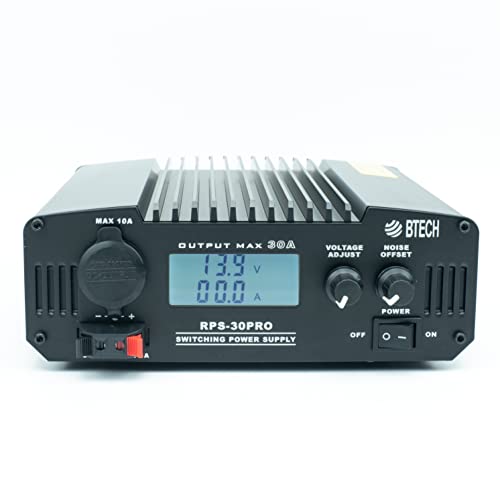
BTECH built the RPS-30PRO around the realities of a working two-way radio bench. Where the Jesverty focuses on raw current, this one offers flexibility at the connection point: cigarette plug, screw-type terminals, and snap-in terminals all share the front face.
The output adjusts from 9 to 15 volts or locks at 13.8V for radio work, and a noise-offset adjustment helps shift switching artifacts away from frequencies that matter for receive sensitivity. CB, ham, GMRS, and LMR operators can plug straight in without adapter cables scattered across the bench. Compared to the Pyramid that follows, this supply trades low cost for more polish and far better connectivity.
The Good Stuff
- Three connector styles remove the need for adapter clutter on a busy bench.
- Noise-offset adjustment reduces interference on sensitive receive frequencies.
- 30-amp rating handles most mid-power mobile radios with margin to spare.
- Fixed 13.8V mode mirrors a running vehicle electrical system accurately.
Honest Caveats
- Cooling fan noise is noticeable in a quiet room, depending on placement.
- Snap-in terminals suit specific plug footprints, which may not fit every accessory.
Made For
Two-way radio enthusiasts running CB, ham, GMRS, or LMR gear who want one supply that connects to anything on the bench.
A Better Fit Elsewhere
The Jesverty SPS-50II is the right call for radio operators whose loads pull more than 30 amps sustained.
The Pyramid PS9KX takes the long road through a linear regulation stage instead of a switching converter, and that choice shows up in the noise profile. Linear supplies produce very clean DC with minimal high-frequency hash, which matters when powering sensitive audio or radio circuits.
At 5 amps and a fixed 13.8V DC output, this unit targets lighter workloads like mobile radio bench testing, CB setups, and small hobby projects. The included cigarette lighter receptacle accepts car-style plugs, and a universal screw terminal pair covers everything else. Where the BTECH offers 30 amps and extra connectors, the Pyramid trades capacity for cleaner output at a friendlier entry cost.
Strong Points
- Linear regulation produces low-noise DC output, ideal for audio and radio work.
- Cigarette plug and screw terminals cover common radio and hobby connections.
- Fixed 13.8V matches vehicle systems for mobile-equipment testing.
- Simple electronic plug-in operation suits first-time bench supply owners.
Less Ideal Details
- 5-amp ceiling rules out anything beyond light-duty 12V loads.
- Linear design runs warmer and heavier than switching alternatives at similar output.
Who Will Love This
Hobbyists and radio operators on a tight budget who need a quiet, reliable 12V-class source for light loads.
Consider Something Else When
The SKY TOPPOWER 30V 10A unit is a smarter buy for anyone stepping up to general electronics repair and prototyping.
Stepping away from fixed-voltage supplies, the SKY TOPPOWER 30V 10A opens up a wide adjustment range that mirrors what most lab-grade units offer. It runs from 0 to 30 volts and 0 to 10 amps with a four-digit LED readout that resolves down to 10 mV and 1 mA increments.
That level of precision matters when charging battery packs at specific absorption voltages, dialing in LED driver circuits, or troubleshooting phone motherboard rails. Coarse and fine adjustment knobs keep changes from overshooting the target value. Unlike the Pyramid, which is locked at 13.8V, this supply handles nearly any DC rail a hobbyist is likely to encounter.
Advantages To Know
- Full 0–30V range covers most analog and digital hobby circuits comfortably.
- 10 mV and 1 mA display resolution enables precise tuning for sensitive loads.
- Coarse and fine knobs prevent accidental overshoot when setting precise values.
Points To Keep In Mind
- Cooling fan runs whenever the unit is under load, which some find distracting.
- Front binding posts suit banana plugs but require care with bare-wire connections.
Best Suited To
Electronics hobbyists and repair techs who need one supply that spans hobbyist circuits from 3V logic up to 24V motor drivers.
Look Elsewhere When
The WANPTEK 0-32V 0-10A is worth considering if memory presets and USB-C charging matter more to the setup.
The WANPTEK 0-32V 0-10A leans hard into repeatability, which makes it a favorite on repair benches where the same voltage is dialed in dozens of times a day. Three memory presets (M1, M2, M3) store voltage and current values, so a tech can jump between common rails without re-spinning the encoder knob every time.
Overcurrent protection (OCP) trips the output when the load exceeds the set current, protecting the device under repair from catastrophic mistakes. A USB-A port adds fast charging for phones and tablets used as test equipment. Compared to the SKY TOPPOWER 30V unit, this one trades a slightly higher voltage ceiling for memory presets and a charging port.
Noteworthy Benefits
- Three memory slots speed up repeat workflows on busy repair benches.
- OCP safeguards sensitive devices from accidental overcurrent conditions.
- USB-A fast-charge output powers phones and tablets without a separate charger.
- Encoder knob allows digit-by-digit value entry for more precise adjustments.
Practical Considerations
- OCP trigger threshold takes practice to set correctly for varying loads.
- Front panel density may overwhelm first-time users on day one.
Who Should Grab It
Repair technicians and serious hobbyists who cycle through the same voltage rails repeatedly and value one-touch recall.
Reach For A Different Pick When
The SKY TOPPOWER 0-60V 0-5A is a smarter fit for projects requiring voltages above 32V.
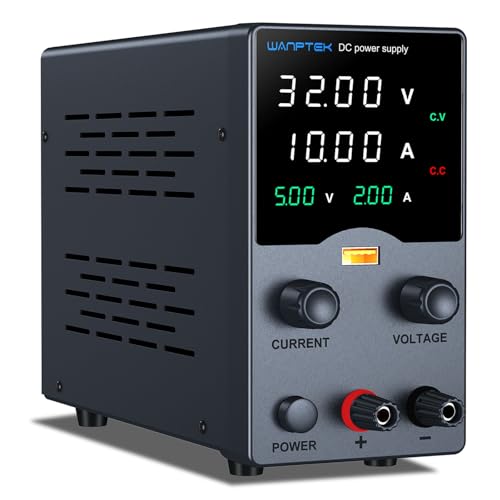
This WANPTEK sibling to the 32V model dials things in tighter rather than wider. The encoder knob replaces the traditional potentiometer, letting users press to select a digit and rotate to set the value, almost like editing a number on a calculator.
A four-digit LED display shows real-time output, and a USB fast-charge port handles phones or test gear that needs topping up mid-job. The 30V ceiling is enough for almost any hobby rail, and 10 amps of headroom covers LED arrays, motor testing, and battery simulation. Where the 32V model adds memory storage, this one focuses purely on the precision of the dial.
Strengths Worth Knowing
- Encoder knob offers digit-by-digit value entry, reducing the odds of overshoot.
- USB fast-charge port saves bench space by replacing a dedicated charger.
- Real-time display readout tracks output changes immediately as knobs turn.
Worth Bearing In Mind
- No memory presets mean returning to common values requires manual readjustment.
- 30V ceiling limits use on circuits that need a 36V or higher rail.
The Right Fit
Hobbyists and repair techs who value dial precision over memory presets and want a fast-charge port built in.
Not Your Match When
The WANPTEK 0-32V 0-10A is a better pick for anyone who relies on stored presets across multiple test routines.
The 0-60V ceiling on this SKY TOPPOWER is what sets it apart from every other entry on the list. Most lab supplies cap out at 30V, which is fine for logic and motor work, but vacuum tube circuits, certain LED strings, and some telecom gear live well above that line.
To hit 60V safely, the unit includes leakage protection, thermal protection, voltage overload, current limiting, short circuit protection, and anti-reverse connection protection. A ground terminal adds a safety reference for test setups. Compared to the WANPTEK 32V unit, the trade is clear: this one gives up half the current capacity to double the voltage ceiling.
The Helpful Details
- 0–60V range unlocks tube, telecom, and high-voltage LED string work.
- Thermal and overload protections reduce risk during long-duration tests.
- Anti-reverse connection protection prevents damage from reversed leads.
Soft Spots
- 5-amp ceiling rules out projects that need both high voltage and high current.
- Cooling fan activates often at higher outputs, adding ambient noise.
Whose Shelf It Belongs On
Specialty hobbyists working with vacuum tubes, telecom gear, or any circuit requiring voltages above the standard 30V ceiling.
Swap It Out When
The SKY TOPPOWER 0-30V 0-10A is a more practical daily driver for general electronics repair work.
The lower-current sibling of the SKY TOPPOWER 30V 10A trades raw amperage for a friendlier price and the same 0-30V range. Five amps covers most beginner projects, Arduino and Raspberry Pi prototyping, and small motor or sensor testing without drama.
A backlit four-digit LED display stays readable across a workshop, and the segmented screen shows voltage and current simultaneously. Coarse and fine knobs keep adjustments smooth. This is the supply I would hand to a student or first-time hobbyist; it has just enough range without overwhelming controls. The Hyelec unit that follows adds data hold and similar precision but in a different package.
The Upside
- Backlit display stays readable in workshop lighting and at awkward angles.
- Coarse and fine knobs reduce the chance of overshoot when setting values.
- 0–30V range covers most beginner electronics builds from logic to small motors.
Some Limits To Know
- 5-amp ceiling rules out charging larger battery packs or running bigger motors.
- Switching supply noise is slightly higher than linear alternatives like the Pyramid.
Perfect Match For
Beginners and students setting up a first electronics bench for Arduino, Raspberry Pi, or small sensor projects.
Another Choice May Suit
The SKY TOPPOWER 0-30V 0-10A is worth stepping up to if any future project might pull more than 5 amps.
The Hyelec 30V 5A focuses on stability and repeatability, which is what repair techs actually need during long diagnostic sessions. The display reads to 0.01V and 0.01A, and a data-hold function freezes the readout when both knobs are pressed simultaneously for three seconds, useful for jotting down readings mid-test.
The encoder knob switches between coarse and fine adjustment, so quick jumps and tiny tweaks share the same control. Bundled 110V alligator leads connect straight to project boards or test fixtures. Compared to the SKY TOPPOWER 30V 5A, this one adds the data-hold feature and a slightly more refined adjustment knob for the same voltage and current window.
A Strong Showing
- Data-hold function freezes readings for note-taking during long diagnostics.
- Encoder knob switches between coarse and fine adjustment with one control.
- 0.01V and 0.01A resolution supports precision bench measurements.
Honest Caveats
- Switching topology introduces slightly more output ripple than linear supplies.
- 5-amp ceiling limits use for any load requiring sustained higher current.
Built With In Mind
Repair technicians and serious hobbyists who value stable readings and the ability to lock a value on screen for documentation.
Not Your Match When
The SKY TOPPOWER 0-30V 0-10A is a better choice for projects that demand higher sustained current.
This WANPTEK rounds out the lineup with the broadest everyday feature set. The encoder knob handles coarse and fine tuning, OCP trips on overcurrent events to protect delicate loads, and a four-digit high-definition display shows values clearly.
USB and Type-C quick-charge ports handle 3.6A of combined output, useful for topping up phones, test tablets, or USB-powered tools during a session. Short-circuit alerts add another layer of protection when probing unfamiliar circuits. Compared to the WANPTEK 32V model earlier in the list, this one offers similar protection features but in a tighter, more travel-friendly package suited for mobile repair setups.
Everyday Advantages
- OCP plus short-circuit alerts protect delicate boards from accidental damage.
- USB and Type-C quick-charge ports replace a separate bench charger.
- Encoder knob combines coarse and fine adjustment into a single control.
Points To Weigh
- Quick-charge port shares current with the main output under heavy load, depending on setup.
- Protection alerts require some learning to interpret correctly across different loads.
Right Fit For
Mobile repair techs and hobbyists who want a full-featured supply that doubles as a USB charging hub on a crowded bench.
A Better Fit Elsewhere
The BTECH RPS-30PRO is worth a look for radio operators who need cigarette and snap-in connectors for two-way gear.
Picking The Right Bench Supply Without Regret
A bench power supply earns its place by being ready when you reach for it, so the spec sheet matters more than the price tag. Voltage range is the first filter: most hobby circuits live between 3.3V and 24V, which a 0-30V supply covers easily. Projects involving vacuum tubes, telecom gear, or long LED strings may need 0-60V. Current comes next, and most beginners find 5 amps comfortable while repair techs benefit from 10 amps of headroom.
Regulation type shapes how clean the output is. Linear regulation (like the Pyramid PS9KX) produces low-noise DC but runs heavy and warm. Switching supplies (most of this list) are lighter, cooler, and more efficient, with a touch more ripple that rarely matters outside sensitive audio or RF work. Connector options matter more than they seem; a supply with cigarette, screw, and snap-in terminals saves adapter clutter.
Display resolution and knob feel determine daily comfort. A four-digit LED readout resolves to 10 mV or better, which is plenty for most builds. Coarse and fine knobs, or encoder knobs with digit selection, prevent overshoot when dialing in precise values. Memory presets and OCP feel like luxuries until you actually use them on a repair bench.
Key Considerations Across These Picks
Pitfalls Shoppers Hit
A surprisingly common mistake is choosing a fixed 13.8V supply for general hobby work and then needing variable voltage a month later. Another trap is underestimating current draw; a 5-amp supply feels fine until a battery simulation or motor test pulls it into current-limit. Buyers also overlook connector variety and end up buying adapters that defeat the purpose of a clean bench.
When Paying More Pays Off
The jump from a basic fixed-voltage supply to a fully featured 0-30V unit with encoder knobs, memory presets, and OCP pays off the moment a repair goes sideways. Overcurrent protection alone can save a board worth many times the supply’s cost. For someone working on phones, laptops, or radio gear daily, the higher tier earns its keep through avoided mistakes and faster repeat workflows.
Frequently Asked Questions
What is an adjustable DC power supply used for?
An adjustable DC power supply converts AC wall current into a controllable DC voltage and current source for testing, prototyping, and repairing electronics. Hobbyists use them to power circuits at specific voltages, while repair techs rely on them to simulate battery and rail conditions.
What is the difference between linear and switching bench supplies?
Linear supplies regulate output through a transformer-and-transistor stage, producing very clean DC with low ripple but running heavier and warmer. Switching supplies use high-frequency conversion, making them lighter, cooler, and more efficient, with slightly more output noise that rarely affects digital or hobby work.
How much current do I need from a bench supply?
Most beginner projects draw under 3 amps, while motor testing, LED arrays, and battery simulation often pull 5 to 10 amps. Ham radio operators running mid-power transceivers typically want 30 amps or more for headroom during long transmissions.
Can I use a bench supply to charge batteries?
Bench supplies with adjustable voltage and current limiting can charge batteries, though dedicated chargers usually include battery-specific safety stages. Setting the supply to the battery’s absorption voltage and current-limit value produces a slow, controlled charge suitable for lead-acid and many lithium packs.
What is overcurrent protection on a bench supply?
Overcurrent protection, or OCP, automatically cuts or limits the output when the connected load draws more current than the set limit. It protects both the supply and the device under test from damage during shorts or wiring mistakes, and is increasingly common on mid-range and higher units.
Closing Remarks
A good bench supply fades into the background of a workspace until the moment you need precise voltage, clean current, and reliable connections, and then it becomes the most important tool on the shelf. The right pick depends on whether the bench leans toward radio gear, microcontroller prototyping, phone repair, or specialty high-voltage work. Match the voltage range, current headroom, and connector layout to the projects already on the bench, and the supply will earn its keep for years.
