Are you tired of relying on utility companies for your cabin’s energy? An off-grid solar system can give you the freedom you crave. With this setup, you can enjoy independence from the grid, especially in remote areas where access is tough. Plus, if the power goes out, your system keeps running, ensuring you stay powered up.
Here are some key benefits of off-grid solar systems:
Benefit | Description |
|---|---|
Independence from utility companies | Off-grid systems allow users to be completely independent from utility providers. |
Functionality in remote areas | They can power properties in locations where grid access is limited or too expensive. |
Resilience during outages | These systems provide energy even when the grid is down, ensuring continuous power supply. |
Control over energy usage | Users have greater control over their energy consumption and system performance. |
So, let’s dive into how you can set up your own off-grid solar system!
Power Needs
Calculate Energy Load
To set up your off-grid solar system, you first need to understand your energy needs. Start by calculating your total daily energy consumption. Here are two effective methods to do this:
Check Your Electric Bills: Look at your electricity bills from the past year. Find the month with the highest usage, divide that total kWh by 30 to get the daily average, and then add a 20% safety buffer. This gives you a solid baseline.
Manual Appliance Calculation: For a more hands-on approach, calculate the daily energy consumption of each appliance. Use this formula:
Daily Energy (kWh) = Power (W) × Hours ÷ 1,000This method helps you understand how much energy each device consumes.
Determine Usage Patterns
Next, consider how your energy usage changes throughout the year. Seasonal variations can significantly impact your energy needs. For instance, winter months often increase heating loads, which can triple your electricity demand in colder climates. Conversely, summer heat waves can spike cooling demands while reducing battery efficiency.
Here’s a quick look at how solar production varies by month:
Month | Solar Production (kWh/m²/day) |
|---|---|
December | 1.2 |
July | 6.8 |
Additionally, short winter days increase your lighting needs. By understanding these patterns, you can better plan your solar system to meet your cabin’s energy demands throughout the year.
By calculating your energy load and recognizing your usage patterns, you’ll be well on your way to designing an efficient off-grid solar system tailored to your needs. 🌞
Choose Components
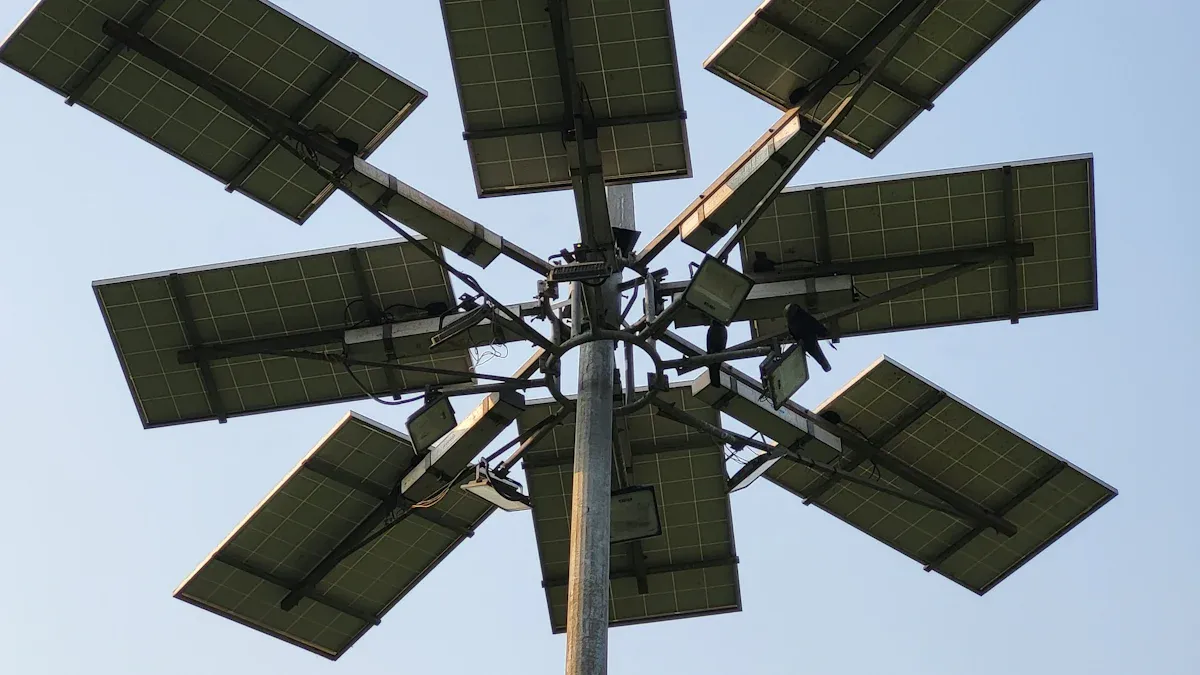
When you design an off-grid solar system, selecting the right components is crucial. Each part plays a significant role in ensuring your system runs efficiently and meets your energy needs. Let’s break down the key components you’ll need to consider.
Solar Panels
Your solar panels are the heart of your off-grid solar system. They convert sunlight into electricity, so choosing the right ones is essential. Here are some factors to consider when you select your solar panels:
Assess Your Energy Requirements: Calculate your daily energy consumption and list the appliances you plan to power.
Evaluate Your Property’s Solar Potential: Check how much sunlight your location receives. Look for shading from trees or buildings that might affect performance.
Select Appropriate System Components: Choose panels that match your energy needs and budget.
Plan for Backup Power: Consider additional power sources for days with low sunlight.
Budget for Installation and Maintenance: Factor in both initial costs and ongoing maintenance.
Ensure Regulatory Compliance: Research local regulations and obtain any necessary permits.
Consider Professional Installation: Weigh the pros and cons of hiring experts versus doing it yourself.
Plan for Future Expansion: Design your system to accommodate potential growth.
Batteries
Batteries store the energy your solar panels generate, allowing you to use it when the sun isn’t shining. When you select your battery, consider these key points:
Feature | Lithium-Ion Batteries | Lead-Acid Batteries |
|---|---|---|
Energy Density | Higher energy density, lighter and smaller | Lower energy density, bulkier |
Charging Rate | Faster charging, can handle higher charge rates | Slower charging, can overheat if charged too quickly |
Maintenance | Virtually maintenance-free | Requires regular maintenance |
Cost | Higher upfront cost, lower total cost of ownership | Lower upfront cost, higher long-term costs |
Lifespan | Longer lifespan | Shorter lifespan |
Depth of Discharge | Greater depth of discharge | Limited depth of discharge |
Efficiency | Higher efficiency | Lower efficiency |
Safety | Safer chemistry (LiFePO4) | Toxic materials, risk if not disposed of properly |
For most off-grid applications, lithium-ion batteries are becoming popular due to their efficiency and longevity. However, lead-acid batteries can be a more budget-friendly option if you’re willing to manage their maintenance.
Charge Controllers and Inverters
Charge controllers and inverters are vital for managing the flow of electricity in your system.
Charge Controllers: They regulate the voltage and current coming from your solar panels to prevent overcharging your batteries. You can choose between PWM (Pulse Width Modulation) and MPPT (Maximum Power Point Tracking) controllers. MPPT controllers are more efficient, often increasing energy capture by 20-30%. This efficiency helps maintain battery health and prolongs lifespan.
Inverters: These devices convert the DC electricity stored in your batteries into AC electricity, which most household appliances use. When you choose an inverter, keep these criteria in mind:
Calculate Your Energy Needs: Determine the total wattage you need, considering peak usage times.
Assess Your Solar Panel Output: Evaluate the DC power production of your panels.
Choose an Appropriately Sized Inverter: Ensure it can handle peak power and matches your solar panel output.
Allow for Future Expansion: Select an inverter that can grow with your system.
Efficiency: Look for high-efficiency ratings.
Compatibility: Ensure it works well with your solar panels and batteries.
Durability and Warranty: Opt for reputable brands that offer warranties.
Monitoring and Control Capabilities: Advanced features can help you manage your system effectively.
Certifications and Compliance: Verify that it meets safety standards in your area.
By carefully selecting your solar panels, batteries, charge controllers, and inverters, you can create a reliable and efficient off-grid solar system that meets your cabin’s energy needs.
Install My Own Off-Grid Solar System

Setting up your own off-grid solar system can be an exciting project! You have two main options: DIY installation or hiring a professional. Each choice has its own benefits and challenges. Let’s explore both paths so you can decide which one suits you best.
DIY Installation
If you’re the hands-on type, building your own off-grid solar system can be a rewarding experience. Here’s a step-by-step guide to help you through the installation process:
Set Up Your Solar Panels: Start by placing your first solar panel on the UFO mounts. Slide two more panels into the track until they touch the top of the first panel.
Secure the Panels: Tighten the UFO mounts to the correct torque. This ensures stability without damaging the panels.
Group Your Panels: Connect five solar panels in series. This setup optimizes voltage and reduces amp transfer, allowing for smaller wiring.
Calculate Total Output: Each 240W panel in series produces 1200 Watts, 186 Volts, and 8 Amps.
Connect Arrays in Parallel: This creates a 7200W, 186V, 50A system.
Gather Wiring and Connectors: Purchase about 300 feet of 10 AWG PV Wire and 24 MC4 Connectors.
Choose Combiner Boxes: Select appropriate combiner boxes based on voltage and amperage. Ensure they are weatherproof and equipped with lightning arrestors.
Mount Combiner Boxes: Secure them using pipe clamps and plywood.
Trench for Conduit Runs: Begin trenching, considering the length and amp capacity of the wires used.
While DIY installation can save you money, it’s essential to follow safety precautions. Here are some key measures to keep in mind:
Safety Measure | Description |
|---|---|
Electrical safety measures | Install fuses and circuit breakers to protect against overcurrents and short circuits. |
Proper grounding | Ground all equipment with rods and/or lightning arrestors to protect against electrical faults. |
Safe battery chemistry | Use lithium iron phosphate (LFP) batteries for their stability and safety compared to lead-acid. |
Secure mounting of panels | Ensure panels are securely mounted to prevent them from becoming projectiles in high winds. |
Regular maintenance | Clean panels and inspect cables for wear to maintain system efficiency and safety. |
Install thermal sensors | Use sensors to prevent overheating and potential fire hazards in batteries. |
Professional Installation
If you prefer to leave the installation to the experts, hiring a professional can be a great choice. Professionals bring experience and knowledge that can save you time and reduce risks. Here are some advantages and disadvantages of going this route:
Aspect | DIY Installation | Professional Installation |
|---|---|---|
Pros | Cost savings, learning opportunity, flexibility | Expertise, time efficiency, reduced risk, warranties |
Cons | Skill requirements, time-consuming, potential risks | Higher costs, scheduling issues, less personal control |
When you hire a professional, look for someone with the right qualifications. They should have:
NABCEP certification for PV installation professionals
Training in the installation and design of solar PV systems
Expertise in grid-tied and off-grid systems
By weighing the pros and cons of DIY versus professional installation, you can make an informed decision that fits your needs and comfort level. Whether you choose to install your own off-grid solar system or hire a professional, you’ll be one step closer to enjoying energy independence at your cabin!
Cost Considerations
Initial Costs
When you decide to install an off-grid solar system, understanding the initial costs is crucial. Here’s a breakdown of what you can expect to spend:
Component | Cost Range |
|---|---|
Solar Panels (500W to 2000W) | $750 to $3,000 |
LiFePO4 Battery (200Ah) | $1,000 to $1,500 |
Inverter (2000W) | $500 to $1,000 |
Charge Controller | $300 to $500 |
Installation | $500 to $1,000 |
Total Cost | $3,050 to $6,000 |
Several factors influence these costs, including:
System size
Type of solar panels
Roof characteristics
Geographic location
Labor costs
Permits and regulations
Additional equipment
Maintenance and warranties
Long-Term Savings
Investing in an off-grid solar system can lead to significant long-term savings. By using high-quality components, like a LiFePO4 battery and a reliable inverter, you can reduce maintenance and replacement costs over time. This approach not only ensures reliability but also supports your energy independence.
Consider these budgeting strategies to maximize your investment:
Take advantage of the Solar Federal Investment Tax Credit (ITC).
Look into net metering options.
Explore property tax exemptions.
Investigate Solar Renewable Energy Tax Credits (SRECs).
These incentives can significantly lower your overall installation costs, enhancing your financial savings. Remember, while the upfront investment may seem daunting, the long-term benefits often outweigh the initial expenses.
Maintenance Tips
Regular Inspections
To keep your off-grid solar system running smoothly, regular inspections are essential. You should check your system at least twice a year, especially after severe weather. Here are some key tasks to include in your inspection routine:
Monitor System Performance: Use a monitoring app or online portal to track how well your system is performing.
Visual Inspections: Look for any signs of wear or damage. Pay special attention to wiring and connections.
Battery Maintenance: Inspect battery terminals for corrosion. If you have flooded lead-acid batteries, maintain proper water levels.
Inverter and Charge Controller: Ensure these components are clean, well-ventilated, and securely connected.
By staying proactive with these inspections, you can catch potential issues early and keep your system functioning optimally.
Cleaning Solar Panels
Cleaning your solar panels is another crucial maintenance task. Dust, dirt, and debris can block sunlight and reduce efficiency. Here’s a quick guide on how often you should clean your panels based on your environment:
Environment Type | Recommended Cleaning Frequency | Reasoning |
|---|---|---|
Standard residential | 1-2 times yearly | Regular rainfall provides basic cleaning |
Urban/industrial areas | 3-4 times yearly | Higher pollution levels create more buildup |
Coastal regions | 2-3 times yearly | Salt spray accumulates on panel surfaces |
Heavily wooded areas | Quarterly | Leaves, sap, and bird droppings require more attention |
Desert/dusty regions | 4-6 times yearly | Dust and sand rapidly reduce efficiency |
Agricultural zones | 3-4 times yearly | Pollen, dust from plowing, and pesticide residue |
You should clean your solar panels at least twice a year, but adjust based on local conditions. Areas with heavy pollen or bird activity may need more frequent cleaning. Keeping your panels clean ensures they capture as much sunlight as possible, maximizing your energy production.
By following these maintenance tips, you can enhance the longevity and efficiency of your off-grid solar system, ensuring it serves you well for years to come! 🌞
Setting up your off-grid solar system can feel overwhelming, but breaking it down into manageable steps makes it easier. Here’s a quick recap of what you need to do:
Work out your home’s power load.
Choose the right batteries for your system.
Select batteries for energy storage.
Calculate how many solar panels you need.
Get a solar charge controller.
Find the best inverter.
By following these steps, you can create a system that meets your energy needs. So, take a moment to think about your cabin’s energy requirements. Explore your options, and soon, you’ll be enjoying the freedom of off-grid living! 🌞
FAQ
What is an off-grid solar system?
An off-grid solar system generates electricity independently from the utility grid. It uses solar panels to capture sunlight, batteries to store energy, and inverters to convert DC power into AC power for your cabin’s appliances.
How many solar panels do I need?
The number of solar panels you need depends on your energy consumption. Calculate your daily energy load and divide it by the output of each panel to determine how many panels will meet your needs.
Can I install the system myself?
Yes, you can install your off-grid solar system yourself if you’re comfortable with DIY projects. However, ensure you follow safety guidelines and local regulations. If unsure, consider hiring a professional for installation.
How often should I clean my solar panels?
You should clean your solar panels at least twice a year. If you live in a dusty area or near trees, you may need to clean them more often to maintain efficiency.
What maintenance does an off-grid solar system require?
Regular inspections, cleaning solar panels, and checking battery health are essential. Monitor system performance and ensure all components are functioning correctly to keep your system running smoothly.