

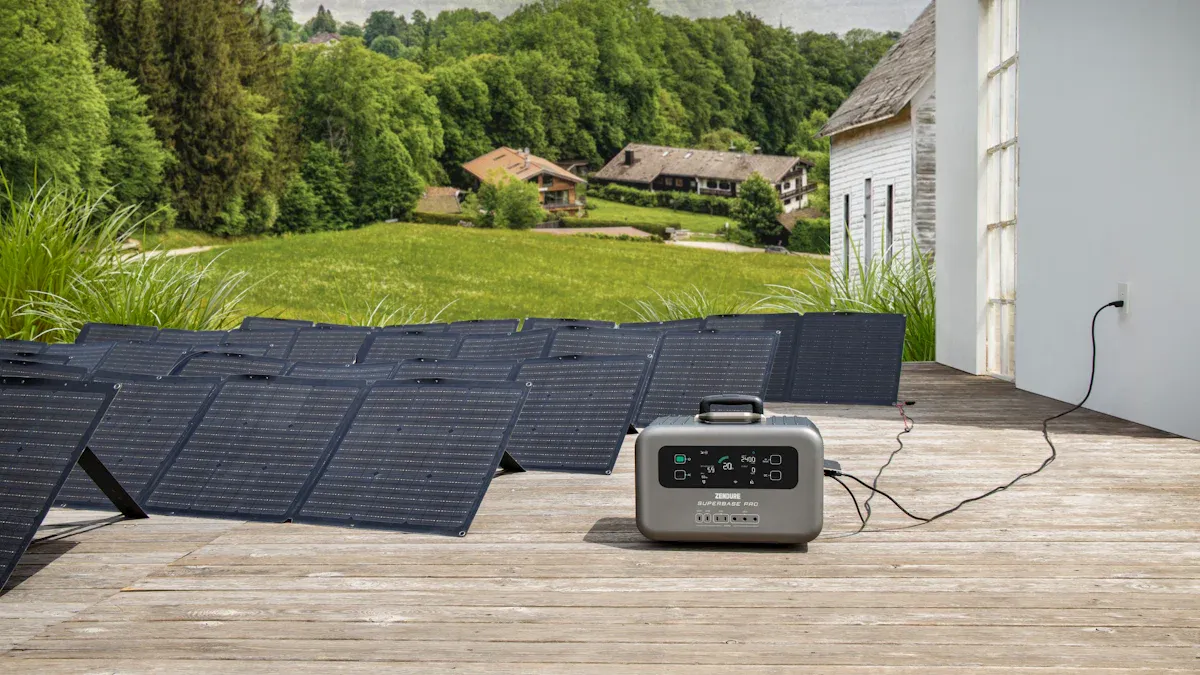
Choosing the right solar generator is crucial for meeting your energy needs. With the rising demand for solar energy solutions, many people are looking for sustainable options. Countries around the world are investing heavily in solar technology to meet green energy targets. This shift is vital for reducing greenhouse gas emissions and combating climate change. As you choose the right solar generator, informed decision-making becomes essential to ensure that your solar generator aligns with your specific requirements.
Key Takeaways
Assess your power needs carefully. Understand both continuous and peak power requirements to choose the right generator.
Consider battery capacity and charging options. A larger capacity allows for longer usage, while fast charging reduces downtime.
Avoid common mistakes. Know your power needs, maintain your generator, and store it properly to ensure longevity.
Research different models. Read user reviews to find a solar generator that fits your specific needs and avoid pitfalls.
Think about portability and versatility. Choose a generator that is easy to transport and has multiple output ports for various devices.
Choose the Right Solar Generator
Power Requirements
When you choose the right solar generator, understanding your power needs is essential. You must consider several factors to ensure your generator meets your energy requirements. Here are some key aspects to evaluate:
Output wattage: Determine how much power your devices require.
Types of output: Check if you need AC, DC, or USB outputs.
Portability: Consider how often you will move the generator.
Additional features: Look for features like built-in lights or USB ports.
Charging time: Understand how long it takes to recharge the battery.
Lifespan and cycles: Know how long the battery lasts and how many charge cycles it can handle.
Environmental conditions: Think about where you will use the generator.
Future-proofing: Plan for any additional devices you may want to power later.
Cost considerations: Balance your budget with your needs.
Many consumers make mistakes when selecting a solar generator. Here are some common pitfalls to avoid:
Not understanding power needs: Many underestimate their requirements, leading to purchasing a generator that is either too powerful or not powerful enough.
Ignoring maintenance routines: Skipping routine maintenance can lead to performance issues and increased costs over time.
Incorrectly charging the generator: Overcharging or undercharging can damage the battery and reduce its lifespan.
Poor storage practices: Storing the generator in unsuitable conditions can degrade its components.
Overloading the generator: Exceeding the generator’s capacity can lead to overheating and potential damage.
Sizing Considerations
Sizing your solar generator correctly is crucial for optimal performance. Here are some important considerations:
Ensure the battery capacity meets your daily energy needs, adding an extra 20% for safety.
Match solar input to the sunlight availability in your area. This ensures efficient charging.
Select an inverter size that corresponds to your highest power-consuming device.
Understanding your load requirements before purchasing is vital. Choose a battery that can support at least one full day of usage. Look for high-efficiency solar charging options to maximize your energy output.
To illustrate how different models compare, consider the following table:
Model | Max Input (W) | Max Output (W) | Efficiency | Ports |
|---|---|---|---|---|
Model A | 100 | 300 | High | 2 AC, 2 USB |
Model B | 200 | 500 | Medium | 3 AC, 3 USB |
Model C | 300 | 600 | High | 4 AC, 4 USB |
Choosing the right solar generator involves careful consideration of your power needs and sizing. By understanding these factors, you can select a generator that will serve you well for years to come.
Solar Generator Sizing
Continuous vs. Peak Power
Understanding the difference between continuous power and peak power is essential when selecting a solar generator. These terms describe how much energy your power station can deliver under different conditions.
Here’s a quick comparison:
Term | Definition |
|---|---|
Continuous Power | The amount of power that your power station can provide consistently. |
Peak Power | The maximum amount of power that a power station can provide in a short burst, such as when turning on an appliance. |
When you use devices that require a lot of energy to start, like refrigerators or power tools, peak power becomes important. These devices may need more power for a brief moment than they do while running. Make sure your solar generator can handle both continuous and peak power needs.
Calculating Wattage Needs
Calculating your total wattage needs helps you choose the right solar generator. Start by listing all the devices you plan to power. Each device has a specific wattage requirement. Here’s how to calculate your total wattage needs:
List Your Devices: Write down all the devices you want to use with your solar generator.
Check Wattage Ratings: Find the wattage for each device. This information is usually on the device label or in the user manual.
Add Up the Wattage: Sum the wattage of all devices to get your total wattage requirement.
To make this easier, you can use the following formulas:
Formula Type | Formula |
|---|---|
Basic Formula | Number of Panels = (Annual kWh ÷ Peak Sun Hours ÷ 365) ÷ (Panel Wattage × System Efficiency) |
Advanced Formula | System Size (kW) = Annual kWh ÷ (Peak Sun Hours × 365 × System Efficiency) |
Number of Panels = System Size (kW) × 1,000 ÷ Panel Wattage | |
System Efficiency | System Efficiency = Inverter Efficiency × (1 – DC Losses) × (1 – AC Losses) × (1 – Soiling Losses) × (1 – Shading Losses) × (1 – Temperature Losses) |
For example, if you want to power a refrigerator (200W), a laptop (50W), and a few lights (20W each), your total wattage would be:
Refrigerator: 200W
Laptop: 50W
Lights: 20W x 3 = 60W
Total Wattage = 200W + 50W + 60W = 310W
This total helps you select a solar generator with sufficient battery capacity to meet your needs.
Here’s a quick reference for typical wattage requirements for common devices:
Device Category | Wattage Range (Wh) | Examples of Devices |
|---|---|---|
Small Size Power Stations | 100-500 | Smartphones, Tablets, Laptops, Small lights |
Medium Size Power Stations | 500-1500 | Refrigerators, Coffee makers, Microwaves |
Large Size Power Stations | 1500-3000 | Grills, Sump pumps, Power tools |
Extra Large Size Power Stations | 3000+ | Air conditioners, Washer and dryer units |
By understanding continuous and peak power, along with calculating your wattage needs, you can confidently choose a solar generator that fits your lifestyle and energy requirements.
Portable Solar Generator Options
Charging Flexibility
Portable solar generators offer significant advantages over stationary models. Their compact sizes often resemble rolling luggage bags, making them easy for one person to transport. This portability allows you to take your power station wherever you go, whether for camping trips or outdoor events.
You can recharge portable solar generators using different methods, providing flexibility in how you obtain energy. Here’s a quick comparison of recharge times:
Power Source | Recharge Time |
|---|---|
AC Outlet | Under 90 minutes |
Solar Panels | A few hours |
Using solar panels allows you to harness renewable energy, especially in remote locations. This feature is particularly beneficial for beginners, as it offers a straightforward and adaptable power solution. You can gradually learn how to manage your energy needs before investing in a more permanent off-grid system.
Emergency Preparedness
In emergencies, portable solar generators play a vital role. They ensure that essential services, like medical facilities and communication systems, remain operational when traditional power sources fail. These generators provide a reliable energy source that supports critical systems, enhancing disaster response efforts.
Here are some key benefits of using portable solar generators during emergencies:
Solar-powered devices can charge independently, keeping communication tools functional.
They power essential medical equipment, lighting, and water purification systems in affected areas.
The modular nature of solar technology allows for rapid installation in challenging conditions.
During disasters, maintaining communication is crucial. Portable solar generators allow emergency responders and affected communities to charge devices like radios and phones independently. This capability ensures access to vital communication tools, facilitating effective disaster response.
Practical Usage Scenarios
Home Backup
Solar generators serve as an excellent backup energy source during power outages. They can power essential devices, ensuring you stay comfortable and safe. Here are some common uses for solar generators in home backup situations:
Backup for Essential Loads: You can run refrigerators, lights, and medical equipment during short outages.
Off-Grid or Remote Use: Ideal for cabins or tiny homes without grid access.
Urban and Indoor Use: These generators produce no fumes or noise, making them suitable for apartments or basements.
Limited Power Requirements: Perfect for users who only need power for select essentials rather than the entire home.
With a 10-15 kWh battery, essential home devices can typically run for 8-24+ hours. This capacity allows you to maintain critical functions during a power outage.
Outdoor Activities
Solar generators are also perfect for outdoor activities like camping and hiking. They provide a reliable power station for various devices. Here are some examples of devices you can power during your adventures:
Small Devices: Charge phones, tablets, and lights with low-capacity solar generators.
Larger Devices: Use higher-capacity generators for mini-fridges and portable fans.
When choosing a solar generator for outdoor use, consider models like the Thia and Cleo, which are lightweight and portable. They are great for hiking and small gatherings. For outdoor cooking, the Minotaur and Helios offer high energy output, suitable for multiple devices.
Here’s a quick comparison of some popular models for outdoor activities:
Model | Best For | Features |
|---|---|---|
Thia | Hiking, small gatherings | Lightweight, portable, charges small devices |
Cleo | Hiking, small gatherings | Lightweight, portable, charges small devices |
Minotaur | Outdoor cooking, high-wattage use | High energy output, suitable for multiple devices |
Helios | Outdoor cooking, high-wattage use | High energy output, suitable for multiple devices |
Solar generators enhance your outdoor experiences by providing reliable energy for your energy needs. Whether you are camping or enjoying a picnic, these generators ensure you have the power you need.
Choosing the right solar generator involves careful consideration of your specific needs. Start by assessing your power requirements, including both continuous and peak power. Evaluate the battery capacity and charging options to ensure you have enough energy for your activities.
Here are some key takeaways to remember:
Energy Storage and Capacity: More watt-hours provide longer usage time.
Inverter and Output Power: A strong inverter ensures clean power delivery.
Charging Options and Speed: Fast charging reduces downtime.
Battery Chemistry and Cycle Life: Modern batteries offer better longevity.
Port Configuration and Versatility: Multiple ports enhance connectivity.
Take your time to research different models and read user reviews. This approach helps you avoid common pitfalls and select a solar generator that meets your needs effectively.
FAQ
What is a solar generator?
A solar generator converts sunlight into electricity. It uses solar panels to capture sunlight and stores energy in batteries. You can use this stored energy to power devices when needed.
How long does it take to charge a solar generator?
Charging time varies based on the power source. Using an AC outlet typically takes under 90 minutes. Solar panels may take several hours, depending on sunlight availability.
Can I use a solar generator indoors?
Yes, you can use a solar generator indoors. They produce no fumes or noise, making them safe for indoor use. Ensure proper ventilation if using devices that generate heat.
How do I maintain my solar generator?
To maintain your solar generator, keep it clean and store it in a dry place. Regularly check the battery and connections for wear. Follow the manufacturer’s guidelines for optimal performance.
What devices can I power with a solar generator?
You can power various devices, including laptops, lights, refrigerators, and small appliances. Check the wattage requirements of your devices to ensure compatibility with your solar generator.
