

A single lightning strike or utility hiccup can quietly cook the circuit boards in your fridge, TV, and router in less than a second. Whole home surge suppressors sit at your electrical panel and catch that energy before it reaches anything expensive, so the small investment up front usually pays for itself the first time a storm rolls through. I pulled together nine solid options that span panel-mounted units, heavy-duty power strips, and an RV-specific model worth knowing about.
The Lineup, Simplified

ABB THOMESURGEP Type 1 SPD NEMA 3R
CCCEI 3 Outlets Heavy Duty Surge Protector 6FT
CCCEI 2PCS Heavy Duty Surge Protector Yellow 4FT

GE 6 Outlet Surge Protector 6FT Extension

ECHOGEAR ShockBlocker 8 Outlet Surge Protector
CCCEI 12 Gauge Heavy Duty Surge Protector 6FT
Kensington Guardian 6 Outlet Surge Protector 15FT

Eaton CHSPT2ULTRA Surge Protection Device

Power Watchdog PWD30EPO Smart RV Surge Protector
What Each Pick Brings To The Table
Panel-mounted surge suppressors are a different animal from the power strips on your desk, and the ABB THOMESURGEP shows what that category is supposed to look like. A Type 1 SPD (surge protective device) is rated to handle the biggest surges that arrive from outside the house, including direct lightning strikes on nearby power lines, before they ever reach your breaker panel.
The NEMA 3R enclosure means the unit shrugs off rain and weather, so installers can mount it at the meter or service entrance without worrying about moisture getting in. For households in storm-prone regions, this kind of primary defense usually gets paired with point-of-use strips for the gear that really can’t fail.
The Case For It
- Type 1 rating handles the largest external surges before they reach the panel
- NEMA 3R weatherproof enclosure suits outdoor meter-base installations
- Last line of defense for sensitive electronics and major appliances
- Brand heritage in industrial-grade electrical gear tends to translate well to home installs
Things To Consider
- Installation requires working near live service entrance wiring, which most homeowners should leave to a licensed electrician
- Doesn’t replace point-of-use protection for delicate electronics that sit downstream
Quick Facts
Whose Shelf It Belongs On
Homeowners in lightning-prone regions who want a panel-mounted first layer of protection and are comfortable hiring an electrician for the install.
Consider Something Else When
The Eaton CHSPT2ULTRA is a more accessible Type 2 option for homeowners who want panel-level protection but prefer a simpler indoor install.
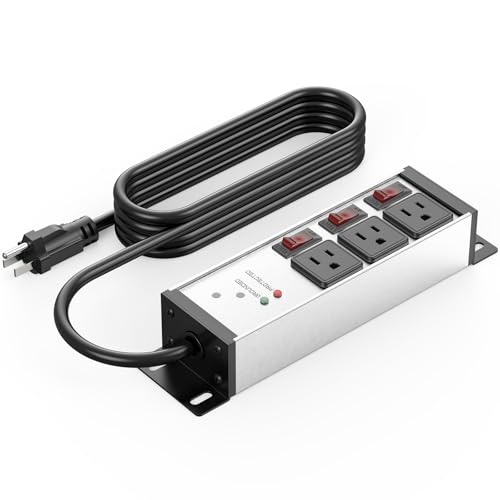
The CCCEI 3-Outlet strip trades outlet count for individual switch control, which is honestly the right call for a bench setup. Each outlet has its own switch backed by a 20A circuit breaker, so you can power down a miter saw without crawling behind the table to unplug anything. That’s the kind of small convenience that ends up mattering every weekend.
The 12-gauge cord (a thicker wire size that handles more current safely over longer runs) and brushed silver housing lean toward shop use, where you might accidentally knock the strip with a board or a tool. Compared to the GE six-outlet strip later in this list, this one prioritizes switch control over raw outlet count.
What Pays Off
- Individual switches let you cut power to one tool without unplugging
- 20A breakers per switch handle unexpected overloads on each outlet
- 12-gauge cord supports higher-draw tools over a 6-foot reach
- Brushed metal housing stands up to the occasional bump
Worth Noting
- Only three outlets means you may need a second strip for larger tool collections
- Owners commonly report the metal housing shows fingerprints and scuffs faster than plastic
Right Fit For
Garage workshops and small fabrication benches where individual tool switching matters more than outlet quantity.
Skip It When
The CCCEI 2PCS Heavy Duty pack is a better match for people who want to spread outlets across multiple work zones.
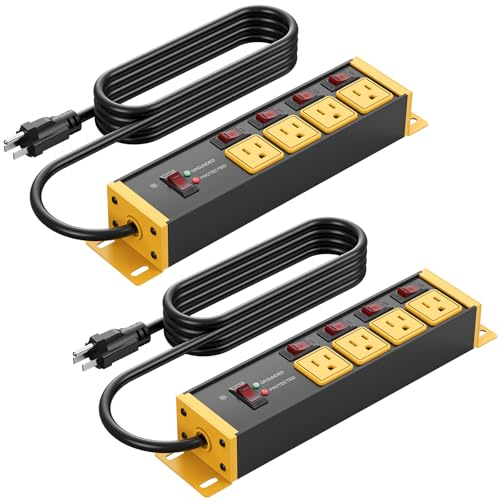
Two strips in a single box sounds gimmicky until you actually need a surge protector on both sides of a garage, and the CCCEI 2-pack solves that exact problem. Each strip carries four individually switched outlets with the same 20A breaker per switch as the single version, so you give up nothing in the move from one strip to two.
The bright yellow housing is intentional. On a crowded workbench, a black or grey strip disappears and becomes the next thing your elbow knocks off. The high-visibility color keeps it from getting buried under cords and sawdust.
The Good Stuff
- Two strips cover multiple workstations or rooms without buying twice
- Independent switches and 20A breakers on every outlet
- Yellow housing stays visible in dusty or cluttered shops
- Wall-mountable design works on exposed shop studs
Minor Gripes
- 4-foot cord may fall short when the nearest outlet sits across a wide bay
- Plastic enclosures are tougher than consumer strips but still no match for a falling drill
Best Suited To
Two-car garages and split workshop spaces where one strip simply isn’t enough reach.
Another Choice May Suit
The CCCEI 3-Outlet single strip is the cleaner choice for a tight bench where you only need one dedicated station.
The GE 6-outlet strip is the kind of product that ends up behind half the TVs and desks in America, and for good reason. Six grounded outlets on a 6-foot cord give you enough flexibility to handle a typical entertainment center or home office without making you choose which device gets to stay plugged in.
It doesn’t pretend to be industrial. The 800-joule rating sits at the consumer end of the spectrum, which is plenty for chargers, lamps, and small electronics but lighter than the ECHOGEAR ShockBlocker covered below. For most living spaces, that’s a sensible trade-off.
Real Benefits
- Six outlets cover an entire entertainment or work setup in one strip
- Grounded three-prong design accepts standard plugs without adapters
- 6-foot cord reaches past most couches and desks
- Plain, low-profile housing disappears behind furniture
Points To Note
- Lower joule rating means faster wear under repeated surge events
- No individual switches, so you cut everything at once or nothing
Made For
Living rooms, bedrooms, and casual home offices where one strip should quietly handle six ordinary devices.
Look Elsewhere When
The ECHOGEAR ShockBlocker is the better call for home theater setups with expensive TVs and gaming consoles that justify higher joule protection.
The ECHOGEAR ShockBlocker earns its place in this roundup with a 3,420-joule rating, which is the highest point-of-use capacity on this list. Joules measure how much energy a surge protector can absorb before its internal components wear out, so higher numbers translate directly to longer service life under repeated small surges.
Eight outlets handle a full entertainment stack or a complete gaming and streaming setup without daisy-chaining another strip. The slim housing tucks behind a TV stand, and the safety covers on unused outlets prevent the curious kid or shedding pet from getting into trouble.
Key Advantages
- 3,420-joule capacity handles big TVs and gaming PCs for years
- Eight outlets cover an entire entertainment or office cluster
- Safety covers on unused outlets stop accidental contact
- Slim profile slides behind most furniture without standing out
Worth Noting
- Filters line noise, which helps sensitive audio gear but adds a small cost premium over basic strips
- Larger footprint than a 6-outlet strip, so very tight media cabinets may need to be remeasured
Perfect Match For
Home theater owners, console gamers, and remote workers running multiple monitors and peripherals from a single wall outlet.
Reach For A Different Pick When
The GE 6-Outlet strip is the friendlier choice for bedrooms and living rooms with ordinary lamps and chargers.
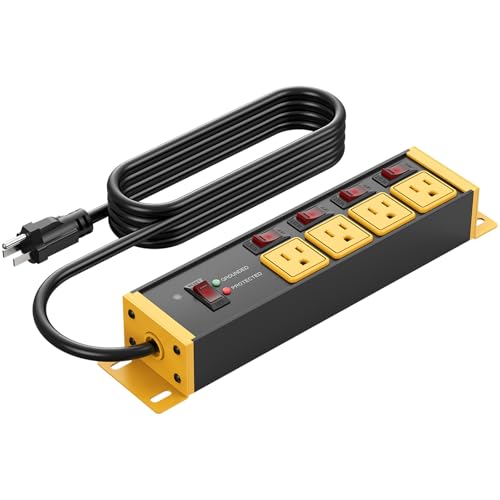
The single-strip sibling in the CCCEI yellow line, this version mixes 5-20R and 6-20R outlets so it can accept both standard 15-amp plugs and the beefier 20-amp plugs that come on bigger tools. Each outlet carries its own 20A breaker, which means a tripped circuit shuts down only the affected tool rather than the whole bench.
It steps up from the three-outlet silver version by offering four switched outlets on a longer 6-foot cord. For most home shops, that’s a meaningful upgrade without jumping to the two-pack covered earlier.
Well-Handled Touches
- Mixed outlet types accept both 15-amp and 20-amp plugs without adapters
- 20-amp breakers per outlet keep one tripped tool from killing the bench
- 6-foot reach works for most workshop layouts
- High-visibility yellow housing stays easy to spot in a busy bay
Points To Keep In Mind
- Wall-mount design works best when studs or backing are already exposed
- Still a single strip, so larger shops may need a second unit for full coverage
Quick Facts
Who Should Grab It
Shops running table saws, air compressors, or other 20-amp tools that don’t fit on a residential-grade strip.
Not Your Match When
The CCCEI 2PCS pack is smarter for multi-zone workshops that need more than one protected outlet cluster.
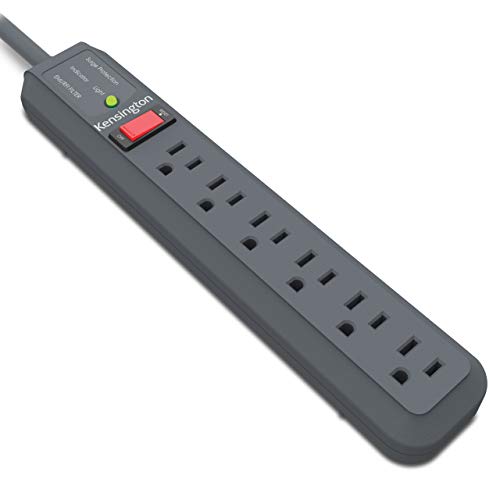
Most strips ship with 6-foot cords because that’s what fits the average room. The Kensington Guardian stretches that to 15 feet, which sounds excessive until your only available outlet is across a room from your desk. For conference tables, standing desks pushed against a window, or studios with awkward outlet placement, that reach alone is often the deciding factor.
The 540-joule rating is modest, on par with light consumer use. That’s fine for a phone charger and a laptop, but the ECHOGEAR ShockBlocker across the room is a smarter pick for a rack of equipment that draws constant power.
What It Does Well
- 15-foot cord reaches outlets that most strips can’t get near
- Six grounded outlets handle a typical workstation or media corner
- Plastic and rubber housing grips hard floors without sliding around
- Mature product with a long track record in office environments
Honest Caveats
- 540-joule rating is light for power-hungry gear or areas with frequent brownouts
- Long cord can become a tripping hazard if not routed along a wall
Feature Snapshot
Who Will Love This
Remote workers and home studio owners whose desks live far from the nearest usable wall outlet.
A Better Fit Elsewhere
The ECHOGEAR ShockBlocker is the stronger pick for entertainment centers where higher joule capacity matters as much as cord reach.
The Eaton CHSPT2ULTRA is the indoor-friendly alternative to the ABB unit at the top of this list. Where the THOMESURGEP is built for the service entrance, the Eaton mounts inside or beside the load center (the main breaker panel that distributes power through the house) and connects to any manufacturer’s panel via a quick-connect design.
A 108kA/phase short-circuit current rating is meaningfully higher than most residential Type 2 devices, and the integrated LED status indicator tells you at a glance whether the unit is still protecting or has reached the end of its sacrificial life. UL 1449 compliance confirms the unit meets the current safety benchmark for SPD hardware.
The Upside
- 108kA/phase rating absorbs large surges without failing
- LED status light shows protection status without opening the panel
- Universal fit works with most residential breaker boxes
- Quick-connect design simplifies the install for a qualified electrician
Room For Improvement
- Type 2 placement means it doesn’t catch the very largest external surges the way a Type 1 unit does
- Installation still requires an electrician comfortable working inside a live panel
At A Glance
Built With In Mind
Homeowners who want professional panel-level protection without a service-entrance install and who can coordinate an electrician visit.
Swap It Out When
The ABB THOMESURGEP is the right call for households that need the very first line of defense mounted at the meter itself.
The Power Watchdog PWD30EPO is the odd one out in this roundup because it’s built for campground pedestals, not residential breaker panels. RVers plug into unfamiliar shore power at every stop, and a miswired pedestal can quietly send 240V into a 120V coach and destroy the electrical system in seconds. This unit’s automatic shutoff catches that scenario before the damage starts.
Bluetooth reporting and a 3,000-joule rating put it in the conversation with the ECHOGEAR ShockBlocker for everyday electronics, while the IP65 weather rating (a standard that means dust-tight and protected against water jets) handles life on a storage lot or a rainy campsite. It’s a niche pick, but the right niche if your home happens to have wheels.
Positive Points
- Automatic shutoff on miswired or low-voltage pedestals protects the coach
- 3,000-joule rating handles big RV rooftop AC units and inverters
- Bluetooth connection sends voltage and fault data straight to a phone
- IP65 weather rating survives outdoor storage and wet sites
A Few Limitations
- 30-amp plug won’t fit 50-amp coaches without an adapter
- Bluetooth range is short, so the phone needs to stay nearby during hookup
Feature Card
Made For
RV owners who plug into a different pedestal every weekend and want a hard cutoff if the campground wiring is faulty.
Where Another Pick Suits Better
The ECHOGEAR ShockBlocker is the right answer for stationary home theaters, not the rolling life of an RV.
Picking The Right Layer For Your Home
Choosing whole home surge suppressors comes down to layering rather than picking a single product. The most resilient setups stack protection in tiers: a Type 1 or Type 2 panel-mounted unit catches big surges at the entry point, while point-of-use strips absorb the smaller spikes that get past the panel and protect delicate electronics directly. For most homeowners, this two-layer approach costs less than replacing a single high-end TV or kitchen appliance after one bad storm.
Match the device to the load. Heavy-draw workshops and 20-amp tools need a strip rated for that current with per-outlet breakers, while living room electronics do just fine with a 6- or 8-outlet strip carrying a high joule rating. RV owners should think of their shore-power connection as a separate system entirely and shop for a dedicated pedestal protector like the Power Watchdog rather than reusing a residential strip.
Buying Guide: What Actually Matters Before You Choose
Joules And Clamping Voltage
The joule rating tells you how much surge energy a protector can absorb before its internal components wear out. Higher numbers last longer under repeated small surges, which matters more in areas with frequent thunderstorms or an aging utility grid. Clamping voltage (the voltage level at which the protector starts diverting excess energy) is the other half of the equation: a lower clamping voltage means the protector reacts more quickly to a spike, though most consumer strips hide this spec behind marketing language.
Type 1 Versus Type 2 At The Panel
Type 1 SPDs mount at the service entrance and handle surges coming from outside the home, including direct strikes on nearby lines. Type 2 SPDs mount at or inside the load center and catch the residual energy that gets past the utility transformer and meter. Pairing a Type 2 unit with quality point-of-use strips is the most common residential setup. Adding a Type 1 is worth it in regions with frequent direct lightning activity.
Build Quality For The Environment
A workshop strip lives a harder life than one behind a TV, and the build should match. Metal housings shrug off bumps, yellow or bright colors stay visible on cluttered benches, and per-outlet breakers prevent one tripped tool from shutting down the whole work surface. For indoor use, a slim low-profile strip that tucks behind furniture keeps the setup clean and discourages stacking.
Outlet Type And Cord Reach
A 20-amp tool won’t fit every residential strip. Mixed 5-20R and 6-20R outlets handle the common plug varieties on heavier equipment, while a 15-foot cord solves the room-layout problem that a standard 6-foot cord can’t. Measure first, then buy, rather than discovering the cord falls two feet short on install day.
Smart Shopper Notes For This Category
Common Shopping Slip Ups
A frequent mistake is treating any power strip as a surge protector. Many basic strips carry no surge protection at all, so the first thing to check before buying is whether the listing actually mentions a joule rating or surge component. Another trap is choosing the highest joule number without checking clamping voltage; a high joule count with weak clamping still lets small spikes reach your gear. Finally, shoppers sometimes skip the panel-level layer entirely, which leaves point-of-use strips doing work they were never designed to handle alone.
What The Higher Tier Buys
The jump from a basic consumer strip to a premium model usually buys three things: more joule capacity for a longer service life, better EMI/RFI filtering (circuitry that cleans up electrical noise that can interfere with audio and video), and safety touches like outlet covers or rotatable plugs. For a one-off lamp and a phone charger, none of that matters. For a high-end gaming PC and a 4K TV plugged into a strip that runs warm, those upgrades tend to justify themselves quickly.
Frequently Asked Questions
Do whole home surge suppressors really need to be installed by an electrician?
Panel-mounted units almost always do, because the work involves live service entrance wiring or the inside of a breaker panel. Point-of-use strips plug into a standard outlet and don’t require any special tools or training, so those remain a DIY-friendly purchase. Mixing the two layers in the same household is normal, even when only one of them needs a professional install.
How long does a surge protector actually last?
It depends on how often it absorbs surges, which depends on your area’s weather and grid quality. In a quiet suburban neighborhood with rare storms, a strip may protect for many years. In a storm-prone region or near industrial equipment that causes regular grid switching, a high-joule strip may wear out in a few years. Many premium models include an LED that signals when protection has ended and the unit needs replacement.
Can a surge protector handle a direct lightning strike?
Most consumer and mid-tier residential units cannot, and that’s exactly why the two-layer approach exists. A direct or very close strike delivers far more energy than any plug-in strip is built to absorb. The panel-mounted Type 1 or Type 2 layer takes the brunt of that energy, and point-of-use strips handle the smaller events that get through. For complete confidence in lightning country, the panel unit is the real defense, and the strips are a backup.
What’s the difference between joules and clamping voltage?
Joules measure total energy a protector can absorb over its lifetime, while clamping voltage is the trigger point at which the protector begins diverting excess current. A higher joule rating means longer service life, and a lower clamping voltage means faster reaction to a spike. Both numbers matter, and the best protectors balance high joule capacity with low clamping voltage rather than maxing out one and ignoring the other.
Is an RV surge protector worth the extra cost?
For anyone who plugs into a campground pedestal regularly, it’s one of the better investments in the category. Campground wiring is maintained by everyone and no one, and a single miswired pedestal can destroy an RV’s electrical system before anyone notices. The Power Watchdog and similar units cut power automatically under those conditions, which often pays for itself the first time it prevents a single repair bill.
The Takeaway
The honest read is that the best surge protection is the kind you stop noticing because nothing ever goes wrong. Panel-mounted units from ABB and Eaton handle the heavy lifting at the electrical entry point, and a solid point-of-use strip picks up the slack for the gear that matters most to you. Match the tier to your home’s risk profile, your equipment’s value, and your willingness to schedule an electrician, and the rest tends to fall into place on its own.
