

I keep a small greenhouse in my garage, and before I plugged a temperature controlled outlet into the wall, my seedlings swung between chilly nights and overheated afternoons. These little plug-in thermostats fix exactly that, switching a heater or cooler on and off based on the reading from a wired probe, so the environment stays where you set it. Below are eight models worth a look for reptile rooms, fermentation setups, propagation tents, and anything else that needs steady warmth or chill.
A Snapshot Of The Selections

KETOTEK Digital Thermostat Timer Plug Outlet 120V

Inkbird ITC-308 Digital Temperature Controller

INKTEM WiFi Temperature Controller 110-230V

INKTEM Temperature Controller Digital Thermostat 110-230V
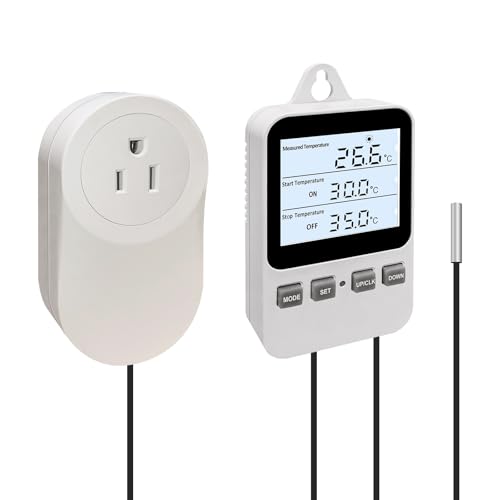
HIADA Heating Cooling Digital Thermostat 120V 15A

INKTEM Plug-in Temperature Controlled Outlet 1200W
Inkbird ITC-308 Outlet Thermostat 2-Stage 1100W

Inkbird ITC308 Freezer Thermostat 110V 1200W
The Picks, Examined More Closely
Three operating modes set this KETOTEK apart from the simpler single-function plugs on the market. The 3-meter (about 10-foot) wired probe reaches deep into a terrarium or propagation tray, and the backlit LCD makes midnight checks easier on the eyes. Where the Inkbird models we look at later focus on straight heating or cooling control, this unit folds a 24-hour on/off timer into the package for lights, fans, and pumps.
For a leopard gecko enclosure or a small germination tent, day/night dual-temperature cycling mirrors the natural drop in temperature after sundown, which is something many keepers value. Setup requires only plugging the probe into the unit, mounting the controller, and choosing your mode.
What Stands Out
- Three modes: constant temperature, day/night cycling, and a basic 24-hour timer for non-thermal accessories.
- 3 m probe reaches across wider enclosures and deep seed trays without stretching.
- Backlit LCD remains readable when checking a dark reptile room late at night.
- 120V compatibility matches standard North American wall outlets.
Things To Consider
- Owners commonly report the user manual is light on detail, so first-time setup takes patience.
- The single outlet limits you to running one heated or cooled device at a time.
Who It Suits Best
Reptile keepers who want separate day and night temperature targets without buying two separate controllers will find this profile especially practical.
Look Elsewhere When
Anyone needing simultaneous heating and cooling across two devices may prefer the INKTEM Temperature Controller Digital Thermostat 110-230V, which offers two independent outputs.
The Inkbird ITC-308 has earned its reputation as the friendly face of plug-in temperature control. Two outlets on the front allow simultaneous heating and cooling, so a fridge and a small heater can run side by side to maintain a tight band around your setpoint. A dual display shows both the measured and the target temperature, which removes the guesswork when you first set things up.
Switching between Celsius and Fahrenheit is a menu option rather than a hardware mod, and high/low audible alarms kick in if the probe disconnects or the temperature drifts beyond the range you define. For first-time builders, that safety net is genuinely useful.
What Earns Its Place
- Dual relay outputs handle a heater and a cooler at the same time.
- Audible alarms fire when the temperature escapes the set range or the probe fails.
- 1100 W maximum load covers most household heaters and small fridges.
- Celsius and Fahrenheit readouts switch from a menu instead of a jumper.
Honest Caveats
- The probe cable sits at a fixed length, so very large rooms may need an extension or a repositioned controller.
- It is a single-zone controller, not a multi-room or multi-zone system.
Feature Snapshot
Made For
Beginners who want a forgiving, well-documented controller for a single fermentation fridge or reptile room will feel at home with this profile.
Consider Something Else When
Remote greenhouse owners should look at the INKTEM WiFi Temperature Controller 110-230V, which adds app-based monitoring and a wider voltage range.
App connectivity is the headline feature on this INKTEM controller, and for someone managing a greenhouse while traveling, that alone is worth the step up. A long-press on the Wi-Fi button puts the unit into pairing mode, and from there, you monitor readings and adjust the setpoint from a phone. The 110-230V input range also makes it usable in regions with different mains voltages, which helps anyone moving a setup internationally.
Two outlets handle combined loads of up to 1200 W on 120V mains or 2300 W on 230V. The trade-off is that the Wi-Fi link adds a small amount of setup complexity and requires a stable home network.
Standout Benefits
- App-based remote control removes the need to physically visit the greenhouse for routine adjustments.
- Wide voltage input (120V or 230V) supports different regions and outlet standards.
- Two receptacles handle a heater and a fan simultaneously.
- Total output scales with input voltage, up to 2300 W on 230V mains.
Worth Noting
- Initial Wi-Fi pairing can take a few attempts, especially on networks with separate 2.4 and 5 GHz bands.
- Internet outages temporarily cut remote access until the network returns.
Quick Facts
Right Fit For
Greenhouse owners who travel frequently or simply want to check conditions from the kitchen table will appreciate the connected profile.
A Better Fit Elsewhere
Shoppers who never need remote access may find the Inkbird ITC-308 Digital Temperature Controller a simpler, more affordable match.
Where the Wi-Fi sibling leans on phone apps, this sibling stays grounded: two independent outputs, broad voltage support, and no extra connectivity to configure. A heater can plug into one outlet and a cooler into the other, and the controller alternates which one runs based on whether the room drifts above or below your setpoint. The 110-230V input range mirrors the Wi-Fi model, so it suits setups in mixed-voltage regions.
Output ceiling climbs to 1200W at 120V or 2300W at 230V, shared across both receptacles. Compared to the Inkbird ITC-308 reviewed earlier, this unit offers the wider voltage range, but it lacks the audible alarm feature.
What It Does Well
- Two output ports run heating and cooling equipment at the same time.
- Wide voltage input covers both 120V and 230V electrical systems.
- Higher wattage ceiling handles more demanding greenhouse accessories.
- Straightforward button-based setup avoids app downloads entirely.
Points To Note
- No built-in audible alarm means you will not get a heads-up if the probe disconnects at night.
- The display and controls are functional rather than polished, so the learning curve feels a touch steeper.
Best Suited To
Greenhouse builders running multiple devices on a single circuit who prefer button-based controls over phone apps will find this profile matches their routine.
Not Your Match When
Anyone needing remote monitoring on the road should consider the INKTEM WiFi Temperature Controller 110-230V instead.
This HIADA thermostat steps up to a 15-amp capacity, which is the kind of headroom that matters when you are driving a large heat mat, a sizeable ceramic heater, or an entire incubation rack. Like the other heating-and-cooling units in this roundup, it switches direction based on whether the temperature climbs above or drops below your setpoint. The 120V focus keeps things simple for North American outlets.
Use cases stretch from reptile enclosures to seedling mats and incubation rooms, where seasonal swings demand both heating in winter and active cooling in summer. The trade-off for the extra amperage is a slightly larger housing.
Features That Help
- 15-amp rating handles larger heaters and multi-tier incubation racks.
- Year-round switching between heating and cooling modes avoids swapping controllers seasonally.
- Wide scenario support covers reptile, greenhouse, and incubation builds.
Less Ideal Details
- Single-voltage 120V design rules out use on 230V mains.
- Owners commonly note the included probe is on the shorter side, so plan placement accordingly.
Who Should Grab It
Anyone running higher-draw heating elements in a 120V setup, such as a rack of seed trays or a room-sized reptile enclosure, will benefit most from this profile.
Reach For A Different Pick When
Shoppers needing international voltage support should consider the INKTEM Temperature Controller Digital Thermostat 110-230V.
An impressively wide control range of -40°F to 212°F sets this INKTEM outlet apart from the more typical reptile-focused units. Whether you are protecting a greenhouse from dropping below 68°F or holding an incubator at a steady 85°F, the calibration offset lets you nudge the reading by a few degrees to match a trusted secondary thermometer. The backlit display is genuinely useful for 3 a.m. checks.
Compared to the simpler KETOTEK covered earlier, this unit focuses purely on temperature control without the day/night or timer modes. For a hobbyist who only needs on-off temperature switching, that stripped-down scope can be a relief.
Notable Upsides
- Broad -40°F to 212°F control range handles both heating and cooling extremes.
- Calibration offset of roughly ±8.8°F aligns the reading with a trusted thermometer.
- 1200W capacity covers most household heaters and small refrigerators.
Some Limits To Know
- No Wi-Fi or app connectivity, so remote adjustments are not possible.
- The user interface is button-driven, which feels less refined than touchscreen alternatives.
Spec Overview
Perfect Match For
Mid-range hobby projects like incubation tanks or seedling mats, where a wide range and calibration matter more than remote features, fit this profile well.
Skip It When
Anyone wanting Wi-Fi monitoring or multi-device switching should consider the INKTEM WiFi Temperature Controller 110-230V instead.
This Inkbird variant is essentially the same trusted ITC-308 platform as the unit covered in pick 2, repackaged for kegerators, cured meat chambers, and breeding racks. The 1100W capacity handles a small fridge plus a heat mat, and the dual relay design supports simultaneous heating and cooling. Owners tend to leave these plugged in year-round, which speaks to the long-term reliability of the design.
Setup is essentially plug-and-play: set the temperature, drop the probe into the chamber, and let the controller cycle. Compared to the INKTEM models covered earlier, Inkbird’s documentation and the wider hobby community around the brand make troubleshooting easier.
Bright Spots
- Plug-and-play setup lowers the barrier for first-time kegerator or curing builds.
- Dual relay supports both a refrigeration compressor and a heating element.
- Fahrenheit and Celsius readouts are user-selectable.
Trade-Offs To Consider
- Single-zone design limits use to one chamber at a time.
- 1100W max load rules out running large space heaters in parallel.
Who Will Love This
Homebrewers maintaining fermentation temperatures and home curing enthusiasts running small meat chambers fit this profile especially well.
Where A Sibling Pick Shines
Anyone needing a wider voltage range should consider the INKTEM Temperature Controller Digital Thermostat 110-230V.
The ITC308 rounds out the Inkbird trio in this roundup, and it is the model most hobbyists cut their teeth on. Calibration is intentionally simple: set the target range, place the probe inside the chamber, and plug the heater or cooler into the labeled outlet. The 1200W ceiling on 110V mains gives a touch more headroom than the 1100W units, useful for slightly larger heaters.
Use cases lean toward greenhouse heaters and coolers, reptile rooms, and fermentation setups. Compared to the newer INKTEM models, this Inkbird has the larger installed base, which makes community troubleshooting tips easier to find.
Practical Advantages
- Easy calibration aligns the probe reading with a reference thermometer.
- 1200W max load supports a slightly larger heater than 1100W alternatives.
- Centigrade and Fahrenheit display modes match user preference.
- Established model with abundant community troubleshooting resources.
Practical Considerations
- 110V only, so it cannot be repurposed on 230V European mains.
- Display and buttons feel dated compared to newer touchscreen units.
Feature Card
Built With In Mind
Hobbyists setting up a mixed heating and cooling build on 110V mains, especially those who value a well-documented community around the brand, will feel right at home with this profile.
Swap It Out When
Shoppers needing Wi-Fi or international voltage support should consider the INKTEM WiFi Temperature Controller 110-230V instead.
What To Weigh Before Picking A Temperature Controlled Outlet
Match The Outlet To Your Load
A temperature controlled outlet is essentially a smart pass-through that switches your heater or cooler on and off based on a probe reading. Before any of the picks above, check the wattage of the equipment you plan to plug in. Most household heat mats and small fridges sit comfortably under 1200W, but a sizeable ceramic heater can easily push past that ceiling. Choosing an outlet with too little headroom risks tripping the relay or shortening the controller’s life.
Decide Between Heating, Cooling, Or Both
Some units handle only one direction: they switch a heater on when the temperature drops and leave cooling equipment alone. Dual-relay designs, like the Inkbird ITC-308 covered earlier, alternate between a heater and a cooler to hold a tight band around your setpoint. For reptile rooms that swing seasonally or fermentation fridges that need both compressor and heat mat support, dual-direction is genuinely worth the small step up in cost.
Think About Probe Reach And Calibration
The wired probe is the sensor doing all the work, so its length matters. A 3-meter probe (about 10 feet) handles most home setups, but a longer probe gives flexibility in larger greenhouses. Calibration offsets, available on units like the INKTEM 1200W outlet, let you align the controller’s reading with a trusted thermometer, which is especially useful when accuracy matters for incubation or brewing.
Connectivity Is Optional, Not Essential
Wi-Fi models like the INKTEM WiFi Temperature Controller let you check conditions from your phone, which is a genuine quality-of-life upgrade for travelers or remote greenhouse owners. The trade-off is a slightly steeper setup process and a small dependency on your home network. For a single tank in a spare room, button-based controls are perfectly adequate and tend to feel more reliable over years of use.
Smart Choices In The Temperature Controlled Outlet Category
Where First-Time Shoppers Slip Up
A surprisingly common mistake is buying a controller with too little wattage headroom for the heater or cooler you already own. Always check the load rating first, and leave at least 20% margin above your device’s stated wattage to keep the relay from running at its limit. Another frequent slip is placing the probe too close to the heater itself, which creates a feedback loop where the controller shuts off before the rest of the chamber warms up. Position the probe where you want the temperature measured, not where it is most convenient to mount.
Why The Premium Tier Costs More
Stepping up to a Wi-Fi-enabled or dual-relay model usually buys you one of three things: remote monitoring, simultaneous heating and cooling, or a wider voltage range. For a hobbyist running a single terrarium in a spare room, those extras rarely earn their keep. For someone managing a greenhouse while traveling or balancing a fermenter through summer heat, the upgrade tends to pay back quickly in saved crops, batches, or sleepless nights spent checking on a sensitive setup.
Frequently Asked Questions
Do temperature controlled outlets work with both heaters and coolers?
It depends on the model. Single-function units control only one direction, while dual-relay designs like the Inkbird ITC-308 alternate between a heater and a cooler to hold your setpoint. Always check whether the unit supports both modes before plugging in your equipment.
How accurate are these plug-in thermostats?
Most units in this category hold temperature within roughly 1 to 2°F of your setpoint under steady conditions. Calibration offsets on models like the INKTEM 1200W outlet let you nudge the reading to match a trusted thermometer for tighter accuracy.
Can I use one outlet to run multiple devices?
Standard units power one device at a time through a single outlet. Dual-receptacle models like the INKTEM Temperature Controller Digital Thermostat 110-230V support a heater and a cooler running in parallel, but the total wattage across both receptacles still has to stay under the rated maximum.
Are Wi-Fi temperature controllers worth the extra cost?
For a single terrarium in the next room, app connectivity is usually overkill. For a greenhouse owner who travels or wants to monitor conditions from the couch, the convenience adds genuine value and is worth considering over a button-based unit.
How long do these controllers typically last?
Owners commonly report years of reliable service from mainstream models like the Inkbird ITC-308. The probe is usually the first part to wear, and replacing it with a compatible sensor extends the life of the controller considerably.
The Takeaway
A plug-in temperature controlled outlet quietly takes over one of the more tedious chores in any climate-sensitive hobby, from checking a gecko tank at midnight to babysitting a fermentation fridge through a summer heat wave. Match the unit’s wattage, direction, and probe length to your specific setup, and the rest tends to fall into place. Whichever pick from this roundup fits your profile, you will spend less time fussing and more time enjoying the results.
