

A single brownout can fry a monitor. A passing storm can take out a whole entertainment stack. I pulled together ten surge suppressors that cover the common cases: garage workbenches, living room TVs, home offices stuffed with laptops, and kitchen counters where a few high-draw appliances share one outlet. Some are long-reach extension-cord hybrids for back-of-house projects, others are compact desktop hubs that quietly absorb the spikes from cheap power supplies. I focused on real specifications that affect daily use: gauge and length of the cord, how the joule ratings translate to actual protection, switch layout, USB charging speed, and whether the housing is built to survive a busy shop or just sit behind a nightstand.
A Snapshot Of The Selections

CCCEI 12 Gauge Extension Cord with Multiple Outlets (50FT)

CCCEI 12 Gauge Extension Cord with Multiple Outlets (100FT)

CCCEI Heavy Duty Surge Protector with USB Ports (6FT)

NANOLAKE Surge Protector with 4800J Protection (10ft)
CCCEI 12 Gauge Heavy Duty Surge Protector (6FT)

CCCEI Magnetic Heavy Duty Surge Protector (6FT)

CCCEI 12 Gauge Heavy Duty Power Strip GFCI (6FT)

Anker Power Strip with 900J Protection (35W)
CCCEI GFCI Surge Protector with Individual Switches (6FT)

UGREEN 20-in-1 GaN Surge Protector (5FT)
A Closer Look At Each Pick
For projects that pull you halfway across a garage, a 50-foot reach can mean the difference between getting the work done and dragging a tangle of cords through the doorway. The CCCEI 12 Gauge Extension Cord with Multiple Outlets delivers that reach with a heavy 12-gauge cord, a flat 5-15P plug that hugs the wall behind furniture, and eight outlets on a single strip so you can power a miter saw, work light, and battery charger at the same time. I like how the bright yellow jacket stays visible on a cluttered floor, which is a small safety win when the kids or a curious dog walks through.
It is built for people who treat their garage like a workshop, not a parking spot. Anyone running a table saw or a chunky battery charger should appreciate the 15A/125V/1875W rating and the overload protection that trips before things get ugly. The independent switch and dedicated circuit breaker are genuinely useful when you want to kill the radio without shutting off the saw.
Useful Strengths
- 12-gauge cord handles sustained high-draw tools without overheating under normal use
- Eight outlets plus a single master switch make it easy to control a whole workstation
- Flat 5-15P plug keeps the cord close to the wall behind heavy furniture
- High-visibility yellow jacket reduces trip hazards in dim garages
Trade-Offs To Consider
- 50 feet is a lot of cord to coil and store when the project moves indoors
- No USB ports, so phones and tablets still need a separate wall charger
- Yellow housing can clash with a finished living room or bedroom setup
Whose Shelf It Belongs On
This is the right cord for homeowners who run a serious garage workshop and need one long, rugged strip that can take some abuse.
Reach For A Different Pick When
The CCCEI Magnetic Heavy Duty Surge Protector is a smarter fit when the work happens at a metal workbench and you only need six feet of cord.
The 100-foot version of the CCCEI multi-outlet strip exists for one reason: there are times when fifty feet just is not enough. Think barns, large backyards, event setups, or job sites where the only outlet sits at the far corner of the building. The 12-gauge conductor still pushes 15A at 125V, the same 1875W ceiling, and the same eight-outlet distribution block, so nothing changes except how far you can roam from the wall.
In a backyard, you can run a string of lights, a speaker, and a small cooler without piling on adapters. On a job site, you can keep a single extension reel indoors and run this strip to the work zone. The flat plug stays friendly against siding, and the yellow jacket remains easy to spot in tall grass. Compared to its 50-foot sibling, this one rewards people who work with serious distance between power and project.
A Favorable Mix
- 100-foot reach removes the need to chain multiple extension cords together
- 12-gauge conductor keeps voltage drop reasonable across long runs
- Same eight-outlet, single-switch setup as the shorter CCCEI model
- Bright yellow jacket remains easy to see across wide lawns or work yards
Soft Spots
- 100 feet of cord takes real storage space and can kink if coiled too tightly
- Heavier to drag around than the 50-foot model, so small jobs feel overbuilt
Key Specs
Best Suited To
Homeowners with big yards, event hosts, and contractors who need to push power far from the nearest outlet.
Consider Something Else When
The NANOLAKE 4800J power strip is a better fit when the priority is joule protection for a sensitive home office, not long-distance reach.
Most desk-side power strips are an afterthought: a flat slab with a few outlets and a glowing switch. The CCCEI Heavy Duty Surge Protector with USB Ports is a smarter breed, mixing four AC outlets with two USB-C ports and a single USB-A port, so a phone, a tablet, and a laptop can share one tidy block. The 12-gauge, 6-foot cord still hits the same 15A/1875W ceiling as the longer CCCEI models, which means it can handle a monitor, a docking station, and a desk lamp without breaking a sweat.
For a remote worker, the per-outlet switches are quietly useful: I can kill the printer without rebooting the router. The master switch makes a clean shutdown painless at the end of the day. Where the Anker option later in this list leans into compact size, this one leans into flexibility, with more switches and a sturdier-feeling housing.
The Helpful Details
- Two USB-C ports and one USB-A port cut down on bulky wall bricks
- Four individual switches plus a master switch let you isolate idle devices
- 12-gauge, 6-foot cord handles full-size monitors and docks without overheating
- Overload and grounding protection keep sensitive electronics safer
Where It Is Less Suited
- USB ports are useful, but the listed wattage per port is not specified for fast laptop charging
- Black housing is functional but does not stand out in a busy cable nest
Made For
Remote workers and students who want one tidy block on the desk that covers both AC and USB gear.
Swap It Out When
The Anker Power Strip with 900J Protection is a stronger match when fast 35W USB-C charging is the top priority.
Joule rating, in plain terms, is the total energy a surge protector can absorb before its internal components give out. The NANOLAKE Surge Protector with 4800J Protection sits in the high-protection tier, which is the right zone for an expensive TV, a home office, or any setup where a single spike could mean a costly replacement. The strip carries 18 widely spaced AC outlets and four smart USB ports (two USB-A and two USB-C with 20W Power Delivery), which sounds excessive until you actually count the plugs around a desk or media center.
The 10-foot flat plug cord is friendly to baseboards and tight spaces. Mounting holes on the back let you screw it under a desk or behind a credenza. Grounded and protected LED indicators give an at-a-glance read of whether the strip is still doing its job. This is the one I’d trust with a thousand-dollar monitor, where the cheaper CCCEI models feel more at home running a table saw.
What Makes Sense
- 4800-joule rating is in the protection zone for TVs, gaming PCs, and home office gear
- 18 widely spaced AC outlets accept chunky plugs without blocking neighbors
- Two USB-C ports with 20W PD handle phone and tablet fast charging
- LED indicators show grounded and protected status at a glance
Honest Caveats
- Ten-foot cord and long housing need a real mounting spot to feel organized
- More outlets than most homes need, which can invite cord clutter in small spaces
Quick Facts
Perfect Match For
Anyone with a home entertainment setup, gaming PC, or full home office who wants one central, well-protected hub.
Where Another Pick Suits Better
The CCCEI 12 Gauge Heavy Duty Power Strip GFCI is a better fit when the workspace is wet or near a sink and GFCI protection matters more than joule count.
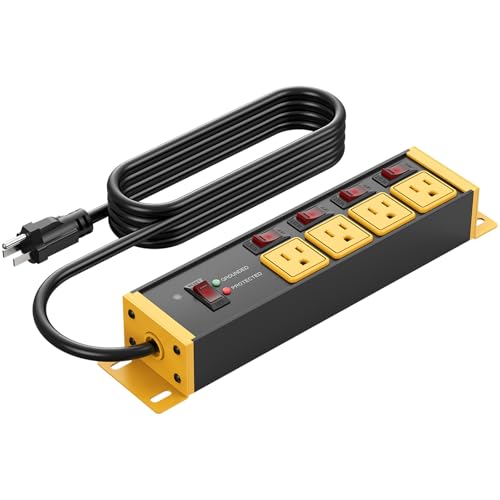
The CCCEI 12 Gauge Heavy Duty Surge Protector looks almost identical to its 50-foot sibling from the front, but the back of the housing tells a different story. This version steps up to 20-amp outlets (5-20R and 6-20R) with individual 20-amp breakers per socket, which is a meaningful jump for anyone running welders, large air compressors, or other 20A plug tools. The 12-gauge, 6-foot cord stays manageable in a small shop, and the wall-mount design keeps the strip off the floor where oil and sawdust collect.
For most people, this is overkill. For someone with a real shop and a dryer-style outlet nearby, it is exactly right. I would not pick this for a living room or a bedroom because the industrial look and the 20A outlets are wasted in those settings. Pair it with the CCCEI magnetic strip later in this roundup and you have a flexible garage setup that handles most weekend projects.
Features That Help
- Individual 20A breakers per outlet isolate problems without killing the whole strip
- Wall-mount design lifts the strip out of dust and sawdust on the floor
- 12-gauge 6-foot cord handles sustained 20A draw without overheating
- Accepts both 5-20R and 6-20R plugs for a wider range of shop tools
Points To Keep In Mind
- Requires a 20A circuit to use the higher-rated outlets properly
- Industrial yellow housing is not the prettiest choice for finished living spaces
The Right Fit
Shop owners and serious DIYers who already own 20A tools and want a strip that matches that draw capacity.
Look Elsewhere When
The NANOLAKE 4800J strip is a smarter pick when the priority is joule protection for sensitive electronics, not 20A output for shop tools.
Most power strips want to live on a floor or a shelf. The CCCEI Magnetic Heavy Duty Surge Protector is happier stuck to the side of a steel toolbox or the leg of a metal workbench, where the built-in magnet on the back keeps it suspended and out of the way. That small design choice is a big quality-of-life upgrade in a busy shop, where stepping over a strip is just part of the daily routine. The 12-gauge, 6-foot cord hits the same 15A/125V/1875W ceiling as the rest of the CCCEI family.
Each of the four outlets gets its own 20A switch, plus a master switch to kill everything at once. For a hobbyist with a small metal workbench, the magnet holds firmly enough that I would not worry about it sliding off. Owners commonly report that the magnet is strong on bare steel but weaker on coated or stainless surfaces, so it pays to test the spot before loading it up with battery chargers.
What Helps Most
- Magnetic back keeps the strip off the floor in a crowded shop
- Four individually switched 20A outlets plus a master switch
- 12-gauge cord handles full 1875W load without overheating
- Bright orange housing is easy to spot in a busy workspace
Possible Compromises
- Magnet grip is weaker on painted, coated, or stainless steel
- Only four outlets, so larger setups may still need a second strip
Who It Suits Best
Hobbyists and pros with a metal workbench who want the strip mounted at hip height rather than underfoot.
Skip It When
The CCCEI 12 Gauge Heavy Duty Surge Protector (6FT) is a better fit when wall-mounting matters more than magnetic mounting.
GFCI stands for Ground Fault Circuit Interrupter, and the short version is that it cuts power in milliseconds when it senses current taking a path it should not, like through water or a person. The CCCEI 12 Gauge Heavy Duty Power Strip GFCI bakes that protection right into a multi-outlet strip, which makes it the right pick for a garage sink area, a covered patio outlet, or any place where a splash is a real possibility. The 8-port layout gives plenty of room for shop tools and outdoor gadgets.
Beyond the safety angle, the strip carries the familiar 12-gauge, 6-foot cord and the 15A/125V/1875W rating. Overload and grounding protection round out the safety story. I would not put this behind a couch in a dry living room, because the extra GFCI cost buys nothing in that setting, but in a workshop or outdoor kitchen it is a quiet lifesaver.
Advantages To Know
- Built-in GFCI cuts power quickly if water is involved
- 8 outlets cover a busy work area without daisy-chaining strips
- 12-gauge cord stays cool under full 1875W load
- Overload and grounding protection add an extra safety layer
What To Weigh
- Periodic GFCI self-test is recommended, which adds a small maintenance step
- Grey industrial housing is not designed to blend with finished decor
Feature Snapshot
Built With In Mind
Shop owners and homeowners who run power near sinks, outdoor kitchens, or covered patios where water and electricity might cross paths.
A Better Fit Elsewhere
The NANOLAKE 4800J strip is a smarter choice when joule protection for a home theater is the main goal and water is not a concern.
Anker leans into the compact end of the surge suppressor market, and the Anker Power Strip with 900J Protection is built for the desk rather than the garage. Twelve ports in total: eight AC outlets, two USB-C ports, and two USB-A ports, all on a slim housing that does not dominate a workspace. The headline feature is the 35W USB-C output, which is enough to fast-charge a 13-inch MacBook Air or top off a phone at full speed. A 900-joule rating is on the modest side compared to the NANOLAKE strip, so this is more of a daily-driver protector than a whole-home defense.
For a small home office or a student desk, that mix of ports is genuinely useful: a laptop, a monitor, a phone, a tablet, and a pair of headphones can all live on one block. I would not run a 1500W space heater off this thing, but for low-to-medium draw electronics it is a tidy, well-finished option. Owners commonly report that the slim profile fits cleanly under monitor risers, where chunkier strips would not.
Useful Highlights
- 35W USB-C fast charging supports modern laptops and phones
- Twelve ports cover a typical laptop-and-accessory desk in one block
- Slim housing fits under monitor risers where bulkier strips do not
- Clean Anker finish looks at home in a finished office
Small Caveats
- 900-joule rating is modest compared to dedicated 4000J+ protectors
- Not designed for high-draw shop tools or heaters
Who Should Grab It
Remote workers, students, and creators who want one clean, fast-charging hub for a laptop-driven desk.
Not Your Match When
The NANOLAKE 4800J strip is the better pick for a home entertainment center where high joule protection matters more than USB-C speed.
The CCCEI GFCI Surge Protector with Individual Switches sits in the sweet spot for small commercial kitchens, auto shops, and serious home workshops. Four 20-amp individual switches mean I can shut off a battery charger without killing a work light, and the GFCI layer protects against ground faults around sinks or damp floors. The 12-gauge, 6-foot cord stays cool even when the strip runs at full draw, which is the kind of detail you only appreciate after a long day on a job site.
For a home kitchen, it might feel overbuilt, and the yellow housing will not blend with quartz countertops. For a garage or a workshop, it earns its keep. Compared to the other CCCEI options in this list, this one is the most “pro” in feel, with the same per-outlet control you’d expect from a piece of equipment on a contractor’s bench.
Notable Upsides
- Four independent 20A switches isolate each outlet from the others
- Built-in GFCI protection adds a safety layer in damp work areas
- 12-gauge cord remains cool under continuous 1875W load
- Compatible with standard 5-15P outlets for easy plug-in
Factors To Consider
- Industrial yellow housing is at home in a shop, not a kitchen
- Four outlets may be limiting for larger multi-tool setups
Feature Card
The Right Fit
Contractors, auto shop owners, and home chefs who want per-outlet control plus GFCI protection in a compact strip.
Where A Sibling Pick Shines
The CCCEI 12 Gauge Heavy Duty Surge Protector is a better match for a high-draw workshop when GFCI is not required.
The UGREEN 20-in-1 GaN Surge Protector is the household charging station that replaces a small drawer full of wall bricks. The 20-in-1 promise covers 16 AC outlets arranged at a 15-degree angle for easy access, plus one USB-C port (up to 20W Power Delivery) and three USB-A ports (up to 15W each). The 15-degree angled layout is a small but thoughtful touch: plugs line up at a comfortable angle instead of stacking in awkward rows. A 5-foot cord keeps the whole station flexible on a long counter or media shelf.
This is the one I would put on a kitchen counter where a blender, a toaster, a phone, a tablet, and a laptop all want power at once. GaN (gallium nitride) tech keeps the USB side cool and efficient. Compared to the Anker strip, this UGREEN leans much more toward raw outlet count than compact size, which is exactly what a busy family hub needs.
What Works In Its Favor
- Sixteen AC outlets handle a full household of small appliances
- 20W USB-C PD plus three USB-A ports cut down on wall bricks
- 15-degree angled layout keeps plugs from crowding each other
- GaN technology keeps the USB section cool during heavy charging
Details To Watch
- 20W USB-C is fast for a phone, slow for a modern laptop
- Large footprint needs a real counter or shelf to live on
Perfect Match For
Large families, shared spaces, and anyone running a small business counter where many devices compete for one wall outlet.
Reach For A Different Pick When
The Anker Power Strip with 900J Protection is a better fit for a small desk where compact size and 35W USB-C matter more than raw outlet count.
Factors To Weigh Before Choosing Surge Suppressors
Match The Joule Rating To The Gear
A joule rating tells you how much energy the suppressor can soak up before its protective components wear out. For a cheap lamp or a basic fan, a few hundred joules is plenty. For a TV, gaming PC, or anything with a motherboard you cannot easily replace, look for ratings in the 2000J to 5000J range. The NANOLAKE 4800J strip is the clearest example of a high-end rating in this list, and it pairs well with sensitive electronics.
Pick The Right Cord Gauge And Length
Wire gauge (AWG, or American Wire Gauge) is one of those specs that is easy to skip. Lower numbers mean thicker wire, which carries more current with less voltage drop. A 12-gauge cord, like most of the CCCEI options in this roundup, handles the full 15A/1875W ceiling without warming up. For long runs, like the 100-foot model, the thicker gauge matters even more because voltage drop grows with distance. Choose a length that actually fits the space, since coiling 100 feet of excess cord is a chore.
Decide Between Outlet Density And USB Convenience
A shop or a kitchen benefits from a wide strip with many AC outlets. A desk benefits from USB-C and USB-A ports that replace a handful of wall bricks. The Anker and CCCEI USB options prioritize charging speed, while the UGREEN 20-in-1 prioritizes raw outlet count. Think about what lives near the strip: if half the plugs are chargers, USB ports pay for themselves quickly.
Check For GFCI In Wet Zones
GFCI protection matters wherever water and electricity could meet, including garage sinks, covered patios, and outdoor kitchens. The CCCEI GFCI models handle this directly inside the strip, which is helpful when the nearest wall outlet is not already GFCI-protected. For a dry living room, GFCI adds cost without much real benefit.
Key Considerations Across These Picks
Mistakes Worth Dodging
A common slip is buying the cheapest strip and plugging a high-end TV into it. A low joule rating wears out fast, and once those internal components are gone, the strip looks fine but offers almost no protection. Another trap is grabbing a long extension cord when the priority is joule protection, or grabbing a high-joule strip when the priority is reach. Match the strip to the job, not the other way around.
Where The Extra Money Goes
Higher-tier models in this category usually buy three things: a higher joule rating, more outlets, or GFCI protection. A 4800J rating genuinely helps sensitive electronics survive big spikes. More outlets solve real clutter in busy households. GFCI protection adds a real safety net in damp environments. Spending up only makes sense when the feature maps to a real risk in the home, like an expensive entertainment center or a workshop near a sink.
Frequently Asked Questions
How Many Joules Do I Really Need?
A small lamp or fan is fine with a few hundred joules. Sensitive electronics like TVs and gaming PCs do better with 2000J or more. Whole-home protection feels right in the 4000J and up range.
Can A Surge Protector Last Forever?
No, the internal components wear down each time they absorb a spike, so heavy storms and brownouts slowly reduce effectiveness. Replacing a strip every few years is the realistic path.
Is GFCI The Same As Surge Protection?
No. GFCI watches for current leaking where it should not, while surge protection watches for sudden voltage spikes. A strip with both, like the CCCEI GFCI options, gives the most complete coverage.
Will A Surge Protector Save My Electronics From A Lightning Strike?
Direct lightning hits overwhelm almost any consumer suppressor. The right strip handles the smaller, more common spikes from grid switching and appliance cycling, which is most of what actually happens in homes.
Do USB Ports On A Surge Protector Charge As Fast As A Wall Brick?
Usually slower, unless the port specifically supports high wattage. The Anker 35W USB-C port is a clear step up from typical 5V/2A USB-A ports on older strips.
The Takeaway
A good surge suppressor should quietly disappear into the background and handle the spikes you never see. The right pick depends entirely on where it lives: a long, rugged 12-gauge cord for the garage, a high-joule hub for the entertainment center, a GFCI strip near the sink, or a USB-rich block for the desk. Match the strip to the room, double-check the joule rating, and the rest usually sorts itself out.
