

A desktop PC setup rarely lives on a single outlet anymore. Between the tower, monitor, printer, external drives, router, and a few chargers, a basic two-plug wall socket just stops making sense. Add a real concern, like a summer storm rolling in, and the value of a dedicated surge protector becomes obvious. I put this roundup together for anyone outfitting a home office, a gaming battlestation, or a workshop, and I focused on units with credible joule ratings, beefy 12-gauge cords, and outlet counts that match how a real desk actually gets used.
The Main Contenders

CCCEI 12 Gauge Long Extension Cord, 50FT, Yellow

CCCEI 12 Gauge Long Extension Cord, 100FT, Yellow

CCCEI Heavy Duty Surge Protector with USB Ports, 6FT

NANOLAKE 4800J Surge Protector Power Strip, 18 Outlets
CCCEI 12 Gauge Heavy Duty Surge Protector, Yellow, 6FT

CCCEI Magnetic Heavy Duty Surge Protector, 12 Gauge, 6FT

CCCEI 12 Gauge GFCI Heavy Duty Power Strip, 8 Ports

Anker Power Strip with 900J Surge Protection, 35W
CCCEI Industrial GFCI Surge Protector, 4 Plugs, 6FT

UGREEN 20-in-1 GaN Surge Protector, 5FT
Why These Options Stand Out
The first entry is built for distance. A 50-foot 12-gauge cord (a thicker wire gauge that handles higher current with less voltage drop over long runs) reaches across a garage, a basement workshop, or any room where the nearest outlet sits awkwardly far from the desk. Eight grounded outlets give a full PC setup plenty of breathing room, and the integrated circuit breaker shuts everything down cleanly during an overload.
It is not subtle, and that is the point. The bright yellow jacket stays visible on a concrete floor so nobody trips over it during a late-night project, and the flat plug tucks behind a workbench without forcing furniture an extra inch away from the wall. For a home shop PC paired with monitors and a few bench tools, this is the kind of utility-first design that actually shows up in daily use.
A Few Strong Suits
- 50-foot reach covers long runs to distant wall outlets.
- 12-gauge wire stays cooler under heavier loads.
- Eight outlets handle a tower, monitors, and peripherals at once.
- Dedicated breaker resets quickly after a tripped circuit.
- Yellow jacket improves visibility in low-light shop corners.
Things To Consider
- 50 feet of cord is bulky to coil and store when not in use.
- Eight outlets feel like overkill for a clean home-office desk.
Feature Snapshot
Right Fit For
Workshop owners and home-PC builders who need serious reach from a wall socket that sits well away from the desk.
A Better Fit Elsewhere
Anyone running a tidy home-office desk should look at the CCCEI Heavy Duty Surge Protector with USB Ports, which delivers a shorter 6-foot cord and built-in charging ports.
Stepping up to a 100-foot run, this is the version for setups where the nearest outlet is genuinely far away. Think a detached garage workshop, a basement office carved out of an unfinished corner, or a temporary PC rig running at an event space. The same 12-gauge construction that helped the 50-foot model earns its place here, where voltage drop (the loss of power as electricity travels through a long wire) becomes a real concern on longer cables.
Eight outlets, an integrated breaker, and the same bright yellow jacket carry over. For most home users this is overkill, but for the specific case it solves, no shorter cord will do the job cleanly.
What Pays Off
- 100-foot length handles detached structures and far outlets.
- 12-gauge wire keeps voltage drop manageable on long runs.
- Same eight-outlet layout as the shorter sibling.
Worth Noting
- 100 feet of cord takes real effort to coil and store.
- More length means more resistance, so distance becomes the trade-off.
Built With In Mind
Anyone whose PC lives in a far-flung garage, basement, or outbuilding without a convenient wall outlet.
Reach For A Different Pick When
The CCCEI 12 Gauge Long Extension Cord at 50 feet is a more sensible choice when an outlet sits within the same room.
Desktop clutter often comes down to wall-wart chargers. This unit tackles that head-on with two USB-C ports and a single USB-A port sitting alongside four AC outlets. For a desk running a PC tower, a monitor, a desk lamp, and a couple of phones, that mix means fewer bulky charging bricks competing for outlet space. The 6-foot 12-gauge cord reaches most wall sockets behind a desk without slack piling up on the floor.
Compared to the long-cord CCCEI models earlier in this list, this one trades reach for convenience. Independent switches per outlet and a master switch let you cut power to specific devices without unplugging, which is helpful for anyone who cycles their monitor or speakers throughout the day.
What It Does Well
- USB-C and USB-A ports cut down on charging-brick clutter.
- Independent switches give per-outlet control.
- 12-gauge cord keeps performance steady for a tower and monitor.
- Six-foot length fits most standard desk-to-wall distances.
Points To Note
- Four AC outlets fill up fast on a multi-monitor setup.
- USB ports do not negotiate the higher wattages that some laptops want under load.
Quick Facts
Whose Shelf It Belongs On
Home-office users with a single PC, a monitor, and a phone or two who want fewer wall-warts on the desk.
Another Choice May Suit
Gamers and content creators running two or three monitors will find more headroom on the NANOLAKE 4800J Surge Protector Power Strip.
Joules are the headline spec on a surge protector, and they measure how much spike energy the unit can absorb before it sacrifices itself. This NANOLAKE strip carries a 4,800-joule rating, which lands well above the typical 600 to 1,800 joules found on basic strips. For a desk where a tower, two or three monitors, a printer, and a stack of peripherals all plug in, the higher rating translates into real resilience during a storm or a brownout (a brief dip in line voltage).
Eighteen widely spaced AC outlets plus four USB ports (two USB-A, two USB-C with 20W Power Delivery) handle the kind of dense setup that buries smaller strips. The 10-foot cord and flat plug keep the whole thing usable behind a wide desk, and the mountable back panel lets you secure it under a shelf if floor space is tight.
Everyday Perks
- 4,800-joule rating outperforms most consumer strips.
- Eighteen outlets swallow an entire desk’s worth of gear.
- USB-C Power Delivery handles phone and tablet fast charging.
- Mountable design clears floor space under a desk.
Honest Caveats
- Eighteen outlets invite over-plugging if not managed thoughtfully.
- Larger footprint demands real desk or shelf space.
Made For
Power users running multi-monitor setups, streamers, or anyone whose work depends on protecting expensive hardware from spike damage.
Swap It Out When
Shoppers who only need four to six outlets and shorter reach will find the CCCEI Heavy Duty Surge Protector with USB Ports easier to live with day to day.
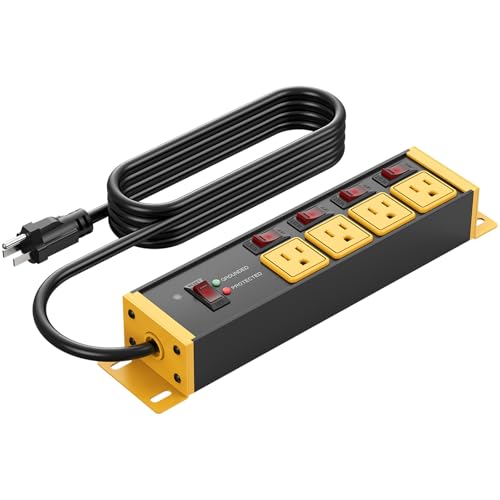
The 20-amp rating is the story here, because it raises the ceiling above a standard household circuit. Most desktop setups pull well under that, but it gives headroom for a power-hungry tower plus a workstation monitor or two without tripping breakers. Each of the four outlets carries its own 20-amp switch, so cutting one device does not affect the rest of the strip.
The housing is wall-mountable, which helps when a floor-strip gets bumped underfoot. Compared to the CCCEI model with USB ports, this one skips phone charging and leans into raw outlet capacity instead. For a workshop PC paired with a monitor and a bench tool, that is the right trade.
Real-World Strengths
- 20-amp outlets handle heavier gear on a single strip.
- Per-outlet switches make targeted shutdowns easy.
- Wall-mountable body clears workspace clutter.
Trade Offs
- Only four outlets is tight for multi-monitor rigs.
- No USB ports means separate chargers for phones and tablets.
- Plug shape is a standard 5-15P, so 20A plugs will not fit.
Feature Card
Who Should Grab It
Workshop and small-business owners running a power-hungry PC alongside bench tools and dedicated displays.
Where A Sibling Pick Shines
Home-office users who care more about USB charging than raw amperage will prefer the CCCEI Heavy Duty Surge Protector with USB Ports.
A magnetic back is a small detail that solves a real annoyance. On a steel workbench, a filing cabinet, or the side of a tool cabinet, this strip hangs at eye level instead of sliding around the floor. Four outlets, a master switch plus individual switches, and a 20-amp per-outlet rating carry over from the previous CCCEI model, but the mounting flexibility changes how the strip fits into a workspace.
The bright orange housing is easy to spot, which is helpful in a busy shop. For a PC tower sitting on a steel shelf, or a test bench where a small-form-factor rig keeps getting moved around, the magnet earns its place quietly.
What Works In Its Favor
- Magnetic mount sticks to steel surfaces without hardware.
- 20A per outlet matches high-draw PC workstations.
- Per-outlet plus master switches add control.
- 12-gauge cord stays stable under load.
Some Limits To Know
- Magnet is useless on wood, plastic, or glass desks.
- Four outlets still require planning for multi-monitor rigs.
Best Suited To
Workshop and lab users with steel workbenches or cabinets who want the strip off the floor and within reach.
Not Your Match When
Anyone with a wood or glass desk should default to the wall-mountable CCCEI 12 Gauge Heavy Duty Surge Protector instead.
GFCI stands for Ground Fault Circuit Interrupter, a safety feature that cuts power in milliseconds when it detects current flowing where it should not, like through water or a person. In a basement, a garage, or any space where moisture is a realistic concern, that protection layer matters. This strip adds it to the standard heavy-duty formula: eight grounded outlets, a 12-gauge cord, and a 20-amp switch built in.
It still behaves like a regular power strip day to day, but the moment a fault occurs, the unit trips rather than relying on the wall outlet behind it to do the catching. For a PC that sits on carpet near a basement window, or a workshop rig that shares space with a utility sink, that extra margin is worth thinking about.
What Makes Sense
- Built-in GFCI cuts power fast during ground faults.
- Eight outlets fit a typical two-monitor PC setup.
- 12-gauge cord keeps performance steady under load.
Soft Spots
- GFCI test-and-reset adds a step after any trip.
- Less useful in a clean, dry upstairs office.
Key Product Details
Who Will Love This
Anyone running a PC in a basement, garage, or other space where ground-fault protection adds real safety value.
Look Elsewhere When
Users in a dry upstairs office can skip the GFCI overhead and grab the CCCEI Heavy Duty Surge Protector with USB Ports for a more desk-friendly layout.
Anker plays a different game than the workhorse strips above. Where the heavy-duty models prioritize amperage and cord thickness, this one aims for desk aesthetics and travel-friendly build quality. Twelve ports total (eight AC, two USB-C, two USB-A) handle a laptop-driven setup, and the 35-watt USB-C output charges a 13-inch laptop at meaningful speed.
The 900-joule rating is modest compared to the NANOLAKE 4,800-joule strip, so this is not the right pick for a region with frequent power spikes. It is the right pick for a clean desk where the strip disappears into the surface and the cable management matters as much as raw protection.
Features That Help
- Twelve ports cover laptop, phone, and accessory charging.
- 35W USB-C charges compatible laptops quickly.
- Slim profile blends into a minimalist desk.
- Anker build quality feels polished out of the box.
Things To Weigh
- 900-joule rating is light for storm-prone areas.
- Fewer outlets than the NANOLAKE 18-port option.
Right Fit For
Laptop-first users and minimalists who care as much about desk aesthetics as they do about joule ratings.
Another Choice May Suit
Anyone in a storm-prone region with a desktop tower will get more protection from the NANOLAKE 4800J Surge Protector Power Strip.
This is the workshop-friendly sibling of the GFCI strip covered earlier. Four outlets instead of eight keep the physical footprint small, and the 20-amp individual switches give finer control over each plugged device. Built-in GFCI protection adds the same fast ground-fault cutoff, so a shop floor with a concrete slab, a utility sink, or a poorly grounded outlet is a reasonable place to use it.
The yellow housing stays visible against shop clutter, and the 6-foot 12-gauge cord handles heavier loads without sagging voltage. Compared to the magnetic version earlier in this list, this unit trades the magnet for the GFCI layer. For a PC tucked into a garage corner, that is usually the more useful trade.
Where It Helps
- GFCI plus 20A per outlet in one compact strip.
- Individual switches give targeted control.
- Yellow housing improves visibility in busy shops.
Practical Considerations
- Only four outlets caps expansion fast.
- No USB charging means separate bricks for phones.
Perfect Match For
Garage and basement PC setups where moisture or poor grounding makes GFCI protection a genuine safety upgrade.
Skip It When
Steel-desk users will appreciate the magnetic back on the CCCEI Magnetic Heavy Duty Surge Protector more than the GFCI overhead here.
The last entry in this roundup goes wide on ports. Sixteen AC outlets, one USB-C, and three USB-A ports all fit into a single tower-style body, which is a different shape language than the long flat strips above. The 15-degree angled outlet faces keep plugs from crowding each other, and the GaN (gallium nitride) internals keep the whole unit running cooler than older designs.
For a desk that doubles as a charging station, or a shared family charging spot where laptops, phones, and tablets all queue up, the port count justifies the bulk. The 20W USB-C output is modest compared to the Anker, but the AC headroom more than makes up for it.
Notable Gains
- Sixteen AC outlets cover dense multi-device setups.
- USB-C and three USB-A ports consolidate charging.
- Angled plug faces reduce crowding between wall-warts.
- GaN internals run cooler than older designs.
Possible Compromises
- Tower footprint takes more desk or shelf space.
- USB-C 20W is slower than the Anker’s 35W output.
Made For
Shared workspaces and family desks that need to charge laptops, tablets, and phones alongside a full PC setup.
Consider Something Else When
Solo users with a single tower and monitor will find the Anker Power Strip more compact and just as capable for daily use.
What Matters Most Before Choosing Surge Protectors For Pc
The first question to ask is how many outlets the desk actually needs, and the honest answer is usually one more than expected. Count the tower, monitors, speakers, printer, router, lamp, and any chargers that live on the desk, then add at least two for future gear. Anything below eight outlets feels tight within a year on most setups.
Joule rating is the spec worth understanding next, since it describes how much spike energy the protector can absorb before it gives up. For a typical home PC setup, 1,000 joules covers normal background noise, and 2,500+ is a strong choice for storm-prone regions. Wire gauge matters too: 12-gauge cords (lower numbers mean thicker wire) carry current more comfortably over distance than the 14 or 16-gauge cords found on cheap strips.
Finally, the environment changes the checklist. A dry upstairs office needs basic surge protection. A basement or garage benefits from GFCI protection for ground-fault safety. A workstation driving heavy tools may want 20A outlets. Matching the strip to the room is what separates a smart purchase from a strip that just happens to fit.
Mistakes Worth Dodging and When The Upgrade Pays Off
Where Shoppers Go Wrong
The most common slip is treating every strip as interchangeable. A basic six-outlet 600-joule strip and a 4,800-joule eighteen-outlet model look similar on the shelf, but they protect hardware very differently during a real power event. Another recurring mistake is buying more outlets than the cord can handle, which leads to daisy-chaining strips (plugging one power strip into another) and overloaded wall circuits. Match the outlet count to the actual device list, and stop the chain.
Where The Extra Money Goes
Higher-tier strips earn their cost through three upgrades: thicker 12-gauge cords that reduce voltage drop, higher joule ratings that survive multiple smaller surges instead of one big one, and added safety layers like GFCI or individual switches. For a setup with a tower, multiple monitors, and peripherals, the upgrade pays for itself the first time a storm rolls through. For a minimal laptop desk, the basics are usually enough.
Frequently Asked Questions
How many joules do I really need for a PC?
For a basic home office, 1,000 joules handles everyday spikes. If you live in an area with frequent storms or unstable power, aim for 2,500 joules or higher to absorb multiple events over the strip’s life.
Is a longer extension cord always better?
Not really. Longer cords add voltage drop, especially on thinner wire gauges. Match the length to the actual distance, and pick a 12-gauge cord if the run goes beyond 25 feet.
What does GFCI actually add on a power strip?
GFCI cuts power in milliseconds when it detects current leaking through water or a person. In a basement, garage, or any damp space, it adds a meaningful safety layer beyond standard surge protection.
Can a surge protector handle a gaming PC with a high-wattage PSU?
Yes, as long as the strip’s amperage (15A or 20A) matches your wall circuit, and the joule rating covers your environment. A 20A strip with a higher joule count gives the most headroom for power-hungry builds.
How long do surge protectors last?
Most last several years under normal conditions, but a major spike can use up the protection in a single event. Look for indicator lights that show when the surge protection has worn out, and replace the strip when those lights go dark.
The Takeaway
The right surge protector depends less on chasing the highest joule number and more on matching the strip to the room, the gear list, and the outlet distance. Heavy workshops want 12-gauge cords and 20A outlets. Dry home offices can stay simple with USB ports and per-outlet switches. Damp spaces benefit from GFCI. Pick the strip that fits how the desk actually gets used, and the rest takes care of itself.
