

A gaming PC draws serious current, and so does everything else crowding the back of the desk: monitor, router, speakers, console, headset stand. One bad voltage spike and a GPU can become an expensive paperweight. The picks below cover everything from a basic 8-outlet workhorse to a magnetic shop-style strip, and each one earns its spot for a different kind of gamer.
An Overview Of The Picks

CCCEI 12 Gauge Extension Cord with Outlets, Yellow 50FT

CCCEI 12 Gauge Extension Cord with Outlets, Yellow 100FT

CCCEI Heavy Duty Surge Protector with USB Ports, Black 6FT

NANOLAKE Surge Protector 10ft, 4800J, 18 AC Outlets
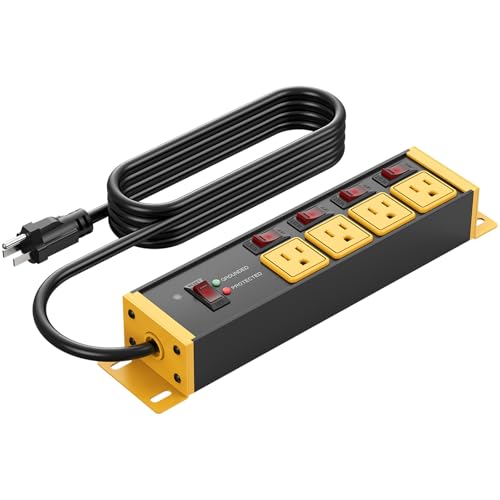
CCCEI 12 Gauge Heavy Duty Surge Protector, Yellow 6FT

CCCEI Magnetic Heavy Duty Surge Protector, Orange 6FT

CCCEI 12 Gauge GFCI Heavy Duty Power Strip, Grey 6FT

Solidock 20 Outlet Power Strip with USB C, White 6FT

popowell Power Strip with USB C, 5FT Flat Plug
CCCEI Industrial GFCI Surge Protector, Yellow 6FT
A Breakdown Of The Leading Choices
When the wall outlet sits halfway across the room and your battlestation lives on the opposite wall, a fifty-foot cord turns a wiring headache into a single plug-in. The CCCEI 12 Gauge Extension Cord with Outlets is built for exactly that situation, with a thick 12-gauge jacket that handles sustained loads without complaint.
Eight grounded outlets run along the body, plus a master switch for full cut-off, and the whole strip is rated for 15 amps at 125 volts. For most home gaming setups, that ceiling never gets close, even with a power-hungry GPU and a console running at the same time.
Well-Handled Touches
- Long reach frees you from rearranging furniture to chase a wall outlet.
- 12-gauge wire stays cool even when the gaming tower, monitor, and console all run at once.
- Eight outlets give breathing room for the full desk, plus a spare for the vacuum or a lamp.
- Bright yellow jacket is easy to spot in a dark room, which helps avoid trip hazards.
Things To Consider
- Coiling fifty feet of cable takes up closet space when not in use.
- Bulkier than a tabletop power strip, so it works best on the floor.
Key Specs
Who It Suits Best
Anyone whose desk sits far from the nearest wall outlet and wants a single plug-in for the entire rig.
Skip It When
Pick the CCCEI 12 Gauge Extension Cord with Outlets, Yellow 100FT instead if your gaming room is in a basement or finished garage where the wall outlet sits even farther away.
Some setups live where the nearest outlet is essentially a rumor: finished basements, detached garages, bonus rooms above the shop. The hundred-foot version of this CCCEI cord answers that problem without skimping on wire quality.
It keeps the same 12-gauge construction and 15-amp rating as the shorter sibling, so distance does not translate into a thinner cable or a weaker connection. Eight grounded outlets and a master switch sit at the far end.
Key Advantages
- Reaches outlets that other power strips simply cannot.
- Twelve-gauge wire holds voltage steady across the full length.
- Eight outlets handle a complete rig plus accessories in one block.
Worth Noting
- Cable management becomes a real chore at this length.
- Routing across a doorway or hallway needs a proper cord cover to avoid tripping.
- Overkill for small bedrooms where the fifty-foot version already reaches.
Made For
Gamers running a setup in a basement, detached garage, or bonus room where the wall outlet is far from the desk.
Look Elsewhere When
The CCCEI 12 Gauge Extension Cord with Outlets, Yellow 50FT is a smarter pick when fifty feet is enough, since it stores more easily and costs less.
Streamers and mobile-heavy gamers tend to run out of wall outlets first, then USB bricks second. This CCCEI strip solves both problems on the same body: four standard outlets, two USB-C ports, and one USB-A, all sharing a six-foot 12-gauge cord.
Each AC outlet has its own switch, so the tower can stay live while the monitor goes dark, and a master switch kills everything at once when the session ends. For desk-side use, it sits where the action is, not on the floor.
A Favorable Mix
- Built-in USB-C and USB-A cut down on charging bricks at the desk.
- Per-outlet switches let you power down peripherals without rebooting the PC.
- Twelve-gauge cord keeps voltage stable even with a hungry GPU pulling peak wattage.
Trade Offs
- Only four AC outlets, so a full tower-plus-console-plus-monitor setup can crowd it quickly.
- USB ports do not fast-charge laptops, so a phone or headset is the realistic ceiling.
Best Suited To
Streamers and content creators who charge a phone, tablet, or controller at the desk alongside a PC and monitor.
Where Another Pick Suits Better
The NANOLAKE 18-outlet strip handles bigger rigs with more AC ports, while this one stays the cleaner pick when USB convenience matters most.
A high-joule rating is the spec that actually matters on a surge protector: it tells you how much energy the strip can absorb before it gives up. The NANOLAKE Surge Protector comes in at 4800 joules, which is a serious number for a home setup.
Eighteen wide-spaced outlets mean chunky power bricks no longer push neighboring plugs off the strip. Two USB-A and two USB-C ports, with one of the C ports supporting 20-watt PD charging, round out a strip that wants to be the only one on the desk.
Real-World Strengths
- 4800-joule rating absorbs repeated small surges that would wear out lesser strips.
- Wide spacing between outlets fits oversized adapters side by side.
- USB-C PD port charges a phone or handheld console quickly without a separate brick.
- Mountable design lets you clip it under the desk for a clean look.
Room For Improvement
- Long body needs serious desk depth or under-mount space.
- LED indicators stay lit at night, which may bother some sleepers.
Quick Facts
Whose Shelf It Belongs On
Anyone with a full multi-monitor streaming rig, multiple consoles, or a home-office-plus-gaming hybrid that needs every outlet it can get.
Not Your Match When
Pick the popowell Power Strip with USB C, 5FT Flat Plug for tighter desks where a long strip simply does not fit.
Some gaming builds pull more current than a standard fifteen-amp circuit wants to deliver. This CCCEI strip handles that case directly: twenty-amp-rated outlets paired with a 12-gauge cord that resists voltage drop.
Four outlets sit along the body, each with its own breaker, and a wall-mountable back panel makes it easy to fix above a workbench or behind a desk. The yellow jacket keeps it visible in a tangle of other cords.
A Few Strong Suits
- Twenty-amp breakers handle high-draw components without nuisance trips.
- Individual switches let you isolate one outlet at a time for service.
- Wall-mountable design keeps cables off the floor.
Points To Note
- Plug is a standard 5-15P, so the strip cannot pull a true twenty amps from a fifteen-amp wall outlet, capping real-world draw.
- Only four outlets, which fills up fast on a typical rig.
Right Fit For
Power users with custom-built rigs drawing peak wattage, or anyone who treats the gaming area like a small workshop.
Consider Something Else When
Pick the CCCEI Industrial GFCI Surge Protector if you want ground-fault protection alongside the high-amp breakers.
Steel-framed desks, computer cases, and metal shelving give this CCCEI strip an unusual trick: a magnet on the back lets it cling to any iron surface. The strip stays where you put it, even with heavy plugs tugging downward.
Four individually switched outlets run along a six-foot, 12-gauge cord, with a master switch that kills everything in one motion. Twenty-amp breakers back each outlet, and the orange jacket stays visible in low-light setups.
Strong Points
- Magnetic back attaches to steel desk legs or PC cases without screws or adhesive.
- Independent switches let you reboot a peripheral without disturbing the rest.
- Twelve-gauge cord holds steady under sustained gaming loads.
Honest Caveats
- Magnet does nothing on wood or plastic surfaces, where a standard screw-mount strip would still work.
- Higher outlet density would have been welcome for larger rigs.
Built With In Mind
Gamers with steel-frame desks, open PC cases, or metal shelving who want the strip mounted without drilling holes.
A Better Fit Elsewhere
Pick the CCCEI 12 Gauge Heavy Duty Surge Protector, Yellow 6FT for setups that need wall mounting more than magnetic mounting.
GFCI, or ground-fault circuit interrupter, cuts power the moment it detects current leaking where it should not. In older homes, garages, or any space where the wiring is a question mark, that protection is worth more than joule count alone.
Eight outlets run along this CCCEI strip on a six-foot, 12-gauge cord, with a twenty-amp master switch and grounding protection layered on top. The grey jacket blends into most setups, which is rare for a strip built for heavy use.
A Strong Showing
- Built-in GFCI protects against ground faults on older or questionable wiring.
- Eight outlets handle a full desktop plus peripherals in one block.
- Twelve-gauge cord stays cool even at high sustained loads.
Softer Spots
- Grey color can be hard to find if the strip ends up behind furniture.
- One master switch means everything powers off together, which some users dislike.
Feature Snapshot
Perfect Match For
Gamers running setups in older homes, converted basements, or anywhere a ground-fault event is a realistic concern.
Swap It Out When
The CCCEI Industrial GFCI Surge Protector fits better if you want both GFCI protection and individual switches per outlet.
Twenty AC outlets plus six USB ports adds up to twenty-six live connections from a single block, which is overkill for most setups and exactly right for command centers. The Solidock strip leans into that count hard.
A 2700-joule rating absorbs everyday surges, the 120-to-240-volt design tolerates international voltage, and a six-foot cord reaches the wall without stretching. The white housing keeps it low-profile next to a PC case.
Good Reasons To Consider
- Twenty-six total ports handle a tower, two consoles, monitors, and a row of peripherals simultaneously.
- USB-C charging supports up to 18 watts, enough for phones and tablets.
- Wide voltage range covers overseas travel setups.
Factors To Consider
- Long body demands desk depth or floor space behind a media unit.
- More ports than most gamers need, so the value depends on how many devices you actually run.
Who Should Grab It
Anyone running a PC plus multiple consoles, monitors, and accessories in one shared space where outlet count matters more than footprint.
Reach For A Different Pick When
Pick the CCCEI Heavy Duty Surge Protector with USB Ports, Black 6FT for a leaner setup that still wants USB convenience.
A flat plug is the small detail that decides whether the strip fits behind a bookshelf or a tight console stand. The popowell strip uses that flat profile, then layers three USB-C and three USB-A ports on top of eight AC outlets.
Total USB output reaches about 22 watts across the bank, so a phone, a tablet, and a controller dock all stay fed at the same time. A 1080-joule rating covers everyday spikes, and the five-foot cord sits at the right length for most desks.
Why It Works Well
- Flat plug slides behind furniture where a standard plug would not fit.
- Three USB-C ports handle modern phones, tablets, and handheld consoles.
- Auto-detect charging sends the right current to each connected device.
Small Caveats
- Joule rating is modest, so it suits typical apartment wiring more than surge-prone older homes.
- Five-foot cord is short for setups with distant outlets.
The Right Fit
Compact apartment gaming nooks and tight media stands where a slim plug profile matters and USB-C is in daily use.
A Better Fit Elsewhere
Pick the NANOLAKE Surge Protector 10ft, 4800J for setups that need higher joule protection and more outlets.
Four outlets with their own twenty-amp switches, GFCI protection, and a heavy-duty 12-gauge cord: that combination lands this CCCEI strip at the intersection of workshop and gaming-room usefulness.
The yellow jacket stays visible behind a desk or above a workbench, and the cord stays cool under load. Overload and grounding protection round out a strip built for environments where the wiring cannot be taken for granted.
The Good Stuff
- Individual switches per outlet let you power-cycle one device at a time.
- GFCI protection adds a second safety layer beyond basic surge suppression.
- Twelve-gauge cord handles sustained draws without heating up.
Where It May Fall Short
- Four outlets is a tight ceiling for a full multi-monitor gaming rig.
- Industrial styling may not blend into a polished entertainment center.
Who Will Love This
Multi-system enthusiasts who run separate circuits for PC, console, and audio gear and want each on its own switch.
Where A Sibling Pick Shines
Pick the CCCEI 12 Gauge GFCI Heavy Duty Power Strip, Grey 6FT when eight outlets in a single block beat the per-plug control of this four-outlet version.
What Matters Most Before Choosing Surge Protectors For Pc Gaming
A gaming PC is one of the most expensive electronics in most homes, which makes the surge protector behind it worth thinking about. Joule rating is the headline number: higher joules mean the strip can absorb more energy before its protection circuitry wears out. A 1000-joule strip is fine for a bedroom lamp, but a gaming rig deserves something in the 2000-joule range at minimum, with higher numbers giving longer service life on surge-prone grids.
Outlet spacing is the next thing most people underestimate. After the tower, monitor, and console are plugged in, the leftover bricks tend to be the wide ones. Wide-spaced outlets prevent the classic “two plugs, one usable socket” headache. USB ports are a bonus, not a requirement, but a USB-C port with Power Delivery can replace a phone charger entirely.
Cord gauge and length should match the room. Twelve-gauge cords carry current more efficiently than the common fourteen or sixteen gauge, which matters more as cord length grows. For a desk six feet from the wall, a six-foot cord is plenty; a finished basement often wants ten feet or more.
For homes with older wiring, a strip with built-in GFCI adds ground-fault protection that the wall outlet may not provide. It is a small upgrade that pays off when a cable frays or a power brick fails.
Key Considerations Across These Picks
Common Shopping Slip Ups
The biggest mistake is treating every power strip as a surge protector. A basic power strip just multiplies outlets; it does nothing when voltage spikes. Look for the words “surge protector” and an actual joule rating on the listing before buying.
Another trap is ignoring the wall outlet’s amperage. A twenty-amp-rated strip still draws from a fifteen-amp breaker, so plugging it into an overloaded circuit causes trips no surge protector can prevent. Distribute the load across separate wall circuits when running a full rig.
Why Top Tier Costs More
The jump from a budget strip to a higher-end pick usually buys three things: more joules, thicker internal wiring, and safety certifications like ETL listing. Each of those adds real protection against both surges and long-term wear.
For most gamers, the upgrade is worth it on the strip behind the tower. A premium strip there protects a thousand-dollar PC; the one behind a bedside lamp can stay basic.
Frequently Asked Questions
How many joules do I actually need for a gaming PC?
For a single gaming tower plus monitor, look for at least 2000 joules. If you also plug in a console, audio gear, and a router in the same strip, 3000 to 4800 joules gives longer protection life.
Is a surge protector the same as a power strip?
No. A power strip only adds outlets. A surge protector adds circuitry that absorbs voltage spikes before they reach your devices. Always check the listing for an explicit joule rating.
Can I plug one surge protector into another?
Avoid daisy-chaining surge protectors. Stacking protection devices can confuse the internal circuitry and may exceed the wall outlet’s amperage limit. Run a single strip per wall outlet instead.
Do gaming PCs really need surge protection?
Yes. Modern GPUs and motherboards are sensitive to voltage spikes, and a single lightning strike or grid event can destroy components that cost more than a decade’s worth of surge protectors. The protection pays for itself the first time it triggers.
What is GFCI and do I need it?
GFCI stands for ground-fault circuit interrupter. It cuts power when current leaks to an unintended path, which matters most in older homes, garages, or anywhere the wiring may be questionable. For typical bedroom setups, a regular surge protector is enough.
Closing Remarks
The right surge protector depends less on specs on paper and more on the room, the rig, and the wiring. A fifty-foot cord solves the wrong problem for a tight bedroom, while a flat-plug strip is pointless in a wide-open basement. Match the strip to the setup, not the other way around, and the gaming gear stays protected through every surge the grid sends.
