

A single close lightning strike can push thousands of volts through home wiring, and that’s a worst-case scenario for any expensive TV, computer, or router plugged into a bare outlet. I put together this list because the difference between a generic power strip and a true surge protector for lightning strikes comes down to joule rating, clamping response, and whether the unit handles AC power, coax, Ethernet, or phone lines. Homes in storm-heavy regions, off-site offices with outdoor cameras, and anyone running a home server or gaming PC will find the right match below.
The Shortlist At A Glance

Belkin Surge Protector Power Strip w/ 12 AC Outlets & 8ft Flat Plug, 3,940 Joules

Belkin Surge Protector Power Strip w/ 8 Rotating & 4 Standard Outlets, 4320 Joules

Amazon Basics Surge Protector Power Strip, 6 Outlets, 2 USB Ports, 1000 Joule

Belkin Power Strip Surge Protector, 12 AC Outlets, 10 ft Flat Plug, 4,156 Joules

20KA Ethernet Surge Protector Gigabit, 2 Pack PoE++ RJ45 Lightning Arrestor

LIDER Outlet Extender with 4 Receptacles, USB-A & 2 USB-C, 5ft Cord
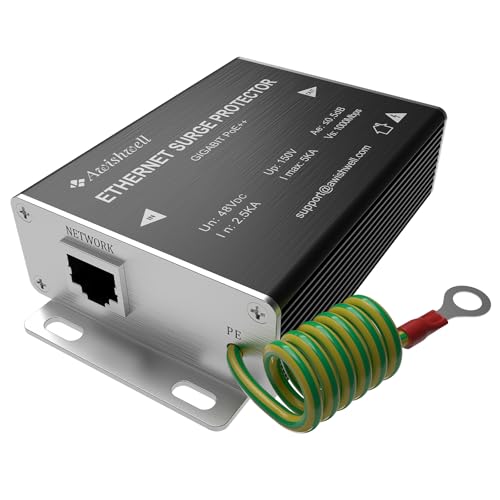
Gigabit Ethernet Surge Protector, 5KV PoE+ RJ45 Lightning Arrester

Gigabit PoE++ RJ45 Surge Protector, 2 Pack 20KA Lightning Arrestor
What Each Pick Brings To The Table
Belkin’s 12-outlet strip is the kind of workhorse I lean on when a single desk needs to host a tower, two monitors, a printer, and a charging dock without juggling wall adapters. The 8-foot flat plug slides behind a bookshelf or media cabinet where a standard plug head would never fit, and the 3,940-joule rating (joules measure how much energy the unit can absorb before its protection wears out) puts it firmly in surge protector territory, not just power strip territory. Compared with the rotating Belkin below, this model trades pivot flexibility for higher overall outlet count.
The six block-spaced outlets across the center keep chunky plugs from colliding, which matters once you start plugging in laptop bricks and camera chargers side by side. For most home offices and entertainment nooks, this is the one I’d mount and forget about.
Where It Excels
- 3,940-joule rating absorbs repeated small surges without burning out the MOV components inside.
- 12 outlets split into block-spaced and standard banks, so two large bricks can sit next to each other.
- 8-foot flat plug tucks behind furniture where depth matters.
- Phone-line protection adds a layer for anyone still running a fax or DSL modem.
Worth Noting
- No USB ports, so phones and tablets still need their own wall adapters.
- Owners commonly report the strip runs warm during heavy loads, which is normal for the MOV design but worth knowing.
Who It Suits Best
Home office workers and media enthusiasts running six to ten devices at once benefit most from the high outlet count and steady joule capacity.
Consider Something Else When
Anyone whose desk is dominated by USB-C laptops and tablets will find the LIDER Outlet Extender a more streamlined fit for daily charging.
Where most surge strips waste space because bulky laptop chargers overlap, this Belkin rotates eight of its twelve outlets sideways to clear the neighbor. The 4,320-joule rating edges out the 12-outlet Belkin above, and the sturdy 8-foot cord with flat pivot plug makes routing around a corner desk much less painful. For a workspace stacked with charging bricks and wall warts, the pivot design is the quiet upgrade.
The four fixed outlets in the corners handle slim cables that don’t need rotation, so nothing feels wasted. Anyone running a home recording setup or gaming PC will appreciate how clean the back of the desk looks once all bricks face outward.
Why It Works Well
- 4,320-joule capacity handles stronger surge events than the entry-level Belkin above.
- Eight pivoting outlets clear oversized plugs without covering neighboring sockets.
- Flat pivot plug sits flush against baseboards and tight wall cavities.
- Twelve outlets total leave room for future gear like a stream deck or USB hub.
Trade Offs
- Pivot mechanism adds slight bulk, so mounting under a shallow shelf can be tight.
- Higher joule rating doesn’t mean longer warranty coverage in every region.
Right Fit For
Gaming PC owners and remote workers with multiple laptop bricks and monitor power supplies benefit most from the rotating layout.
Reach For A Different Pick When
Anyone whose setup relies on coax-fed cable TV should look at the Belkin Power Strip Surge Protector with 10-foot cord and coax protection for full signal coverage.
This Amazon Basics strip is what I’d grab for a guest room or college dorm where the gear list includes a lamp, a laptop, a phone, and maybe a small fan. The two USB ports built directly into the face save a wall adapter, and the 1,000-joule rating is honest about its limits: this is everyday protection, not a fortress for a $3,000 home theater. The 6-foot cord reaches behind a nightstand without forcing the strip onto the floor.
Where the bigger Belkins above aim at performance, this one trades joule count for built-in convenience. For a kitchen counter or bedside table, that trade usually makes sense.
Useful Highlights
- Two USB-A ports handle phones and e-readers without extra adapters.
- Compact housing fits on a desk edge or nightstand without hogging surface area.
- Six-foot cord reaches outlets that sit awkwardly behind dressers.
- Lightweight shell is easy to mount with a single screw or adhesive strip.
Points To Note
- 1,000-joule rating is on the low side for areas with frequent summer storms.
- USB ports share output, so charging two tablets simultaneously slows each one down.
Made For
Dorm residents and renters who need USB charging alongside basic outlet expansion benefit most from this compact, low-joule strip.
Skip It When
Storm-region homes with frequent outages should consider the 12-outlet Belkin with 3,940 joules for a stronger safety margin.
The 10-foot cord on this Belkin solves a problem most people don’t realize they have: a wall outlet that’s a foot too far from the TV stand or desk. Combined with 4,156 joules of surge absorption and 12 outlets, this strip covers an entire entertainment center, including the cable box, soundbar, console, and 4K TV. Built-in coax and phone-line protection round out the package for anyone whose signal enters the room through a coax jack.
For living rooms where a single surge event could fry a TV worth more than the strip itself, the heavy-duty framing is justified. The trade-off is size: this is a long bar that wants floor or shelf space, not a tight nightstand perch.
Advantages To Know
- 10-foot cord reaches outlets positioned far from the entertainment center.
- 4,156-joule rating handles stronger transient events than most 12-outlet competitors.
- Coaxial surge protection shields a cable line that lightning often uses as an entry point.
- Phone-line protection covers fax machines, DSL modems, and alarm panels.
A Few Limitations
- 10-foot cord can look messy if not routed along a baseboard or cable channel.
- Larger housing means it won’t fit on a small media shelf.
Feature Snapshot
Best Suited To
Home theater owners and anyone whose cable or satellite line enters the house overhead will appreciate the coax pathway protection most.
Where Another Pick Suits Better
Anyone whose sensitive gear sits on a desktop with USB-C laptops should look at the LIDER Outlet Extender for a tighter footprint.
An AC surge strip protects gear plugged into the wall, but a long outdoor Ethernet run is its own lightning highway. Awishwell’s two-pack inline surge arrestor clamps down on transients traveling along Cat5e or Cat6 cable, with a 20KA peak surge current rating and PoE++ passthrough for powered cameras and access points. The 10KV surge protection (a measure of how much voltage the unit can shunt to ground before failing) gives outdoor installers a real margin against close strikes.
Unlike the AC strips earlier in this list, this lives in the network closet or junction box, not on the desk. Anyone running outdoor PoE cameras should consider it as essential as a weatherproof junction box.
Positive Points
- 20KA peak surge current handles the largest common lightning-induced transients on cable runs.
- Full Gigabit passthrough means no bottleneck on a 1,000 Mbps network link.
- PoE++ 802.3af/at/bt compatibility supports 60W and higher powered devices inline.
- Two-pack value covers both ends of a long outdoor cable run.
Points To Keep In Mind
- Requires proper grounding to function: an ungrounded coax or Ethernet shield can re-route the surge into the device it was meant to protect.
- Inline form factor takes up space in a structured media enclosure.
Perfect Match For
Outdoor security camera installers and rural homeowners with long PoE runs to remote access points benefit most from the high surge rating.
A Better Fit Elsewhere
Anyone who only needs protection on a short indoor Ethernet link should look at the 5KV single-port Awishwell Gigabit Ethernet Surge Protector below.
The LIDER extender sits in a different category from the heavy Belkins above: it converts a single wall outlet into four AC receptacles plus three USB ports, including two USB-C jacks for modern laptops and tablets. The 1,250W power budget handles a desk lamp, monitor, and laptop without breaking a sweat. For hotel rooms, cruise cabins, and kitchen counters, the wall-mount cube form is what makes it shine.
Travelers who carry a laptop, phone, watch, and earbuds case at all times will appreciate having one plug handle the whole kit. The 5-foot cord adds placement flexibility that wall-cube extenders usually lack.
What It Does Well
- Two USB-C ports deliver Power Delivery for fast-charging laptops and tablets.
- Compact cube body fits behind a hotel desk or on a kitchen counter without dominating the space.
- 1,250W capacity covers a monitor, lamp, and laptop on the same outlet.
- 5-foot cord reaches shelves and nightstands that sit away from the wall.
Honest Caveats
- No listed joule rating, so the surge protection ceiling is unclear for stormy regions.
- Cube shape means three-prong plugs on adjacent outlets may still crowd each other.
Feature Card
Whose Shelf It Belongs On
Frequent travelers and small-apartment dwellers who prioritize USB-C charging alongside a few AC outlets benefit most from this compact cube.
Where Another Pick Suits Better
Anyone in a lightning-prone region needing real joule-rated AC protection should grab the Belkin Power Strip with 4,156 joules instead.
Where the 20KA Awishwell above targets outdoor runs, this single-port 5KV model is the right size for indoor network closets and home offices. Inline RJ45 protection guards a router, NAS, or switch against transients that arrive through a building’s Ethernet wiring, and PoE+ 802.3af/at compatibility keeps a powered access point working through the same port.
For most home networks, a single inline arrestor on the line entering the rack is enough. The compact body slots into a structured media enclosure without a dedicated mounting plate.
Useful Strengths
- 5KV surge protection handles common indoor transient events without overpaying for outdoor rating.
- Gigabit passthrough preserves full link speed for streaming and NAS traffic.
- PoE+ compatibility supports access points and VoIP phones inline.
- Compact inline housing fits behind a desk or inside a structured media panel.
Things To Weigh
- Single-port design means buying two units for both ends of a long indoor run.
- Lower 5KA peak surge current than the 20KA model, so outdoor deployment is not advised.
Who Should Grab It
Home network owners with a single indoor Ethernet backbone and a rack-mounted NAS or router benefit most from the lighter-duty rating.
Swap It Out When
Anyone running an outdoor PoE camera or wireless bridge should pick the Awishwell 20KA 2-pack for stronger outdoor-rated protection.
This second Awishwell 20KA two-pack mirrors the earlier model’s core specs but arrives in a configuration that suits both ends of a cable run at the rack or junction. PoE++ 802.3af/at/bt passthrough supports the highest-wattage powered devices, including outdoor PTZ cameras and long-range wireless bridges. Two units in one box means the indoor side and outdoor side of a long run can both be protected.
For structured cabling installs, buying the two-pack often lines up with the project’s natural shape: one unit at the camera end, one at the switch end. That’s usually where surges enter from either direction.
The Good Stuff
- Two-pack format covers both ends of a long Ethernet run in one purchase.
- 20KA peak surge current absorbs the largest common lightning transients on cable.
- PoE++ passthrough supports 60W and higher powered devices inline.
- Gigabit speed preservation keeps throughput intact on 1,000 Mbps links.
Practical Considerations
- Effective grounding is mandatory; without it, the unit can re-route the surge into the device.
- Inline housings need mounting space in a structured media enclosure or junction box.
Built With In Mind
Network installers and homeowners running long outdoor PoE runs to cameras or wireless bridges benefit most from the matching two-pack format.
Where Another Pick Suits Better
Anyone whose network gear stays indoors with a short cable run should consider the 5KV single-port Awishwell for a lighter-duty match.
Choosing The Right Surge Protectors For Stormy Climates
The first number worth understanding is the joule rating, which tells you how much energy the protector can absorb before its internal components wear out. Higher joules mean longer real-world life under repeated small surges, and for storm-prone regions, 2,000 joules is a sensible floor for home entertainment centers and computers.
Second, match the protector to the lines your devices actually use. A coax-fed cable TV, a DSL phone line, or a long outdoor Ethernet run can each carry a surge that bypasses an AC protector entirely. Homes with rooftop satellite dishes or outdoor cameras need surge coverage on those signal lines too.
Third, look at response time and clamping voltage. A faster MOV (metal-oxide varistor, the component that absorbs the surge) reacts in nanoseconds and clamps the spike down to a level the connected device can survive. Most reputable strips list a clamping voltage around 400V or lower.
Finally, think about outlet layout. Rotating outlets are a real convenience for laptop bricks, but they add bulk. For desk setups with mixed USB-C and AC gear, a hybrid extender often cleans up cable spaghetti better than a long 12-outlet bar.
Key Considerations Across These Picks
Wrong Turns To Avoid
A common misstep is buying a power strip with no joule rating at all and assuming it protects gear the same way. Power strips and surge protectors are not the same product, and the cheapest multi-outlet bars often have no surge absorption at all. Another mistake is forgetting signal lines: a $1,500 TV plugged into a 4,000-joule strip can still die if the coax feed carries the surge, since the AC protector never sees it.
Where The Extra Money Goes
Higher-tier models earn their price through stronger internal MOVs, faster clamping, and additional protected pathways like coax and Ethernet. The jump from a 1,000-joule dorm strip to a 4,000-joule Belkin also brings sturdier housings, longer cords, and warranty coverage that the budget tier typically skips. For gear that costs ten times the price of the protector, the upgrade pays for itself the first time a storm rolls through.
Frequently Asked Questions
How many joules do I really need for lightning protection? Aim for at least 2,000 joules for home entertainment or computer gear, and 3,000+ joules in regions with frequent summer storms or nearby tree strikes.
Will a surge protector actually survive a direct lightning hit? No consumer surge protector is rated for a direct strike. They handle the induced surges that travel through wiring after a nearby bolt, which is what fries most unprotected electronics.
Do I need Ethernet and coax protection too? Homes with cable TV, satellite dishes, outdoor cameras, or wired networking benefit from signal-line protection because surges often enter through those lines before the AC side.
How long does a surge protector last? The internal MOVs wear down with each absorbed surge, and most manufacturers recommend replacement every three to five years in active storm regions, or after a known large surge event.
Can I daisy-chain two surge protectors together? It’s not recommended. Plugging a surge strip into another surge strip can cause the upstream unit to wear out faster and may violate the product’s safety listing.
