

A reliable fuse panel is one of those quiet upgrades that prevents the worst kind of day on the water. Boats, RVs, golf carts, and off-grid trailers all draw power from the same kind of 12V/24V DC circuits, and a clean fuse block keeps navigation lights, bilge pumps, fish finders, and cabin outlets from fighting over a single overloaded wire. The ten panels below cover everything from compact 4-circuit boxes for small skiffs to 12-circuit blocks for serious rewiring projects. I’ve sorted through the specs, mounting styles, and indicator features so you can match the right panel to the way you actually use your boat.
A Closer Look At The Lineup

UCkasayfy 12 Way Fuse Block with LED Indicator

UCkasayfy 12 Way Fuse Block with LED Display

UCkasayfy 6 Way Fuse Block with LED Display

WUPP 12 Volt Marine Fuse Block with Negative Bus

SOYOND 12 Volt Marine Fuse Block with Damp-Proof Cover

DaierTek 12V 6 Way Marine Fuse Block with LED Indicator

FASTSTORM 12 Way Fuse Block with Label Stickers
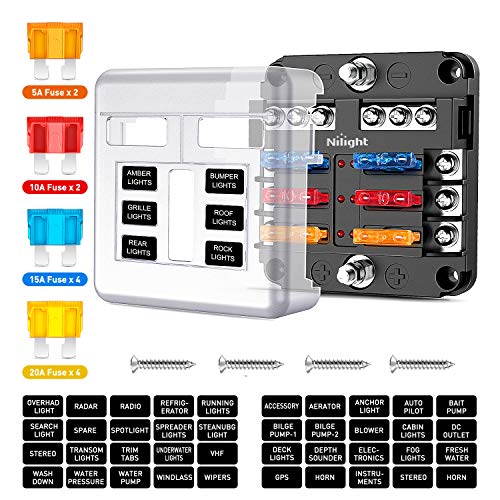
Nilight 50055F 6 Way Blade Fuse Block with Negative Bus

Chatovalo 6 Circuit Fuse Box with Pre-Installed Fuses

YEZriler 4 Circuit Waterproof Marine Fuse Panel
A Breakdown Of The Leading Choices
Twelve circuits is the kind of headroom that turns a full rewire into a tidy, labeled job rather than a tangle of add-ons. The UCkasayfy 12 Way Fuse Block runs on 12V to 32V DC systems, which means it slides into nearly any marine or automotive setup without voltage converters or rewiring gymnastics.
Each circuit gets its own ATC/ATO blade fuse slot, and an LED indicator glows when a fuse pops. The build leans toward heat-resistant, mechanically strong construction, and the per-circuit rating of 30A with a 100A total panel limit handles most accessory loads you’d realistically stack on a center console. Compared with the smaller 6-circuit blocks later in this list, this one trades a wider footprint for breathing room as your electronics grow.
What Stands Out
- Twelve independent circuits let you separate nav lights, pumps, and electronics cleanly
- LED indicators on every circuit speed up troubleshooting at the dock
- 32V max input covers both 12V and 24V marine battery banks
- 30A per circuit covers most accessory loads without upgrade planning
Trade-Offs Worth Weighing
- Larger footprint demands dedicated mounting space behind the helm
- No integrated voltage readout, so a separate meter may be needed
- Cover design and waterproofing details vary across owner setups
Built With In Mind
Boat owners rewiring a console-heavy rig with separate runs for electronics, lighting, and pumps.
Look Elsewhere When
The UCkasayfy 6 Way Fuse Block with LED Display is a tighter fit for compact dash installs with fewer circuits.
Adding a real-time voltage readout to a fuse panel is a small touch that pays off every time you’re anchored at a quiet cove wondering how much battery you have left. The UCkasayfy 12 Way Fuse Block with LED Display carries the same 12-circuit backbone as the first entry, but layers a 5V to 32V battery monitor on top.
That screen means you can catch a slow-dropping alternator or a parasitic draw before it strands you. Independent circuits and terminal distribution keep each accessory protected, and the voltage range lines up with most deep-cycle marine banks. For someone already thinking about energy budgets, having the number on the panel itself removes one more piece of gear to mount.
Points In Its Favor
- Live voltage display removes the need for a separate battery monitor
- Twelve circuits support full-boat rewire projects
- Wide 12V to 32V DC compatibility covers most setups
- Per-circuit protection keeps a single fault from cascading
Soft Spots To Note
- Display adds cost over a plain LED-indicator block
- Reading may be tough in direct sun glare on open consoles
- Larger housing needs solid mounting space
Key Specs
Whose Helm It Belongs On
Anglers and cruisers who want battery status visible at a glance without bolting on a separate monitor.
Swap It Out When
The SOYOND 12 Volt Fuse Block suits boaters who want nickel-plated copper hardware more than a voltage screen.
Six circuits is plenty for a small fishing boat, a kayak trolling motor rig, or a weekend trailer with a couple of accessories. The UCkasayfy 6 Way Fuse Block keeps the voltage display feature from the larger 12-way model while shrinking the box to fit tighter helm spaces.
It still covers 12V to 32V DC systems, so there’s no penalty for running it on either common marine voltage. ATC/ATO blade fuse compatibility means replacement fuses are everywhere, and the LED voltage screen offers the same early-warning value for battery health. For boaters who don’t need a dozen circuits but still want the readout, this is the natural mid-point.
Notable Gains
- Voltage readout on a small-footprint panel
- Six circuits cover typical small-boat accessory lists
- Universal 12V to 32V DC compatibility
- Compact form factor for tight dashes
Worth Bearing In Mind
- Limited headroom for adding more accessories later
- No cover mentioned in available details
- Display visibility depends on mounting angle
Right Fit For
Compact skiff or jon boat owners adding nav lights, a fish finder, and a bilge pump on a tidy harness.
A Better Fit Elsewhere
The YEZriler 4 Circuit Waterproof Marine Fuse Panel suits even tighter installs with just a few accessories.
The damp, splashy reality of an open boat is exactly what the WUPP 12 Volt Fuse Block is built for. It carries six circuits, a negative bus for cleaner return wiring, and a damp-proof cover that snaps over the fuses to keep spray and morning dew from settling on the contacts.
Each fuse position has an LED warning indicator, so when something trips, you can spot the bad circuit without pulling the cover and testing every fuse. The 12V to 24V DC operating range covers the most common marine battery setups. This panel rewards anyone who parks in the slip, splashes through rain runs, or fishes out of an open center console where water and salt air are constant companions.
Everyday Wins
- Damp-proof cover protects fuse contacts in open boats
- Negative bus simplifies return wiring
- LED warning indicators speed troubleshooting
- Six circuits handle typical accessory loads
- Wide compatibility with 12V and 24V marine systems
Possible Compromises
- Some owners report a faint LED glow even with no fuse installed
- Cover adds bulk compared to open-frame blocks
At A Glance
Best Suited To
Open-boat anglers and weekend cruisers who deal with spray, rain, and splash routinely.
Not Your Match When
The Nilight 50055F 6 Way Blade Screw Fuse Block is a smarter pick for trailer owners who prefer screw-terminal wiring.
Where SOYOND earns its keep is in the metalwork. The SOYOND 12 Volt Fuse Block uses nickel-plated copper busbars and fuse clips, which is the right call for any boat that spends time in saltwater air. Corrosion resistance is the difference between a fuse block that still clicks cleanly after five seasons and one that has green fuzz on every contact.
Six circuits, a damp-proof cover, and a negative bus make this a complete marine wiring package. A red LED warning light flags the blown fuse the moment a circuit fails, and the 30A per-circuit, 150A per-panel rating supports heavier accessory loads. Compared with the WUPP block above, this one trades brand familiarity for upgraded internal hardware.
Real Benefits
- Nickel-plated copper busbars resist corrosion in saltwater
- 150A panel rating handles heavier accessory banks
- Damp-proof cover keeps moisture off contacts
- Negative bus simplifies return-wire routing
- LED warning light for at-a-glance fault finding
Small Caveats
- Higher current ratings may exceed needs on small boats
- Larger terminal block footprint
Perfect Match For
Saltwater boaters and liveaboards who need internal hardware that holds up to corrosion year after year.
Consider Something Else When
The Chatovalo 6 Circuit Fuse Box is a friendlier match for casual freshwater weekend use with pre-installed fuses.
The DaierTek 12V Fuse Block arrives with a small but meaningful bonus: a full set of blade fuses in the box. Twelve fuses in mixed ratings ship with the panel, which removes the “gotta run to the store” step from a first install.
Six circuits cover the basics, and LED indicators flag the blown fuse fast. A waterproof cover keeps spray off the contacts, and the 30A per-circuit rating matches the rest of the 6-way field. The two-pack option is genuinely useful for someone wiring a boat and a trailer on the same weekend.
Reasons It Performs
- Twelve blade fuses included in mixed amperages
- Two-pack option supports multi-project wiring
- LED indicator for each circuit position
- Waterproof cover protects from spray
- 30A per-circuit headroom for most accessories
Honest Caveats
- No negative bus in the available specifications
- Cover design varies across production runs
Who Should Grab It
First-time installers and DIYers who want fuses in the box and a clean wiring start without extra trips.
Where Another Pick Suits Better
The WUPP 12 Volt Marine Fuse Block is the smarter choice when a negative bus is non-negotiable.
Labeled circuits are the kind of upgrade you only think about after you’ve spent twenty minutes tracing a wire at dusk. The FASTSTORM 12 Way Fuse Block ships with sticker labels you can apply to the cover, so every circuit gets a name you can read without flipping back to a wiring diagram.
Twelve circuits handle a full accessory inventory, the LED indicators light up when a fuse blows, and the 36 included blade fuses mean the box arrives ready for a long install. Water-resistant construction fits a range of marine and automotive environments, from center consoles to RV bays. Compared with the UCkasayfy 12-way models earlier, this one leans on documentation over a voltage readout.
Why It Works Well
- Circuit labels turn out a clean, readable fuse box
- 36 included blade fuses cover most wiring projects
- Twelve circuits for full accessory separation
- LED indicators speed up fault diagnosis
- Water-resistant build for marine use
Trade-Offs To Consider
- No voltage readout on the panel itself
- Sticker labels can fade in direct sun over time
Who Will Love This
First-time installers wiring a new accessory loadout who want labeled, organized circuits without guesswork.
Reach For A Different Pick When
The UCkasayfy 12 Way Fuse Block with LED Display suits users who care more about voltage monitoring than labels.
Screw terminals make a real difference on a fuse block that lives under a truck seat or inside a trailer tongue. The Nilight 50055F 6 Way Blade Fuse Block uses screw-down connections that hold tight through vibration better than some push-on designs, and the negative bus keeps return wiring tidy.
Six circuits run on 12V automotive systems with a 30A per-circuit ceiling and 100A total panel capacity. LED indicators point at the failed fuse the moment a circuit trips, and the cover meets common ABYC (American Boat and Yacht Council) and USCG (United States Coast Guard) safety expectations for insulated fuse access. For trailer owners and tow-vehicle builders, the screw terminals are a quiet but meaningful upgrade.
Positive Points
- Screw-terminal connections hold firm through vibration
- Negative bus included for cleaner wiring
- Cover design meets ABYC and USCG insulation standards
- LED warning indicators on every circuit
- 30A per-circuit capacity covers most accessories
Potential Drawbacks
- No built-in voltage readout
- Screw terminals slow install compared to plug-in designs
Made For
Trailer owners, RV builders, and tow-vehicle upfitters who need rugged, vibration-resistant fuse wiring.
Skip It When
The SOYOND 12 Volt Fuse Block suits saltwater boaters who want corrosion-resistant busbars more than screw clamps.
Pre-installed fuses sound like a small thing until you’re halfway through a wiring job and realize you’re out of 15A blades. The Chatovalo 6 Circuit Fuse Box arrives with twelve ATC/ATO fuses already seated in the panel, in a useful mix of 5A, 10A, 15A, and 20A ratings.
The 100A total panel capacity and 30A per-circuit ceiling match the broader 6-way class, and 12V to 24V DC compatibility covers standard marine and automotive systems. LED warning indicators flag the bad circuit, and the 32V max voltage rating offers some overhead on bigger banks. For weekend projects where the goal is a tidy, working fuse box by Sunday afternoon, the pre-installed fuses shave real minutes off the job.
What Pays Off
- Twelve fuses included and pre-installed
- Mixed fuse ratings cover common accessory loads
- LED indicators simplify fault diagnosis
- 30A per-circuit, 100A total capacity
Where It May Fall Short
- Compact 4-circuit variant offers even smaller footprint
- No negative bus in the listed features
Who It Suits Best
Weekend warriors and casual installers who want a plug-in-and-go fuse panel without sourcing extra parts.
Where A Sibling Pick Shines
The DaierTek 12V 6 Way Marine Fuse Block delivers a similar pre-fuse convenience with a two-pack option.
Sometimes four circuits is the honest answer. The YEZriler 4 Circuit Waterproof Marine Fuse Panel targets the smallest installs: a tiller boat with nav lights and a fish finder, a kayak trolling motor rig, or a side-console jon boat running a bilge pump and a stern light. The single-side stud input keeps wiring simple, and a spare fuse slot sits ready for a quick add-on later.
A damp-proof cover wraps the fuses, LED indicators flag the bad circuit, and the 12V to 24V DC compatibility lines up with most small marine battery banks. Compared with the 6-way blocks earlier, this panel trades expandability for a smaller, simpler footprint that fits where larger boxes simply won’t.
Standout Benefits
- Ultra-compact 4-circuit layout for tight installs
- Single-side stud input simplifies wiring
- Spare fuse slot for future accessories
- Waterproof cover protects fuse contacts
- LED indicator for fast fault diagnosis
Limitations To Acknowledge
- Limited headroom for accessory expansion
- Smaller current ceiling than larger blocks
Right Fit For
Small-boat owners running minimal electronics who want a tidy fuse box that disappears behind a panel.
Look Elsewhere When
The Chatovalo 6 Circuit Fuse Box is the smarter pick if you expect to add circuits in the next year or two.
What To Weigh Before Choosing A Marine Fuse Block
Circuit Count And Future Expansion
The honest answer to “how many circuits do I need?” is to count the accessories you have today, then add two. Trolling motors, fish finders, nav lights, bilge pumps, spreader lights, USB chargers, and VHF radios all want their own fuse and switch. A 12-way block costs a little more upfront but saves the hassle of mounting a second panel when the electronics list grows. A 4- or 6-circuit block fits a small skiff today but can run out of room fast.
Voltage Range And Marine Battery Compatibility
Most marine and automotive battery banks run at 12V DC, but some cruisers move to 24V DC systems for longer cable runs and less voltage drop. A panel rated 12V to 32V DC handles either without complaint. The “32V” ceiling is a safety margin that lets the panel shrug off the brief voltage spikes that happen when an alternator drops offline and a battery absorbs a charging surge.
Indicators, Monitors, And Damp-Proofing
LED warning indicators save time. When a fuse pops, you can spot the dark circuit in seconds rather than pulling and testing each fuse. A live voltage readout goes a step further, catching slow alternator failures or parasitic draws before they leave you stranded. Damp-proof covers matter most on open boats, center consoles, and any install near a bilge, where condensation and spray are routine.
Negative Bus, Terminals, And Mounting
A negative bus bar turns the panel into a single ground point, which simplifies wiring and reduces the chance of a mysterious ground loop. Screw terminals hold firm through trailer and tow-vehicle vibration better than push-on connectors. For marine installs, look for panels that meet common ABYC and USCG insulation standards, which means the cover protects fingers and fuses from accidental shorts and moisture at the same time.
Key Considerations Across These Picks
Common Shopping Slip Ups
Picking a panel by circuit count alone is the most common mistake. A 6-way block sounds like plenty until you realize you also want a separate fuse for the livewell pump, the spreader lights, and the USB charger. Equally common is forgetting that an LED indicator panel still needs a fuse holder you can actually reach to swap a popped fuse in the field. Always confirm the cover opens cleanly with the panel mounted, and that the spare fuse slot is large enough for the blade fuses you plan to stock.
Where The Extra Money Goes
The jump from a basic 6-way block to a feature-rich 12-way panel usually buys three things: a voltage readout, corrosion-resistant busbars, and a damp-proof cover. For a freshwater weekend boat, the basic block is plenty. For a saltwater cruiser, liveaboard, or anyone wiring a serious accessory loadout, the upgrade pays for itself the first time a corroded fuse clip leaves you troubleshooting in the dark. The cost difference is real, but so is the reliability gap.
Frequently Asked Questions
How many circuits do I really need on a small boat?
Count your accessories, then add two for future add-ons. A typical small center console running nav lights, a bilge pump, a fish finder, and a VHF radio is well served by a 6-circuit block. Anything with trolling motors, spreader lights, USB chargers, and cabin outlets leans toward 12 circuits.
What’s the difference between ATC and ATO fuses?
ATC and ATO refer to the same blade-fuse style (the flat plastic body with two metal prongs) and are interchangeable in most marine fuse blocks. The “C” in ATC originally indicated a hard plastic body, while “O” referred to the original open design. For replacement purposes, either label works on these panels.
Do I need a fuse panel with a voltage display?
Voltage displays help if you fish for hours at anchor and want a quick battery check without mounting a separate monitor. They are less critical on trailered boats that get topped off between trips. For liveaboards and offshore anglers, the readout is worth the modest upgrade.
Can I use an automotive fuse block on a boat?
Yes, with conditions. Automotive blocks handle the same 12V DC and share fuse styles, but marine panels add damp-proof covers, sealed connections, and corrosion-resistant hardware that hold up to spray and salt air. For any open-boat or saltwater install, a marine-rated panel is the safer choice.
How do I know when a circuit fuse has actually blown?
The LED warning indicators on these panels go dark the moment a fuse pops, which is the fastest way to identify the failed circuit. Without an indicator panel, you would need to pull and visually inspect each blade fuse, looking for the broken metal link inside the plastic body, or test with a multimeter.
The Takeaway
The right marine fuse panel comes down to honest circuit math, voltage range, and how much water the panel has to shrug off. A small skiff running four accessories is happy with a compact 4- or 6-way block; a console-heavy rig with separate electronics, lighting, and pump circuits calls for 12. Match the panel to the boat, not the other way around, and the wiring will quietly do its job for years.
