

A solid battery cable lug is the small part doing the big work: it has to grip the cable, carry the current, and stay put through vibration, heat, and weather. I’ve talked to enough people wiring car audio, marine battery banks, off-grid solar setups, and weekend repair projects to know that a loose or undersized lug is the first place a system starts losing voltage.
Choosing a lug gets confusing fast because the same box of copper looks right whether you’re working with a 4 AWG accessory feed or a heavy 1/0 inverter run. Cable gauge (wire thickness), stud size, copper purity, and whether the lug is bare or tinned all change how the joint performs over time.
That’s why this list exists. I pulled together ten battery cable lugs that cover the most common combinations of gauge, stud size, and finishing style, with notes on what each one actually does well and where it’s the wrong tool. Skim the picks table, then dig into the reviews that match your setup.
An Overview Of The Picks

SELTERM 25pcs 4 AWG Bare Copper Cable Lugs

SELTERM 6 AWG Tinned Copper Lugs with Heat Shrink Kit

RED WOLF 1/0 Gauge Copper Ring Terminals Kit
TKDMR 1/0 AWG 3/8″ Copper Ring Terminals

SELTERM 25pcs 2 AWG 3/8″ Bare Copper Cable Lugs

Sanuke 4 Gauge 3/8″ Ring Terminal Lugs

SVAAR 1/0 and 2/0 AWG Copper Lugs Kit

SVAAR 4 6 8 AWG UL Listed Cable Lugs

Bare Copper Lugs 2 4 6 Gauge 72pc Kit
SELTERM 4/0 AWG Marine Tinned Copper Lugs
A Closer Look At Each Pick
This 25-pack of 4 AWG bare copper lugs lands right in the middle of the gauge range most people actually use. The 5/16″ stud fits a wide spread of battery posts and distribution blocks on trucks, SUVs, and mid-sized boat setups. Because the copper is annealed (heat-softened for better forming), it crimps tightly and holds its shape under vibration.
I think of these as the everyday lug, the one that handles trailer rewires, dual-battery installs, and replacement runs without anyone thinking too hard about it. The bare copper finish solders cleanly and crimps predictably with a hex die. For someone planning a single weekend project, a 25-count gives margin for mistakes plus leftovers for the next job.
Key Advantages
- 25-count pack is generous for a one-off project and leaves spares for later repairs.
- 4 AWG suits most accessory feeds: amplifier wiring, winches, and small inverter loads.
- Annealed copper crimps tightly and takes solder cleanly for hybrid join methods.
- 5/16″ stud matches many OEM-style posts and bus bars, reducing adapter fuss.
- OEM-accepted design points suggest consistent dimensional tolerances batch to batch.
Points To Note
- Bare copper will oxidize (tarnish) faster than tinned versions in damp engine bays or marine bilges.
- No heat shrink tubing included, so insulation materials must be sourced separately.
Who It Suits Best
Shade-tree mechanics and home installers running 4 AWG accessory cable in dry or protected locations will get dependable, no-frills performance from this SELTERM pack.
Look Elsewhere When
Boat owners and outdoor solar users see better long-term corrosion resistance from the SELTERM 25pcs 6 AWG Tinned Copper Lugs with Heat Shrink Kit, which ships with adhesive-lined shrink tubing.
Where the SELTERM 25pcs 4 AWG Bare Copper Cable Lugs above are an all-purpose pick, this kit is the moisture-aware version. The tin plating (a thin protective layer over the copper) resists corrosion in damp engine bays, bilge areas, and outdoor enclosures, and the included 108-piece heat shrink assortment covers 3/4″, 1/2″, and 5/8″ tubing for sealing and strain relief.
The 6 AWG size is the common middle ground for accessory circuits, lower-amp inverters, and trailer harnesses. For anyone building a small marine bus or a backyard solar battery box, having lugs and matching adhesive-lined shrink in one box removes the most common excuse for skipping proper sealing.
What Works In Its Favor
- Tinned copper resists salt and humidity, helping joints stay low-resistance over time.
- Adhesive-lined 3:1 shrink tubing (shrinks to one-third its original diameter) seals the crimp area against moisture creep.
- 108-piece tubing assortment in three diameters handles varied cable and lug combinations.
- OEM-accepted construction aims at consistent tolerances for repeatable crimps.
- Lower gauge count keeps the kit focused on common mid-sized projects rather than specialty work.
Honest Caveats
- Tin plating adds cost compared with bare copper, so this kit costs more per lug than simpler packs.
- 1/4″ stud size is small, so users running 3/8″ or 5/16″ posts need a different lug or adapter.
- 6 AWG tops out around modest inverter loads, so heavier battery banks need a thicker gauge.
Made For
Boat owners and off-grid solar builders who want tinned copper and a full shrink assortment in one package without hunting for matching parts.
A Better Fit Elsewhere
Shop owners restocking a bin of mixed gauges may prefer the Bare Copper Lugs 2 4 6 Gauge 72pc Kit, which covers three gauges without the marine-focused extras.
This is the lug kit for serious current. RED WOLF packs both 3/8″ and 5/16″ stud versions of the 1/0 gauge lug in one box, plus twelve pieces of 3:1 adhesive heat shrink tubing split evenly red and black for polarity marking. That dual-stud approach matters when you’re jumping between batteries, bus bars, and inverters that use different hardware.
1/0 cable is the threshold where a lot of homeowners and hobbyists cross over from accessory wiring into the big-amp territory of starter cables, winch motors, and 1000W-plus inverters. Bare annealed copper keeps conductivity high, and the included color-coded tubing makes it harder to reverse polarity on a re-install months later.
The Good Stuff
- Includes both 3/8″ and 5/16″ stud sizes, which covers most heavy-battery and inverter post layouts.
- Color-coded red and black tubing helps keep polarity straight during future service work.
- Bare annealed copper crimps well and accepts solder for hybrid joint methods.
- Special surface treatment on the copper adds a layer of corrosion protection beyond plain bare copper.
- 3:1 adhesive-lined shrink tubing seals the crimp zone against moisture.
Some Limits To Know
- Only 12 total lugs, so larger multi-bank installations need to buy multiples.
- 1/0 cable is stiff, and bending it to fit tight engine bays can be a wrestling match without proper tools.
Feature Snapshot
Best Suited To
Owners upgrading factory battery cables for high-output alternators, winches, or mid-sized inverter installations where 1/0 gauge is the minimum size.
Swap It Out When
For 2/0 or 4/0 battery banks feeding larger inverters, the SVAAR 20pcs 1/0 and 2/0 AWG Copper Lugs Kit or the SELTERM 4/0 AWG Marine Tinned Copper Lugs step up to heavier cable.
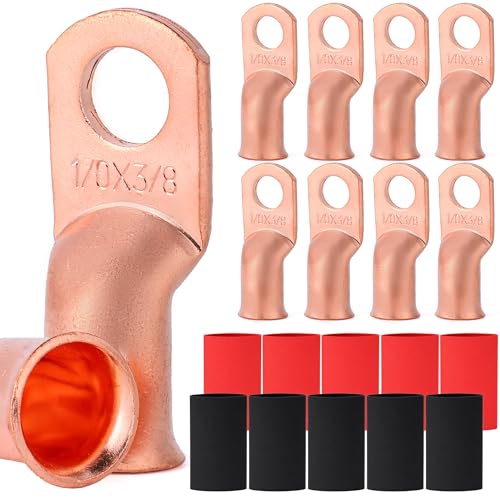
TKDMR keeps things simple: ten lugs, ten pieces of 4:1 adhesive shrink tubing, one stud size. The 4:1 shrink ratio (the tubing shrinks to one-quarter of its starting diameter) is the standout spec, because 1/0 cable is bulky and many cheaper 3:1 tubes won’t fully wrap the lug shoulder. A tighter finished seal protects the crimp joint where it matters.
This is the kit I picture on a workbench during a starter-cable replacement or a battery relocation. Bare annealed copper with a treated surface keeps conductivity steady, and ten lugs is plenty for a single high-amp run with one or two spares. For someone who has a proper hex crimp die already, this is a low-fuss choice.
Notable Upsides
- 4:1 shrink tubing ratio wraps thick 1/0 lug shoulders fully for a sealed, professional-looking joint.
- Bare annealed copper takes both crimp and solder cleanly for hybrid install methods.
- Surface treatment helps slow tarnish between install and final sealing.
- 3/8″ stud fits common large battery posts, including many AGM and lithium battery terminals.
- Compact ten-pack suits single-job use without leftover inventory taking up shelf space.
Things To Weigh
- Single stud size means users with 5/16″ posts must source a separate lug.
- Bare copper is fine indoors and in dry engine bays but needs extra sealing in marine environments.
The Right Fit
Bench-builders and DIY installers doing one or two high-amp cable replacements where the 4:1 shrink tubing improves the finished result.
Reach For A Different Pick When
Marine installers and outdoor users see better corrosion resistance from the SELTERM 6 AWG Tinned Copper Lugs with Heat Shrink Kit, which ships tinned copper and a broader tubing assortment.
The 25pcs 4 AWG Bare Copper Cable Lugs from SELTERM lead this list as the everyday pick, and this 2 AWG cousin is the heavy-gauge sibling for higher-current jobs. 2 AWG handles mid-sized inverters around 1000 to 1500 watts, large amplifier systems, and starter cables on bigger engines where 4 AWG would be undersized.
The 3/8″ stud is the common large-battery and bus-bar size, so the lug drops onto most heavy posts without modification. Twenty-five pieces at this gauge is a serious stock level: enough for a full system rebuild plus enough leftover to cover the inevitable mistake.
Positive Takeaways
- 25-count pack offers strong per-piece value for high-current lugs.
- 2 AWG suits medium inverters, big audio systems, and heavy starter cables.
- 3/8″ stud is the standard heavy-battery post size in most automotive and marine banks.
- Bare annealed copper crimps cleanly and solders easily for permanent joints.
- OEM-accepted dimensional tolerances aim for consistent crimp feel batch to batch.
Small Limitations
- Bare copper needs extra sealing in damp or salt-exposed environments.
- No tubing included, so insulation materials need separate purchase.
- 3/8″ stud is too large for small accessory posts, requiring a smaller lug elsewhere.
Spec Overview
Whose Shelf It Belongs On
Shops stocking for multiple vehicles, and DIYers planning a multi-bank battery upgrade, get the most value from a 25-pack of 2 AWG lugs.
Not Your Match When
For 1/0 or 2/0 heavy-gauge projects, the SVAAR 20pcs 1/0 and 2/0 AWG Copper Lugs Kit provides a wider gauge spread in a single order.
Sanuke’s 10-pack reads like a teaching kit: ten 4 AWG lugs with 3/8″ (M10) studs, plus ten pieces of color-coded 3:1 adhesive shrink tubing split five red and five black. For a first-time installer, the color coding is the difference between guessing polarity at the end of the job and being sure of it.
The 4 AWG size matches common accessory circuits in cars and boats, from amplifier feeds to small inverter loads. M10 studs sit between the SAE 5/16″ and 3/8″ sizes, which makes them useful on imports and metric-spec battery hardware. This kit is one of the easiest to grab when the goal is a tidy, identifiable install without buying extras.
Where It Excels
- Color-coded red and black tubing removes the guesswork around polarity marking.
- M10 stud size fits many import and metric-spec battery hardware setups.
- Adhesive-lined 3:1 tubing seals the crimp area against moisture.
- 4 AWG covers most low-to-mid current accessory jobs in cars and small boats.
- Ten-pack is approachable for first-time DIY projects without big commitment.
Trade Offs
- Bare copper without tin plating requires diligent sealing in damp or marine locations.
- M10 stud doesn’t match all SAE-spec posts, so users with 5/16″ hardware may need a different lug.
Right Fit For
First-time installers and weekend builders who want a tidy, color-coded result without sourcing tubing and lugs separately.
Consider Something Else When
Anyone working in a marine or high-humidity environment benefits more from the SELTERM 6 AWG Tinned Copper Lugs with Heat Shrink Kit, which uses tinned copper for added corrosion resistance.
Where most lug kits on this list stick to a single gauge, SVAAR packs four different combinations into one 20-piece box: 1/0 and 2/0 lugs in both 3/8″ and 5/16″ stud sizes. That’s the right answer for a project where the battery side, the inverter side, and the bus bar all sit on different stud sizes, so one box covers the whole run.
The maker claims T2-grade copper (a specific copper alloy used for its low electrical resistance and high conductivity), with a closed-end design that conforms to UL486 (the Underwriters Laboratories standard covering electrical connector safety and performance). For anyone whose work touches inspection, that closed-barrel spec matters because it keeps moisture from wicking into the cable strands.
Everyday Advantages
- Four size combinations (1/0 and 2/0 in both 3/8″ and 5/16″) cover mixed heavy-gauge projects in one box.
- Closed-end barrel design conforms to UL486 standards for safer long-term installations.
- T2-grade copper offers strong conductivity for high-current runs.
- Adhesive 3:1 heat shrink tubing seals both the crimp and strain-relief area.
- Twenty-piece count balances high-volume use without overstocking uncommon sizes.
Practical Considerations
- Bare copper finish calls for diligent sealing in marine and outdoor locations.
- Heavy 2/0 cable requires serious crimp tools, and undersized dies leave weak joints.
- Split across four sizes, the count per specific lug is small for very large installations.
Details At A Glance
Perfect Match For
Installers handling mixed 1/0 and 2/0 runs with different stud sizes, especially when an inspection or code-conscious application is part of the job.
Another Choice May Suit
Boat and outdoor users who need tinned corrosion resistance should consider the SELTERM 4/0 AWG Marine Tinned Copper Lugs for the heaviest runs.
This SVAAR kit covers the middle of the gauge range: 4, 6, and 8 AWG lugs with both 5/16″ and 3/8″ stud sizes. That’s the spread most accessory projects use, from amplifier wiring (4 AWG) to lighting and switch runs (8 AWG). UL-listed construction with a closed-end barrel means the cable stays dry inside the joint, which is the slow-failure mode that ruins otherwise fine installs.
T2-grade copper aims at low resistance, and the lugs work for both crimping and soldering. For a homeowner or contractor whose work is checked against common electrical codes, the UL listing is the kind of detail that ends up mattering on inspection day.
What Earns Its Place
- Three-gauge spread (4, 6, 8 AWG) covers the most common accessory wiring jobs.
- Both 5/16″ and 3/8″ stud sizes reduce the need for separate lug orders.
- UL-listed closed-end design supports code-conscious installations.
- T2-grade copper provides low-resistance conductivity across the pack.
- Heat shrink tubing included for sealing each joint.
Where It Is Less Suited
- Bare copper finish needs careful sealing in outdoor or marine setups.
- Pack size is moderate, so very large multi-vehicle jobs may need to buy multiples.
Who Should Grab It
Homeowners and small-shop installers who want UL-listed construction for car, trailer, and small marine accessory wiring projects.
Where Another Pick Suits Better
Heavy 1/0 and 2/0 inverter builds call for the SVAAR 1/0 and 2/0 AWG Copper Lugs Kit, which steps up to heavier gauges.
This is the bin-stuffer. Seventy-two lugs spread across 2, 4, and 6 AWG with both 3/8″ and 5/16″ studs, plus heat shrink tubing. For a working shop or a serious hobbyist who burns through lugs on multiple vehicles, this kind of count turns reordering from a monthly chore into an annual one.
Like the SVAAR 1/0 and 2/0 AWG Copper Lugs Kit, the design uses UL486-style closed-end construction with T2-grade copper. The big difference is gauge coverage: where that kit targets heavy cables, this one targets the everyday range. Pair it with a separate tin-plated pack for marine jobs and most shops are well covered.
Features That Help
- 72-piece count supports high-volume shop use and reduces reordering frequency.
- Three common gauges (2, 4, 6 AWG) cover most accessory and mid-current work.
- Both 3/8″ and 5/16″ stud sizes handle mixed hardware on cars and trailers.
- UL486 closed-end design helps block moisture wicking into strands.
- T2-grade copper supports consistent, low-resistance crimps batch to batch.
Worth Noting
- No 1/0 or 2/0 gauge included, so heavy inverter work needs another kit.
- Bare copper needs extra sealing in marine and outdoor setups.
Built With In Mind
Working shops, fleet maintenance operations, and serious hobbyists who go through lugs faster than they want to keep ordering.
Skip It When
Boat owners and outdoor solar users see better corrosion resistance from the SELTERM 6 AWG Tinned Copper Lugs with Heat Shrink Kit in moderate-gauge applications.
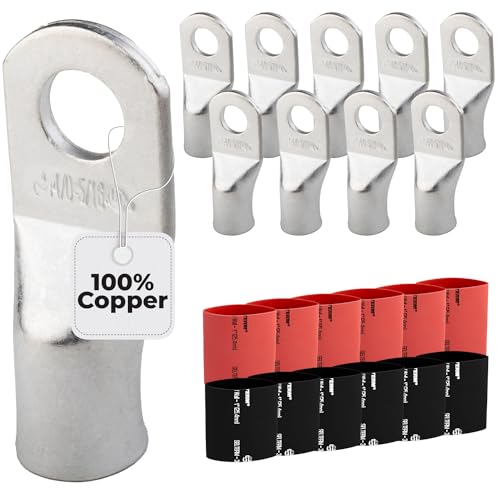
4/0 is the heavy end of the cable lug world, sized for the biggest marine battery banks, large inverters, and high-output alternators. SELTERM’s ten-pack brings tinned copper to that gauge, with salt-spray testing referenced to ASTMB117 (a standard laboratory test that simulates years of salt exposure in hours) for marine use. Matte tin plating matters here: it gives the surface enough tooth for both crimp and solder joints, where glossy plating can be slippery under the die.
For someone rewiring a big boat or building a serious off-grid battery bank, 4/0 cable is the difference between a system that runs cool and one that wastes energy as heat through the cable. This kit sits at the top of the gauge range covered on the list, so it’s the pick for those projects and overkill for anything smaller.
Practical Advantages
- 4/0 gauge handles the largest inverter and battery bank applications cleanly.
- Tinned copper resists salt and humidity in marine and outdoor environments.
- Matte finish gives both crimp and solder joints good mechanical grip.
- Salt-spray testing to ASTMB117 standard points to serious corrosion resistance.
- OEM-accepted construction supports consistent dimensional tolerances.
Honest Caveats
- Only ten lugs per pack, so big multi-bank projects require multiple purchases.
- 4/0 cable and lugs demand heavy-duty crimp tools that not every home shop owns.
Quick Facts
Who Will Love This
Boat owners, marine electricians, and off-grid builders running the largest battery banks where 4/0 cable is the minimum practical size.
Where A Sibling Pick Shines
For mid-sized inverter and accessory projects at 1/0 or 2/0 gauge, the SVAAR 1/0 and 2/0 AWG Copper Lugs Kit offers a more appropriately sized, less expensive option.
Matching Cable Lugs To The Job At Hand
Wire gauge comes first, before anything else. The American Wire Gauge (AWG) number tells you the cross-sectional area of the copper conductor, and a smaller number means thicker cable. A 4 AWG lug is wrong for a 1/0 cable, and a 1/0 lug will not crimp correctly onto 6 AWG wire. Match the lug’s stated gauge to the cable’s printed gauge exactly.
Stud size matters almost as much. The stud is the threaded post the lug ring slips over, and the most common sizes are 5/16″ (about M8 metric), 3/8″ (M10), and 1/4″ (M6). Measure the existing hardware or check the battery spec sheet. Forcing an oversized lug onto a smaller stud looks fine until vibration cracks the copper ring.
Material finish decides where the lug can live. Bare copper is the most conductive and the cheapest, but it tarnishes quickly in salt air or high humidity. Tinned copper adds a thin tin layer that fights corrosion at modest extra cost. In a marine bilge, a tinned lug routinely outlasts a bare one by years. In a sealed indoor battery box, bare copper is perfectly fine.
Closed-end versus open-end barrels. An open-end barrel lets you see how far the cable inserts, which is helpful for beginners. A closed-end barrel keeps moisture from wicking up the cable strands and is the standard most inspectors expect on serious work. UL-listed closed-end lugs are the safer pick for any installation that might be reviewed.
Insulation and sealing. Bare copper or tinned copper alone does not stop corrosion at the crimp. Adhesive-lined heat shrink tubing (the inner layer melts and seals around the joint) over the crimped barrel is the difference between a joint that lasts and one that greens up within a season. If tubing is not included, budget to buy it at the same time.
Crimp tooling. The right die is non-negotiable. A hammer crimp or generic plier-style tool leaves a loose joint that heats up under load. A hex or indent crimp die matched to the cable gauge produces the cold-welded connection that battery lugs are designed to make.
Pitfalls Worth Skipping
Common Buying Slip Ups
The most frequent error is matching the stud size to the bolt pattern on the wrong side of the cable. People measure the battery post, then realize the lug also has to clear the inverter terminal or the bus bar, which uses a different stud size. Buying a mixed kit like the SVAAR 1/0 and 2/0 AWG Copper Lugs Kit or the Bare Copper Lugs 2 4 6 Gauge 72pc Kit covers both ends in one order.
Another trap is grabbing a beautiful tinned lug and skipping the heat shrink because the joint looks finished. Salt air and engine-bay moisture find the smallest gap at the crimp shoulder. Sealing the joint with adhesive-lined tubing is what makes the tinned finish actually pay off over time.
Where The Extra Money Goes
Stepping up to tinned copper, UL-listed closed-end barrels, and heavier gauges costs more per piece, and the difference shows up in two places. First, longevity: a tinned lug in a marine bank can outlast bare copper by years, so the per-year cost often works out lower. Second, code and inspection: UL-listed lugs satisfy inspectors and insurance paperwork in a way that unmarked copper does not, which matters on permitted boat electrical work and some residential solar installs.
Frequently Asked Questions
What cable gauge lug do I need?
Match the lug’s gauge marking to the cable’s printed gauge exactly. Common sizes are 4 AWG for accessory circuits, 2 AWG for mid-sized inverters and audio systems, 1/0 for heavy starter cables and large inverters, and 4/0 for the biggest marine and battery bank runs.
Bare copper or tinned copper battery lugs?
Bare copper is the more conductive and affordable choice for dry, indoor installations. Tinned copper costs slightly more but resists corrosion in marine, automotive engine bay, and outdoor environments, making it the better pick where moisture or salt exposure is likely.
What stud size should I pick?
Measure the existing battery post, bus bar, or terminal hardware first. The three most common stud sizes are 1/4″, 5/16″, and 3/8″. Some hardware uses metric sizes like M8 or M10, which line up with 5/16″ and 3/8″ respectively. When in doubt, mixed-size kits save a return trip.
Do I need heat shrink tubing with battery lugs?
Yes. Adhesive-lined heat shrink tubing over the barrel seals the crimped joint against moisture and adds strain relief. Skipping this step is the most common cause of premature corrosion at the lug shoulder, especially in marine or outdoor use.
What is the difference between open-end and closed-end lugs?
Open-end barrels let you see how far the cable inserts, which is helpful for beginners. Closed-end barrels seal the cable end inside the lug, blocking moisture from wicking up the strands. Closed-end lugs that meet UL486 are the standard for marine and inspection-conscious installations.
Wrap Up
The right battery cable lug comes down to three honest measurements: the cable gauge, the stud size, and the environment. Match those three and almost any of the kits above will do the job cleanly. The rest is about how many lugs you want on the shelf and whether the install needs tinned copper or UL-listed construction for the conditions it will live in.
