

I’ve spent enough time under dashboards and behind battery boxes to know that a good automotive circuit breaker is the kind of part you forget about until you desperately need it. Whether you’re wiring up a sound system, protecting a trolling motor, or just tired of replacing blown fuses, the right breaker keeps amps where they belong and protects the gear behind them. I put together this list to help DIYers, weekend tinkerers, and pros find a breaker that fits their setup without overspec’ing or undersizing it.
A Side-By-Side Look

GLOSO E9A Waterproof Breaker Auto Reset 80A IP67

GLOSO Circuit Breaker Blade Fuse E39 (T3) Manual Reset 20A

RED WOLF BS6100 100A Circuit Breaker Manual Reset 12-48V

RED WOLF 100A Circuit Breaker 6 Gauge Ring Terminal Waterproof

Ford DA8Z-14526-A Circuit Breaker Assembly
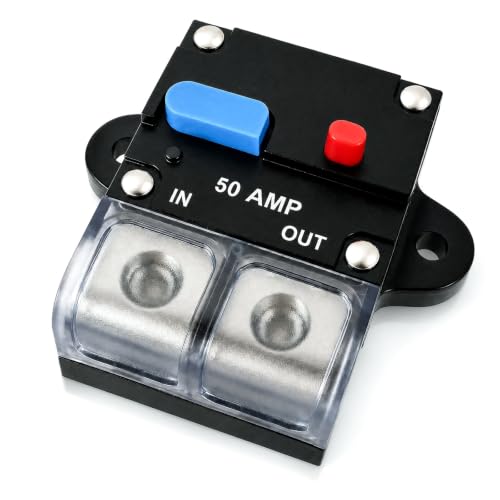
IGEYAPA 50 Amp Circuit Breaker Fuse Holder Manual Reset CB-4

IGEYAPA 60 Amp Circuit Breaker Trolling Motor Disconnect CB-4

IGEYAPA 80 Amp Circuit Breaker 12V-48VDC Waterproof Inline

IGEYAPA 100 Amp Marine Circuit Breaker Trolling Motor CB-4

RED WOLF Waterproof 100Amp Circuit Breaker 12V-48V Manual Reset
What Each Pick Brings To The Table
When the wiring lives somewhere wet, I look for sealed bodies and auto-reset behavior, because a breaker that has to be opened up and reset manually every time a transient hits gets old fast. The GLOSO E9A handles 80 amps through side-by-side studs (threaded posts mounted in parallel on the breaker face, which makes ring-terminal landings easy) and carries an IP67 rating, meaning it’s dust-tight and can survive temporary immersion.
Compared to the GLOSO blade-style breaker in slot two, this one trades a compact ATC footprint for raw current capacity and weather sealing. It’s the kind of breaker I’d bolt to a bulkhead on a center-console boat or near a battery box on an overland rig.
The Upside
- IP67 sealing handles spray, rain, and the occasional dunk without leaking
- Auto reset recovers from nuisance trips without you popping a hatch
- Side-by-side studs accept heavy-gauge ring terminals cleanly
- 80A rating covers large accessory loads like inverters or winches
Trade Offs To Consider
- Bulkier than blade-style breakers, so tight fuse-box slots won’t fit
- Auto reset means a fault can re-energize before you finish diagnosing it
Best Suited To
Boat owners and overlanders who need weatherproof 80A protection on a wet or dusty circuit.
Where Another Pick Suits Better
DIYers replacing standard automotive ATC fuses should reach for the GLOSO Circuit Breaker Blade Fuse E39 instead, since it slots into existing fuse panels.
Most cars already run ATC/ATO fuse panels, the familiar low-profile blade-style slots you see under the dash, so a breaker that simply drops into one of those slots is the lazy-install win. The GLOSO E39 is exactly that: a 20A manual-reset breaker in a Type 3 (T3) configuration, meaning it stays tripped until you press the reset button. That’s the safer choice on a circuit you actually want to inspect after a trip.
The body uses UL-rated 94V0 thermoplastic (a flame-retardant plastic rated to extinguish within 10 seconds), and the terminals are tin-plated copper alloy blades 5.2mm wide, so they slide into standard ATO fuse blocks without forcing. Compared to the heavy-duty GLOSO E9A in slot one, this is the much friendlier swap for accessory circuits like radios or interior lighting.
Why It Works Well
- Drops straight into existing ATC fuse holders with no rewiring
- Manual reset forces you to acknowledge the trip instead of silently re-energizing
- Flame-retardant thermoplastic housing adds a margin of safety near hot wiring
- Tin-plated copper terminals resist corrosion in humid environments
Honest Caveats
- Limited to low-amperage accessory circuits at 20A
- Larger physical profile than a standard fuse, so neighboring slots can feel tight
Feature Snapshot
Right Fit For
DIYers replacing burned-out ATC fuses in car, RV, or boat accessory panels.
Swap It Out When
You need weatherproof 80A protection for a heavy load, in which case the GLOSO E9A Waterproof Breaker is the better call.
Big-amp car audio systems and trolling motors tend to eat cheap fuses, and replacing them mid-trip is no fun. The RED WOLF BS6100 handles up to 100A across a 12 to 48V DC range, which covers everything from a single 12V sub setup to a 48V lithium off-grid bank. A visible reset lever shows you at a glance whether the breaker is open or closed, and the push-button reset doubles as a kill switch for the whole circuit.
It’s a step up from the IGEYAPA 50A breaker further down the list, mostly in raw capacity and the visibility of its reset state. Where the BS6100 really earns its place is anywhere the current draw is heavy, like multi-amp audio banks or mid-sized trolling motors pulling hard at low speed.
Features That Help
- 100A rating handles aggressive loads like inverters and high-wattage amps
- Visible reset lever tells you the circuit state from across the engine bay
- Push-button acts as a manual kill switch for service or emergency
- 12 to 48V range covers automotive, marine, and solar battery banks
Worth Bearing In Mind
- No listed waterproof rating, so it prefers protected enclosures
- Larger footprint than 30A or 50A breakers and needs solid mounting space
Built With In Mind
Car audio installers and solar/marine users running 100A-class loads on 12 to 48V systems.
Consider Something Else When
You need a fully sealed body for splash-prone installs, where the RED WOLF Waterproof 100Amp Circuit Breaker is a stronger match.
Wiring a 100A breaker often turns into an errand: ring terminals, a crimper, heat shrink, and a lug kit. The RED WOLF kit trims that by shipping with 6 gauge ring terminal leads already attached, so the install is essentially unbox, bolt, and connect. It’s waterproof, manual reset, and doubles as a battery disconnect so you can service the system without pulling every wire off the post.
Where it sits relative to the rest of the list: think of it as a more turnkey version of the RED WOLF BS6100, with sealing added and the terminal work already done. For someone wiring a trolling motor or a stereo bank for the first time, that pre-built wiring is the difference between a one-trip job and a Saturday project.
The Practical Payoff
- Pre-crimmed 6 gauge leads cut install time and skipped tools
- Acts as both breaker and battery disconnect for charging and service
- Waterproof housing stands up to bilge and engine-bay moisture
- Manual reset keeps you in the loop on persistent faults
Practical Considerations
- Lead length is fixed, so very long battery runs may need splicing
- 100A may be overkill for small accessory circuits, where the IGEYAPA 50A breaker is a better match
Who Will Love This
First-time installers who want a complete breaker-and-wire kit without sourcing separate terminals.
A Better Fit Elsewhere
Tight budgets and lighter loads are served better by the IGEYAPA 50 Amp Circuit Breaker a few slots down.
Not every breaker job is about upgrading. Sometimes the factory breaker in a Ford has gotten weak or corroded, and you need the OE part number replacement to keep the wiring stock. The Ford DA8Z-14526-A is the genuine assembly, made in the US, and it slots into the original bracket without adapters. At roughly 295 grams and a compact 12 by 16 by 16 centimeter footprint, it’s a direct-fit piece rather than a universal accessory.
The honest read here is that it’s not the most exciting item on the list, but for a service job where matching factory wiring matters, it’s hard to beat an OE assembly. Anyone adding accessories to a Ford should still look at the RED WOLF and IGEYAPA picks further down.
Positive Points
- Genuine Ford part preserves factory wiring integrity
- Compact assembly fits the original bracket and harness path
- Direct OE replacement avoids fitment guesswork
A Few Limitations
- Limited to specific Ford applications, not a universal breaker
- Typically pricier than aftermarket equivalents for the same amperage
Perfect Match For
Owners doing factory-spec service work on compatible Ford vehicles.
Look Elsewhere When
You’re adding aftermarket accessories, in which case the RED WOLF BS6100 100A Circuit Breaker is the more flexible choice.
Mid-amp loads like trailer brakes, modest inverters, and smaller trolling motors don’t need a 100A breaker, and over-spec’ing just means a slower trip when something actually goes wrong. The IGEYAPA CB-4 at 50A hits that sweet spot. The push-button reset works as a stop switch and a main breaker for the circuit, and the “IN” and “OUT” terminals are clearly labeled, which saves time when you’re leaning into a battery box at dusk.
It can also replace disposable 50A fuses in trolling circuits and DC breaker boxes. Mounting options include panels or firewalls, so it works in both automotive and marine layouts. Relative to the bigger RED WOLF kits above, this is the budget-friendly middle ground for loads that don’t justify 80A or 100A hardware.
Strong Points
- 50A rating fits common mid-load accessories without over-spec’ing
- Push-button works as both reset and main disconnect
- Labeled IN/OUT terminals reduce wiring mistakes on first installs
- Replaces disposable fuses in trolling and DC breaker boxes
Some Limits To Know
- Not as heavy-duty as the RED WOLF 100A units for large audio or inverter banks
- Mounting hardware and weatherproofing may need extra parts for fully exposed installs
Feature Rundown
Whose Shelf It Belongs On
Trailer owners and smaller-boat anglers running 50A-class loads like brake circuits or modest trolling motors.
Not Your Match When
Your loads run closer to 80A or 100A, in which case the IGEYAPA 80 Amp Circuit Breaker or the RED WOLF BS6100 is a smarter buy.
A 60A trolling circuit sits right in the zone that most 12V boat motors actually draw under load, especially when fighting current or pushing through weeds. The IGEYAPA CB-4 at 60A covers that band with the same body style as the 50A model, so it shares the manual-reset push button and the labeled IN/OUT terminals that made the lower-amp version easy to wire.
The difference between this and the 50A unit a slot above comes down to load sizing rather than features. If your motor spec sheet lists a 60A fuse, this breaker is the cleaner swap than jury-rigging a 50A unit with a slow-burn workaround. It also works as a panel or firewall mount, which is useful on smaller craft with limited console space.
Useful Strengths
- 60A rating matches common trolling motor fuse recommendations
- Manual reset works as a quick disconnect at the ramp
- Labeled IN/OUT terminals reduce wiring errors during install
- Compact panel-mount design fits tight console layouts
Points To Keep In Mind
- Not sealed for full submersion, so splash zones still need a cover
- Limited to 60A, so large 24V or 36V motors will outgrow it
Made For
Anglers running 12V trolling motors in the 60A-class range on jon boats and small bass rigs.
Reach For A Different Pick When
Your system runs 24V or 36V at higher amps, where the IGEYAPA 100 Amp Marine Circuit Breaker makes more sense.
Inline breakers splice directly into a cable run instead of mounting to a panel, which is a huge advantage on overland rigs, UTVs, and trailer wiring where you don’t have a flat surface to bolt a traditional breaker to. The IGEYAPA 80A is built in that inline style and sealed for moisture, so it can live inside a frame rail or under a body panel without complaint.
Covering 12V to 48V systems, it handles solar battery banks, larger trolling motors, and mid-range inverters. Compared to the panel-mount IGEYAPA units at 50A and 60A, this one trades mounting flexibility for amp headroom and a waterproof body, which is the trade that matters for exposed installations.
Practical Pluses
- Inline body splices into wiring without a dedicated panel mount
- Waterproof construction handles underbody and bilge environments
- 80A capacity handles mid-sized inverters and high-draw accessories
- Manual reset acts as a quick disconnect during service
Factors To Consider
- Inline format means cable ends need to be properly terminated before install
- Not the cleanest fit if you actually want a labeled breaker panel look
The Right Fit
Off-road and overland builders who want a sealed inline breaker spliced into a high-amp run.
Where A Sibling Pick Shines
Boat owners wanting a tidy panel-mount breaker should look at the IGEYAPA 60 Amp Circuit Breaker instead.
Big 24V and 36V trolling motors pull serious amps at full throttle, and undersizing the breaker is a great way to nuisance-trip in the middle of a fish fight. The IGEYAPA 100A marine breaker is sized for that class of motor, with the same panel-mount body and manual push-button reset shared by the smaller CB-4 units earlier in the list.
It also pairs naturally with a battery box setup, which is where the form factor shines. Relative to the inline IGEYAPA 80A breaker a slot above, this one is more about amp headroom than cable-routing convenience, and it complements the RED WOLF 100A kits earlier for installers who want a marine-rated panel option.
What Works In Its Favor
- 100A capacity covers larger 24V and 36V trolling motor circuits
- Manual push-button doubles as a main disconnect at the battery
- Mounts on panels or firewalls for clean console layouts
- Labeled IN/OUT terminals simplify install on crowded bus bars
Where It May Fall Short
- Larger body footprint needs dedicated mounting space
- Not fully sealed, so bilge installations still benefit from a cover or enclosure
Who Should Grab It
Boat owners running 24V or 36V trolling motors who want panel-mounted 100A protection.
Skip It When
You need a sealed inline breaker for an exposed run, in which case the IGEYAPA 80 Amp Circuit Breaker 12V-48VDC Waterproof Inline is the better tool.
When a breaker is going to live in the splash zone of an ATV, a kayak trolling setup, or any open vehicle, a sealed housing is non-negotiable. The RED WOLF waterproof 100A breaker ships in a solid waterproof-resistant body that has been through a professional electrical performance and aging test, which gives a little more confidence than the generic untested alternatives out there.
It carries the same 12V to 48V range as the BS6100 a few slots up, with the manual reset switch that doubles as a service disconnect. Where it pulls ahead is the sealed housing, which makes it the better pick for marine and powersports users even though the BS6100 is a slightly more refined indoor install.
Where It Helps
- Waterproof-resistant housing handles spray, rain, and dust exposure
- 100A capacity covers demanding audio, solar, and trolling loads
- Manual reset switch stays accessible for emergency shutoff
- 12V to 48V range suits automotive, marine, and off-grid systems
Honest Caveats
- Heavier body than open-style breakers and needs solid mounting
- Lead configuration may require additional ring terminals for some installs
Built With In Mind
ATV, marine, and powersports users who need sealed 100A protection in exposed environments.
Another Choice May Suit
Indoor audio and solar installers who don’t need weather sealing are served well by the RED WOLF BS6100 100A Circuit Breaker at a similar capacity.
What Matters Most Before Choosing Automotive Circuit Breakers
Match The Breaker To Your Real Load
The single biggest mistake I see is picking a breaker rated way above the wire and the device it’s protecting. A breaker is supposed to trip before the wire insulation melts, not before the fuse holder looks pretty. For accessory circuits in the 20A range, a Type 3 manual reset like the GLOSO E39 is plenty. For a 100A trolling motor or audio bank, you want the headroom of a RED WOLF or IGEYAPA 100A unit, sized to the actual peak draw, not just the marketing peak.
Decide Between Manual And Auto Reset
Manual reset breakers stay tripped until you press the button, which is the safer behavior on a circuit where a fault might otherwise re-energize itself. Auto reset breakers, like the GLOSO E9A, recover on their own, which is convenient for nuisance trips in remote locations but can hide intermittent faults. For circuits you’re hands-on with, manual is the better default.
Plan Around The Environment
A garage install doesn’t care about sealing, but a boat transom, an overland frame rail, or an ATV fender well absolutely does. IP67 and waterproof-rated bodies cost a little more but pay back in reliability when the breaker lives somewhere wet or dusty. Match the body style to the install: inline for splicing into a cable run, panel-mount for clean console layouts.
Check The Voltage Range And Terminal Type
Modern vehicles are mostly 12V, but marine and solar systems push 24V and 48V, so a breaker rated for 12V to 48V DC covers more ground. Terminal style matters just as much: ATC/ATO blade terminals fit standard fuse blocks, while studs accept ring terminals for heavier gauge wiring. Choosing the wrong terminal type is a common source of “why doesn’t this fit” frustration.
Where Shoppers Go Wrong And When Paying More Pays Off
Common Shopping Slip Ups
The most common trap is buying a breaker based on the fuse rating it replaces without checking the actual circuit draw, which leads to either nuisance trips on startup or, worse, a breaker that won’t trip when it should. Another slip is ignoring polarity on units with labeled IN and OUT terminals: reverse them and the breaker can fail to trip under fault conditions. Finally, many shoppers skip the wire gauge math entirely, since a 100A breaker on 10-gauge wire is a real safety issue waiting to happen.
Where The Extra Money Goes
Higher-tier breakers usually spend the premium on housing materials, sealing, and electrical performance testing rather than raw amperage. The RED WOLF waterproof 100A, for example, carries a sealed body and aging-test validation that cheaper units don’t bother with. For a hidden underbody install where you won’t see the breaker again, that premium is well spent. For a clean garage install on a low-amp accessory circuit, the budget tier is perfectly reasonable.
