

Dead remote. Silent smoke detector. A garage-door remote that finally gives up after months of barely working. Most of us have tossed a battery we assumed was fine, only to learn it was the culprit. A small tester pays for itself the first time it saves a good battery from the trash, or tells you a “dead” one just needs a charge. I put together this list for the household drawer crowd, the weekend tinkerers, and the pros who need a deeper read on a vehicle’s electrical system, so anyone can find the right tester for their situation.
A Quick View Of The Lineup

ANCEL BST600 12V/24V Lead-Acid Battery Tester with Printer
Amprobe BAT-250 Battery Tester

Dlyfull Battery Tester Universal LCD Checker

FOXWELL BC521 2-in-1 Battery Charger & Tester

ANCEL BA101PRO 12V/24V Battery Tester 2.8in Display
Tenergy T-333 Universal Battery Tester LCD
FOXWELL BT705 24V 12V Battery Tester
FOXWELL BT705Plus 24V 12V Load Tester

ANCEL BA101 12V Automotive Alternator Meter
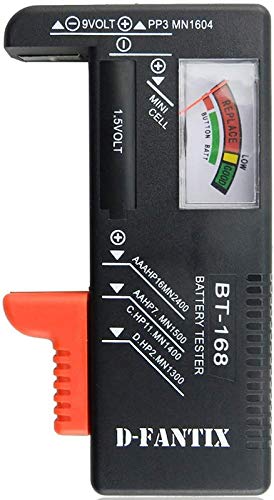
D-FantiX BT-168 Universal Battery Charge Checker
What Each Pick Brings To The Table
The ANCEL BST600 is built for the kind of work where paperwork matters as much as the reading. It evaluates both 12V and 24V lead-acid systems in cars, trucks, RVs, and boats, returning SOH (State of Health), SOC (State of Charge), CCA (Cold Cranking Amps, the industry-standard measure of starting power), voltage, and internal resistance in a single workflow.
Shops that need to hand a customer a printed slip showing why a battery was replaced will appreciate the onboard thermal printer. Compared with the pocket-friendly household testers later in this list, the BST600 is a serious piece of diagnostic gear, and it shows in both the price class and the depth of the report. Fleet managers handling mixed vehicles on a daily basis will get the most from it.
Features That Help
- Covers 100–2000 CCA across 12V and 24V lead-acid batteries for broad vehicle compatibility.
- Reads SOH, SOC, voltage, and internal resistance so you can see the full picture, not just one number.
- Built-in thermal printer produces a customer-ready report without a paired phone or laptop.
- Cranking and charging system tests in one workflow help pinpoint whether the issue is the battery or the alternator.
- CCA is short for Cold Cranking Amps, and the BST600 uses it as a standardized benchmark, which keeps results consistent across different vehicles and battery brands.
Honest Caveats
- It’s overkill for someone who only wants to sort AA cells in a kitchen drawer.
- Print rolls are a consumable; you’ll need to keep spares on hand in a busy shop.
- Menus take a few uses to feel natural, especially for first-time shop staff learning the unit.
Key Specs
Whose Shelf It Belongs On
Busy repair shops and small fleet operators who service mixed 12V and 24V vehicles will find the BST600 pays for itself quickly.
Where Another Pick Suits Better
A weekend DIYer sorting household cells should reach for the D-FantiX BT-168 instead, since a shop-grade tester is unnecessary for that job.
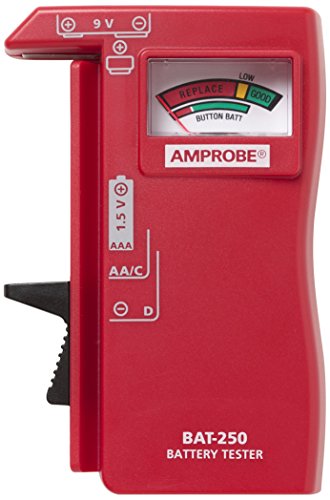
The Amprobe BAT-250 is the kind of tool you can hand to anyone in the house. There’s no menu to learn; you drop a battery in, and the color-coded scale tells you whether to keep it or toss it. It accepts 9V, AA, AAA, C, D, and 1.5V button cells, which covers roughly 95% of what sits in a typical junk drawer.
It runs without its own batteries, so it’s always ready in a power outage or a quick midnight check. Compared with the ANCEL BST600 reviewed above, the BAT-250 trades shop-grade diagnostics for a near-zero learning curve, and for many households, that’s the right trade.
Advantages To Know
- Color-coded “Good,” “Low,” and “Replace/Recharge” zones make decisions fast, even for kids helping out.
- Works on standard and rechargeable cells across six common sizes plus 1.5V button types.
- No batteries required to operate, so it’s reliable after long storage in a drawer.
Points To Keep In Mind
- No digital readout, so you won’t see exact voltage for borderline cells.
- Doesn’t support cylindrical photo lithium sizes like CR123A or CR2, which a few specialty devices use.
Made For
Households that want a one-step “keep or toss” answer for everyday batteries without scrolling menus.
Not Your Match When
Anyone testing a wide range of button cells and lithium cylinders should look at the Dlyfull LCD Checker, which covers those chemistries.
The Dlyfull tester earns its place by saying yes to almost any cell someone might toss at it. From AAAs to 9V blocks, plus a long list of button cells and photo lithiums like CR123A, CR2, CRV3, 2CR5, and CR-P2, it covers more chemistries than most household testers. The LCD readout adds a numeric layer the Amprobe BAT-250 doesn’t offer.
An AAA cell ships in the box so you can start testing right away. Compared with the Tenergy T-333 further down, the Dlyfull pushes harder on button cell coverage, which is a real advantage in homes with watches, key fobs, and small electronics mixed in the same drawer.
Where It Helps
- Handles AA, AAA, C, D, 9V, N, CR123A, CR2, CRV3, 2CR5, CR-P2, plus a wide spread of button cells.
- LCD screen reports poor, weak, or good voltage conditions for a clearer call than a color dial.
- Included AAA battery means the tester itself is ready out of the package.
Trade Offs
- Contact alignment matters for tiny button cells; a slightly off-center placement can give a misleading read.
- Not suited to 12V automotive batteries, so car owners need a separate tool for that job.
Best Suited To
Households with a mix of cylinders, button cells, and photo lithiums who want one tester instead of two or three.
Swap It Out When
Anyone focused purely on color-coded simplicity should look at the Amprobe BAT-250, which skips the LCD entirely.
The FOXWELL BC521 reframes the question. Instead of test-then-decide, it test-then-charge in one box, taking a 12V lead-acid battery through health checks and an 8-stage charging cycle without unplugging and switching tools. A 5A output keeps things moving on cars, SUVs, and motorcycles.
It supports AGM, GEL, EFB, and flooded cells, so most car owners will find their battery on the menu. Compared with the FOXWELL BT705 further along, the BC521 adds actual charging hardware, which makes it the better pick for owners of seasonal vehicles who let a battery sit for months at a time.
Everyday Perks
- Test and charge in one workflow, useful for batteries that need recovery and a fill-up at the same time.
- 8-stage charging plus pulse repair helps revive lightly sulfated batteries in storage.
- Compatible with AGM, GEL, EFB, and flooded lead-acid chemistries commonly found in modern cars.
Worth Noting
- 12V only, so it won’t cover heavy-duty 24V systems like the ANCEL BST600 handles.
- Bulkier than a tester alone, which matters in a small apartment closet or a packed garage shelf.
Quick Facts
The Right Fit
Garage owners with a daily driver and a seasonal toy who need charging and testing without buying two devices.
A Better Fit Elsewhere
Owners running a fleet of 24V trucks should pick the ANCEL BST600, which covers higher-voltage systems.
The ANCEL BA101PRO feels like the BA101’s grown-up sibling. It keeps the 100–2000 CCA range and adds 24V coverage alongside 12V, with a 2.8-inch color display that’s much easier to read in a dim garage than the older screen on the BA101.
Regular flooded, AGM flat plate, AGM spiral, GEL, and EFB batteries are all on the menu. For RV, boat, and heavy-duty owners, that breadth matters, since these vehicles tend to mix chemistries over a single fleet. The honest read is that this is a serious tool for serious vehicles, not for someone sorting AA cells.
What Helps Most
- Spans 100–2000 CCA across both 12V and 24V systems, useful for mixed-vehicle owners.
- Reads SOH, SOC, voltage, and internal resistance, the same data set the BST600 reports.
- Five battery types supported, including AGM spiral and EFB common in start-stop cars.
- Cranking and charging tests in one workflow help decide if the battery or alternator is at fault.
Smaller Limitations
- No printer, so shops needing hard copies should still reach for the BST600.
- Carrying case isn’t always included, depending on the listing configuration.
Who It Suits Best
RV, marine, and heavy-duty owners who want shop-grade readings without committing to a printed-report workflow.
Consider Something Else When
Shops that hand out printed reports to customers will get more value from the ANCEL BST600.
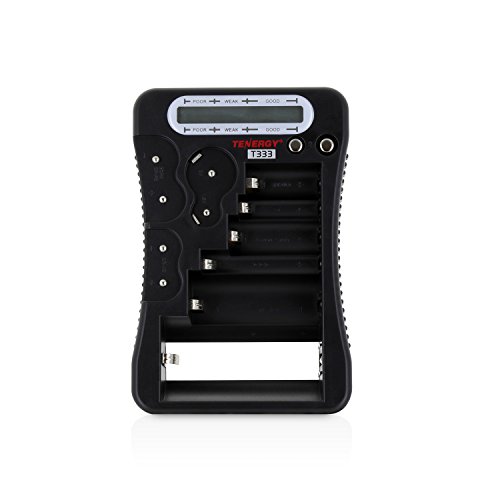
The Tenergy T-333 has been a kitchen-drawer staple for years, and the reason is simple: it covers the cells people actually own. AAA, AA, C, D, and 9V sit alongside CR123A, CR2, CRV3, 2CR5, CR-P2, and a range of button cells on the LCD readout.
Compared with the Dlyfull LCD Checker reviewed earlier, the T-333 leans toward long-term familiarity over chasing the very latest chemistry list. For most homes, that’s a fair trade, since the included cell types match what shoppers buy at a big-box store.
Useful Highlights
- Spans AAA, AA, C, D, 9V, plus CR123A, CR2, CRV3, 2CR5, CR-P2, and various button cells.
- LCD screen gives a quick numeric read without needing a smartphone app.
- Compact body fits in a drawer or a small toolbox without dedicated storage space.
Practical Considerations
- Doesn’t handle 12V automotive cells, so car owners need a separate tool for the driveway.
- Some button cell sizes require careful contact alignment for a stable reading.
Perfect Match For
Family households that want a familiar, general-purpose tester for remotes, toys, and small electronics.
Reach For A Different Pick When
Anyone chasing the widest possible button cell coverage should look at the Dlyfull, which lists more coin-cell types.
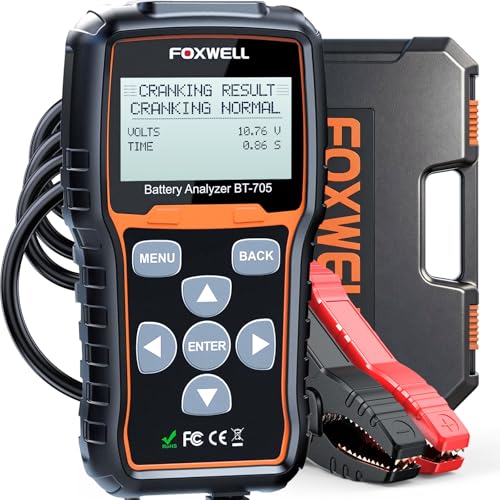
The FOXWELL BT705 leans into cold-weather and heavy-duty work, with measurements that include readings down to 32°F (0°C), a useful benchmark for anyone whose truck or tractor sits outside in winter. It checks CCA, voltage, internal resistance, and SOH across 12V and 24V systems.
Where the BT705 Plus further down adds processor speed, the BT705 offers a simpler price-to-feature ratio for DIYers who don’t need the latest silicon. For home mechanics and small shops, it remains a sensible middle ground between the ANCEL BA101 and the BT705 Plus.
Where It Excels
- Reads CCA, voltage, internal resistance, and SOH for a multi-angle picture of battery health.
- Performs cold-rated testing down to 32°F, helpful in northern climates and unheated garages.
- Covers both 12V and 24V systems for cars, trucks, and light commercial vehicles.
Honest Caveats
- No printer, so customer-facing shops will still want the ANCEL BST600 for printed slips.
- Menus assume some familiarity with battery ratings, which can frustrate first-time users.
Feature Snapshot
Built With In Mind
DIY mechanics and small-shop owners who service cars and trucks in cold-weather regions will appreciate the cold-rated workflow.
Look Elsewhere When
Anyone wanting the fastest possible processor and a screen tuned for marginal batteries should step up to the FOXWELL BT705Plus.
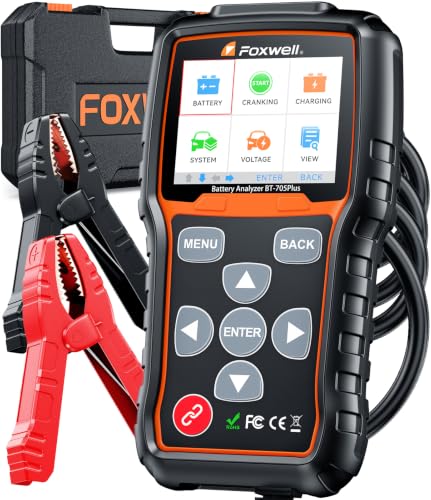
The FOXWELL BT705Plus is the BT705 with a faster processor and refined algorithms, which matters most when you’re testing batteries near the end of their life. Low-voltage and nearly dead cells give readings that older testers will waver on, and the Plus is built to handle that edge case with more stability.
Compared with the standard BT705 reviewed just above, the Plus is the same toolset with a snappier brain, useful in shops where a tech runs dozens of tests a day. For occasional weekend use, the BT705 is usually plenty.
Practical Advantages
- Faster processor speeds up the workflow in shops running high test volumes.
- Improved accuracy on low-voltage and near-dead batteries, a common weak spot in older testers.
- Same 12V/24V and alternator coverage as the BT705, so existing FOXWELL habits carry over.
Trade-Offs To Consider
- Pricier than the standard BT705 for a difference most home users won’t notice in a once-a-month check.
- No printer, so it doesn’t replace the ANCEL BST600 for printed customer reports.
Who Should Grab It
Shops and serious hobbyists upgrading from an older tester who want a faster, more decisive read on marginal batteries.
Skip It When
Weekend DIYers will find the BT705 does the same job well enough at a friendlier price tier.
The ANCEL BA101 is the entry point I’d hand to a friend who just bought their first used car and wants to know what’s going on under the hood. It focuses on 12V systems and reads SOH, SOC, voltage, current, and CCA in plain language, without burying the answer in menus.
It handles cranking and charging tests, so a slow-start morning can be diagnosed without a trip to the shop. Compared with the BA101PRO reviewed earlier, the BA101 stays 12V-only, which is fine for the vast majority of passenger vehicles and small boats. For someone with a 24V truck, the PRO is the better fit.
A Strong Showing
- Reads SOH, SOC, voltage, current, and CCA in one workflow for a full picture of battery health.
- Cranking and charging system tests help spot a weak alternator before it strands the car.
- 100–2000 CCA coverage handles compact cars through larger light trucks.
Things To Weigh Up
- 12V only, so heavy-duty truck and commercial fleet owners should step up to the BA101PRO.
- Screen is smaller than the BA101PRO’s, which can be tough to read in bright sunlight.
The Right Fit
First-time car owners who want a friendly way to catch battery and alternator issues before they become a tow-truck bill.
Another Choice May Suit
Owners of larger vehicles who need 24V support should pick the ANCEL BA101PRO or the ANCEL BST600.
The D-FantiX BT-168 is a tiny analog dial that takes up about as much space as a matchbox. There’s no power switch, no menu, and no app: the needle moves across a color-coded scale the moment you drop a cell in. AA, AAA, C, D, 9V, and 1.5V button cells are all supported.
It runs without its own batteries, so the BT-168 is always ready, even after a year in a junk drawer. Compared with the Amprobe BAT-250 reviewed earlier, the BT-168 offers a similar simplicity at a friendlier price tier, with a small visual trade-off in dial readability.
What Works In Its Favor
- Compact, lightweight body fits anywhere from a junk drawer to a glove box.
- No batteries required to operate, so it’s reliable after long storage.
- Color-coded analog scale gives a clear “good or replace” answer in seconds.
Small Caveats
- Analog needle is harder to read for borderline cells than a digital readout like the Dlyfull’s.
- Doesn’t cover photo lithiums like CR123A or CR2, which a growing number of small devices use.
Who Will Love This
Budget-focused households, classroom settings, and anyone who wants a no-fuss tester for the most common cell types.
Where A Sibling Pick Shines
Anyone testing a wider mix of lithium cylinders and button cells should consider the Dlyfull LCD Checker, which covers those chemistries.
Matching The Right Tester To Your Battery Drawer
Choosing the right battery tester comes down to three honest questions: what cells do you actually own, where will you use the tool, and how much detail do you really need. Households with mostly AA, AAA, 9V, and button cells do best with a compact checker like the Amprobe BAT-250 or the D-FantiX BT-168. Both run without their own batteries and answer “good or replace” in seconds, which is what most people actually want at 10 p.m. on a Tuesday when the remote stops working. The Dlyfull and Tenergy T-333 step up for homes with more chemistries in play, especially photo lithiums like CR123A or CR2 that power cameras, key fobs, and garage sensors.
Chemistry Coverage And Cell Size
The first thing to check is whether the tester physically accepts the cells you actually buy. AA and AAA are universal, but button cells vary in diameter and thickness, and not every checker aligns well with the smaller coin formats. Lithium cylinders like CR123A and CR2 use a different internal chemistry, so alkaline-only testers won’t read them accurately. For most homes, a tester that handles AA, AAA, C, D, 9V, and a spread of button cells covers 95% of the drawer without overcomplicating things.
Vehicle Systems And Heavy-Duty Use
For car, truck, RV, and boat owners, the conversation shifts to a 12V/24V lead-acid tester like the ANCEL BA101, BA101PRO, or FOXWELL BT705. CCA, short for Cold Cranking Amps, is the standardized measure of starting power, and a real vehicle tester reads it directly. Cranking and charging tests add value because they catch a weak alternator before it strands you. Shops that print customer reports should look at the ANCEL BST600, which has a built-in thermal printer.
Display Style And Workflow
A color-coded dial is the fastest to read at a glance, and a numeric LCD adds precision for borderline cells. Cold-rated testing, like the BT705’s 32°F (0°F) benchmark, matters for vehicles stored outside in northern winters. If you service batteries daily, a faster processor like the BT705Plus saves real time over weeks and months.
What To Watch Before You Click Buy
Before pulling the trigger, take a minute to think through the most common slip-ups shoppers hit in this category, and what separates a basic tester from one worth paying up for.
Wrong Turns To Avoid
The biggest mistake is buying an automotive tester for a kitchen drawer, or a household checker for a car. AA/AAA-only testers can’t read 12V lead-acid batteries, and 12V automotive testers won’t help with a CR2032 button cell. Another trap is assuming every tester reads the same metrics. Some only show a “good/replace” verdict, while others report voltage, internal resistance, CCA, and SOH. For households, a simple dial is plenty. For vehicles, those extra numbers are the whole point.
When Paying More Pays Off
Higher-tier testers earn their keep with broader chemistry support, larger displays, faster processors, and printer or charger integrations. The FOXWELL BC521 folds a charger into the tester, the BT705Plus handles low-voltage edge cases better than the BT705, and the ANCEL BST600 prints customer-ready slips. None of those matter for a casual household, but for shops and serious vehicle owners, the upgrade pays back in saved time and clearer reports.
Frequently Asked Questions
What Is A Battery Tester And Why Would I Need One?
A battery tester checks the charge level and overall health of a battery so you can tell whether to keep it or replace it. For households, it stops the “dead or just tired?” guessing game, and for vehicle owners, it catches a weak battery or alternator before it strands you.
Can One Tester Handle Both Household And Car Batteries?
Most can’t. Household testers cover AA, AAA, 9V, and button cells, while vehicle testers work on 12V and 24V lead-acid systems. Owning two is normal: one for the kitchen drawer, one for the garage.
What Does CCA Mean On An Automotive Battery Tester?
CCA stands for Cold Cranking Amps, the standardized measure of how much current a battery can deliver at 0°F for 30 seconds while staying above a minimum voltage. A higher CCA rating generally means stronger cold-starting performance.
How Often Should I Test My Car Battery?
Twice a year is a reasonable rhythm for most drivers, with extra checks before winter and after long storage. For seasonal vehicles sitting unused, a test every one to two months helps catch a slow drain before it kills the battery.
Do Battery Testers Need Their Own Batteries To Work?
Many don’t. Analog testers like the D-FantiX BT-168 and color-dial units like the Amprobe BAT-250 draw a tiny amount of power from the cell being tested, so they work even after years in a drawer. LCD testers often include a small cell for the display, and the Dlyfull ships with one in the box.
The Takeaway
The best battery tester is the one that fits the cells you actually own and the questions you actually ask. Households do well with a compact, no-fuss checker; vehicle owners do better with a 12V/24V tester that reads CCA, cranking, and charging. Match the tool to the job, and it’ll quietly save you from a lot of tossed batteries and a few surprise no-start mornings.
