

I keep flashlights, game controllers, and a small army of remote controls around the house, and buying disposable cells every few weeks used to add up fast. Swapping to rechargeable AA and AAA cells plus a dedicated charger cut my battery budget dramatically, and I never have to scramble for fresh AAs when a kid’s toy dies at bedtime. The picks below cover everything from entry-level starter kits to high-capacity charging stations that handle dozens of cells at once.
The Picks In Brief

Eneloop K-KJ55MCA4BA Advanced 3-Hour Quick Charger with 4 AA Batteries (White)

Eneloop K-KJ55MC84CZ Power Pack with 8 AA, 4 AAA, and Advanced 3-Hour Quick Charger

NICEBATT Rechargeable 8-Pack AA Batteries with 2800mAh High-Capacity Charger Set

NICEBATT Rechargeable 4 AA + 4 AAA Batteries with Smart USB Charger Set

Ostation 2 Pro AA AAA Rechargeable Battery Charging Station with 24 Batteries

Smart 8-Bay AA AAA USB-C Charger with Over-Discharge Repair for Ni-MH and Ni-CD

Eneloop BQ-CC55KSBHA Advanced Pro Charger with BK-3MCCA8BA AA and BK-4MCCA8BA AAA Batteries

Eneloop BQ-CC55KSBHA Advanced Pro Charger with BK-3HCCA8BA AA and BK-4HCCA8BA AAA High-Capacity Batteries
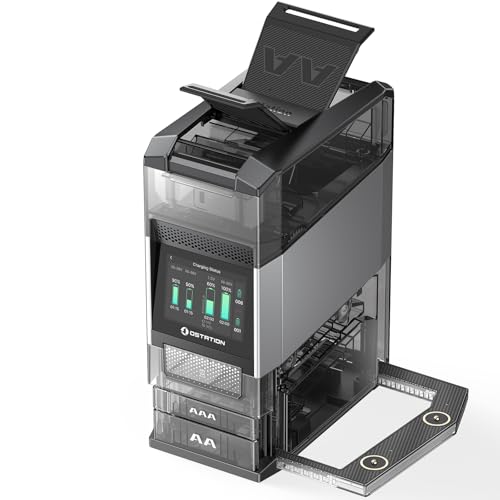
Ostation 2 Pro AA AAA Charging Station for NiMH and Lithium Batteries

Ostation 2 Smart AA AAA Charging Station with Polarity-Free Auto Detection and Storage Organizer
Inside Each Recommended Option
The Eneloop K-KJ55MCA4BA Advanced kit has been my go-to recommendation for years whenever a friend first cuts the cord on disposables. Four AA NiMH (nickel-metal hydride) rechargeable cells arrive pre-charged, so a new owner can drop them into a TV remote the same afternoon and skip the awkward “wait three hours” intro to rechargeables.
For someone running a single remote, a wireless mouse, and a couple of small toys, this kit covers the basics without overbuying. It’s also a calm starting point before graduating to the larger Power Pack reviewed next.
The Case For It
- Cells arrive factory-charged and ready to install straight out of the box.
- Up to 2,100 recharge cycles per cell, so a four-pack can outlast several hundred disposable batteries.
- Holds roughly 70 percent of its charge after years of shelf storage, handy for flashlights used in emergencies.
- Compact four-bay charger fits on a kitchen counter or in a drawer without dominating the space.
Things To Consider
- Only AA cells are included; AAA households need to buy those separately.
- Charges in pairs, so topping off a single battery isn’t an option.
Feature Snapshot
Right Fit For
First-time rechargeable shoppers with mostly AA devices and modest battery turnover.
Look Elsewhere When
Heavy AA plus AAA households should reach for the Eneloop K-KJ55MC84CZ Power Pack instead.
The Eneloop K-KJ55MC84CZ Power Pack takes the friendly K-KJ55MCA4BA Advanced kit and stretches it for a busier home. Eight AA and four AAA NiMH cells ship with the same 3-hour quick charger, so a household juggling remotes, game controllers, and a wireless keyboard has spares already on hand when something dies mid-use.
For families tired of hearing “my controller is dead” right before bedtime, the extra cells pay off fast. It also serves as a sensible upgrade over the four-AA starter reviewed above without changing brands.
What Works In Its Favor
- Twelve cells out of the box covers most household AA and AAA needs immediately.
- AA cells rated up to 2,000mAh typical (1,900mAh minimum) deliver steady runtime in controllers and toys.
- AAA cells rated up to 800mAh typical, comfortably powering TV remotes for months.
- Same 2,100-cycle NiMH chemistry as the smaller kit, so longevity expectations carry over.
Worth Noting
- Larger bundle means more cells to keep organized in a drawer or caddy.
- The charger still fills in pairs, which can feel slow when only one cell is low.
Best Suited To
Multi-device households that run AA and AAA cells side by side and want a turnkey first rechargeable bundle.
Reach For A Different Pick When
Someone running double-digit battery counts should consider the Ostation 2 Pro charging dock for higher throughput.
The NICEBATT Rechargeable 8-Pack AA Batteries with Charger targets households that burn through AA cells faster than the budget can keep up. Eight 2800mAh NiMH cells ship alongside an 8-bay smart USB fast charger, which handles both AA and AAA cells when extras show up later.
The 2800mAh rating outpaces the Eneloop AA cells reviewed above, so toys and flashlights stretch a bit longer between swaps. For someone tired of half-used battery packs cluttering the junk drawer, the eight-cell count feels right.
Noteworthy Benefits
- Eight 2800mAh AA cells ship in the box, enough to outfit several remotes at once.
- Cells rated for up to 1,200 recharge cycles, plenty for years of household use.
- 8-bay USB charger accepts both AA and AAA cells in any combination.
- Low self-discharge chemistry keeps stored cells ready between uses.
Honest Caveats
- No AAA cells included, so mixed households must add those separately.
- USB-powered design means it needs an adapter or powered USB port nearby.
- Brand recognition lags behind Eneloop, so long-term cell availability feels less certain.
Feature Snapshot
Built With In Mind
Budget-minded shoppers with AA-heavy devices who want a high-capacity starter bundle without the Eneloop markup.
Consider Something Else When
Households needing both AA and AAA from day one should consider the NICEBATT 4 AA + 4 AAA set reviewed next.
The NICEBATT 4 AA + 4 AAA set fixes the one weakness I called out on the previous 8-pack: it ships AAA cells in the box. Four 2800mAh AA cells pair with four 1100mAh AAA cells, all feeding an 8-bay smart USB fast charger that handles both sizes at once.
For a household with mixed-size remotes, a few toys, and maybe a wireless mouse, this bundle lands closer to a complete starter. It also keeps the same USB-powered convenience of the all-AA set.
Practical Advantages
- Both AA and AAA cells included, removing a second purchase right out of the gate.
- AAA cells rated at 1100mAh give remotes and small electronics a solid runtime boost.
- 8-bay charger accepts both sizes in any combination, useful for topping off odd numbers.
- Up to 1,200 recharge cycles per cell keeps replacement costs low over time.
Some Limits To Know
- Four AA cells may run thin for households with several AA toys running at once.
- USB cable is the only power option, so a wall adapter isn’t bundled in.
Whose Shelf It Belongs On
Mixed-size households that want one starter kit covering both AA and AAA without mixing brands.
Swap It Out When
Gamers running a dozen controllers at once should swap to the Ostation 2 Pro charging station further down the list.
The Ostation 2 Pro is a different category of AA and AAA charger. Instead of the small four-bay units we’ve reviewed so far, this is a hands-free charging, testing, and organizing station that holds up to 24 cells at once. It also doubles as an MCC (magnetic charging connector) dock for compatible Olight flashlights.
For gamers and smart-home owners whose battery drawer looks like a battery store, the station replaces a pile of chargers with one tidy dock. I like it best for households where cells constantly cycle between devices and storage.
Bright Spots
- Holds up to 24 batteries in one dock, eliminating a clutter of loose cells.
- Built-in tester checks remaining capacity without guessing by LED color.
- Smart sorting funnels charged and depleted cells into separate zones.
- Dual MCC magnetic ports add value for owners of compatible Olight flashlights.
Trade Offs
- Bulkier than a four-bay charger, so it needs a dedicated shelf or desk spot.
- Higher up-front cost than simple starter kits reviewed above.
- MCC ports only benefit flashlight owners with compatible models.
Feature Snapshot
Made For
Gamers and smart-home owners with a steady rotation of AA and AAA cells that need organized, hands-off charging.
Skip It When
Owners of just a few devices will find the NICEBATT 8-bay USB charger a more proportionate fit.
The Smart 8-Bay AA AAA Charger leans into USB-C (the modern reversible connector found on phones and laptops) and skips the wall wart entirely. It supports both Ni-MH (nickel-metal hydride) and Ni-CD (nickel-cadmium) cells, and an over-discharge repair mode attempts to recover deeply drained cells that other chargers reject.
I like this pick for travelers or anyone working at a desk where every cable is USB-C already. The repair function also adds a quiet lifeline for older cells showing their age.
The Helpful Details
- Eight independent charging bays accept any mix of AA and AAA cells.
- USB-C input simplifies cable management for laptop-heavy workspaces.
- Built-in chip cuts power at full charge to prevent overcharging damage.
- LED indicators show per-cell status without checking the back of the unit.
- Over-discharge repair mode can revive cells other chargers flag as dead.
Things To Weigh
- No batteries included, so this is purely a charger upgrade.
- Repair mode takes longer than a standard charge, so plan ahead for reviving cells.
Perfect Match For
Travelers and remote workers with a USB-C ecosystem who want a compact, repair-friendly charger.
Where Another Pick Suits Better
Buyers who need cells in the box should look back at the Eneloop K-KJ55MCA4BA Advanced kit reviewed first.
The Eneloop BQ-CC55KSBHA Advanced Pro Charger treats each cell as an individual unit rather than a paired set. Four color-coded LEDs show 80 percent, mid-range, and low charge levels, so I always know which cell is ready before pulling it from the bay.
The included BK-3MCCA8BA AA and BK-4MCCA8BA AAA cells share the standard 2,100-cycle longevity of the Eneloop line, just with smarter charging. This is the right upgrade over the smaller K-KJ55MCA4BA Advanced kit for someone wanting per-battery feedback.
The Good Stuff
- Individual cell charging means a single weak battery can be topped off without pulling the others.
- Color-coded LEDs (green, orange, red) communicate state at a glance.
- Compatible with both standard Eneloop and Eneloop Pro cells, so mixing sets is fine.
- Up to 2,100 recharge cycles per cell keep ownership costs predictable.
Points To Note
- Higher cost than the basic Eneloop charger reviewed first.
- Only four bays, so high-volume households may want a larger dock.
Feature Snapshot
Who Should Grab It
Enthusiasts who already own multiple Eneloop sets and want a charger that gives per-cell visibility.
A Better Fit Elsewhere
Power users running 20+ cells should compare the Ostation 2 Pro charging station reviewed above.
The BK-3HCCA8BA AA and BK-4HCCA8BA AAA High-Capacity cells push the Pro charger reviewed above into heavy-drain territory. AA cells reach up to 2500mAh typical, while still pairing with the same per-cell charging intelligence and color-coded LEDs.
For camera flashes, handheld gaming controllers, and other devices that sip batteries fast, the higher capacity noticeably stretches runtime. Cycle life drops to 500 charges compared to the standard 2,100, so this is a “power over longevity” trade-off.
Benefits That Matter
- AA cells up to 2500mAh typical, the highest standard NiMH capacity in this roundup.
- Same BQ-CC55KSBHA Advanced Pro charger with independent per-cell charging.
- Color LEDs reveal charge level at a glance, no app or menu needed.
- Pre-charged at the factory, ready for immediate use out of the package.
Some Limits To Know
- 500-cycle rating is lower than standard Eneloop cells reviewed earlier.
- Premium capacity carries a premium price compared to entry Eneloop kits.
- Heavier demand applications still favor lithium cells for max runtime.
The Right Fit
Photography enthusiasts and serious gamers who burn through standard AA cells faster than they’d like.
Where A Sibling Pick Shines
Long-term low-drain households will get more value from the Eneloop K-KJ55MC84CZ Power Pack reviewed second.
The Ostation 2 Pro Charging Station adds lithium support on top of the standard NiMH capabilities from the earlier Ostation 2 Pro reviewed above. So 1.5V rechargeable lithium cells can join traditional NiMH AA and AAA cells in the same 24-cell dock, with the unit auto-detecting what gets dropped in.
For households already using Olight flashlights and a mix of battery chemistries, this station quietly replaces three or four different chargers. Real-time monitoring and thermal-adaptive charging keep cells healthy even with this kind of mixed traffic.
Everyday Wins
- Auto-detection handles NiMH AA, AAA, and 1.5V lithium cells without manual switches.
- Hands-free operation lets me drop in cells and walk away.
- Thermal-adaptive charging adjusts for cell type to reduce wear.
- Compatible with Olight Baton and Warrior series flashlights via dual MCC ports.
Practical Considerations
- Higher price than simple four-bay chargers reviewed earlier.
- Physical footprint needs a dedicated counter or desk space.
- Lithium-cell support is most useful for owners already invested in that ecosystem.
Who Will Love This
Smart-home and workshop owners using both NiMH and 1.5V lithium cells who want one dock for everything.
Not Your Match When
Anyone sticking to NiMH-only and modest cell counts will find the Smart 8-Bay USB-C charger plenty.
The Ostation 2 Smart Charging Station removes one of the oldest frustrations in battery charging: polarity. Polarity-free design means I can drop AA or AAA cells into the dock without checking plus and minus, and the unit auto-detects what kind of cell it just received.
For shared spaces like a family kitchen counter, where anyone in the household might use the station, that hands-off feel is genuinely useful. It’s the same 24-cell, three-in-one concept as the Pro models, just friendlier for first-time users.
What Pays Off
- Polarity-free slots eliminate the plus/minus guesswork that frustrates kids and guests.
- Auto-detection reads cell type and adjusts charging accordingly.
- Built-in storage organizer keeps charged and depleted cells separate.
- Fast charging handles up to 24 cells in a single docking session.
Soft Spots
- Premium pricing puts it well above basic starter kits.
- Larger physical size compared to a four-bay wall charger.
Made For
Families and shared spaces where multiple people use the same charging dock and need a foolproof design.
Look Elsewhere When
Single-user households with a small battery footprint should compare the Eneloop K-KJ55MCA4BA Advanced kit instead.
What Matters Most Before Choosing Aa Aaa Chargers
The first question to settle is which battery sizes a household actually uses. A home built around AA devices can save money on a charger that focuses only on that size, while mixed remotes and slim electronics benefit from AA plus AAA support. Counting the cells in active rotation helps avoid overbuying a 24-bay station when an 8-bay unit would do.
Next, look at capacity and cycle rating together. Higher mAh (milliamp-hour, the unit that measures how long a cell can deliver current) numbers stretch runtime per charge, but cycle ratings hint at how many full recharge cycles a cell tolerates before capacity drops. Standard Eneloop cells favor longevity at 2,100 cycles, while high-capacity variants trade cycles for longer runtime.
Finally, think about how the charger fits into the household routine. USB-powered models travel well, while wall-plugged units suit permanent kitchen counters. Per-cell charging and color indicators help when devices drain unevenly, and polarity-free stations remove the most common charging mistake for shared homes.
Key Considerations Across These Picks
Where Shoppers Go Wrong
The most common slip-up is buying a charger without checking whether it charges individual cells or only pairs. Pair-only chargers waste time when only one cell is low, and they can overwork a healthy partner cell. Independent per-bay charging, like the BQ-CC55KSBHA Advanced Pro charger reviewed above, sidesteps that frustration.
Another trap is mixing old and new cells in chargers that don’t auto-detect chemistry. NiMH, Ni-CD, and 1.5V lithium cells each need different charge curves, and a mismatch shortens cell life over time.
Where The Extra Money Goes
Premium chargers tend to add three things: per-cell intelligence, thermal management, and storage-friendly organization. The Ostation models reviewed above bake all three into one dock, which is why they cost more than a four-bay starter kit.
Spending up makes the most sense in households with frequent battery turnover, where the saved time and longer cell life pay back the higher price quickly. For occasional use, a basic USB-C eight-bay charger does the job without the premium.
Frequently Asked Questions
How long do rechargeable AA and AAA cells usually last per charge?
Runtime depends on the device, but most AA cells in this roundup deliver 1,900 to 2,500mAh, which translates to weeks of typical remote use and days in high-drain toys. Higher capacity ratings generally mean longer intervals between swaps.
Can I mix brands of rechargeable cells in the same charger?
Yes, as long as the cells share the same chemistry, like NiMH across brands, and the charger supports independent charging. The Smart 8-Bay USB-C charger and the BQ-CC55KSBHA Advanced Pro both handle mixed-brand cells without complaint.
Do rechargeable batteries leak less than alkaline disposables?
Modern NiMH cells are far less prone to leaking than old alkaline disposables, which makes them safer for expensive electronics. Still, removing cells from rarely used devices before long storage extends their working life.
How should I store rechargeable cells when not in use?
Keep them in a cool, dry place at roughly half charge if possible, and avoid leaving fully depleted cells in devices for months. Low self-discharge chemistries, like the Eneloop line reviewed above, hold charge well during storage.
What does “pre-charged” actually mean on the label?
Pre-charged cells arrive with a usable charge from solar power at the factory, so they work straight out of the package. That removes the awkward first-charge wait common with older rechargeable cells.
Closing Remarks
The right AA and AAA charger depends less on a single spec and more on the shape of a household’s battery use. A small family with mostly AA remotes can start with the Eneloop K-KJ55MCA4BA Advanced kit and feel set for years, while gamers and smart-home owners get more mileage out of an Ostation dock. Pick the kit that matches today’s routine, then upgrade when the routine grows.
