

Tired of finding your smoke detector dead at midnight or your guitar pedal going silent mid-song? A reliable 9V battery charger turns one-time batteries into a renewable power source, saving trips to the store and cutting waste. I put together this roundup for households juggling remote controls, kids’ toys, and pro audio gear, since charging 9V cells well takes a different setup than AA or AAA. The seven options below cover everything from solo hobbyist needs to busy studios and emergency kits.
The Choices Worth Comparing

HiQuick Battery Charger for AA AAA 9V
Palogreen Rechargeable C Batteries with Charger 6-Pack

Palogreen Battery Charger for C D AA AAA 9V

BEVIGOR AA AAA Battery Charger
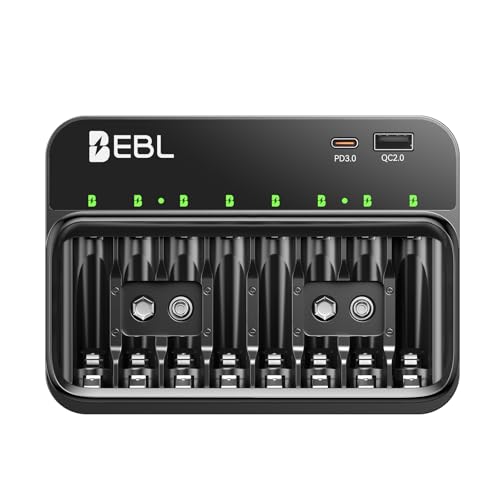
EBL PD 20W AA AAA 9V Battery Charger

MIEKLALE 20+2 Bay AA AAA Battery Charger

Palogreen C Batteries 4-Pack 5000mAh
A Deeper Look At The Lineup
I like chargers that pull double duty, and this HiQuick unit handles AA, AAA, and 9V cells without adapters. The integrated AC plug folds into the body, so it slips into a junk drawer between uses. For most living rooms juggling remotes, game controllers, and a smoke alarm or two, the mixed-format design solves the “one charger, three sizes” headache that plagues simpler units.
It accepts both Ni-MH and Ni-CD chemistries, which matters for anyone holding older rechargeable batteries from previous purchases. The individual slot design means a half-empty tray is not a problem, and you can top off a single 9V without wasting a charging cycle. Compared to single-format chargers, this flexibility is the main reason it earns the top spot for general household use.
Why It Works Well
- Twelve independent slots handle AA, AAA, and 9V cells together.
- Folding AC plug removes the need for a separate adapter brick.
- Ni-MH and Ni-CD compatibility covers older rechargeable stock.
- Charging a single 9V does not require pairing it with another cell.
Trade Offs To Consider
- The 9V bay count is modest, so loading up a full pro audio kit takes multiple rounds.
- No LCD readout, meaning progress is indicated by basic LEDs rather than per-cell percentages.
Right Fit For
Mixed-device households with a steady rotation of AA, AAA, and occasional 9V cells.
A Better Fit Elsewhere
Audio professionals and pedal board owners should consider the Palogreen NC906, since its discharge function extends battery memory and runtime.
Here is one of those all-in-one kits that saves a separate shopping trip. The bundle ships with six 5000 mAh C cells plus a multi-format charger, and the included car charging cable matters more than it looks for campers and road-trippers. Three storage boxes round it out, so loose cells stop rattling around the glove compartment.
The charger covers C, D, AA, AAA, and 9V Ni-MH and Ni-CD batteries, plus a discharge function for refreshing cells. The LCD screen makes the charging state visible at a glance. For anyone assembling a power-outage kit or stocking a vacation cabin, this bundle replaces the guesswork of matching cells to a charger.
What Works In Its Favor
- Bundled 5000 mAh C cells remove the search for matching batteries.
- Car charging cable supports road-trip and off-grid charging.
- Discharge function refreshes cells suffering from voltage memory.
- Three storage boxes keep loose cells organized in drawers or bags.
Honest Caveats
- Only one to two 9V cells charge at once, limiting fast turnaround for larger collections.
- The size of the kit may feel bulky for apartment dwellers without dedicated storage.
Key Product Details
Whose Shelf It Belongs On
Campers, van lifers, and anyone building an emergency power kit from scratch.
Swap It Out When
Studio owners with mostly AA and 9V needs may prefer the MIEKLALE 20+2 Bay charger for its larger capacity.
The NC906 from Palogreen focuses on the chore that most chargers skip: refreshing tired cells. Pressing the blue button flips the unit into discharge mode, marked by a “DISCHG” readout, and the charger returns to filling those same cells automatically. For musicians running 9V-powered pedals or wireless mics, that discharge cycle helps prevent the voltage drop that kills mid-performance.
It handles one to four AA/AAA/C/D cells or one to two 9V Ni-MH and Ni-CD batteries at a time, paired with AC wall power and a car cable for travel. The independent slot design keeps partial loads simple. Compared to the HiQuick unit reviewed earlier, the trade-off is fewer total slots in exchange for the discharge refresh.
Everyday Advantages
- Discharge function reverses voltage memory buildup in older rechargeables.
- Car cable adds road-trip and field-use flexibility.
- Independent bays allow mixed or partial loads without pairing rules.
- AC plug removes the need for a separate adapter brick.
Points To Keep In Mind
- The plastic housing is functional but unremarkable, so handle the unit gently during travel.
- Two 9V slots mean restocking a pedal board takes more than one charging session.
Feature Snapshot
Built With In Mind
Musicians, podcasters, and audio engineers who depend on consistent 9V performance night after night.
Consider Something Else When
Large family households that cycle through dozens of AA cells each week should look at the BEVIGOR AA AAA charger instead.
Eight bays with transparent housing feels almost industrial. The BEVIGOR station runs sixteen AA or AAA cells at once through sixteen isolated charging circuits, plus two 9V slots along the top edge. That scale suits shared living spaces where four people each own a wireless mouse, a keyboard, and a handful of remotes.
Smart charge technology drops to a trickle near full capacity, which protects against the overcharging that slowly kills Ni-MH cells. The transparent shell makes visual inspection simple, and the red and green LEDs telegraph status from across a room. Compared to the Palogreen NC906 reviewed just above, this unit trades the discharge feature for sheer slot count.
Notable Gains
- Sixteen isolated circuits prevent one weak cell from slowing the rest.
- Trickle-charge mode near full capacity extends overall battery lifespan.
- Transparent housing simplifies visual inspection of every slot.
- Dual 9V slots along the edge keep rectangular cells separate from cylinders.
Where It May Fall Short
- Larger footprint demands dedicated shelf space on a desk or in a closet.
- Batteries ship separately, so total ownership cost includes the cell purchase.
Made For
Shared apartments, classrooms, and households where AA and AAA cells disappear faster than coffee filters.
Reach For A Different Pick When
Owners of the EBL PD 20W unit prefer faster 300 mA charging and a smaller footprint.
Speed is the story here. The EBL station pushes 300 mA of charging current to Ni-MH and Ni-CD AA and AAA cells, with a gentler rate reserved for 9V blocks. For home offices running through a controller or headset battery every few days, that faster turnaround means fewer interruptions.
The eight-plus-two layout charges up to eight AA or AAA cells plus two 9V batteries in one session. It draws on USB-PD 20W input, so a laptop brick or modern wall adapter powers it. The compact shell fits a desk drawer, which is a nice change of pace after the larger BEVIGOR unit reviewed above.
Standout Benefits
- 300 mA charging current shortens the wait for AA and AAA cells.
- USB-PD 20W input works with modern laptop and phone chargers.
- Compact shell fits inside most desk drawers when not in use.
- Independent slots handle mismatched cell counts without fuss.
Small Caveats
- Requires a USB-PD power source, which may not ship in the box.
- Only two 9V slots cap the throughput for larger pedal collections.
Who It Suits Best
Home offices, gaming setups, and households that rotate through AA cells faster than they recharge them.
Look Elsewhere When
Workshop owners needing twenty-plus bays should consider the MIEKLALE 20+2 Bay charger for higher volume.
Twenty bays is overkill for a typical apartment, but it is just right for a workshop or a recording studio. The MIEKLALE station handles twenty AA or AAA cells plus two 9V batteries in a single load, and the LCD screen reports the status of each slot independently. Tech reviewers, podcast studios, and anyone whose house runs on battery-powered gear will appreciate the volume.
Compatibility stops at Ni-MH and Ni-CD 1.2V rechargeables, and the unit cannot handle 3.7V lithium or 1.5V lithium AA cells. For most households sticking to traditional rechargeables, that restriction is no problem at all. The trade-off for the LCD detail is a wider footprint than the EBL unit reviewed earlier.
A Few Strong Suits
- Twenty-plus-two bays cover the largest household collections in one pass.
- Per-slot LCD readout makes it easy to spot a failing cell.
- Independent charging means partial loads do not slow the rest.
- Ni-MH and Ni-CD support covers most rechargeable chemistries in circulation.
Things To Weigh
- Discharge function is absent, so cell refresh requires a separate step.
- Larger footprint demands a dedicated shelf or workbench area.
Quick Facts
Best Suited To
Studios, workshops, and tech-heavy homes cycling through large battery collections weekly.
Not Your Match When
Solo users with just a few 9V cells may find the HiQuick Battery Charger a simpler, smaller solution.
This is not a charger, but it belongs in any honest 9V battery conversation because the cells matter as much as the dock. The Palogreen C-Cell pack delivers 5000 mAh of Ni-MH capacity with a low self-discharge chemistry that retains most of its charge even after years in a drawer. For emergency kits or seasonal flashlights, that shelf stability is the headline feature.
The cells tolerate roughly twelve hundred recharge cycles, which is enough to outlast several generations of chargers. A storage case ships in the box, so loose cells stop disappearing into junk drawers. Note that these are C cells, not 9V, so they pair with the larger chargers reviewed earlier, like the Palogreen NC906 or the bundled kit, for recharging.
The Helpful Details
- Low self-discharge chemistry keeps cells ready after long storage.
- Twelve hundred recharge cycles stretch the value of every cell.
- Storage case prevents loose cells from cluttering drawers.
- Ni-MH chemistry is compatible with all multi-format chargers on this list.
A Few Limitations
- C-cell format means a separate charger is needed; this is not a charging station.
- Higher self-discharge than premium low-drain cells under heavy use.
Feature Card
Who Should Grab It
Anyone assembling emergency kits, camping supplies, or backup power for C-cell flashlights and portable radios.
Where Another Pick Suits Better
Owners of the BEVIGOR charger should consider that station’s AA and AAA focus instead, since this Palogreen pack is strictly C-cell.
Picking The Right 9V Charger for Your Routine
Match The Charger To The Devices You Actually Own
Before looking at slots and screens, count the 9V-powered gear in your home. Smoke detectors, guitar pedals, wireless microphone receivers, and certain studio tools all sip from 9V cells, but at very different rates. A household with three smoke alarms needs reliable, slow charging that keeps a steady bench of fresh cells. A pedal board owner needs faster turnaround and possibly a discharge function. The Palogreen NC906 serves the second crowd, while the HiQuick unit covers the first.
Understand Battery Chemistry Compatibility
Ni-MH (nickel-metal hydride) and Ni-CD (nickel-cadmium) are the two rechargeable chemistries these chargers support. Ni-MH cells hold more energy and lack toxic cadmium, making them the modern default. Ni-CD cells still appear in older equipment and tolerate extreme temperatures better. Chargers that accept both formats, like every model on this list except the EBL PD 20W and the Palogreen battery pack, future-proof your setup against chemistry transitions.
Decide Between Slot Count And Special Features
Slot count affects how many cells you can refresh overnight. A two-slot 9V charger works for a couple of smoke detectors; a twenty-bay station like the MIEKLALE suits a studio. Discharge functions, like the one on the Palogreen NC906, help refresh cells that have developed voltage memory from partial charge cycles. LCD readouts make it easier to spot a dying cell, while simple LEDs are easier to read across a dim room.
Plan For Power Source And Travel
Wall power is the default, but units with car cables, like the two Palogreen models, open road-trip and cabin charging. USB-PD input, like the EBL PD 20W, lets a modern laptop brick do double duty. Folding AC plugs travel better than fixed cables. For most urban households, wall power is enough; for campers, the car cable tips the scale.
Key Considerations Across These Picks
Mistakes Worth Dodging
Buying a charger without checking 9V support is the most common slip. Plenty of multi-format chargers only handle AA and AAA, leaving 9V owners stranded with a partial solution. Confirm 9V bay count and discharge function before committing. Another trap is ignoring battery chemistry compatibility. A drawer full of older Ni-CD cells will not charge well in a Ni-MH-only unit, so verify dual-chemistry support when you own older cells.
Where The Extra Money Goes
Higher-tier chargers, like the MIEKLALE 20+2 Bay and the EBL PD 20W, charge for faster current, larger bay counts, and LCD readouts. The speed bump matters when cycling through dozens of cells each week. The bay count matters in shared spaces where multiple people depend on the same dock. For occasional top-offs in a small household, a simpler charger covers the routine, while heavy users feel the difference within a month.
Frequently Asked Questions
How long does it take to charge a 9V rechargeable battery?
Most 9V chargers fill a depleted Ni-MH cell in two to four hours, depending on the charger’s milliamp output. Higher current chargers, like the EBL PD 20W, finish faster, while basic trickle chargers may need overnight.
Can I charge different battery sizes at the same time?
Multi-format chargers like the HiQuick and Palogreen NC906 let you mix AA, AAA, and 9V cells in one session. Independent slot designs avoid the pairing rules that older units enforced.
Do 9V rechargeable batteries lose charge while sitting on a shelf?
Ni-MH cells lose roughly one to two percent of their charge per day at room temperature. Low self-discharge chemistries, like the Palogreen C-Cell pack, slow this rate, retaining most of their capacity after years of storage.
Is a discharge function worth the extra cost?
Discharge modes help restore cells that have developed voltage memory from repeated partial charges. Musicians and audio professionals see the most value. Households with steady, full charge cycles rarely need the feature.
How many charging cycles can I expect from rechargeable 9V cells?
Quality Ni-MH 9V cells typically survive several hundred full charge cycles before capacity drops noticeably. Lower-cost cells may degrade sooner, so cycling capacity matters for long-term ownership costs.
Wrap Up
A good 9V battery charger pays for itself within months, especially for households running smoke detectors, pro audio gear, or a rotation of wireless gadgets. The seven picks above cover everyone from casual top-off users to studio owners cycling through dozens of cells each week. Match the charger to your real workload rather than the biggest spec sheet, and you will spend less time hunting for fresh batteries and more time enjoying the gear that needs them.
