

A 60 amp 2 pole breaker sits at the heart of countless electrical setups, from solar arrays and RV battery banks to subpanels feeding a workshop or a heavy appliance circuit. Picking the wrong one means nuisance tripping at best and a safety gap at worst, so I put together this list to help you match the breaker to the system it actually protects. Whether you’re wiring a DC-only off-grid setup or replacing a tired AC breaker in a residential panel, the seven options below cover the most common scenarios I hear about from homeowners, installers, and off-grid hobbyists.
The Leading Options At A Glance
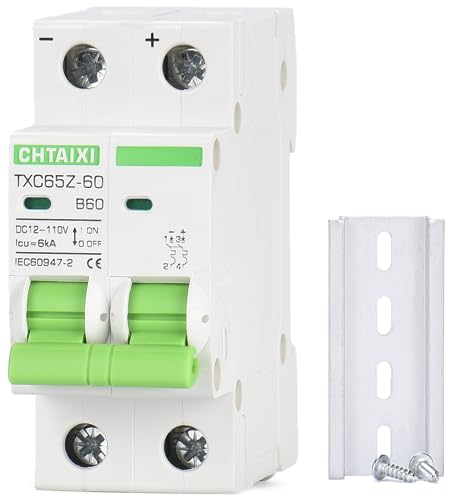
CHTAIXI 60A 2-Pole DC Miniature Circuit Breaker

CHTAIXI DC Miniature Circuit Breaker 1000V 63A

DIHOOL 60A 2-Pole Solar Disconnect DIN Rail

CHTAIXI DC Miniature Circuit Breaker 500V 125A

Square D HOM260 60A Double Pole Breaker

Connecticut Electric UBIP260 Pushmatic Replacement

Sezbaifles 1000V 30A PV Disconnect Switch
More On The Choices That Made The List
Low-voltage DC work rarely needs more sophistication than a solid electromagnetic trip unit, and this CHTAIXI breaker covers a remarkably wide voltage window for the category. Rated for circuits from 12V up through 110V DC, it slots into battery systems, solar arrays, RV house banks, and small electric mopeds without needing a separate breaker per voltage tier. The Curve B magnetic trip range (the current threshold at which the breaker snaps open during a sudden surge) trips at roughly four to seven times the rated current, which suits the inrush patterns I see in DC motor and inverter circuits.
The two-pole configuration means both conductors are interrupted together, which is the safer arrangement for ungrounded DC systems where one conductor is bonded to chassis. Compared to the higher-voltage CHTAIXI unit reviewed below, this one sacrifices ceiling voltage for broader low-voltage coverage, so it makes more sense in 12V to 48V environments than in series-string PV arrays.
Practical Advantages
- Covers 12V, 24V, 36V, 48V, 60V, 100V, and 110V DC systems with a single model.
- Magnetic trip action responds almost instantly to short circuits, reducing arc damage risk.
- Two-pole design interrupts both conductors simultaneously for safer DC isolation.
- Suitable for battery banks, RV setups, solar arrays, and small electric vehicles.
Worth Noting
- Voltage ceiling tops out at 110V DC, so it cannot protect higher-voltage PV strings.
- No enclosure is included, so owners commonly mount it inside a DIN-rail box for outdoor use.
Key Specs
Made For
DIYers and RV owners running battery-based DC systems who want one breaker that handles multiple voltage tiers without stocking spares.
Consider Something Else When
High-voltage series-string solar arrays should look at the CHTAIXI DC Miniature Circuit Breaker 1000V 63A reviewed next, since it tolerates far higher open-circuit voltages.
DC arc suppression is genuinely harder than AC because there is no natural current zero crossing to extinguish the arc, and that is exactly the problem this breaker is engineered to handle. With a 1000V DC rating and a magnetic assist for arc extinguishing, it suits the open-circuit voltages that show up in residential PV strings, particularly when panels are wired in series. At 63 amps, it also gives installers a bit of headroom above a typical 60A target, which is useful when continuous loads approach the breaker rating.
The trade-off shows up in low-voltage battery work, where this breaker is overkill. For 12V and 24V systems, the CHTAIXI 12V-110V unit covered above is a more honest fit, and the price difference rarely justifies over-speccing a small battery bank.
Real Benefits
- 1000V DC rating handles series-string solar arrays without derating.
- Magnetic arc-extinguishing system addresses the harder DC interruption problem.
- 63A continuous rating offers margin above a 60A nominal load profile.
- Also useful for control and isolation switching beyond protection duties.
Trade Offs
- Excessive for battery-only 12V or 24V systems where a lower-voltage breaker suffices.
- Requires DIN-rail enclosure for safe outdoor or panel mounting.
Who It Suits Best
Solar installers and homeowners wiring mid-sized PV arrays who need verified high-voltage DC protection and want one breaker that doubles as an isolation switch.
A Better Fit Elsewhere
RV owners running house battery banks at 12V or 24V should reach for the DIHOOL Solar Disconnect Switch, which handles those voltages natively without the 1000V premium.
Some installations mix AC and DC in the same enclosure, and few breakers in this category tolerate both without a separate SKU for each side. The DIHOOL unit bridges that gap with a 48V to 500V DC range and a 90V to 480V AC range in a single 60A two-pole body. The non-polarized design also means you don’t have to obsess over which terminal carries the source, which simplifies the wiring for first-time installers.
The thermal-magnetic trip mechanism (a dual system that reacts to slow overloads via a heating element and to sudden shorts via a magnetic coil) plus the built-in arc-suppression magnet and flame-retardant enclosure make this a credible choice for RV battery isolators and small PV arrays. Where it falls short is in heavy-duty service above 60 amps, where stepping up to the CHTAIXI 125A unit reviewed later makes more sense.
Bright Spots
- Handles both AC and DC circuits in one breaker, simplifying mixed-system builds.
- Non-polarized terminals remove a common wiring mistake during installation.
- Fits standard 35mm DIN rail for easy panel integration.
- Compact 54mm x 80mm x 75mm footprint leaves room in crowded enclosures.
Honest Caveats
- 60A ceiling rules out large inverter or subpanel feeds.
- Source listings don’t specify a trip curve, so matching to specific inrush loads requires care.
Feature Snapshot
Built With In Mind
RV owners and off-grid hobbyists running mixed AC/DC loads who want one breaker type across battery, inverter, and PV circuits.
Skip It When
Large-scale PV installations drawing more than 60 amps should pick the CHTAIXI DC Miniature Circuit Breaker 500V 125A reviewed next, since it doubles the current headroom.
Big DC systems need real current headroom, and 125 amps at 500V DC is enough to protect sizeable battery banks, combiner boxes, and inverter feeds without forcing the breaker to live at the edge of its rating. The silver alloy contacts and flame-retardant shell suggest a manufacturer that has thought about the wear pattern of repeated tripping, which matters in any installation where a fault might happen more than once in the breaker’s lifetime.
The honest read is that 125A is too much breaker for a 60A application, so this is really an upgrade path pick. If your design is currently sized at 60 amps but you anticipate expansion to a larger inverter or additional PV panels, oversizing here saves a swap later.
Practical Pluses
- 125A rating supports large battery banks and inverter-fed subpanels.
- Silver alloy contacts resist pitting and welding under fault conditions.
- Flame-retardant enclosure adds margin in fault-event scenarios.
- Color indicator on the housing aids quick status checks during service.
Where It May Fall Short
- Overkill for typical 60A residential loads, raising enclosure cost unnecessarily.
- Source listings do not confirm a trip curve, so verify against your specific load profile.
Quick Facts
Right Fit For
Installers designing expandable solar or battery systems who want to specify one breaker that survives the transition from a 60A to a larger-amp installation.
Look Elsewhere When
Standard 60A residential service work belongs with the Square D HOM260 reviewed below, which is purpose-built for Homeline load centers.
Residential panel work is its own category, and Square D’s Homeline series has been the go-to load center for decades. The HOM260 is the genuine OEM breaker designed for that ecosystem, which matters because panel compatibility lists can be unforgiving when a third-party unit doesn’t quite seat right. Thermal-magnetic trip action covers both sustained overloads and instantaneous short circuits, which is the dual protection most homeowners actually need.
Compared to the DC miniature breakers above, this is an AC-only, plug-on breaker intended for indoor load centers. Where the CHTAIXI and DIHOOL units shine in battery and PV systems, the HOM260 is the right tool when the job is a 240V appliance circuit or subpanel feed in a house.
Benefits That Matter
- Genuine OEM Square D unit guarantees fit in Homeline load centers.
- Thermal-magnetic trip handles both slow overloads and fast short circuits.
- 60A double-pole rating suits common 240V appliance and subpanel circuits.
- Factory-new condition with OEM packaging for warranty traceability.
Things To Consider
- Limited to AC applications and incompatible with DC battery or PV systems.
- Only fits Homeline panels, not the competing QO or competitor lines.
Feature Rundown
Who Will Love This
Homeowners and electricians adding a 240V circuit to a Square D Homeline panel who want a genuine OEM replacement that drops in without fit issues.
Not Your Match When
Homes with older Pushmatic panels should reach for the Connecticut Electric UBIP260 reviewed next, which is built as a direct replacement for that legacy format.
Pushmatic panels were common in mid-century homes, and finding a replacement breaker for them used to mean scavenging used parts or rewiring the entire panel. The Connecticut Electric UBIP260 solves that headache as a new-manufacture P260 replacement, listed to UL 489 for both US and Canada. The 10,000 AIC rating (the maximum fault current the breaker can safely interrupt) is a serious spec, indicating this is built to clear a substantial fault without failing open.
The bolt-on style is specifically Pushmatic, so this is not a universal fit. Homes with Homeline, QO, or other modern panels will find no use for it, and those shoppers should pivot to the Square D HOM260 reviewed above.
The Helpful Details
- New manufacture replacement keeps legacy Pushmatic panels in service.
- UL 489 listing covers both US and Canadian installations.
- 10,000 AIC rating handles substantial fault currents safely.
- 120/240 VAC rating fits standard residential split-phase service.
Points To Keep In Mind
- Bolt-on format is specific to Pushmatic panels and won’t cross-fit other brands.
- Some owners of very old panels choose full panel replacement instead, which is a separate scope of work.
Best Suited To
Homeowners with vintage Pushmatic load centers who need a working 60A double-pole breaker without replacing the entire panel.
Reach For A Different Pick When
Modern Homeline or QO panel work belongs with the Square D HOM260 reviewed earlier, since plug-on breakers fit those ecosystems cleanly.
Rooftop solar installs need a disconnect that survives weather, and the Sezbaifles unit comes pre-housed in an IP65 enclosure (a rating that means dust-tight and protected against water jets), which removes the cost and labor of sourcing a separate weatherproof box. The integrated male and female connectors are a thoughtful touch that speeds up plug-and-play wiring between panels and the inverter, and the widened operating handle is easier to actuate with gloves on.
The 30A current rating is the key limitation. String sizes that pull above 30 amps require a heavier breaker, and the 60A DIHOOL reviewed earlier handles that scenario better. For typical residential arrays in the 30A range, though, this is a tidy, outdoor-ready package.
Strong Points
- IP65 enclosure protects against dust and water jets for outdoor mounting.
- Integrated connectors simplify plug-and-play wiring at the array.
- Widened handle makes manual switching easier, even with work gloves.
- Transparent cover lets you see device status without opening the box.
Some Limits To Know
- 30A current ceiling rules out larger strings and high-amperage inverters.
- Enclosed design adds bulk, so retrofitting into tight existing enclosures can be tight.
At A Glance
Perfect Match For
Rooftop solar installers who want an all-in-one outdoor disconnect and don’t want to source a separate weatherproof enclosure.
Swap It Out When
Arrays exceeding 30 amps continuous should pivot to the DIHOOL 60A 2-Pole Solar Disconnect, which doubles the current capacity in a DIN-rail format.
Choosing The Right 60 Amp 2 Pole Breaker for Your Setup
A 60 amp 2 pole breaker is more nuanced than its size suggests, because “60 amp” describes the current handling while “2 pole” tells you how many conductors the breaker interrupts. In a 240V AC circuit, both poles are the two hot legs; in a DC system, both poles are typically the positive and negative conductors, which is why DC breakers need arc-extinguishing features that AC breakers often skip.
Voltage rating is the first filter. Battery systems at 12V to 48V live in a different voltage class than residential PV strings at 300V to 1000V DC, and using an underrated breaker is a fire and safety hazard. The CHTAIXI 12V-110V unit covers the low end, while the 1000V CHTAIXI and Sezbaifles units cover high-voltage arrays.
AC versus DC is the second filter. Breakers listed for AC only, like the Square D HOM260 and Connecticut Electric UBIP260, should never be used on DC circuits, because the trip curve and arc behavior differ fundamentally. For mixed AC/DC environments, the DIHOOL is one of the few in this category that handles both natively.
Panel compatibility is the third filter for residential replacements. Homeline, QO, Pushmatic, and other legacy formats use different mounting styles, and a breaker that physically fits one may not seat correctly in another. Always match the breaker family to the panel brand before considering current or voltage.
Finally, consider installation environment. Outdoor rooftop work demands an IP65 or better enclosure like the Sezbaifles unit, while indoor panel work is fine with a bare breaker on DIN rail or plug-on bus.
Key Considerations Across These Picks
Mistakes Worth Dodging
The most common error I see is grabbing an AC breaker for a DC circuit because the amperage and pole count match on paper. AC breakers lack the arc-extinguishing features that DC arcs demand, and the result is a breaker that may weld shut instead of tripping during a fault. Equally risky is underrating voltage, which shows up when someone uses a 110V DC unit on a 400V PV string, expecting the breaker to “trip fast enough.” It usually does not.
A subtler slip is ignoring panel compatibility. Pushmatic, Homeline, and QO breakers look similar at a glance but use different mounting and bus designs. Cross-fitting often leads to loose connections, which generate heat and premature failure even if the breaker appears to function at first.
Where The Extra Money Goes
Higher-tier breakers in this category earn their premium through better arc suppression, more durable contact materials like silver alloy, and wider operating temperature ranges. For a one-off residential repair, a basic thermal-magnetic unit may be perfectly adequate. For an off-grid system that cycles daily or a PV array exposed to temperature swings, the upgraded contact materials and arc-handling of the DIHOOL or the 125A CHTAIXI tend to pay back in longer service life and fewer nuisance trips.
Frequently Asked Questions
What is the difference between a 60 amp 2 pole breaker and a single-pole breaker?
A single-pole breaker interrupts one conductor and is used for 120V AC circuits. A 2 pole breaker interrupts two conductors simultaneously and is required for 240V AC circuits or full DC isolation where both legs must open together.
Can I use a 60 amp 2 pole AC breaker in a DC solar system?
No. AC breakers lack the arc-extinguishing design needed to safely interrupt DC current, which arcs much more aggressively because there is no zero-crossing point. Always choose a breaker rated and listed for the DC voltage of your system.
What does AIC rating mean on a circuit breaker?
AIC stands for “Ampere Interrupting Capacity” and is the maximum fault current the breaker can safely clear without failing. The 10,000 AIC rating on the Connecticut Electric UBIP260 indicates it can interrupt up to 10,000 amps of fault current.
Do DIN-rail breakers need a separate enclosure?
For indoor protected panels, DIN-rail breakers can mount to an open rail. For outdoor, dusty, or wet locations, an appropriate enclosure with a matching IP rating is required to keep the breaker safe and functional.
How do I know if my panel takes Homeline or Pushmatic breakers?
Open the panel cover and look for the brand and model label inside the door or on the label. Homeline panels accept Square D HOM-series breakers, while Pushmatic panels use the distinctive bolt-on Pushmatic style like the Connecticut Electric UBIP260.
The Takeaway
A 60 amp 2 pole breaker is a small component with outsized consequences, and matching its voltage rating, current capacity, panel fit, and AC/DC compatibility to your actual system is the real work. Start with the system type, narrow by voltage, then confirm the panel family, and the right pick from this list usually becomes obvious. Take your time on that match, and the breaker will quietly do its job for years.
