

A 555 timer IC is one of those small, stubborn chips that has held a workshop together for decades. Hobbyists reach for it when they want a square wave, a long delay, a one-shot pulse, or just a blinking LED that actually blinks. The trouble starts when you need more than one, or you want a kit that bundles a few different timing parts so a weekend project doesn’t stall at the breadboard.
I pulled together four popular listings that cover the common buying scenarios: bare timer chips for stocking up, timers bundled with sockets, a classic 50-pack, and a wider analog IC assortment that includes 555s alongside the rest of your bench essentials.
A Side-By-Side Look

DORHEA 50Pcs NE555 Timer IC NE555P 8-Pin Machined Contact Pins
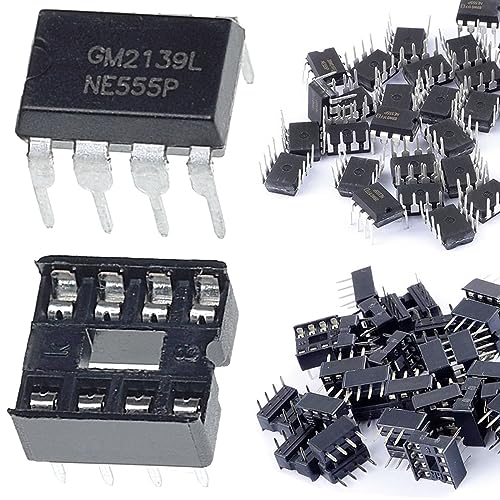
50 pcs NE555P Timer IC + 50 pcs DIP-8 IC Sockets

MCIGICM 50Pcs DIP-8 NE555 Timer IC Chip Kit

EEEEE 161 pcs IC Kit with 20 Models and IC Plier
The Strengths Of Each Pick
The DORHEA pack arrives as fifty DIP-8 (Dual In-line Package, an 8-pin through-hole chip format) timer chips built around the NE555P, which is the classic precision timer format most hobbyists grew up wiring on a breadboard. Power supply range is broad enough (roughly 4.5 V to 16 V) to span everything from a small 555 flasher on a 9 V battery up to a 12 V automotive-style timing project.
Machined contact pins tend to slide into a breadboard with less wobble than the stamped leads you’ll find on cheaper pulls, which matters when you are prototyping a circuit that has to sit stable while you probe with a meter. Compared to the DAOKAI bundle below, this option skips the sockets and focuses on the chip itself.
Everyday Wins
- 50-count pack covers the typical “I burned one, where’s another?” moments in long project runs.
- Standard NE555P pinout drops into any 555 reference circuit you find in a textbook or datasheet.
- Supply range up to 16 V gives headroom for automotive and 12 V projects.
- Machined pins sit flat in breadboards and IC sockets, which can cut down on flaky connections.
Things To Consider
- No sockets are included, so first-time builders may need to source DIP-8 sockets separately.
- Operating range tops out at 70°C, which is fine for hobby work but limiting in a hot enclosed project box.
Key Specs
Best Suited To
Workshop regulars who keep burning through 555s on prototyping and want a single bulk pack to refill the parts drawer.
Where Another Pick Suits Better
The DAOKAI 50-pack is a better fit if you’d rather get matched DIP-8 sockets in the same box and don’t want a second parts order.
DAOKAI’s bundle ships fifty NE555P chips alongside fifty matching DIP-8 IC sockets, which is the small, plastic carriers that let you solder a chip into a PCB without heating the chip directly. For a first-timer, that combination removes the most common 555 footgun: bending a pin while forcing the bare chip into a tight PCB hole.
Same story here on the electrical side: 4.5 V to 16 V operation covers the typical hobby rails, and the bipolar 555 architecture handles the textbook astable (free-running oscillator) and monostable (one-shot pulse) modes that show up in beginner kits. The bundled sockets also make it easy to swap a suspect chip out without desoldering.
Bright Spots
- Sockets are included, so the chips can be socketed rather than soldered directly.
- Matched 50/50 count keeps chip and socket inventory balanced over a long project.
- Standard 555 pinout works with every common astable and monostable reference design.
- Sockets let you replace a chip in seconds if you suspect a bad one.
Trade Offs
- Sockets add a small amount of height to the build, which can matter in tight enclosures.
- Bipolar 555s draw more quiescent current than CMOS 555 alternatives, so battery-powered projects may drain faster than expected.
Who It Suits Best
First-time builders and students who want a chip-and-socket kit in one box for breadboard and through-hole learning projects.
Skip It When
The EEEEE 161-piece kit is a better fit if you’d like 555s plus op-amps, comparators, and PWM (pulse-width modulation) controllers in a single organizer rather than two specialized packs.
MCIGICM’s kit is the simple, no-frills option: fifty NE555-class timer chips in the standard 8-pin DIP package, aimed at classrooms, repair benches, and group workshops. The supply range and operating temperature match the DORHEA pack, so electrically you’re looking at roughly the same chip behavior across both listings.
Where this kit differs from the DORHEA option is the framing: the listing highlights the chip’s role as a single timer/oscillator, which is the right mental model for someone who only needs the chip to flash a few LEDs or build a basic pulse generator. For a small electronics class handing out the same part to ten students, that focused description is actually useful.
Standout Benefits
- Fifty identical DIP-8 chips are easy to distribute across a classroom or workbench.
- Standard 555 pinout keeps lab guides and existing reference circuits directly compatible.
- Through-hole leads survive repeated breadboard insertion by students learning soldering.
Worth Noting
- No sockets ship with this kit, so plan to source DIP-8 sockets separately.
- No specialized variants like CMOS 555s are included, so low-power builds will need a different order.
The Right Fit
Electronics instructors, repair technicians, and workshop organizers who need a plain 50-pack of NE555s without extras to manage.
Look Elsewhere When
The DORHEA 50-pack is the better pick if machined contact pins matter for your breadboard stability, since this kit’s lead finish isn’t called out as specifically.
EEEEE’s kit zooms out from “just 555s” and gives you a 161-piece, 20-model analog IC (integrated circuit) assortment organized in a compartmentalized case. The 555 timer sits alongside op-amps (LM358, LM324, NE5532, LM386, TDA2030, TDA2822, UA741), comparators (LM393, LM339), a multivibrator (CD4047), an echo audio processor (PT2399), PWM controllers (UC3842, UC3843), and Darlington arrays (ULN2003, ULN2803).
An IC plier comes in the box for pulling chips out of the case, and a pin assignment table is included so beginners can map each chip without flipping through separate datasheets. Compared to the MCIGICM 50-pack, this is the broader, “fill the lab drawer” choice rather than a focused 555 refill.
Benefits That Matter
- Twenty different analog IC models support audio, power, and timing projects in one organizer.
- Compartmentalized case keeps mixed chips from tangling together in a drawer.
- Included IC plier avoids fishing small chips out with fingers or tweezers.
- Pin assignment table inside the kit removes a lot of datasheet hunting for beginners.
Points To Note
- 555 count is lower than the dedicated 50-packs, so heavy 555 users may still need a separate refill.
- Mixing twenty models means a beginner has to learn which chip goes where before each build, which slows early projects.
Whose Shelf It Belongs On
Hobbyists running mixed analog projects, from audio amps to motor drivers, who want a one-stop assortment instead of several single-purpose packs.
Another Choice May Suit
The DAOKAI 50-pack is a better fit if your work centers almost entirely on 555 timing circuits and you’d rather have more chips than more chip types.
What Matters Most Before Choosing 555 Timer Ics
Match The Chip Variant To Your Power Budget
The classic bipolar 555 found in the DORHEA, DAOKAI, and MCIGICM packs draws several milliamps even when idle. For battery or solar projects, look for CMOS (a low-power chip-fabrication process) 555 variants like the LMC555 or TLC555; they sip microamps and stretch battery life significantly. Stick with bipolar parts for mains-powered or short-run learning kits where the supply isn’t precious.
Check The Package And Footprint
DIP-8 through-hole, like every pack here, is the easiest format to breadboard, swap, and replace. Surface-mount packages (TSSOP, SOIC, tiny solder-on formats) save board space but demand hot air or fine-pitch soldering. Beginners almost always want DIP-8, and seasoned builders only switch to SMD when enclosure size forces it.
Think Beyond The 555
A standalone 555 pack is right when you already own the supporting parts. A mixed kit like the EEEEE assortment makes more sense when you’re filling out a fresh bench and want op-amps, comparators, and PWM controllers in the same organizer. Match the kit to how bare your parts drawer already is.
Buy In Bundles That Match Your Failure Rate
Through-hole 555s are hardy, but static discharge, reversed power, and student mis-wiring still claim a few per project. A 50-pack covers a semester of tinkering; a 5-pack doesn’t. If you’re teaching or running a long build, the larger counts pay for themselves simply by avoiding mid-project reorders.
Key Considerations Across These Picks
Mistakes Worth Dodging
Buying surface-mount 555s by accident is a common slip-up; always double-check the package is DIP-8 if you plan to use a breadboard. Another trap is assuming every NE555-marked chip behaves identically; unmarked pulls can drift in timing accuracy or current draw, which is why sealed retail packs are safer than loose grab bags.
The Case For Spending Up
A mixed analog kit like the EEEEE assortment costs more than a bare 555 pack, but the extras (op-amps, PWM controllers, a pinout chart, an IC plier) replace several separate orders. The upgrade pays off when your projects stretch beyond timing into audio or motor control; it doesn’t make sense for someone who only ever builds 555 blinkers.
Frequently Asked Questions
What is a 555 timer IC actually used for?
A 555 timer IC generates precise time delays or oscillations, and hobbyists use it for everything from LED flashers and tone generators to motor speed controls and simple one-shot pulses.
Are all 555 timers interchangeable?
Standard bipolar NE555 parts in DIP-8 are mostly interchangeable across hobby circuits, but CMOS variants have different pin behavior, lower current draw, and may not drop into every reference design unchanged.
How many 555 chips should I buy at once?
For personal tinkering a 10-pack is enough; for classrooms, repair benches, or long projects, a 50-pack covers normal loss rates without forcing mid-build reorders.
Do I need sockets with my 555 chips?
Sockets are optional but very helpful for beginners, since they let you swap a suspect chip quickly and avoid heating the chip during soldering. Dedicated kits like the DAOKAI bundle include matched sockets for that reason.
Can beginners actually use a mixed IC kit like the EEEEE pack?
Yes, as long as the included pin assignment table is used to identify each chip. Beginners benefit from the variety, but should plan extra time to learn which chip suits which project before building.
Wrap Up
A solid 555 timer IC pick depends less on the brand and more on how you build. Stocking up on a focused 50-pack makes sense when timers are the core of your work. A chip-and-socket bundle eases first builds. A mixed analog kit fills a fresh bench with the supporting parts a 555 project often needs. Pick the shape of kit that matches the shape of your bench, and the rest of the project tends to fall into place.
