

A dead battery has a funny way of ruining the first nice weekend of spring. I’ve spent enough mornings hunting for jumper cables to know that a small charger tucked in the garage is one of the most useful things a vehicle owner can own. This roundup focuses on compact 12V trickle chargers that quietly top off motorcycle, ATV, lawn tractor, and classic car batteries over weeks of downtime, so the machine just starts when you need it. The picks below lean toward models with multi-stage charging profiles, since modern batteries reward patience more than raw amperage.
The Main Contenders

Battery Tender Junior 12V, 750mA Charger and Maintainer
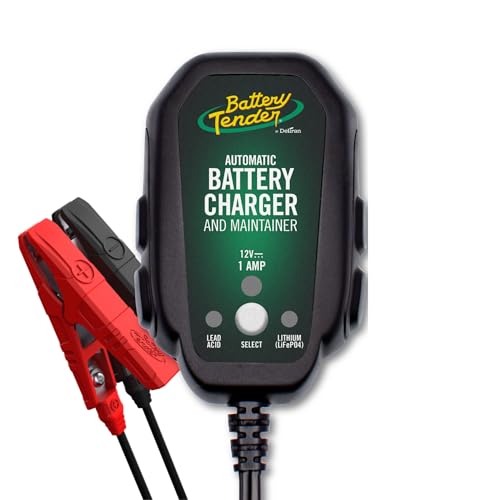
Battery Tender Junior 12V, 800mA Lead Acid and Lithium Charger

Battery Tender Plus 12V, 1.25 AMP Battery Charger and Maintainer

NOCO GENIUS1 1A 6V/12V Smart Battery Charger

NOCO GENIUS5 5A 6V/12V Smart Battery Charger

SUNER POWER Waterproof 20W 12V Solar Charger and Maintainer

NOCO GENIUS2 2A 6V/12V Smart Battery Charger
A Closer Look At Each Pick
I’ve recommended this little black-and-silver box to more riding buddies than any other charger on the market. It runs a four-step program: initialization, bulk charge, absorption, and float mode, the last of which is what actually sets a smart maintainer apart from an old-school trickle. Once your battery is topped up, the unit dials itself down to a holding voltage, so you can leave it clipped on all winter without cooking the cells.
For a 12V lead-acid, flooded, AGM, or gel battery in a motorcycle or ATV, the 750mA output is plenty. The alligator clips and ring terminals both come in the box, which matters more than people expect when the battery is buried under a body panel.
The Helpful Details
- Four-stage charging handles initialization through float automatically, so you can plug in and forget it for months at a time.
- Compatible with lead-acid, flooded, AGM, and gel batteries, covering most powersports vehicles on the road.
- Float mode keeps a full battery topped up indefinitely without the risk of overcharging common with dumb trickle units.
- Compact body fits in a saddlebag or under a workbench without hogging space.
Things To Consider
- At 750mA, recovering a deeply discharged battery takes patience compared with the higher-output picks later in this list.
- Not designed for lithium chemistry, so owners of newer LiFePO4 powersports batteries need to look elsewhere.
Whose Shelf It Belongs On
Riders who tuck a motorcycle, scooter, or ATV away for the winter and want a set-and-forget maintainer that just works.
Look Elsewhere When
Anyone running lithium batteries should reach for the Battery Tender Junior 12V, 800mA Lead Acid and Lithium Charger, which handles LiFePO4 out of the box.
The same Junior form factor, but with a chemistry switch on the side. A single button toggles between lead-acid (AGM, flooded, gel) profiles and lithium (LiFePO4), so a household with both types of battery can use one charger instead of two. An ISM microcontroller handles the heavy lifting on the algorithm side, which is the part that decides whether your battery gets a full meal or just a trickle.
At 800mA, the output is marginally stronger than the original Junior, and the housing is white for easy identification on a crowded workbench. Owners commonly stash it on a shelf with both clip and ring leads, swapping between machines depending on the season.
The Upside
- Switchable lead-acid and lithium profiles cover AGM, flooded, gel, and LiFePO4 packs with a single purchase.
- ISM-managed multi-stage charging keeps the algorithm adaptive to battery condition, which matters for older batteries that may have lost a little capacity.
- The same compact Junior footprint as the original, so storage and mounting options carry over.
Worth Noting
- You must remember to flip the mode switch before connecting a lithium battery; mismatched profiles can damage LiFePO4 cells over time.
- Still a small-output unit, so recovery on a deeply discharged large battery is a slow affair.
Made For
Garages with a mix of older lead-acid bikes and newer lithium-equipped machines, where one flexible unit is more useful than two dedicated ones.
Consider Something Else When
Riders who need faster recovery on a larger AGM should consider the Battery Tender Plus 12V, 1.25 AMP Battery Charger and Maintainer for its extra amperage.
Where the Junior line prioritizes compactness, the Plus line prioritizes throughput. The 1.25A output pushes meaningful current into AGM and flooded batteries, which shortens the time between a dead cell and a ready-to-ride machine. It still uses the same four-step approach (full charge, then float), so once the battery is topped up the unit settles into maintenance mode for safe long-term storage.
It’s a slightly larger unit than the Junior, but still very garage-friendly, and it carries a California-compliant charger designation. In my experience with chargers in this class, owners who ride regularly rather than storing for months tend to appreciate the extra current most.
Standout Benefits
- 1.25A output recovers a moderately discharged AGM noticeably faster than the Junior models in this list.
- Full-charge-to-float cycling suits batteries that get used weekly, not just stored seasonally.
- Designed with AGM and flooded batteries in mind, which covers most automotive and powersports use cases.
- California-compliant design meets tight energy-efficiency rules, so it draws less standby power than older units.
Honest Caveats
- No lithium mode, so LiFePO4 owners still need a different charger.
- Slightly larger footprint than the Junior units, so tight saddlebag storage is less practical.
Best Suited To
Active riders and weekend drivers who use their AGM-equipped machine often enough that faster top-ups matter more than ultra-compact size.
A Better Fit Elsewhere
Owners with a single motorcycle that sits untouched for months will do just as well with the Battery Tender Junior 12V, 750mA Charger and Maintainer and save a few dollars.
The GENIUS1 is the smallest of NOCO’s smart charger family, and that matters for anyone with limited shelf space. It handles both 6V and 12V batteries, plus AGM, gel, flooded, deep-cycle, and lithium-ion (LiFePO4) chemistries, so it earns its keep across an entire garage of mixed vehicles. Compared to its predecessor, the G750, the GENIUS1 packs more power into a smaller body.
I like the GENIUS1 for vintage owners, since the 6V support means a classic tractor or pre-war car battery can be maintained alongside a modern daily driver. At 1A it’s still modest, so deep recovery isn’t the goal, but steady maintenance is.
Well-Handled Touches
- 6V and 12V support covers classic cars, motorcycles, and modern vehicles with one unit.
- Compatible with lead-acid (AGM, gel, flooded, deep-cycle) and lithium-ion (LiFePO4) batteries up to 30 amp-hours, which suits most small powersports batteries.
- Compact housing is easier to mount in a tight garage or carry in a tour pack than larger chargers.
Room For Improvement
- At 1A, it isn’t built for quick recovery on larger battery banks; for that, the NOCO GENIUS5 is the step up.
- Owners commonly report that the included accessory bundle is best supplemented with longer leads for hard-to-reach battery trays.
The Right Fit
Collectors with a mix of vintage 6V machines and modern 12V batteries who want one compact unit on the bench.
Reach For A Different Pick When
Drivers of larger vehicles with deeply discharged batteries are better served by the NOCO GENIUS5 5A 6V/12V Smart Battery Charger, which has the current to push bigger banks back up.
The GENIUS5 sits in the middle of NOCO’s lineup, and for many households it’s the sweet spot. With 5A on tap, it can push a real charge into a car, SUV, or deep-cycle battery, not just dribble current into a motorcycle pack. It works on 6V and 12V lead-acid (AGM, gel, flooded, deep-cycle) and lithium-ion (LiFePO4) batteries up to 120 amp-hours, which covers most passenger vehicles on the road.
The unit handles battery charging, maintenance, and restoration in one package, and it’s notably smaller than its predecessor, the G3500. For someone with a truck or boat who wants one charger to do everything, this is often the answer.
Why It Works Well
- 5A output moves current into larger battery banks faster than the 1A GENIUS1 in this list.
- Works across 6V and 12V systems, and across AGM, gel, flooded, deep-cycle, and LiFePO4 chemistries.
- Handles batteries up to 120 amp-hours, which covers most cars, SUVs, and many boats.
- Combines charging, maintenance, and restoration features in a single unit.
Points To Note
- Bigger and heavier than the GENIUS1, so it isn’t the pick for tucking into a saddlebag or small tool drawer.
- More amperage than a motorcycle battery strictly needs, so smaller-battery owners may not use its full capability.
Feature Snapshot
Who Should Grab It
Truck, SUV, and boat owners who need real charging power and want a single unit that handles every battery in the driveway.
Swap It Out When
Powersports-only owners will find the NOCO GENIUS1 1A 6V/12V Smart Battery Charger more appropriately sized for their batteries.
Not every battery lives near an outlet. The SUNER POWER kit is a 20W solar panel with a built-in MPPT (Maximum Power Point Tracking) charge controller, which is the part that squeezes the most usable energy out of whatever sunlight hits the panel. The improved three-stage charging algorithm walks the battery through bulk, absorption, and float stages, similar in spirit to the AC-powered units earlier in this list.
The panel is waterproof and aimed at the RV, marine, trailer, and off-grid crowd. You mount it on a deck or dash, run the leads to the battery, and the sun does the rest. For someone whose boat or camper sits at a storage lot without power, this is the practical answer.
Points In Its Favor
- No AC outlet required, which makes it the right tool for unpowered storage lots and remote parking situations.
- Built-in UltraSmart MPPT controller maximizes the panel’s output across varying light conditions.
- Waterproof construction handles rain, splashes, and marine environments without extra housing.
- Three-stage charging protects batteries from the kind of overcharging a dumb solar panel can cause.
Small Caveats
- 20W is enough to maintain, not quickly recharge, so deeply discharged batteries still need an AC unit.
- Cloudy weeks and winter sun angles can drop output significantly, which matters for owners in northern climates.
Built With In Mind
RVers, boaters, and trailer owners whose vehicles sit outdoors or at storage lots without reliable AC power.
Where Another Pick Suits Better
Daily drivers parked in a garage are better served by the NOCO GENIUS2 2A 6V/12V Smart Battery Charger, which uses household power and works through any weather.
The GENIUS2 is the middle child of NOCO’s GENIUS lineup, and in many ways it’s the most universally useful. At 2A it has more punch than the GENIUS1 but doesn’t dominate a small battery the way the 5A GENIUS5 can. It supports 6V and 12V lead-acid (AGM, gel, flooded, deep-cycle) and lithium-ion (LiFePO4) batteries up to 40 amp-hours, which fits mid-sized car and light-truck applications.
Like its siblings, the GENIUS2 combines charging, maintenance, and restoration in one unit, all wrapped in a housing notably smaller than its predecessor, the G1100. For someone who wants one charger for daily-driver maintenance and occasional recovery duty, this is often the comfortable middle ground.
Practical Advantages
- 2A output handles most passenger-vehicle batteries without overdriving smaller powersports packs.
- Multi-chemistry support covers AGM, gel, flooded, deep-cycle, and LiFePO4 batteries up to 40 amp-hours.
- Combines charging, maintenance, and restoration modes, so it’s useful for both routine top-ups and recovery jobs.
- Smaller than the GENIUS5, so storage on a workbench or shelf is straightforward.
Factors To Consider
- Not the right tool for very large deep-cycle banks, where the 5A GENIUS5 has the edge.
- Restoration mode is helpful but not a substitute for replacing a battery that has lost significant capacity.
Perfect Match For
Daily-driver owners and small-fleet managers who want a flexible 6V/12V charger that doesn’t specialize too hard in either direction.
Not Your Match When
Owners maintaining larger battery banks should reach for the NOCO GENIUS5 5A 6V/12V Smart Battery Charger, which has the current to handle them.
What To Match Against Your Battery Before You Choose
A trickle charger, in the strict sense, just pushes a slow, constant current into a battery indefinitely. The smart units in this list improve on that idea by reading the battery’s state and dialing back to a maintenance voltage once the cell is full. That distinction matters more than the output number on the box.
Chemistry is the first filter. Lead-acid (flooded, AGM, gel) batteries are forgiving and widely supported. Lithium-ion (LiFePO4) batteries need a charger with a matching profile; mismatched voltage can shorten cell life. Match the chemistry first, then think about amperage.
Output current sets the pace. A 750mA unit can maintain a motorcycle battery comfortably, but recovering a dead car battery at that rate takes days. A 2A or 5A unit shortens that window considerably. For storage-only use, slower is fine. For mixed use, faster pays off.
Connection style affects daily convenience. Alligator clips are quick. Ring terminals are permanent. Owners who keep the same machine on the charger all winter tend to install rings; people who rotate between vehicles use the clips.
Environment matters too. Indoor garage use opens the door to any AC-powered unit. Outdoor storage or remote lots push you toward a waterproof solar panel with an MPPT (Maximum Power Point Tracking) controller, like the SUNER POWER option. Picking the right format for your parking situation prevents a lot of frustration later.
Key Considerations Across These Picks
Common Shopping Slip Ups
The mistake I see most often is buying a 12V-only charger for a 6V classic, or assuming any lead-acid profile is fine for a lithium battery. Both assumptions shorten battery life, and the fix is a quick check of the chemistry switch on the unit before you connect it. Another recurring slip is underestimating how long a deeply discharged battery takes to recover on a small-output maintainer. Patience helps, but matching the amperage to the battery saves days of waiting.
Where The Extra Money Goes
Higher-tier models in this category typically buy more output current, broader chemistry support, and a smaller physical package. The NOCO GENIUS5, for example, costs more than the GENIUS1 because it pushes 5A versus 1A and handles larger battery banks. For someone with a single motorcycle that sits for months, the extra capability doesn’t earn its keep. For someone with a truck, an ATV, and a classic car, the upgrade is well worth it.
Frequently Asked Questions
Do I need a 12V trickle charger if I ride my motorcycle regularly?
Regular riding keeps a battery topped up on its own, but a smart maintainer is still useful during short off-seasons or for vehicles with parasitic draws (small electrical loads that drain a battery while parked), like alarm systems or accessories. It is inexpensive insurance against coming back to a dead battery after a few weeks away.
Can I leave a smart charger connected for months?
Yes. The float mode in the units reviewed here is designed for long-term connection, holding the battery at a safe voltage without overcharging. Old-style trickle chargers without float mode can damage a battery over that kind of timeframe.
Will any of these work on a lithium battery?
Only the models with explicit lithium (LiFePO4) support, including the Battery Tender Junior 12V, 800mA Lead Acid and Lithium Charger and the NOCO GENIUS1, GENIUS2, and GENIUS5. Pure lead-acid chargers should not be used on lithium packs.
Is solar practical in winter or cloudy climates?
Solar output drops sharply in low-light conditions, so a solar maintainer is best understood as a summer and shoulder-season tool in northern climates. In sunnier regions or summer use, it works very well for boats, RVs, and trailers parked outside.
How do I know what amperage I need?
A small motorcycle battery (around 10 amp-hours) is happy with 750mA to 1A. A typical car battery (40 to 60 amp-hours) recovers meaningfully faster at 2A to 5A. Pick the amperage that matches the largest battery you expect to maintain.
Bottom Line
A smart 12V trickle charger is one of those small tools that quietly prevents one of the most annoying problems a vehicle owner can have. For most garages, the NOCO GENIUS2 hits the comfortable middle of capability and size, while the Battery Tender Junior 750mA remains a trusted choice for pure powersports storage. Match the chemistry, pick the right amperage for the battery in front of you, and let the charger do the rest.
