

Charging a lithium battery the wrong way is a fast way to shorten its life, and that’s exactly the trap I want to help you sidestep. LiFePO4 chemistry (a lithium iron phosphate battery) needs a specific charging profile that lead-acid chargers simply don’t deliver. Whether you’re topping off an RV house bank, keeping a garage queen ready, or maintaining a fleet of powersports machines, the right smart charger protects your investment. I put this guide together so you can match charger output, amperage, and connector type to your setup without guesswork.
A Fast Comparison Of The Options

Victron Energy Blue Smart IP65 12V 7A Charger

CTEK CT5 12V Automotive Charger
JMR 12V Battery Charger for McLaren

NOCO GENIUS1 1A 6/12V Smart Charger

NOCO GENIUS10 10A 6/12V Smart Charger

LiTime 12V 20A Lithium Battery Charger

NOCO GENIUS5 5A 6/12V Smart Charger
Meet The Standout Selections
Workshop owners and serious DIYers tend to gravitate toward Victron’s Blue Smart line because it does something most chargers in this category don’t: it talks to your phone. The 7-amp output lands in a sweet spot for 12V LiFePO4 banks up to roughly 100 amp-hours, fast enough to recover from a deep discharge overnight without cooking the cells.
The sealed ABS plastic enclosure carries an IP65 rating, which means dust-tight and resistant to low-pressure water jets. For a damp garage or an open-air workshop, that kind of weatherproofing is genuinely useful, not just marketing. The integrated Bluetooth pairs with the Victron Connect app for live voltage readings, charge-stage alerts, and remote setting changes.
The Practical Payoff
- Bluetooth monitoring means you can check charge status from across the shop without walking over.
- IP65 sealed housing handles dusty garages, covered patios, and the occasional splash.
- A dedicated LiFePO4 mode applies the correct absorption voltage for lithium chemistry.
- 7A output strikes a balance between recovery speed and gentle cell conditioning for mid-size banks.
- The Victron Connect app logs historic data so you can spot a failing battery before it strands you.
Things To Consider
- For larger banks above 150Ah, expect overnight runs to stretch into a full day or longer.
- The app pairing can be finicky on older Android phones, which is a commonly reported frustration.
Feature Snapshot
Who It Suits Best
DIYers and workshop tinkerers with mixed battery fleets who want app-based monitoring and a sealed enclosure that survives the real world.
Where Another Pick Suits Better
The CTEK CT5 is a better travel companion for someone who values a smaller brick and simpler button-driven operation over Bluetooth.
CTEK has built its reputation on chargers that quietly sit in the corner of a garage and keep batteries topped off for months on end. The CT5 continues that legacy with a compact brick that handles cars, motorcycles, ATVs, and snowmobiles on a single dial. For powersports owners pulling a sled out of storage in November, this unit’s Recond mode can nurse a deeply discharged battery back toward health.
Unlike the app-driven Victron unit, the CT5 keeps things simple with mode buttons and indicator lights. A “Supply” mode can route power directly from the alternator to critical accessories, which is a niche but useful feature for show-car owners running accessories without a battery in the loop.
What Helps Most
- Multi-chemistry support covers lead-acid, AGM, and LiFePO4 from a single mode dial.
- Compact footprint slides into a saddlebag, trunk bin, or toolbox without a fight.
- Recond mode attempts to revive deeply discharged batteries that other chargers refuse to touch.
- Spark-proof connector design prevents accidental shorts when clipping to terminals in tight engine bays.
Worth Noting
- Charging speed is gentle, so a deeply discharged large battery may need a full day or more.
- The included lead-acid-only clamp set can feel redundant if you only run lithium.
Best Suited To
Powersports owners and seasonal-vehicle keepers who want a set-and-forget maintainer that handles multiple chemistries without app pairing.
Look Elsewhere When
Drivers with large LiFePO4 banks over 100Ah will find the NOCO GENIUS10’s 10A output far better suited to nightly recovery.
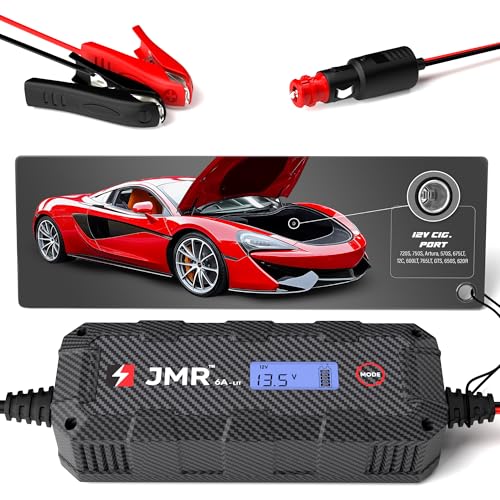
Most chargers assume you can pop a hood and reach the battery, but McLaren owners know the 12V cell often hides behind panels that require tools and patience. Juice My Ride solves that puzzle with a cigarette-lighter plug-and-play adapter designed to mate with the factory port on most non-electric McLaren models. For a 720S sitting in a climate-controlled garage between weekend drives, this unit keeps the 12V battery topped off without ever cracking a panel.
The “Add Lithium Mode” switch lets owners flip between AGM and LiFePO4 charging profiles, which matters since McLaren has transitioned between battery chemistries across model years. Compatibility covers 720S, 750S, 570S, 675LT, 12C, 600LT, 765LT, GT, GTS, 650S, and 620R.
Standout Benefits
- Cigarette-port adapter means no panel removal, no direct terminal access, and no risk of scratching carbon fiber trim.
- Mode switch adapts to AGM, lead-acid, or LiFePO4 depending on the car’s original spec.
- Charges through the factory port while the battery remains sealed and protected.
Trade Offs
- Niche by design: this charger only makes sense if your car has the matching factory port.
- Charging speed is conservative, prioritizing battery longevity over quick turnarounds.
Made For
McLaren owners storing a non-electric supercar between weekend drives who want zero-touch maintenance without opening body panels.
Reach For A Different Pick When
Anyone outside the McLaren ecosystem should grab the NOCO GENIUS5, which handles the same charging job across a much wider range of vehicles.
The GENIUS1 is NOCO’s smallest smart charger, and it punches well above its weight class. The 1-amp output sounds modest, but for trickle maintenance on powersports batteries, lawn tractors, or seasonal toys, that gentle rate is exactly what the cells need. It also handles both 6V and 12V systems, which covers everything from a vintage motorcycle to a modern ATV.
Compared to the bulkier GENIUS5 or GENIUS10 in this roundup, the GENIUS1 trades raw speed for a footprint that disappears in a glovebox or under a workbench. Owners commonly report leaving it connected for weeks without issues, since the automatic float mode keeps the battery at full charge without overdoing it.
Practical Advantages
- Supports 6V and 12V systems in one unit, doubling its usefulness across mixed fleets.
- Force Mode can coax charge into a battery that other chargers won’t recognize as present.
- Sealed housing shrugs off garage dust and the occasional knock off a shelf.
- Charges LiFePO4 plus flooded, gel, AGM, and deep-cycle lead-acid batteries.
- Tiny form factor makes it the easiest unit here to stash in a trailer or saddlebag.
Points To Note
- 1A is too slow for a meaningful recovery on larger car batteries; it shines as a maintainer, not a rescuer.
- Lead-acid clamps are permanently attached, which can feel cluttered for owners running only lithium setups.
Perfect Match For
Motorcycle, ATV, and lawn tractor owners who need a low-current maintainer that can ride along on trips and hibernate all winter.
Swap It Out When
Anyone charging a full-size car or truck battery regularly will find the NOCO GENIUS10’s 10A output saves hours per session.
When a battery has been neglected for a season or two, a 1-amp trickle won’t cut it. The GENIUS10 brings 10 amps to bear, which is enough to recover a deeply discharged car battery overnight and still gentle enough to leave connected as a maintainer. The integrated desulfator applies high-frequency pulses to break down lead sulfate crystals, which is a real-world benefit for older lead-acid banks sitting in storage.
Temperature compensation adjusts the charging profile based on ambient heat or cold, which protects batteries in unheated garages or summer sun. Force Mode lets the unit push charge into a battery that reads as zero volts, a feature that can rescue a pack other chargers have abandoned.
Notable Upsides
- 10A output recovers deeply discharged batteries in a reasonable window.
- Desulfation mode can extend the life of older lead-acid batteries by breaking down sulfate buildup.
- Temperature compensation protects cells in extreme heat or cold environments.
- Force Mode revives batteries that other chargers refuse to recognize.
- Compatible with LiFePO4, AGM, gel, flooded, and deep-cycle batteries up to 230Ah.
Room For Improvement
- The unit runs warm under heavy load, so plan ventilation if it’s mounted in an enclosed compartment.
- More expensive than smaller NOCO models, which may not pencil out for a single-vehicle owner.
Feature Snapshot
The Right Fit
Owners with neglected or larger-capacity batteries who need real recovery power plus long-term maintenance in one box.
Skip It When
The CTEK CT5 is a smarter call for someone maintaining a motorcycle or ATV who doesn’t need 10 amps of recovery muscle.
The LiTime 20A is purpose-built for LiFePO4, and that focus shows in the spec sheet. A 14.6V absorption output matches the chemistry’s exact requirements, while the 0V activation can wake batteries that other chargers have written off. For RV owners running a 200Ah house bank or off-grid cabins charging a deep-cycle lithium setup, this unit handles the workload without breaking a sweat.
The Anderson connector and AC-DC design mean it plugs into a standard wall outlet and feeds the battery through a robust, locking connection. Six safety protections guard against overvoltage, overcurrent, short circuits, reverse polarity, overheating, and timer overrun. An LED indicator gives at-a-glance status without an app or display screen.
What Works In Its Favor
- 20A output cuts charging time on large LiFePO4 banks by half compared to 10A units.
- 0V activation can recover lithium batteries that have dropped below standard recovery thresholds.
- Anderson connector locks securely and resists accidental disconnection in mobile setups.
- Six-layer safety suite covers the most common failure modes without requiring owner intervention.
Some Limits To Know
- Not waterproof, so mounting location matters in marine or open-deck environments.
- LiFePO4-only design means you’ll need a separate charger for any lead-acid battery on the property.
Quick Facts
Built With In Mind
RV owners, off-grid cabin dwellers, and solar system users running 100Ah or larger LiFePO4 banks who want fast, dedicated lithium charging.
Consider Something Else When
The Victron Blue Smart is a better choice for someone running a mixed-chemistry fleet who wants Bluetooth monitoring in one box.
The GENIUS5 sits in the middle of NOCO’s product lineup, and for most daily-driver owners, that’s exactly where the sweet spot lives. Five amps strikes a balance that handles a deeply discharged car battery overnight while staying gentle enough for long-term maintenance on a 100Ah lithium bank. The compact housing finds a home in a trunk bin or under a seat without dedicated mounting hardware.
It supports 6V and 12V batteries up to roughly 120Ah, covering classic cars, modern daily drivers, and small marine setups from a single unit. The thermal compensation adjusts output based on ambient conditions, which protects batteries parked outdoors in summer sun or winter cold.
Points In Its Favor
- 5A output recovers daily-driver batteries overnight without overdoing it.
- Multi-chemistry support covers LiFePO4 plus all major lead-acid variants.
- Compact housing tucks into a trunk or shelf without taking over the space.
- Repair mode can recover batteries that other chargers have abandoned as unrecoverable.
- Thermal compensation adjusts output for hot or cold environments.
Less-Strong Areas
- Not fast enough for large 200Ah+ banks where a 10A or 20A unit pays off.
- The integrated cable design limits mounting flexibility in tight engine bays.
Key Specs
Whose Shelf It Belongs On
Daily-driver owners and small-boat skippers who want one charger that handles maintenance, recovery, and mixed chemistries without dedicated mounting.
Not Your Match When
Large-RV owners running 200Ah+ house banks will see much faster turnaround from the LiTime 20A charger.
Matching Output And Connectors To Your Setup
A few core attributes drive whether a charger fits your situation, and understanding them up front saves you from a mismatched purchase. The first consideration is amperage output. A rough rule: 10 percent of battery capacity is a comfortable charge rate for most LiFePO4 cells, so a 100Ah bank pairs well with a 10A charger, while a 50Ah pack is happier with 5A.
Voltage compatibility matters more than it sounds. LiFePO4 cells charge at 14.6V during the absorption stage, which is higher than what most lead-acid chargers deliver. Using a mismatched charger either undercharges the battery or, worse, leaves it perpetually sitting below full capacity.
Connector type is the practical detail that trips up first-time owners. Clamp leads work for direct terminal access, while Anderson plugs and ring terminals suit permanent installations. Make sure the charger’s output matches how you’ll actually connect it, especially in permanent RV or solar setups.
Finally, IP ratings matter if the charger will live in a damp or dusty environment. An IP65 rating like the Victron offers is genuinely useful for outdoor or unprotected locations, while indoor-only units should stay inside.
Smart Choices And Smarter Spending
Pitfalls Shoppers Hit
The most common mistake I see is buying a lead-acid charger for a LiFePO4 battery and wondering why the pack never reaches full charge. The voltages simply don’t line up. A close second is underestimating amperage needs: a 1A trickle unit on a 200Ah house bank will technically work, but it’ll take a week to fill from empty. The third trap is overlooking connector compatibility, which turns a perfect charger into a paperweight when the plug doesn’t match the battery port.
Where The Extra Money Goes
Higher-tier models in this category tend to earn their cost through smarter charging profiles, app integration, and faster recovery. The LiTime 20A, for instance, charges twice as fast as a 10A unit on the same bank, which matters when you actually need to use the RV tomorrow morning. Premium pricing also buys weatherproofing, robust safety circuits, and the ability to recover batteries that budget units abandon. For owners running expensive battery banks, the upgrade pays for itself by protecting the larger investment underneath.
