

A 120 volt plug is one of those small parts you only think about when something stops working. A cord end cracks on a job site, a shore-power inlet leaks after a rainstorm, or a halogen bulb burns out in a wax warmer you actually use every day. I pulled together seven solid options that cover the situations most people hit: repairing an extension cord, wiring an RV or boat inlet, splitting generator power, and replacing specialty bulbs.
The Choices Worth Comparing

HYDUUU 110V 3-Prong Drop Cord Repair Plug

PAULINN 15A Flanged Inlet 125V NEMA 5-15

PAULINN 15A Inlet w/Dual 18″ Extension Cord
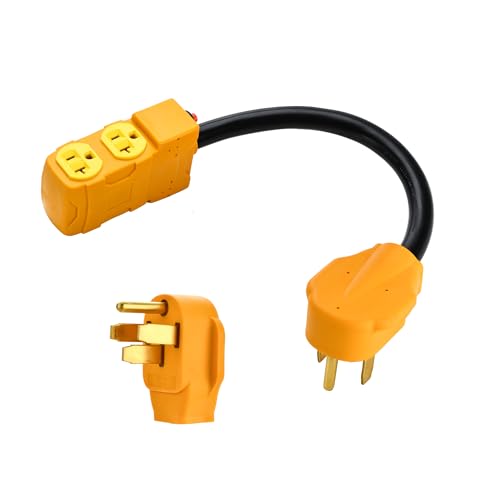
lalarodia 50A to 20A RV Distribution Adapter

PAULINN Shore Power Inlet w/18″ Cord
G6.35 120V 35W Halogen Bulbs 10-Pack
12Vmonster GY6.35 35W Halogen Bulbs 10-Pack
Why These Options Stand Out
When an extension cord end gets crushed under a pallet or snapped by a dropped tool, replacing the whole cord is wasteful. The HYDUUU drop cord cap is a NEMA 5-15P repair plug, the standard three-prong configuration you’ll see on nearly every household outlet in North America, rated for 15 amps and 120 volts. It accepts 12 AWG wire, which is the heavier gauge you’d find on serious outdoor or workshop cords.
The shell is built from high-impact thermoplastic, the same kind of material used in professional cord caps that take daily abuse. Captive screws and adjustable cord clamps inside the body mean the wires won’t pop loose during a tug. For someone rewiring a chewed-up shop cord or building a replacement for a generator lead, this is the kind of straightforward fix that beats a trip to the hardware store.
The Helpful Details
- Captive screws stay in the body during assembly, so a dropped screw on the shop floor is one less annoyance
- Adjustable cord clamp grips 12 AWG cable firmly, reducing strain on the internal wire connections
- ETL listing signals it has passed third-party safety testing for North American electrical use
- Ergonomic easy-grip ridges help pull the plug free from tight outlet arrangements
Things To Consider
- Only suits 12 AWG cords, which is great for heavy use but won’t fit lighter 14 or 16 AWG cables
- Single-pack means you’ll need extras on hand if multiple cords need work
Key Specs
Made For
DIYers, electricians, and shop owners who need to repair a heavy-gauge cord end without replacing the entire cable.
Swap It Out When
RVers wiring an exterior shore-power inlet should look at the PAULINN 15A Flanged Inlet instead, since that option is built for permanent outdoor mounting.
A flanged inlet is the part you bolt into the side of an RV, boat, or shed so you can plug in an extension cord from outside. The PAULINN 15A model is a 2-pole, 3-wire weatherproof unit rated at 125 volts with a hinged cover that protects the contacts when not in use. It’s the kind of fitting that keeps rain and road salt off your shore-power connection during a long winter at the marina.
The body is nickel-coated copper with tough black nylon, which holds up to UV rays and the random scrapes that come with docking and trailering. Inside, a see-through wiring block and color-coded clamps take some of the guesswork out of termination. The cord grip accepts 12 through 18 AWG wire, giving flexibility for either a short pigtail or a longer run back to the breaker panel.
A Few Strong Suits
- Spring-loaded waterproof cover shields the inlet between uses, which matters for any outdoor install
- Wide wire range from 12 to 18 AWG suits most RV and boat wiring projects
- UV- and impact-resistant nylon housing extends service life in coastal or sunny climates
- Color-coded wire clamps simplify correct termination for less experienced installers
Points To Note
- Requires a 2-inch mounting hole, which means planning ahead before drilling into a finished wall
- Wiring is left to the installer, so beginners may need a multimeter and a careful hand to get polarity right
Right Fit For
Boat owners, RV enthusiasts, and shed owners adding a permanent exterior power connection for the first time.
Consider Something Else When
Anyone who wants a pre-attached pigtail should look at the PAULINN Shore Power Inlet with the 18-inch integrated cord, which removes the wiring step entirely.
Most boat and RV owners only need one shore-power inlet, but some setups benefit from a Y-split that feeds two separate circuits. This PAULINN inlet ships with two integrated 18-inch cords, each ending in a standard NEMA 5-15 plug. You bolt the inlet to the hull or RV wall, then run both cords to wherever they need to land, often one toward the galley and one toward the cabin.
The flanged body carries the same waterproof cover and UV-resistant nylon shell as the single-inlet version, so durability should be consistent across the line. A 2-inch mounting hole is required, and the see-through wiring block keeps installation straightforward. Owners commonly report that having two cables cuts down on adapter juggling when running a microwave and a battery charger at the same time.
Notable Gains
- Two pre-wired leads skip the step of wiring a second cord yourself
- Same weatherproof cover and marine-grade nylon housing as the single-inlet model
- Color-coded clamps and transparent wire block reduce wiring errors for first-time installers
- 15A, 125V rating matches standard household shore-power setups
Some Limits To Know
- Two cords through one hole means more strain relief planning than a single-cord install
- Still requires a 2-inch cutout, which is more invasive than a cable pass-through
Best Suited To
Boat or RV owners who want to power two separate cabin circuits from a single exterior inlet without buying extra adapters.
Look Elsewhere When
Anyone needing a single, no-frills shore-power hookup will find the PAULINN 15A Flanged Inlet simpler and easier to install.
A 50-amp RV pedestal at a campground is great until you only have household gadgets to plug in. This 1.5-foot adapter steps down from a NEMA 14-50P (the large four-prong RV plug) to four standard 5-20R/15R outlets, which is the typical 15- or 20-amp household receptacle. It comes with a built-in 20-amp circuit breaker, adding a layer of protection that a plain splitter lacks.
For someone running a portable generator in a tailgate setup or dividing power at a food truck, having four usable outlets from one source is the main draw. The UL listing supports that the unit has been reviewed for safety. Compared with the HYDUUU cord cap at the top of the list, this is a very different tool, more about distributing power than repairing a single cord, but it shares the same general electrical safety theme.
Everyday Advantages
- Built-in 20A breaker protects downstream devices from overloads
- Four household outlets from a single 50A source reduces adapter stacking
- UL listing indicates independent third-party safety review
- 1.5-foot length keeps the adapter close to the pedestal, leaving room for a padlock if desired
Where It May Fall Short
- Total draw across all four outlets is capped at 20 amps, so high-wattage appliances like space heaters need to be the only thing running
- Heavier and bulkier than a simple dogbone adapter, taking up more trunk space
Key Specs
Who Should Grab It
RVers and tailgaters who regularly pull from a 50-amp pedestal and need to run multiple low-draw household devices at once.
A Better Fit Elsewhere
Someone who only needs one extra outlet should consider a standard dogbone adapter rather than this four-outlet splitter.
This is the pre-wired cousin to the bare PAULINN inlet I covered earlier. Instead of terminating wires yourself, you get an integrated 18-inch extension cord coming out the back. For someone who doesn’t own a crimper or just wants to skip the wiring step, that pigtail alone can save an afternoon.
The same weatherproof cover, ETL approval, and UV-resistant nylon housing carry over, so the durability story stays consistent. The 2-inch mounting hole and four-screw install remain, and the back cover seals around the cord exit. It’s the option I’d recommend to a friend doing a first RV or shed wiring project on a Saturday.
Real-World Strengths
- Pre-attached 18-inch cord removes the wiring step for first-time installers
- ETL approval supports safety compliance for permanent outdoor use
- Spring-loaded cover keeps rain and road spray off the contacts
- Black nylon body resists UV degradation at sunny campsites
Practical Considerations
- 18-inch pigtail may be too short for some wall cavities, requiring a junction box splice
- Two-inch hole saw is still required, which not every DIYer already owns
Key Specs
Whose Shelf It Belongs On
Weekend DIYers installing their first shore-power hookup on an RV, truck camper, or backyard shed.
Reach For A Different Pick When
Installers running two circuits from one inlet should consider the PAULINN dual-cord version for the extra flexibility.
Stepping away from cords and inlets for a moment, this is the kind of bulb you’ll see in a candle warmer, a small range hood, or a science classroom. The G6.35 base has two prongs spaced 6.35mm apart, and at 120 volts with 35 watts it’s a common fit for specialty fixtures. Ten bulbs per pack means you won’t be back at the store in a month.
The dimmable T4 form factor gives a clean halogen glow that suits wax melters and pendant fixtures where softer light is welcome. In a busy kitchen or a classroom lab, you’ll go through these fast, so a multi-pack pays off. Compared with the 12Vmonster pack I’ll cover next, the two are similar enough that I’d choose based on which one is in stock at the right moment.
A Favorable Mix
- Ten-bulb pack keeps spares on hand for busy wax melters or classroom use
- Dimmable T4 form factor fits a range of small fixtures and pendants
- Clear halogen output produces the warm tone most people associate with wax warmers
- G6.35 base is one of the more common small specialty sockets
Honest Caveats
- Halogen bulbs run hotter than LED equivalents, so fixtures need clearance around the bulb
- Glass envelope is fragile, so storing spares in a padded container helps prevent breakage
Built With In Mind
Home users running multiple wax melters, plus teachers and students who need a steady supply for classroom physics experiments.
Not Your Match When
Anyone wanting a longer 39mm form factor for specific range hood or oven fixtures should look at the 12Vmonster 10-pack next.
This pack rounds out the list with the same general profile as the previous halogen bulbs, but with a 39mm length that suits a slightly wider range of fixtures. The GY6.35 base is the same 6.35mm pin spacing, and the 120V 35W rating covers standard household circuits. Where this one earns its place is in appliance-specific spots like range hoods, microwaves, and ovens where dimensional fit matters.
For someone replacing bulbs in a pendant or under-cabinet light, the universal fit across kitchen appliances makes this a useful spare to keep in a drawer. Owners commonly report that having ten on hand means never worrying about running out during a dinner party. It’s a quiet, dependable pick to round out the roundup.
Standout Benefits
- 39mm length fits standard range hood, microwave, and oven bulb sockets
- Works on AC 110V to 130V systems, which covers the common North American household range
- Multi-use compatibility suits desk lamps, pendants, fans, and small appliances
- Ten-bulb count keeps spares available for the next few burnouts
Soft Spots
- Halogen bulbs burn hotter than LED alternatives, so enclosed fixtures may feel warm to the touch
- Glass construction requires careful handling when swapping out a bulb in a tight fixture
Perfect Match For
Home cooks and renters who need a steady supply of replacement bulbs for range hoods, microwaves, and under-cabinet fixtures.
Where Another Pick Suits Better
Classroom or science lab users running bulk experiments should consider the earlier G6.35 10-pack, which is a strong alternative for that workload.
What Matters Most Before Choosing 120 Volt Plugs
The first decision is where the plug actually lives. A repair plug like the HYDUUU cord cap sits at the end of a portable cable, so it needs to take abuse. A flanged inlet like the PAULINN models bolts to a wall, so weatherproofing and UV resistance matter more. A distribution adapter like the lalarodia unit lives near an RV pedestal, so built-in circuit protection should be the deciding factor.
Wire gauge is the next practical checkpoint. Most household cords are 14 or 16 AWG, but heavier tools and RV inlets often run 12 AWG. If the plug doesn’t match the cable you’re using, the connection will be loose or impossible to terminate safely. A 120 volt plug rated for 15 amps covers the majority of household loads, but anything pulling closer to 20 amps should be confirmed against the plug’s rating.
Third-party certification, either ETL or UL, signals that the product has passed independent safety testing. For outdoor or RV installs especially, that’s worth looking for. For indoor specialty bulbs like the halogen packs, certification matters less, but matching the base type (GY6.35 vs G6.35) and confirming the voltage rating prevents a flicker or early burnout.
Finally, think about installation complexity. Pre-wired inlets save an afternoon for beginners. Bare inlets give flexibility for custom routing. Multi-outlet adapters add convenience but limit total draw. Pick the level of effort that matches your comfort with electrical work.
Key Considerations Across These Picks
Where Shoppers Go Wrong
The most common mistake is mixing wire gauges and plug ratings. A 15-amp plug on a 20-amp circuit isn’t automatically unsafe, but it does limit how much you can pull through that cord. Another frequent error is skipping the weatherproof cover on outdoor inlets, which leads to corrosion after one rainy season. For specialty bulbs, the trap is assuming any small halogen will fit; GY6.35 and G6.35 look similar but have slightly different dimensions, and a wrong base means a wobbly connection at best.
The Upgrade Payoff
Higher-tier plugs and inlets earn their keep through better materials. Nickel-coated copper contacts resist corrosion longer than bare copper. UV-stabilized nylon housings don’t turn brittle after a summer in the sun. Integrated breakers on distribution adapters replace the need for a separate inline fuse box. For a one-off indoor repair, a basic plug is fine, but for a permanent outdoor install, the upgrade tends to pay back in fewer replacements over time.
Frequently Asked Questions
What is a NEMA 5-15 plug?
A NEMA 5-15 is the standard three-prong plug and outlet configuration used across most of North America, rated for 15 amps at 125 volts. You’ll see it on everything from lamps to kitchen appliances to RV shore-power inlets.
Can I use a 120V plug on a 110V circuit?
Yes. In practice, household circuits in North America deliver roughly 110 to 125 volts depending on the utility and the load. Plugs rated for 120 volts handle that range without issue.
What’s the difference between G6.35 and GY6.35 bases?
Both bases use two pins spaced 6.35mm apart, but GY6.35 typically refers to a slightly longer 39mm bulb used in appliances like range hoods, while G6.35 covers shorter specialty bulbs used in wax melters and lab fixtures.
Do RV shore-power inlets need a weatherproof cover?
Yes. Any inlet mounted on an exterior wall will see rain, spray, and road debris. A spring-loaded cover keeps the contacts clean and prevents corrosion that would otherwise shorten the inlet’s service life.
What gauge wire works with a NEMA 5-15 plug?
Most NEMA 5-15 plugs accept 14 to 12 AWG wire, with heavier-duty versions like the HYDUUU cord cap rated specifically for 12 AWG. Always match the wire gauge to both the plug and the load it will carry.
Closing Remarks
The right 120 volt plug depends on the job in front of you. A repair plug fixes a single cord, an inlet adds a permanent exterior hookup, a distribution adapter multiplies one outlet into several, and a specialty bulb keeps a fixture running. Match the plug to the environment, confirm the wire gauge, and look for third-party certification when the install is permanent.
