

Anyone who has tried to run 12-volt gear from a 36 or 48-volt battery pack already knows the frustration: lights flicker, accessories quit, or worse, a mismatched reducer cooks a perfectly good radio. I put together this list because the right converter quietly solves that problem, turning higher pack voltages into clean, usable 12-volt power without heat issues or wiring headaches. These seven picks cover the main scenarios I see most often: golf carts and utility vehicles, off-grid solar sheds, LED lighting runs, RV and truck cabs, and the occasional household AC-to-DC need.
Your Options, Compared

Meanwell LRS-100-12 Alimentation 12 V DC

dkplnt 30A 360W 48V/36V to 12V Converter
dkplnt 20A 240W 48V/36V to 12V Converter
dkplnt 10A 120W 48V/36V to 12V Converter

ALITOVE 120V to 12V 13A 156W Adapter

inShareplus 12V 16.5A 200W LED Power Supply

WZRELB 1000W Pure Sine Wave Inverter
A Deeper Look at the Lineup
Mean Well’s LRS-100 series is a single-output switching power supply (a compact circuit that swaps inefficient linear transformer designs for lighter, cooler-switching electronics), and the 12-volt version sits in that sweet spot between hobby-grade wall warts and serious industrial supplies. It belongs inside a proper enclosure, mounted where airflow is decent, with screw terminals that accept real wire gauges rather than the fragile pins on consumer adapters.
Compared to the sealed, vehicle-focused dkplnt units later in this list, the LRS-100 is built for stationary duty: a workshop control box, a 3D-printer farm, CCTV runs, or any project where the input is already AC mains and you want a stable 12-volt rail. For anyone running a permanent low-voltage setup indoors, it’s a quieter, more deliberate choice than a generic adapter brick.
Everyday Perks
- Switching topology keeps the housing compact and the surface temperature reasonable during long runs
- Screw-terminal output accepts the wire sizes hobbyists and installers actually use
- Brand reputation in the industrial supply world tends to mean tighter output regulation than off-brand equivalents
- Single-output design removes the confusion of multi-rail supplies for projects that just need clean 12V
Things To Consider
- Open-frame format means it expects a cabinet or cover, so it isn’t a drop-in sealed solution for damp spots
- No on-board fusing or surge protection beyond the internal design, so external protection is a sensible add-on
Best Suited To
Makers and small-shop owners building a permanent 12-volt bus inside an enclosure or control panel.
Skip It When
A mobile or vehicle install needs a sealed, vibration-resistant unit; the dkplnt 30A 360W converter handles that better.
This is the muscle option in the dkplnt trio. It accepts 40 to 60 volts DC on the input side, which means it speaks both 36-volt and 48-volt battery packs without any rewiring, and it pushes a fixed 12-volt output at up to 30 amps (360 watts). That ceiling matters for anyone running a stereo, light bars, and a USB charging bank all at the same time from the same reducer.
Where the smaller dkplnt 10A unit feels like a trickle charger for accessories, this one feels like a real electrical component. The aluminum housing with silicone sealing makes sense on a cart fender or under a seat where splash and vibration are daily life. Where the Meanwell LRS-100 is a stationary workshop part, this is a vehicle part through and through.
Features That Help
- Wide 40–60V input window accepts both 36V and 48V packs with no jumper changes
- 360W ceiling covers multi-accessory loads without constant thermal throttling
- Silicone-sealed aluminum shell shrugs off under-cab moisture and wash-downs
- Built-in safeguards against over-current, over-temperature, and short circuits
Points To Keep In Mind
- At full draw, the housing gets warm, so it still wants airflow rather than buried-in-foam placement
- Larger footprint than the 10A and 20A siblings in the same line
Quick Facts
Right Fit For
Golf cart owners running multiple 12-volt accessories off a 36V or 48V pack and needing real headroom.
A Better Fit Elsewhere
The dkplnt 20A 240W unit makes more sense for carts that only power a radio and a light strip.
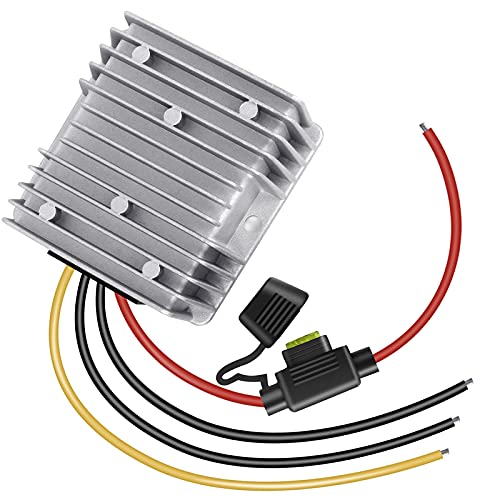
The middle child of the dkplnt golf-cart family trades the 30A unit’s overhead for a more practical size while keeping the broad input range. The 30–60V input window actually goes a touch lower than its bigger sibling, which gives it a small edge on worn 36V packs whose resting voltage sags. A 20A/240W output covers a radio, LED light bar, USB hub, and a phone charger without breaking a sweat.
The added fuse is the quiet hero here. Many DC reducers rely on the vehicle’s existing wiring for protection, which is not great practice, so having a serviceable fuse on the input side is a nice touch for someone who values easy field repairs. Compared to the 10A model, this is the version most golf-cart owners end up wanting once they actually wire up their accessories.
Where It Excels
- Hits the sweet spot of capacity versus size for typical cart accessory loads
- On-board fuse simplifies protection and swap-out on the road
- Low-end input tolerance helps with aging battery packs
- Aluminum housing handles typical under-seat temperatures
Some Limits To Know
- Pushing close to the 240W ceiling during a long ride can shorten component life compared with the 360W model
- Still not a sealed unit for direct exposure to rain
Feature Snapshot
Built With In Mind
Cart owners who want one converter that handles a real accessory list without paying for capacity they will never use.
Look Elsewhere When
Heavy stereo systems or winch-style accessories push past 20A; the dkplnt 30A 360W model is the safer match.
For carts that just need to power a radio, a small light bar, and maybe a USB phone charger, the 10A/120W dkplnt is the right size. It accepts the same 30–60V input range as its bigger siblings, so it works with both 36V and 48V packs, and the 96% efficiency spec means it wastes very little energy as heat during the conversion.
It’s also the smallest unit in this golf-cart family, which makes it the easiest to tuck behind a dash or under a seat without giving up storage space. Where the 20A and 30A models feel like serious electrical upgrades, this one feels like a smart, lightweight add-on. For utility vehicles or basic neighborhood carts, that scale is usually enough.
What Earns Its Place
- Tiny footprint fits in tight cart nooks
- Same input versatility as the larger dkplnt converters
- Aluminum body helps with passive cooling
- Efficient enough that it does not cook itself in confined installs
Potential Drawbacks
- 10A ceiling means adding a second high-draw accessory will push it to the edge
- Still requires basic wiring skill; not a beginner-friendly plug-and-play kit
Who Will Love This
Light-accessory owners and DIYers on 36V or 48V carts who want the smallest reasonable converter.
Reach For A Different Pick When
Plans include a sound system or heated accessories; the dkplnt 20A 240W has the headroom.
This unit flips the usual script: it takes household AC (100–240V) and outputs 12V DC at up to 13 amps (156W). That’s the direction most other picks on this list don’t go, and it makes the ALITOVE the right tool for indoor use cases: powering a car vacuum from a garage outlet, running a 12V cooler for a tailgate, or bench-testing automotive gear on the workbench.
The 11.5-foot cord is a small but real quality-of-life detail, because most generic bricks ship with a fraction of that reach. The built-in automatic over-voltage protection is the kind of feature that earns its keep the first time a brownout hits. It’s not a vehicle converter, but for the shop and the house it covers a different gap.
Positive Takeaways
- Long power cord reaches across a typical garage or basement without an extension
- Broad 100–240V input range is forgiving on older circuits
- Automatic over-voltage protection adds a layer of safety for sensitive 12V devices
- 156W ceiling covers most 12V appliances people bring indoors
Trade Offs
- Not waterproof or sealed, so it stays on dry benches and counters only
- Sustained loads near 156W shorten the adapter’s working life, common across this product class
Key Product Details
Perfect Match For
Home users and tinkerers who want to run 12V car gear indoors from a regular wall outlet.
Where Another Pick Suits Better
Anyone running a vehicle electrical system needs the dkplnt 30A 360W converter instead.
The inShareplus unit is purpose-built for the LED crowd. It takes AC mains (110–250V) and delivers a steady, regulated 12V DC at up to 16.5 amps, which is enough headroom for a long run of strip lights around a kitchen soffit, a workshop under-cabinet setup, or a sizeable signage install. The metal-enclosed body helps with heat dissipation, which matters when a supply is expected to run for hours on end.
Compared to the ALITOVE above, this one carries more current and is built around sustained lighting use rather than intermittent appliance loads. The internal protection suite covers the usual suspects: over-voltage, over-current, over-temperature, overload, and short circuit. For lighting pros and serious DIYers, that combo is exactly what an LED driver should look like.
A Few Strong Suits
- Stable, regulated 12V output keeps LED strips from flickering or shifting color temperature
- 200W rating covers a meaningful strip-light run from a single supply
- Metal housing supports passive cooling for long-on installations
- Auto-recovery shutdown reacts to faults and resumes when conditions normalize
Worth Bearing In Mind
- Recommend staying under 85% of rated load for the longest service life, which is industry-wide advice for switching supplies
- Indoor-rated housing means outdoor installations need a proper weatherproof enclosure
Feature Rundown
Whose Shelf It Belongs On
Lighting installers and homeowners running multi-meter LED strip or module projects on a dedicated 12V feed.
Not Your Match When
The job is mobile 12V from a battery; the Meanwell LRS-100 handles stationary AC-to-12V, but the dkplnt family owns the vehicle side.
The WZRELB inverter is the wildcard on this list because it runs in the opposite direction: 12V DC in, 110/120V AC out. That’s the missing piece for anyone who wants to run household electronics from a vehicle, an RV battery bank, a solar setup, or a truck sleeper cab. The “pure sine wave” label is the important part, since modified-sine units can make audio gear hum, confuse battery chargers, and shorten the life of sensitive electronics.
Two AC outlets and an LED display make it feel closer to a small appliance than a wiring project. For off-grid cabins, mobile workspaces, or emergency backup, that’s the difference between a useful tool and an awkward compromise. Among the seven picks here, it’s the one that covers the “12V battery to wall-outlet-style power” need cleanly.
The Value In It
- Pure sine output is safe for laptops, audio gear, and modern battery chargers
- 1000W continuous handles real household loads, not just phone chargers
- Two AC outlets reduce the need for a power strip
- LED display gives quick visibility into operating status at a glance
Honest Caveats
- Draws from a 12V source, so the battery bank itself needs to be sized for the load
- Cooling fans run under heavy load, which can be noticeable in a quiet cabin
Quick Technical Notes
Who Should Grab It
RVers, overlanders, and off-grid cabin owners who need clean AC power from a 12V battery bank.
Swap It Out When
The goal is 12V output from a higher-voltage pack; the dkplnt 30A 360W is the correct direction for that.
Picking the Right Converter for Your Setup
A 12-volt converter is a small device with outsized consequences. The wrong unit either cooks itself, drops voltage under load, or fails to protect the gear wired to it. The right one disappears into the build and just works.
Match the Input Side First
Before chasing output specs, confirm what you are feeding the converter. Household AC, 36V battery packs, and 48V battery packs all need different devices. The Meanwell LRS-100, the ALITOVE, and the inShareplus all expect AC mains; the dkplnt trio expects 36V or 48V DC; the WZRELB expects 12V DC. Getting this wrong is the fastest way to a fried component.
Right-Size the Output, Then Add Headroom
Output current is the next constraint. A rough rule I lean on: add up the amp draw of everything you plan to run at once, then multiply by about 1.25 to keep the converter from living at its thermal limit. The dkplnt 10A, 20A, and 30A lineup reflects exactly this ladder, so picking the right tier matters more than picking the fanciest brand.
Look at Build, Protection, and Environment
Sealed aluminum housings, silicone potting, and on-board fuses all matter once a converter leaves the workbench. For under-cab or fender installs, moisture and vibration are real concerns. For LED work, regulated output and thermal headroom keep strip lights from flickering months later.
Don’t Ignore the Direction of Power
Most of this list steps voltage down, but the WZRELB steps 12V up to household AC. Off-grid setups, mobile workstations, and emergency backup all hinge on that direction. Knowing which way the power flows is half the battle.
Smart Choices Across the Lineup
Pitfalls Shoppers Hit
The most common mistake I see is buying by wattage alone and ignoring input voltage. A 360W converter that expects 110V AC will not help someone with a 48V golf cart. The second is under-sizing: a 10A unit feeding a stereo and a light bar will overheat within an hour. Build a quick load list first, then pick the tier above it.
What the Higher Tier Buys
Stepping up to a larger converter, like the dkplnt 30A over the 10A, mostly buys thermal headroom and the comfort of knowing accessories can run together without watching an ammeter. Pure-sine inverters cost more because they generate cleaner AC output that sensitive electronics actually need. In both cases, the upgrade pays off when the build is permanent or the loads are real, and matters less for a weekend project.
