

The right 40 amp breaker depends on whether you’re wiring a home subpanel, protecting an RV battery bank, or replacing a worn unit in an existing load center. I’ve put together six options that cover the most common scenarios I see homeowners and hobbyists run into, from AC household circuits to DC mobile setups. Each one earns its spot for a specific reason, and the trade-offs are worth knowing before you commit.
The Leading Options At A Glance

Square D QO240CP QO 40 Amp Two-Pole Circuit Breaker
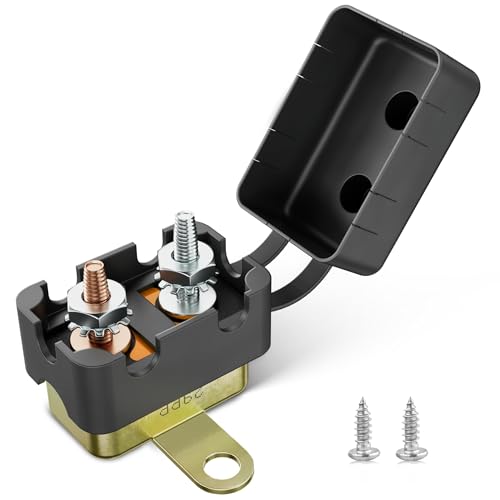
RED WOLF 40A DC 12V-24V Automatic Reset Circuit Breaker

smseace Miniature Circuit Breaker AC 40A 400V 2-Pole DIN Rail

Siemens Q240 40-Amp Double Pole Type QP Circuit Breaker

SIEMENS QF260A 60 Amp 2-Pole 120/240V GFCI Self-Test Breaker

SIEMENS QF120A GFCI Circuit Breaker 20 Amp 1-Pole 120V Self-Test
A Deeper Look At The Lineup
The Square D QO240CP is a thermal-magnetic two-pole breaker designed for residential branch circuits feeding heavier loads like water heaters, subpanels, or workshop machinery. Its plug-on design snaps directly into a QO load center without any extra mounting hardware, which matters for anyone who’s spent an afternoon wrestling with bolt-on breakers.
I like how the Visi-Trip indicator makes a tripped breaker obvious at a glance, since you don’t have to flip every breaker to find the offender in a dark basement. It’s built to guard against both overloads and short-circuits, and it fits QO panels and CSED units that accept a two-space footprint. For homeowners already committed to the QO ecosystem, this is the straightforward choice.
Positive Points
- Plug-on installation gets the breaker seated in seconds, no bus bar bolts required.
- Visi-Trip flag shows a clear red indicator on any tripped unit, helpful in crowded panels.
- Thermal-magnetic trip mechanism handles both sustained overloads and sudden short-circuits.
- Compatible with most QO load centers, so it’s a clean fit for existing Square D panels.
Trade Offs
- Only compatible with Square D QO panels, so it won’t drop into Siemens or Homeline enclosures.
- Replacement rather than upgrade, so you don’t gain GFCI or arc-fault protection on its own.
Quick Facts
Made For
Homeowners with a Square D QO panel who need a direct replacement or a new 40A two-pole circuit without mixing breaker brands.
Swap It Out When
Your panel is a Siemens QP load center, in which case the Siemens Q240 is the better drop-in fit.
This RED WOLF unit is a completely different animal from the others here, since it lives in DC systems rather than household AC panels. It uses #10-32 stud terminals and a metal housing suited to trolling motors, RV battery banks, and solar charge wiring, anywhere a 40A inline fuse isn’t reliable enough.
What stands out is the auto-reset behavior. After a trip, the breaker restores the circuit automatically once conditions normalize, which matters on a boat or in an off-grid setup where you can’t always reach the breaker manually. Compared to the Square D QO240CP, this is a specialty tool for a different job entirely, and it serves that niche well.
The Good Stuff
- Auto-reset function clears the trip within about a minute, useful when you can’t reach the breaker physically.
- Wide operating range from -40°C to 85°C handles marine bilges and sun-baked engine bays.
- Solid metal housing resists vibration better than plastic fuse holders in mobile setups.
Things To Consider
- Ambient heat can cause nuisance trips even when current stays below 40A, a common report in hot engine compartments.
- DC-only design means it’s never a substitute for an AC household breaker like the QO240CP or Q240.
Whose Shelf It Belongs On
Boat owners, RV enthusiasts, and off-grid solar hobbyists who need resettable 40A protection on a 12V or 24V DC bus.
Look Elsewhere When
You’re wiring a 240V home circuit, since the smseace DIN rail breaker or the Siemens Q240 is the right category match.
The smseace DZ47-63 is a miniature circuit breaker built for DIN rail mounting inside a subpanel or equipment enclosure. It’s a 40A, 2-pole unit rated for 400V AC at 50 or 60 Hz, so it fits 220V branch circuits found in many workshop builds and outbuilding setups. The compact 79 x 35.5 x 74mm body leaves room for additional breakers on the same rail.
Where the previous RED WOLF unit handles DC mobile systems, this one is firmly in AC territory. I find it useful for hobbyists assembling their own subpanels from scratch, since it clips onto a standard DIN rail without custom mounting. It’s not a plug-on household breaker, so panel compatibility with Siemens or QO load centers isn’t relevant here.
Everyday Perks
- Standard DIN rail clip means it drops onto most subpanel backplates without adapters.
- 400V rating gives headroom for 240V circuits and the occasional 277V lighting branch.
- Two-pole design interrupts both live conductors, important for proper 240V disconnect.
Worth Noting
- Not compatible with North American plug-on load centers, so it needs its own enclosure.
- Requires DIN rail and wiring lugs you may need to source separately for a clean install.
Key Product Details
Best Suited To
DIYers assembling a custom subpanel, workshop feeder, or outbuilding distribution board where DIN rail breakers are the norm.
Not Your Match When
You need a plug-on breaker for an existing Siemens or Square D panel, in which case the Q240 or QO240CP fits without rewiring.
The Siemens Q240 is the mirror image of the Square D QO240CP, aimed squarely at owners of Siemens PL and ES series load centers. It’s a 40A, double-pole, 240V magnetic breaker with a 10,000 AIC interrupting rating, meaning it can clear a serious fault without failing itself.
The insta-wire feature speeds up panel terminations, which I appreciate when adding a circuit to an already-crowded Siemens box. Where the QO240CP requires a QO chassis, this breaker uses the QP form factor, so the choice usually comes down to which panel brand is already on the wall. Either way, it’s a straightforward, no-frills workhorse.
Everyday Advantages
- 10,000 AIC rating handles higher fault currents common in modern residential service.
- Insta-wire terminals speed up connections during panel work.
- Fits Siemens PL and ES load centers without modification.
Points To Keep In Mind
- Limited to Siemens QP-compatible panels, so cross-brand swaps aren’t possible.
- No GFCI or arc-fault protection, so it doesn’t replace the QF series for wet locations.
Who It Suits Best
Homeowners and electricians working in Siemens panels who want a brand-matched 40A two-pole breaker without mixing product lines.
A Better Fit Elsewhere
You need ground-fault protection for a spa, hot tub, or pool pump, where the Siemens QF260A earns its premium price.
The Siemens QF260A shifts the conversation from simple overload protection to ground-fault safety. It’s a 60A, two-pole GFCI breaker for 120/240V circuits, which puts it in spa, pool equipment, and large appliance territory where water and electricity share a panel.
The self-test feature continuously checks the GFCI circuitry and locks the breaker out if it detects a compromised state, a meaningful upgrade over older GFCI designs that could silently fail. Compared to the Q240 above, this unit trades raw amperage margin for code-required safety on wet-location circuits, and it’s the right tool when local rules demand GFCI protection at the panel.
Where It Excels
- Self-test and lockout feature meets UL 943 expectations for ongoing GFCI reliability.
- Two-pole 120/240V design protects shared-neutral loads common in spa and pool equipment.
- Drop-in fit for Siemens load centers already in many homes.
Honest Caveats
- Higher price than a standard QP breaker, since GFCI electronics add real cost.
- 60A rating means it’s not the right fit for circuits that actually need exactly 40A protection.
Feature Snapshot
Right Fit For
Homeowners running a spa, pool pump, or other wet-location 240V appliance that requires GFCI protection at the panel.
Reach For A Different Pick When
You’re protecting a standard 40A branch circuit without GFCI requirements, since the Siemens Q240 covers that job at lower cost.
The Siemens QF120A is a single-pole, 20A GFCI breaker for standard 120V household circuits like bathrooms, kitchens, garages, and outdoor outlets. While it’s not a 40A unit, it earns a place here because anyone shopping for a 40A GFCI often needs GFCI coverage on related circuits at the same time.
The self-test feature follows the same UL 943 logic as the QF260A above, automatically verifying the GFCI circuitry on a regular schedule. For homeowners upgrading a panel to add a larger 240V circuit, this single-pole GFCI rounds out the safety picture on the smaller branch circuits feeding the same room. It’s a tidy companion pick rather than a competitor to the 40A options.
What Makes Sense
- Self-test function meets UL 943 requirements without monthly manual testing.
- Single-pole design takes only one space in a Siemens load center.
- 10,000 AIC interrupting rating handles residential fault levels.
Practical Considerations
- Not a 40A breaker, so it won’t replace any of the higher-amperage units on this list.
- Limited to Siemens QP-style panels for plug-in compatibility.
Perfect Match For
Homeowners completing a panel upgrade who also want GFCI protection on a 20A bathroom, kitchen, or laundry circuit at the same time.
Where Another Pick Suits Better
You specifically need a 40A two-pole breaker for a subpanel or large appliance, where the Siemens Q240 is the more direct match.
Factors That Matter Before Choosing A 40 Amp Breaker
The first thing to lock down is your panel brand and form factor. Square D QO panels take QO breakers like the QO240CP, while Siemens load centers use the QP form factor found on the Q240 and QF260A. Plugging the wrong breaker into a panel is unsafe and a code violation in most jurisdictions, so match before anything else.
Next, consider whether you actually need ground-fault protection. Standard breakers protect the wiring from overload and short-circuit damage, but GFCI breakers also detect current leaking through a person or water path. For spa equipment, pool pumps, and some kitchen or bathroom circuits, local electrical codes often require GFCI, which pushes you toward the Siemens QF series.
Finally, think about the system type. Household AC circuits call for panel-mount breakers, while DC applications on boats, RVs, and solar arrays need a different design entirely. The RED WOLF unit handles DC, while the smseace DIN rail breaker suits custom subpanel builds where QO or QP form factors don’t apply.
Key Considerations Across These Picks
Traps First Timers Fall Into
A common slip is assuming any 40A breaker fits any panel. It doesn’t. Mixing brands can mean a breaker that physically doesn’t seat, or worse, one that connects without proper bus alignment. Always confirm your panel model before ordering, and check the breaker’s listed compatibility.
Another mistake is choosing GFCI when you don’t need it, or skipping it when code requires it. GFCI breakers cost more and can nuisance-trip on certain equipment, so they belong on circuits that benefit from ground-fault detection rather than every line in the box.
What The Higher Tier Buys
Stepping up to a Siemens QF GFCI breaker adds genuine safety electronics: the self-test and lockout feature, plus code-compliant ground-fault detection for wet locations. That premium pays off when you’re protecting a circuit where a person could contact a live conductor and water is in the picture. For a standard 240V workshop feeder with no water exposure, a basic QP breaker like the Q240 does the same job without the extra cost.
Frequently Asked Questions
What does AIC mean on a breaker rating?
AIC stands for Ampere Interrupting Capacity, the maximum fault current a breaker can safely stop without failing. A 10,000 AIC breaker can clear a short-circuit up to that level before damage occurs.
Can I swap a 40A breaker for a 40A GFCI breaker?
Only if the GFCI model fits your panel form factor and the circuit rating matches. The Siemens QF260A is 60A, while a true 40A GFCI two-pole breaker would replace a Q240 only when the panel accepts the GFCI body.
Are DIN rail breakers legal for home use?
DIN rail breakers like the smseace DZ47-63 are intended for equipment enclosures and subpanels, not for plug-on installation in a standard residential load center. They’re common in workshop and outbuilding builds where a separate enclosure is used.
Why do some 40A breakers trip in hot weather?
Heat lowers the trip threshold of thermal-magnetic breakers, so a unit in a hot attic or sun-exposed enclosure may trip below its rated amperage. The RED WOLF DC breaker explicitly notes this ambient temperature effect in its documentation.
Do I need an electrician to replace a 40A breaker?
Most jurisdictions require a licensed electrician for panel work, and many utilities require a permit for breaker replacement. Even experienced homeowners should verify local code before opening a load center, since energized bus bars present serious shock risk.
Bottom Line
The right 40 amp breaker comes down to your panel brand, the circuit’s voltage, and whether GFCI protection is required. The Square D QO240CP and Siemens Q240 cover most household branch circuits in their respective ecosystems, while the smseace DIN rail unit fits custom subpanel builds. For wet-location circuits needing ground-fault safety, the Siemens QF260A is the clear step up, and the QF120A rounds out smaller circuits during a panel upgrade. Match the breaker to the panel and the application, and the rest takes care of itself.
