

A 40 amp double pole breaker sits at the heart of some of the most demanding circuits in a home, from electric water heaters and EV chargers to subpanels feeding detached workshops. Picking the wrong one means nuisance trips at best and a safety gap at worst, so matching the breaker’s type, mounting style, and rating to the panel it lands in matters far more than chasing a brand name. I’ve lined up six options that span the usual residential and light-commercial scenarios, from a QO plug-on for Square D panels to DIN-rail units for solar sheds and a manual-reset thermal breaker for marine or automotive work.
A Quick View Of The Lineup
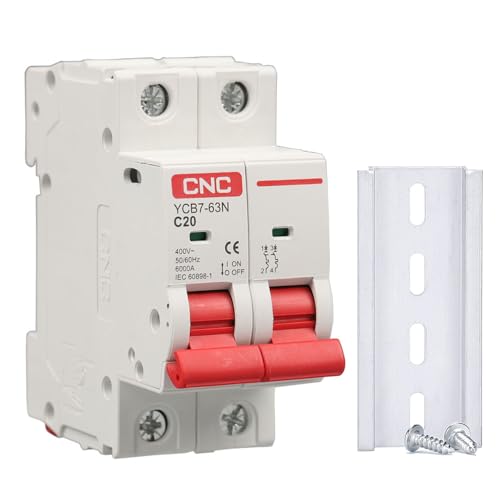
CNC AC Miniature Circuit Breaker, 40A 2 Pole

Siemens Q24020CT2 Tandem Double Pole Breaker

CNC DC Miniature Circuit Breaker, 2 Pole 25A

Square D QO240CP 40A Two-Pole Circuit Breaker

Siemens 40A and 25A QP Breaker Bundle

DIYhz 40A Push Button Manual Reset Breaker
The Details Behind The Selections
This CNC miniature breaker mounts on a standard 35 mm DIN rail, which is the same rail used inside most aftermarket subpanels, inverter enclosures, and small distribution boards. The two-pole, 40 amp rating covers 120/240V AC circuits across the common North American residential range, and the unit ships with the rail, end stops, and mounting screws so the install feels self-contained.
Owners adding a shed subpanel or an inverter-driven backup circuit often run into panels that don’t accept the plug-on breakers made for Square D or Siemens load centers. This breaker sidesteps that compatibility wall, since DIN-rail hardware works with any panel that provides the rail.
What Works In Its Favor
- Curve C magnetic trip range trips between 5 and 10 times the rated current, which is the standard window for general lighting and outlet loads.
- Silver-alloy contact surfaces resist pitting and weld damage over repeated trip cycles.
- Flame-retardant housing adds a layer of protection if a fault event ever vents hot gas inside an enclosure.
- Wide voltage compatibility from 110V up through 380V AC makes it useful across light-commercial projects too.
Worth Noting
- This breaker does not snap into a residential Square D QO or Siemens QP panel, so it’s the wrong pick if your home panel expects a plug-on format.
- No listed AIC interrupting rating in the source data, which can matter in locations with high available fault current.
Right Fit For
Anyone wiring a DIN-rail enclosure for a shed, garage, or inverter-backed subpanel who needs a true 40A two-pole device.
Swap It Out When
Homeowners with a stock Square D QO panel should reach for the Square D QO240CP, since plug-on compatibility removes the rail hardware step entirely.
The Siemens Q24020CT2 is a tandem device that delivers a 20 amp and a 40 amp two-pole circuit from a single breaker body. In a panel where space is the bottleneck, this saves two full pole spaces compared to running two separate breakers, which can be the difference between finishing a job and needing a panel upgrade.
It slots into any Siemens load center that accepts the QP breaker family, including many ES and PL series panels. Anyone finishing a basement, adding a small apartment, or feeding a detached office often runs into “no more open spaces” long before they run out of amperage, and that’s where this format pays off.
Where It Excels
- Compact tandem body frees panel real estate for additional circuits later on.
- 40A leg handles a mid-sized 240V load like a small water heater or air-conditioner condensing unit.
- Siemens QP compatibility means a direct plug-on install into most modern Siemens residential panels.
Trade Offs
- Panel compatibility is brand-locked to Siemens, so it won’t drop into a Square D QO box.
- Tandem breakers aren’t allowed in every panel slot position, so the installer’s layout matters.
Built With In Mind
Homeowners with a Siemens panel who need both a 20A and a 40A double-pole circuit without burning extra spaces.
Reach For A Different Pick When
Anyone with a Square D QO panel should look at the Square D QO240CP, since QO plug-on compatibility removes any brand-mixing concerns.
The CNC DC breaker is built for direct-current circuits rather than standard household AC, and that distinction matters once you step into a solar array, a battery bank, or an RV house system. The 1000V DC rating is a comfortable ceiling for most residential string inverters and many off-grid setups, while the 25A continuous rating suits mid-sized charge controller runs.
Where AC breakers rely on the natural zero-cross of the sine wave to interrupt current, DC breakers need extra arc-quenching design. CNC builds this one with a dedicated arc-extinguishing chamber so the contacts separate cleanly even under sustained DC loads, which is the kind of detail that separates a true DC breaker from an AC unit repurposed for the wrong job.
Everyday Perks
- 1000V DC ceiling covers nearly all residential PV string configurations.
- Arc-extinguishing chamber handles the harder job of breaking DC current cleanly.
- DIN-rail mount matches the rails used inside most combiner boxes and inverter enclosures.
- Electromagnetic trip reacts fast to short-circuit events, limiting damage to upstream wiring.
Less Ideal Details
- 25A rating is well below the 40A target, so it only fits smaller solar branch circuits rather than a whole-array disconnect.
- DC-specific labeling means this is the wrong tool for a 240V AC water heater feed.
Made For
Off-grid homeowners, van builders, and small PV installers who need a 1000V DC breaker on a DIN rail and accept a lower continuous amperage.
Look Elsewhere When
Anyone needing a 40A breaker for a standard AC water heater or subpanel feed should grab the Square D QO240CP for residential panels or the CNC AC Miniature unit for DIN-rail enclosures.
The Square D QO240CP is the residential workhorse for 40A 240V circuits in a QO panel, and it remains a default pick for many electricians for a reason. The plug-on design clicks into the bus without a separate mounting bracket, and the Visi-Trip indicator flips a red flag in the window the moment the breaker trips, which saves a lot of flashlight time when tracing down a tripped circuit in a dark basement.
It’s a thermal-magnetic design, so a slow overload gets the bimetal strip treatment while a hard short gets a fast magnetic kick. That split personality is what you want on mixed loads like a hot tub, a small electric range section, or a workshop subpanel where nuisance tripping is the bigger concern.
Positive Points
- Visi-Trip indicator makes a tripped breaker obvious without pulling the panel cover.
- Plug-on design installs in seconds with no extra rail hardware.
- QO compatibility covers a huge installed base of Square D residential panels.
- Thermal-magnetic trip curve handles both gradual overloads and sudden shorts.
Honest Caveats
- Brand-locked to Square D QO panels, so swapping it into a Siemens or GE load center is a no-go.
- No explicit AIC rating in the source data, so high fault-current locations may need verification with the panel’s spec sheet.
Key Specs
Who Should Grab It
Homeowners with a Square D QO panel who want a straightforward 40A breaker for a water heater, EV charger, or detached workshop feed.
A Better Fit Elsewhere
Installers working in a Siemens panel should pick the Siemens Q24020CT2 or the Siemens QP bundle, since mixing brands in a load center is rarely a good idea.
This bundle pairs a 40A and a 25A double-pole Siemens QP breaker in a single package, which mirrors the way a small workshop or garage subpanel often gets built: one big circuit for the table saw or welder and a smaller one for a heater or lighting run. The matched brand keeps everything inside the Siemens ecosystem, and both breakers carry the same 10,000 AIC rating for safety.
The 40A unit accepts #8 to #14 AWG wire, while the 25A breaker is rated for #14 to #8 AWG. That overlap means most residential copper and aluminum feeders land in either breaker without a fuss, which simplifies the parts list for a weekend subpanel project.
Advantages To Know
- Matched Siemens QP design eliminates brand mixing inside one panel.
- 10,000 AIC rating on both breakers keeps fault-current handling consistent.
- 40A unit takes #8 to #14 AWG wire for flexible feeder sizing.
- 25A partner unit is sized for sub-panel lighting or a small workshop heater.
Points To Weigh
- Brand-locked to Siemens panels, so it won’t fit a Square D QO box.
- Pair format means you’re paying for two breakers even when you might only need one.
Feature Snapshot
Best Suited To
Garage and workshop projects that need a coordinated 40A feeder and 25A branch inside a Siemens subpanel.
Consider Something Else When
Homeowners with a single-circuit need in a Square D QO panel should pick the Square D QO240CP and skip the second breaker entirely.
The DIYhz is a thermal breaker with a manual reset button, and it lives outside the usual residential load center. It’s rated for 32V DC and 125/250V AC, so the same device can sit between a battery bank and an inverter, or guard an auxiliary feed in a boat or RV. The push button pops out on overload and resets with a finger press, which removes the hunt for a tripped breaker in a dark engine bay.
Quick-connect terminals speed up install in tight enclosures, and a waterproof button cap keeps splashes and rain from tripping the reset by accident. Two units ship in each pack, which suits a dual-battery setup or a primary-plus-secondary circuit.
A Favorable Mix
- Manual reset button stays in the tripped position until pressed, making fault diagnosis obvious.
- Dual-voltage rating covers 32V DC and 125/250V AC applications.
- Waterproof button cap protects against splashes in marine or outdoor installs.
- Quick-connect terminals speed up wiring in compact enclosures.
- Two-pack quantity suits dual-battery or paired-circuit setups.
Some Limits To Know
- Not designed to act as a manual on-off switch, so it can’t replace a disconnect in that role.
- Thermal-only trip means slower response to hard short circuits compared to magnetic breakers.
Whose Shelf It Belongs On
Marine, RV, and automotive tinkerers who want a resettable inline breaker between a battery and a heavy accessory load.
Where A Sibling Pick Shines
For a residential 240V water heater or subpanel feed, the Square D QO240CP remains the stronger fit inside a standard home panel.
What Matters Most Before Choosing 40 Amp Double Pole Breakers
A double pole breaker controls a 240V circuit by interrupting both hot legs at once, which is why the right pick depends on the panel brand and the load profile more than the amp number alone. Panel compatibility comes first: a Square D QO panel wants a QO-style plug-on, a Siemens panel wants QP, and a DIN-rail enclosure needs something that mounts to a 35 mm rail. Matching the bus interface avoids the common mistake of buying a perfectly rated breaker that simply will not click into the box.
Next, look at trip curve type. Thermal-magnetic breakers handle both slow overloads and sudden shorts, which suits mixed residential loads. Magnetic breakers respond faster to short circuits and are common in higher-amperage branch protection. Pure thermal breakers, like the DIYhz unit, lean toward slower thermal response and manual reset, which fits inline DC or marine duty where you want to see and acknowledge each trip.
Finally, check wire gauge range and AIC rating. The breaker’s wire range must accept the feeder you’re running, and the AIC rating must equal or exceed the panel’s available fault current. For most homes, 10,000 AIC covers the typical service, but detached workshops near large utility transformers occasionally need higher. In those edge cases, verifying with a multimeter or a local electrician pays off before the breaker lands in the panel.
Key Considerations Across These Picks
Where Shoppers Go Wrong
The most common slip-up is grabbing the right amperage in the wrong family. A Square D HOM breaker will not seat in a QO panel even though both are 40A, and a Siemens QP unit behaves the same way. Another trap is assuming a residential AC breaker works for solar or battery wiring, since AC breakers interrupt at the sine wave’s zero-cross and a DC breaker needs extra arc suppression to break the circuit safely.
When Paying More Pays Off
Spending up usually buys two things: tighter trip-curve tolerances that cut nuisance trips, and an AIC rating that handles higher fault current without failing. For a workshop subpanel or a near-utility service, the upgrade can be the difference between a breaker that does its job and one that welds itself shut on a major fault. For a simple indoor water heater in a standard panel, a mainstream unit typically gets the job done without stretching the budget.
