

Working with 3 phase power means there’s no margin for guessing. A breaker that misjudges your load, trips under normal motor startup, or fails to coordinate with the rest of the panel turns into downtime, damaged equipment, or a fire risk. I’ve put together this shortlist for electricians, shop owners, RV solar builders, and homeowners wiring up a detached workshop or subpanel who need parts that actually fit the job.
The Shortlist At A Glance
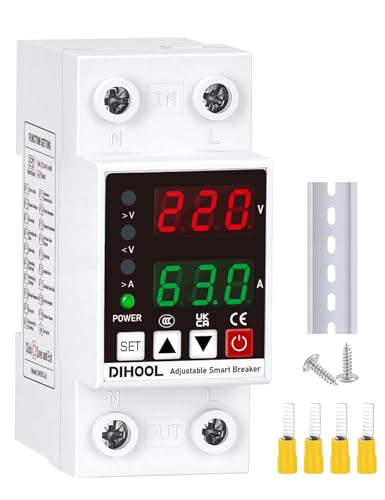
DIHOOL Smart Circuit Breaker with Adjustable Voltage Protection
ABB Q-Line THQL32030 Circuit Breaker, 30A, 3-Pole

CHTAIXI 32A 2 Pole DIN Rail MCB, Solar AC Disconnect

Siemens PN Series 125A 30-Space Load Center

Square D Homeline 200A Main Breaker Load Center Value Pack
The Picks, Examined More Closely
The DIHOOL adjustable breaker fits DIN rail enclosures, which makes it the kind of unit I’d reach for when a standard residential breaker just won’t talk to the equipment. Unlike the fixed-trip ABB and CHTAIXI units in this lineup, this one lets you dial in your own overvoltage, undervoltage, and overcurrent windows. For someone setting up solar where battery voltage swings are normal, that flexibility is the whole point of buying it.
It’s built around an AC disconnect switch function, so it doubles as a service cutoff. In a small workshop or a hybrid off-grid system, that means one device handles both protection and isolation. Compared to the rigid ABB Q-Line coming up next, this one trades brute-spec simplicity for tunability, and that trade works for the right person.
Where It Excels
- Adjustable overcurrent from 1 to 63A lets you match the breaker to motors, inverters, or battery banks that don’t sit at common ratings.
- Configurable undervoltage and overvoltage cutoffs protect sensitive electronics from grid sag or surge events.
- Doubles as an AC disconnect, so a single device handles both overload protection and lockout service isolation.
- DIN rail mounting fits the same enclosures used by the CHTAIXI MCB below, easing integration in custom panels.
- Flame-retardant shell and visible status indicators help during troubleshooting without cracking the enclosure open.
Things To Consider
- The wide adjustability means you have to read the manual and set values correctly, or the breaker may nuisance-trip or fail to protect.
- As a DIN rail device rather than a plug-on panel breaker, it won’t drop into a Siemens PN or Homeline load center without a separate enclosure.
Who It Suits Best
DIY solar builders and small-shop owners who need one breaker that adapts to different loads without buying a new unit each time the project changes.
Where Another Pick Suits Better
For a homeowner wiring into a Square D or Siemens residential panel, the Square D Homeline 200A Main Breaker Load Center Value Pack is a more straightforward fit.
The ABB Q-Line THQL32030 is the no-nonsense workhorse of this list. A thermal-magnetic trip unit combines a bimetallic strip that bends under sustained overload with an electromagnet that snaps the contacts open on a sudden short, and ABB has refined both into a compact 3-pole package. At 30A across all three poles, it covers most 120/240 VAC feeder circuits in light commercial gear and small machinery.
The 10 kAIC (kiloampere interrupting capacity) rating means the breaker can safely break a fault current up to 10,000 amps without rupturing. Quick-make and quick-break action reduces contact wear, and the visible trip indicator saves time during diagnostics. While the DIHOOL above offers tunability, this ABB gives you the kind of predictable trip curve that electricians trust in panelboards.
Benefits That Matter
- Thermal-magnetic trip gives both slow overload response and fast short-circuit clearing in a single mechanism.
- Plug-in mount installs quickly into compatible Q-Line load centers without separate hardware.
- Visible trip indicator helps homeowners and pros diagnose a tripped circuit at a glance.
Honest Caveats
- Fixed 30A rating means you need a different breaker for anything outside that load profile.
- Only fits Q-Line compatible panels, so it won’t drop into a Siemens PN or Square D Homeline box without adapter work.
- No adjustable settings like the DIHOOL smart unit above, so applications with variable loads need extra planning.
Best Suited To
Contractors and facility techs replacing a single 3-pole 30A breaker in an existing Q-Line panel who need reliable thermal-magnetic performance.
Skip It When
For an off-grid solar disconnect where DIN rail mounting and adjustable trip are priorities, the CHTAIXI 32A 2 Pole DIN Rail MCB is a more natural match.
The CHTAIXI miniature circuit breaker (MCB) is the smallest member of this roundup and the one I’d pick for tight enclosures. A C-curve trip characteristic means the magnetic element trips at 5 to 10 times the rated current, which is the right shape for handling the inrush of motors and inverter loads without nuisance trips. At 32A on a 2-pole footprint, it sits comfortably in 120/240 VAC systems.
It’s designed for DIN rail mounting inside solar AC disconnects, RV power panels, and sub-distribution boxes. Silver-alloy contacts and a flame-retardant shell extend service life in warm enclosures, while a color indicator lets you see the on/off state without removing the cover. Where the ABB above is a panel-replacement part, this one is more of a build-it-yourself component.
The Value In It
- Compact 2-pole DIN rail design fits inside solar combiner enclosures and RV distribution panels where space is tight.
- C-curve magnetic trip range handles motor and inverter inrush without nuisance tripping on startup.
- Works across 110, 120, 220, and 230 VAC systems, giving flexibility for off-grid and international builds.
- Functions as both overload protection and a manual isolation switch in one device.
Worth Noting
- Only 2 poles, so it covers single-phase loads rather than the full 3-phase feeds the ABB Q-Line handles.
- Requires a separate DIN rail enclosure, which adds to installation time compared to a plug-on panel breaker.
Made For
Solar DIYers and RV owners building a custom AC disconnect or subpanel who want a compact thermal-magnetic breaker on a DIN rail.
Look Elsewhere When
If the install requires a complete residential load center with a main breaker, the Siemens PN Series 125A Load Center is the more complete package.
The Siemens PN Series load center is the panel itself, not just a breaker. With 30 spaces and 48 circuits, a 125A main lug rating, and a copper bus bar inside, it gives a contractor enough room to land multiple branch circuits without cramming wires into half-full panels. The plug-on neutral design means the neutral wire clicks directly onto the breaker, eliminating the floating pigtail that complicates older panels.
It’s rated for indoor use, so I’d hang it in a garage, basement, or utility room rather than on an exterior wall. The included insta-wire neutral and ground system speeds up rough-in work, which matters when you’re paying a contractor by the hour. Compared to the DIHOOL and CHTAIXI components above, this is the empty box you build a system inside.
Notable Upsides
- Copper bus bar resists corrosion and maintains solid conductivity better than aluminum alternatives over time.
- Plug-on neutral design reduces wiring clutter inside the cabinet and speeds up branch circuit termination.
- 30-space layout leaves room to grow, useful for workshops where tool circuits tend to multiply after move-in.
A Few Limitations
- Main lug only, so it needs a separate upstream disconnect or backfed breaker, unlike the Homeline value pack below.
- Indoor rating means it can’t be installed in a damp or exterior location without a weatherproof cabinet.
- Breakers are sold separately, raising the total project cost beyond the panel price alone.
Perfect Match For
Contractors and serious DIYers setting up a new subpanel in a workshop or addition who want copper bus quality and room to expand.
A Better Fit Elsewhere
For a service entrance that needs a main breaker and meter socket in one package, the Square D Homeline 200A Main Breaker Load Center Value Pack covers more in the box.
The Square D Homeline value pack is the most complete package in this roundup. A 200A main breaker is preinstalled, and the box ships with three HOM120 20A single-pole breakers and two HOM230 30A 2-pole breakers already included, so a new service install can start landing circuits the day the panel is mounted. The 20-space, 40-circuit interior gives flexibility without the bulk of larger commercial panels.
The ringless meter socket with horn bypass allows utility reading without removing the meter, which matters in regions where the power company needs that access. Plug-on neutral compatibility keeps the wiring tidy inside. Where the Siemens PN above is a subpanel, this Homeline is sized to be a main service entrance for a typical home or large outbuilding.
A Favorable Mix
- 200A main breaker preinstalled means one less separate part to source and wire during the install.
- Includes five breakers in the box, so basic branch circuits are covered on day one.
- Ringless meter socket with horn bypass supports utility-side access in areas that require it.
- Plug-on neutral ready simplifies wiring for AFCI and GFCI breakers added later.
Practical Considerations
- 20 spaces fill up faster than the Siemens PN’s 30 spaces, so expansion planning matters before purchase.
- Larger physical footprint than a subpanel, requiring adequate wall space and mounting hardware.
Whose Shelf It Belongs On
Homeowners and contractors handling a full 200A service upgrade who want the main breaker, meter socket, and starter breakers in one coordinated package.
Reach For A Different Pick When
For a smaller workshop subpanel that doesn’t need a meter socket, the Siemens PN Series 125A Load Center offers a simpler, lower-amperage option.
What Matters Most Before Choosing 3 Phase Circuit Breakers
Match The Breaker To Your Load Profile
A 3 phase circuit breaker is rated in amperes and poles, and those numbers have to align with the equipment downstream. A 30A 3-pole unit like the ABB Q-Line THQL32030 suits a feeder circuit, while a 32A 2-pole MCB like the CHTAIXI handles single-phase subfeeds. For full 3 phase machinery, a 3-pole breaker is the right shape; for residential subpanels, single- and double-pole breakers fill the bus. Knowing your load’s full-load amps and startup surge tells you whether a C-curve or D-curve trip is the correct curve.
Understand Interrupting Capacity
The kAIC rating on a breaker tells you the maximum fault current it can safely clear. In a residential panel fed from a small transformer, 10 kAIC is usually enough. In a commercial service with a large transformer close by, the available fault current can climb higher, and a higher kAIC breaker becomes necessary. Mismatching the kAIC to the available fault current is a real safety issue, not a paperwork one.
Decide Between Adjustable and Fixed Trip
Fixed-trip breakers like the ABB Q-Line are predictable and easier to spec. Adjustable units like the DIHOOL smart breaker cover a range of loads in one device, but they require setup and a careful read of the manual. For a one-off install where the load is well-defined, fixed-trip is straightforward. For a system that may grow or change, adjustable earns its higher complexity.
Consider The Panel Ecosystem
A breaker only works in a panel it physically and electrically fits. Q-Line breakers fit Q-Line panels, Homeline breakers fit Homeline panels, and DIN rail MCBs need a DIN enclosure. Plug-on neutrals simplify wiring but only work with compatible breakers. Before buying a breaker, confirming the panel brand and bus style saves a return trip and a half-day of rework.
Key Considerations Across These Picks
Common Shopping Slip Ups
The most frequent mistake is matching poles to load incorrectly, for example buying a 2-pole MCB for a true 3 phase motor feed. Another is ignoring the kAIC rating and assuming any breaker fits any panel, which can leave you with a device that won’t safely clear a real fault. Buyers also underestimate the difference between a main lug panel and a main breaker panel. A main lug panel like the Siemens PN needs a separate disconnect ahead of it, while a main breaker panel like the Homeline value pack has that disconnect built in.
Where The Extra Money Goes
Spending up on a higher-tier breaker typically buys longer mechanical life, tighter trip tolerances, and better materials in the contacts and bus. Premium thermal-magnetic units also tend to have clearer trip indicators and easier mounting hardware. The upgrade is worth it in commercial settings where downtime is costly, or in any install where nuisance trips would interrupt critical loads. For a one-time residential project with predictable loading, a mid-tier unit usually delivers the right balance of cost and reliability.
Frequently Asked Questions
What Is The Difference Between A 2-Pole And 3-Pole Circuit Breaker?
A 2-pole breaker interrupts two hot conductors and is used for 240V single-phase loads, while a 3-pole breaker interrupts all three phases of a 3 phase circuit simultaneously. Choose a 3-pole unit for true 3 phase equipment and a 2-pole unit for split-phase or single-phase applications.
Can A DIN Rail MCB Replace A Plug-On Panel Breaker?
Not directly. DIN rail MCBs like the CHTAIXI mount on a standardized rail inside a separate enclosure, while plug-on breakers attach to a specific panel bus. The two systems serve similar protective functions but require different mounting hardware.
What Does kAIC Mean On A Breaker Label?
kAIC stands for kiloampere interrupting capacity and represents the maximum fault current the breaker can safely interrupt without damage. A 10 kAIC rating handles up to 10,000 amps of fault current before the device is considered to be operating beyond its design.
Do Adjustable Breakers Require Special Programming?
Most adjustable breakers use dials or buttons on the front face rather than software, but the values still need to be set correctly for the load. Reading the included manual before energizing the circuit is part of the install, not an optional step.
Is A Main Breaker Panel Necessary For Residential Service?
In most regions, yes. The main breaker provides a single disconnect for the entire service, which is required by code and gives homeowners a way to cut power to the whole building. A main lug panel can work as a subpanel downstream of another disconnect, but it typically can’t serve as the service entrance on its own.
Bottom Line
The right 3 phase circuit breaker depends on where it lives. The DIHOOL adjustable unit fits variable-load solar and workshop builds. The ABB Q-Line THQL32030 is the dependable replacement for a Q-Line panel. The CHTAIXI DIN rail MCB earns its spot in compact solar and RV enclosures. The Siemens PN Series load center anchors a new subpanel, and the Square D Homeline value pack covers a full 200A service upgrade in one box. Match the device to the panel, the load, and the available fault current, and the rest of the install gets a lot easier.
