

When your truck or van starts looking like a wiring spaghetti bowl, a solid 12v switch panel pulls everything into one tidy line. I put together this roundup for anyone building out a rig, a boat console, or an overland setup. These panels trade the loose inline fuses and random toggle switches for a single, labeled control center. The picks below cover full multi-gang digital panels, a bare-bones waterproof toggle, and a Bluetooth-capable pod with both app and remote control.
A Snapshot Of The Selections
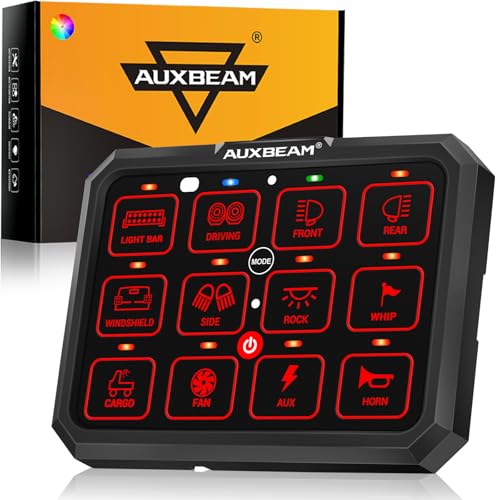
Auxbeam RB120 12 Gang Switch Panel RGB

BEP 1002016 SPST PVC Toggle Switch

Auxbeam AC-1200 12 Gang Bluetooth Switch Panel

Auxbeam AC-1200 Switch Pod with Remote
What Each Pick Brings To The Table
The RB120 is the panel I keep coming back to when someone asks for a hardwired, no-app 12v switch panel that just works. It runs on a DC 12–24V range, handles 1200W to 2400W depending on input voltage, and tops out at 100A, which is plenty for a stack of off-road lights, a winch solenoid trigger, and a compressor.
Each of the twelve switches can run in toggle, momentary, or pulsed mode. You set the behavior at install time, which keeps things predictable on a bumpy trail. The auto-dimming backlight reads well at noon and doesn’t blow up your night vision after sundown. Compared to the bare BEP toggle covered below, this one consolidates an entire fuse block into a single bezel.
Everyday Wins
- Twelve programmable switches let you rename and color each button for fast identification at a glance.
- Auto-sensing backlight dims in tunnels and brightens under sunlight, sparing you from a glaring dash.
- Rated across 12–24V systems, so it slots into cars, trucks, UTVs, and many marine setups.
- Momentary and pulsed modes cover horns, winches, and air lockers without extra relays.
Things To Consider
- Hardwired only, so anyone wanting phone control should look at the AC-1200 instead.
- The 100A ceiling means you still need a secondary relay for very heavy draw accessories.
- Installation takes patience: routing twelve labeled leads cleanly behind a dash is a weekend job.
Feature Snapshot
Built With In Mind
Off-roaders, overlanders, and work-trup owners running multiple 12–24V accessories who want a single labeled control point without leaning on a phone app.
A Better Fit Elsewhere
Drivers who want remote or app control from a cab or trailer should step up to the Auxbeam AC-1200 Switch Pod with Remote instead.
The BEP 1002016 isn’t a panel at all, and that’s exactly the point. Sometimes the cleanest install is one sealed toggle on a console that switches a single circuit on and off. PVC coating around the body keeps saltwater and rain from wicking into the switch, which is why you’ll see it on boats and tow rigs.
It’s an SPST (single pole, single throw) switch rated for 25A at 12V DC, with 8-inch 16 AWG leads ready to land on a fuse block. The 15/32-inch mounting stem fits panels up to 3/16-inch thick, so it drops into most aluminum and plastic console plates. Compared to the full RB120 panel above, this is the surgical option for a single bilge pump or spreader light.
Practical Pluses
- PVC coating shrugs off spray and humidity, making it a reliable choice for marine dashboards.
- 25A rating handles mid-draw accessories like bilge pumps, livewell pumps, and nav lights.
- Pre-leaded 16 AWG wire trims install time and removes the guesswork from terminal choice.
- Drop-in replacement form for common Cole Hersee part numbers, easing fleet maintenance.
Points To Keep In Mind
- Single-circuit only, so multi-accessory builds will need several of these plus a fuse block.
- No backlight or labeling, which can complicate reading it in a dark cabin.
Whose Shelf It Belongs On
Boat owners, trailer builders, and DIYers who just need one trustworthy waterproof toggle for a single 12V circuit.
Reach For A Different Pick When
Anyone running more than two or three accessories should jump to the Auxbeam AC-1200 12 Gang Bluetooth Switch Panel to keep the wiring manageable.
The AC-1200 is the panel I lean toward when someone wants a phone-first install. A registered U.S. design patent gives it a clean, modern face, and the 12-gang layout centralizes anything from a light bar to a fridge slide. It runs on the same 12–24V range as the RB120, so it slots into the same family of vehicles.
The Bluetooth app lets you rename switches, change RGB colors, and toggle outputs without leaving the cab. For someone whose phone already mounts to a MagSafe holder, that means lights off, compressor on, and fridge cycling from a single screen. Where the BEP toggle handles one circuit at a time, this panel juggles twelve with software-defined labels.
Advantages To Know
- App control means you can rename and regroup switches to match your build, not the factory labels.
- RGB backlighting doubles as both night visibility and a visual fault indicator if a circuit trips.
- Registered design patent hints at a more refined face than generic 12-gang clones.
- 12V to 24V support keeps it useful on cars, boats, and heavier trucks alike.
Small Caveats
- Phone-only control can feel limiting if Bluetooth drops or the app version changes.
- You still depend on Auxbeam’s app for naming and color, so a long-term app support question hangs in the air.
- Wiring twelve leads still takes planning, no matter how polished the panel looks.
Right Fit For
Tech-forward drivers, van-lifers, and marine console installers who want phone-driven control over a full accessory stack without sacrificing a clean dash.
Skip It When
Riggers who want physical remote control from outside the cab should look at the Auxbeam AC-1200 Switch Pod with Remote instead.
The AC-1200 Switch Pod is the same 12-gang brain as the previous panel, but it adds a 433MHz wireless remote that works up to 165 feet. A pair of magnets on the back of the remote lets it cling to a metal dash panel or toolbox, which is genuinely handy for trailer and bed control.
This is the version I recommend when someone needs to fire up bed-mounted lights, drop a trailer jack, or run an onboard compressor from outside the cab. You still get the app for fine-tuning, plus the tactile remote for quick hits. Compared to the RB120 covered earlier, this adds remote flexibility without giving up the hardwired relay outputs.
What Helps Most
- 165-foot remote range covers most camp setups, driveways, and trailer walkarounds.
- Pre-paired 433MHz remote with magnetic backing sticks to most steel surfaces.
- App and remote work together, so phone-based setup and physical daily use both stay simple.
- 12-gang layout matches the rest of the AC-1200 family, easing shared spares across builds.
Honest Caveats
- Remote uses a 433MHz signal, so metal-heavy environments can occasionally shorten range.
- Cost runs higher than the basic RB120 panel thanks to the added remote hardware.
Feature Snapshot
Who Should Grab It
Truck, trailer, and overland owners who want both in-cab panel control and a pocket-sized remote for bed and outside-the-vehicle accessories.
Where Another Pick Suits Better
Minimalists wiring a single circuit like a bilge pump will find the BEP 1002016 SPST PVC Toggle Switch simpler and cheaper.
Matching The Panel To Your Build
A 12v switch panel earns its keep when it consolidates messy wiring into something you can actually troubleshoot. Start by counting accessories, then double it for headroom: most owners add lights, a compressor, and a fridge within a year. Voltage range matters more than people think, since boats and heavy trucks often run 24V systems. Look for rated current that exceeds your worst-case draw, not your typical draw.
Switch modes shape daily use. Toggle is fine for lights, momentary works for horns and winches, and pulsed unlocks clever behaviors like a momentary blinker. If your build lives in a phone-mount cab, app-driven panels save you from leaning over to read tiny labels. For outdoor rigs, a wireless remote with magnetic backing turns trailer work into a one-handed job.
Material and mounting details quietly decide whether the install survives a season. PVC-coated switches shrug off spray in marine environments, and panels rated past 200°F handle engine-bay heat. For most DIYers, panel thickness around 3/16-inch drops into existing console plates without adapter plates. Match the panel to your existing fuse block rather than the other way around: most modern panels assume a host fuse box downstream.
Key Considerations Across These Picks
Where Shoppers Go Wrong
The single biggest mistake is under-counting future accessories. A four-switch panel feels plenty until you add a light bar, ditch light, compressor, and a second fridge. Skipping the wiring diagram is the next pitfall: twelve labeled leads become chaos without a one-line sketch. Finally, ignoring voltage range catches marine shoppers who grab a 12V-only panel for a 24V system.
Where The Extra Money Goes
Higher-tier panels buy app control, RGB customization, registered design patents, and wireless remotes with real range. The cost also covers tougher backlighting, broader temperature ratings, and pre-leaded harnesses that save install time. For one-circuit projects, none of that matters, and a simple toggle like the BEP 1002016 covers the job.
Frequently Asked Questions
What does a 12v switch panel actually do?
It centralizes control of multiple 12V accessories into one labeled, fused panel, replacing a tangle of inline switches and relays.
Can I install a 12v switch panel myself?
Most DIYers with basic hand tools and a wiring diagram can handle it, though routing twelve leads cleanly takes a few hours.
Are Bluetooth panels reliable on a worksite?
They work well within range, but metal-heavy environments can shorten signal, so a hardwired backup switch is a common-sense addition.
How many switches do I really need?
Count current accessories, then add three or four for future lights, a compressor, and a fridge slide before you settle on a gang count.
Do these panels work on boats?
Yes, when rated for marine environments and paired with a waterproof toggle like the BEP 1002016 for exposed circuits.
Bottom Line
The right 12v switch panel depends on how much gear you actually run and how you like to control it. A single sealed toggle covers one circuit cleanly, while a 12-gang panel with app and remote support keeps a full accessory stack under control from inside or outside the cab. Pick the format that matches your wiring reality, and the rest of the install gets easier.
