

Workshop benches, home offices, and entertainment walls all share one quiet headache: too many plugs chasing too few outlets. Add a few wall warts and a bulky laptop brick, and a basic four-port strip buckles fast. I’ve put together ten purpose-built surge protector gadgets that handle everything from a six-tool garage bench to a minimalist standing desk, so the right level of reach, joules, and outlet count lands in the right hands.
A Fast Comparison Of The Options

JUNNUJ Long Metal 16 Outlet Power Strip

JUNNUJ Long Metal 16 Outlet Power Strip (Black, 6FT)

Tower Power Strip with PD 30W Fast-Charging Port

SUPERDANNY Power Strip Surge Protector 22 AC + 6 USB

JUNNUJ PDU Rack Mount Power Strip

JUNNUJ Heavy Duty 20 Amp Power Strip (6 Outlet)

JUNNUJ 20 Amp Power Strip Surge Protector 4800J

JUNNUJ Heavy Duty Power Strip Wall Mount 8 Outlet

JUNNUJ Long 16 Outlet Power Strip Surge Protection 4800J
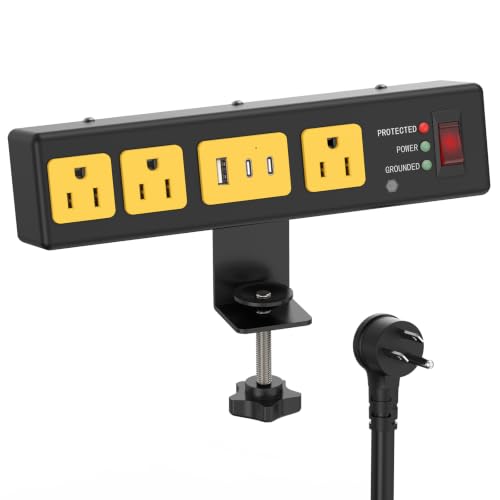
JUNNUJ Desk Clamp Surge Protector USB
More Details On Our Top Picks
A long metal chassis with sixteen outlets reads as overkill until you start plugging in a table saw, a dust collector, and three battery chargers at once. This JUNNUJ runs at 20 amps with a 4800-joule (a joule is a unit measuring how much energy the surge protector can absorb before failing) surge rating, so it sits comfortably on a workbench where smaller strips would overheat or trip.
The widely spaced T-slot receptacles accept chunky wall warts without blocking neighboring outlets, which matters more than people expect in a real garage. The 4-foot cord with a 5-15P plug is short for room-sized runs, so it works best mounted close to an outlet. I see this fitting a workshop owner who needs genuine headroom for tool charging, not a casual desk setup.
What Helps Most
- Sixteen outlets let you run a full bench of tools, chargers, and lighting off one strip.
- 4800-joule rating absorbs aggressive surges without sacrificing the protected devices behind it.
- 20-amp capacity handles heavier draw from shop vacuums and small stationary tools.
- T-slot design swallows oversized plugs and right-angle adapters that block standard strips.
- Wall-mountable metal housing keeps cables off the floor where sawdust collects.
Things To Consider
- The 4-foot cord limits where you can mount it relative to the wall outlet.
- 20-amp draw requires a 20-amp receptacle for full benefit, which many home garages lack.
Right Fit For
Workshop owners with a stationary tool bench and a dedicated 20-amp wall outlet nearby.
Consider Something Else When
Anyone wanting a compact home-office strip should look at the Tower Power Strip with PD 30W Fast-Charging Port instead, since it adds USB-C charging the JUNNUJ lacks.
Think of this JUNNUJ as a sibling to the first pick: same sixteen-outlet count and same 4800-joule protection, but with a longer 6-foot cord for garages where the outlet sits further from the bench. The metal housing still mounts flat against studs or shelving brackets, which keeps the strip itself out of the way of foot traffic.
Compared to item 1, the extra two feet of cord matters more in older shops with awkward outlet placement. For most home workshops, the 12-gauge cord gauge (the wire thickness, where lower numbers mean thicker wire that handles more current safely) keeps voltage steady under load. This is the version I’d pick when reaching the wall outlet is the actual problem.
Notable Upsides
- 6-foot cord clears wider garage layouts where the wall outlet sits away from the bench.
- Same robust 4800-joule protection as the shorter sibling, so no compromise on safety.
- Wall-mountable metal frame resists impacts from dropped tools better than plastic strips.
- Twenty widely spaced outlets power a full shop plus household backup simultaneously.
Worth Noting
- Heavier cord gauge makes the strip itself heavier to wall-mount securely.
- Two-feet of extra cable needs management to avoid becoming a snag hazard in tight shops.
Built With In Mind
Garage workshops with wall outlets mounted high or far from the main work surface.
Skip It When
Anyone wanting USB charging should reach for the JUNNUJ Desk Clamp Surge Protector USB instead, since this strip is purely AC.
Where the JUNNUJ strips read as industrial, this TAGZILO tower reads as office furniture. The vertical layout holds twelve AC outlets and four USB ports, including a 30W USB-C Power Delivery port that actually fast-charges a phone or small laptop without a separate brick. PD (Power Delivery) is a fast-charging standard that negotiates higher wattage over USB-C when the device supports it.
The 10-foot cord gives plenty of slack to reach a wall outlet from the center of a large standing desk. For most people working from home with a laptop, monitor, phone, and a few accessories, this consolidates five chargers into one tower. It suits a clutter-conscious desk owner who wants fewer bricks on the surface.
Advantages To Know
- 30W USB-C PD port charges phones and small laptops faster than standard USB-A ports.
- Tower form factor keeps plugs distributed vertically, so wide wall warts don’t block neighbors.
- Ten-foot cord reaches distant wall outlets without an extension cord.
- Twelve AC outlets cover a full workstation plus peripherals and a printer.
Honest Caveats
- Tower design tips more easily if kids or pets bump it, so it needs a stable base placement.
- 1800-joule rating suits electronics but lags behind the 4800-joule workshop strips above.
Who Should Grab It
Home office workers consolidating laptops, phones, monitors, and accessories onto a single tower.
A Better Fit Elsewhere
Someone running a shop vacuum and a table saw off one strip should pick the JUNNUJ Long Metal 16 Outlet Power Strip, since this tower is built for lower-draw electronics, not heavy tools.
Twenty-two AC outlets plus six USB ports makes this the highest-density option in the lineup, and it shows on entertainment walls where a TV, soundbar, console cluster, and streaming gear all want a plug. The 6.5-foot cord reaches a typical media console without strain, and the 1875W rating covers the full draw of a home theater.
The form factor is wide and flat rather than tower-shaped, so it tucks behind a console cleanly. For a household with a gaming rig plus a media wall plus a few smart-home hubs, this consolidates what would otherwise need two strips. It’s the pick for anyone whose outlet count has outgrown anything reasonable.
The Helpful Details
- Highest AC outlet count in this roundup handles a full entertainment and gaming wall.
- Six USB ports charge phones, tablets, and controllers without extra wall adapters.
- Flat layout slides behind a TV console or desk without tipping.
- 2100-joule protection sits comfortably above most household surge needs.
Points To Keep In Mind
- Width takes up more shelf space than a tower-style alternative.
- Not designed for 20-amp tool draws, so it fits electronics far better than shop equipment.
Made For
Gamers and home theater owners running a console stack, sound system, and smart-home hubs from one strip.
Look Elsewhere When
Anyone needing a clamp-mounted desk option will find the JUNNUJ Desk Clamp Surge Protector USB more desk-friendly than this wide flat strip.
A PDU (power distribution unit) is a rack-form power strip designed for server cabinets and AV racks. This JUNNUJ fits standard 19-inch server racks with swivelling mounting tabs, so it slides into a network closet or homelab setup without improvisation. The 12-gauge cord stays cool under sustained draw from network switches and always-on gear.
Eight outlets handle a small server, a switch stack, a router, and a UPS pass-through, which is the typical homelab load. It’s overkill for a bedroom desk, but it suits someone with a growing network rack who’s tired of using wall strips behind the cabinet. The 6-foot cord reaches nearby wall outlets cleanly.
Strengths Worth Knowing
- Standard 19-inch rack form factor fits homelab and AV cabinets without adapters.
- 12-gauge cord handles sustained 24/7 draw from switches and servers without heating up.
- Swivelling mounting tabs simplify installation across different rack depths.
- Heavy-duty build stands up to vibration and movement inside rolling racks.
Practical Considerations
- Designed for IT loads, not 20-amp tool circuits, so it fits a closet more than a shop.
- Eight outlets fill fast in a homelab with multiple switches and accessories.
Who Will Love This
Homelab owners and AV rack enthusiasts who want a clean rack-mounted power solution instead of a wall strip tucked behind the cabinet.
Reach For A Different Pick When
Anyone needing wall-mount power for a workshop should consider the JUNNUJ Heavy Duty Power Strip Wall Mount, which suits non-rack installations.
Six outlets is sometimes all a small benchtop actually needs, and this JUNNUJ delivers the heavy-duty build without the bulk of the 16-outlet siblings. The metal housing shrugs off shop impacts, and the 20-amp rating with a 12-gauge cord handles stationary tools without tripping.
The 1.57-inch spacing between outlets leaves room for chunky plugs. Where item 1 stretches across an entire bench, this version tucks into a tighter spot near a single work zone. I’d point a hobbyist with a small set of benchtop tools toward this size over the bigger sixteen-outlet strips.
A Few Strong Suits
- Compact 6-outlet footprint fits small benches where a 16-outlet strip would be wasted space.
- 20-amp capacity handles a single stationary tool plus a few chargers without strain.
- 1.57-inch outlet spacing accepts oversized plugs without blocking neighbors.
- 3000-joule rating covers workshop surge events safely.
Soft Spots
- Six outlets fill quickly once you add a charger cluster alongside tools.
- 3000-joule rating falls below the 4800-joule models above for extreme surge events.
Best Suited To
Hobbyists with a small benchtop tool setup needing a compact, tough power strip without excess outlets.
Where Another Pick Suits Better
Anyone running a full workshop’s worth of tools simultaneously should step up to the JUNNUJ Long Metal 16 Outlet Power Strip instead.
Diagnostic indicator lights on a power strip sound trivial until your bench mysteriously loses power and you need to know whether it’s the outlet, the strip, or the tool. This JUNNUJ pairs a 4800-joule rating with illuminated status lights that tell you the strip is grounded and protected at a glance.
Six widely spaced outlets sit on a 20-amp chassis with a 6-foot cord, putting it between the compact item 6 and the larger 16-outlet strips. The illuminated ON/OFF switch doubles as a quick power cut in emergencies. This is the version for someone who values feedback over feature bloat.
Strong Points
- Diagnostic lights confirm grounding and protection status at a glance.
- 4800-joule rating matches the higher-end workshop strips above.
- Illuminated switch doubles as a power cut for the whole bench in an emergency.
- Twenty-amp capacity supports heavier tool draws alongside standard plugs.
Worth Bearing In Mind
- Six outlets may run short when stacking multiple chargers alongside tools.
- Indicator lights add a small always-on power draw, though negligible in practice.
The Right Fit
Workshop users who want visual confirmation of surge protection status at a glance.
Swap It Out When
Anyone needing more than six outlets for a charging-heavy setup should look at the JUNNUJ Long Metal 16 Outlet Power Strip instead.
Ten feet of cord sounds excessive until your wall outlet sits behind a fridge or in a basement corner with no nearby power. This 8-outlet JUNNUJ trades outlet density for reach, and the wall-mount design with included screws lets it ride flat under a desk or along a workbench back panel.
The 1200-joule rating sits below the workshop-tier strips, so I’d reserve this for electronics loads rather than heavy tool draws. For a wall-mounted standing-desk setup with monitors and accessories, the long cord does the real work. Where item 1 wins on protection, this one wins on placement flexibility.
Positive Takeaways
- Ten-foot cord clears awkward outlet placements without needing an extension cord.
- Eight outlets cover a typical wall-mounted standing desk or small workshop bench.
- Mounting hardware included for under-desk or wall installation.
- Metal housing resists bumps under a busy desk.
Trade-Offs To Consider
- 1200-joule rating lags behind the 4800-joule workshop strips for surge-heavy environments.
- Eight outlets may be tight for a charging-heavy electronics setup.
Perfect Match For
Wall-mounted desk owners with distant outlets who need a long cord and durable housing.
A Better Fit Elsewhere
Someone prioritizing maximum surge protection for power tools should pick the JUNNUJ 20 Amp Power Strip Surge Protector 4800J instead.
Aluminum alloy housing sets this JUNNUJ apart from the steel versions above, which translates to lighter weight without losing rigidity. Flame-retardant plastic panels on the outlets add another layer of heat resistance, useful in workshops where the strip sits near soldering or grinding sparks.
Sixteen outlets at 4800 joules mirror the first two picks, so the real story is the chassis material and the included 20-amp switch. For a daily-driven shop where the strip gets bumped, dragged, and dusty, aluminum shrugs off abuse with less rust over time. This fits a long-term workshop owner planning to keep the same setup for years.
A Strong Showing
- Aluminum alloy housing resists corrosion better than steel in humid garages.
- Flame-retardant outlet panels add heat safety near soldering or grinding work.
- Sixteen outlets and 4800-joule rating match the larger workshop picks above.
- 20-amp switch cuts power to the whole strip cleanly when needed.
Possible Compromises
- Six-foot cord is shorter than the 10-foot pick above for distant outlets.
- Aluminum is lighter but can dent under sharp impacts more easily than steel.
Whose Shelf It Belongs On
Long-term workshop owners who want corrosion resistance and a sturdy aluminum chassis for daily use.
Another Choice May Suit
Anyone needing a longer cord for distant outlets should consider the JUNNUJ Long Metal 16 Outlet Power Strip with the 6-foot cord over this shorter-cord version.
A clamp-mounted power strip stays out from underfoot entirely, which is the point of this JUNNUJ. Three AC outlets plus two USB-C and one USB-A port sit at desk edge level, so cables drop straight down to devices without crossing the floor. The iron housing feels closer to a piece of shop equipment than a typical office strip.
The 3300-joule rating handles everyday surges from a laptop, monitor, and phone. For minimalist standing-desk setups where floor space is precious, the clamp design earns its place. This is the strip I’d suggest to a remote worker who hates floor-level cable mess.
Everyday Advantages
- Clamp mount lifts power off the floor and out from under the desk.
- Two USB-C and one USB-A port cut down on separate charging bricks.
- Iron housing feels more durable than typical plastic office strips.
- 3300-joule rating handles standard home-office surge loads safely.
Small Caveats
- Only three AC outlets limit how many desktop devices can plug in directly.
- Clamp design requires a compatible desk edge thickness to fit securely.
Right Fit For
Minimalist standing-desk owners who want power at desk level without a strip on the floor.
Not Your Match When
Anyone needing more than three AC outlets should pick the Tower Power Strip with PD 30W Fast-Charging Port, which offers twelve AC outlets plus USB-C PD.
What Matters Most When Choosing Surge Protector Gadgets
Joule Rating and What It Means for You
A joule rating measures how much energy a surge protector can absorb before it stops protecting. Higher joules mean longer protection life and better handling of large surges. Workshop setups with power tools benefit from 3000 to 4800 joules, while home-office electronics can usually manage with 1500 to 2100. Pick the joule rating to match the value of what you’re protecting.
Outlet Count and Spacing
Outlet count sounds simple until you plug in a real-world mix of wall warts and laptop bricks. Widely spaced T-slot receptacles accept chunky plugs without blocking neighbors. Count your current devices, then add two or three for headroom. Crowded strips run hotter and invite accidental disconnections.
Amperage and Cord Gauge
A 20-amp strip with a 12-gauge cord handles stationary tools and sustained loads, while a 15-amp strip with a 14-gauge cord fits standard electronics. Gauge refers to wire thickness, and lower numbers mean thicker wire that carries more current safely. Match the amperage to your intended use case, and make sure your wall outlet can supply it.
Form Factor and Mounting
Wall-mount strips clear floor space and resist damage. Tower strips save desk surface area. Rack-mount PDUs fit network cabinets. Clamp mounts lift power off the floor entirely. Choosing the right shape for the space matters as much as outlet count, since a strip in the wrong spot becomes a long-term annoyance.
Key Things Worth Knowing Before You Pick
Mistakes Worth Dodging
Counting outlets without measuring plug sizes is the most common slip, since a six-outlet strip with tight spacing accepts fewer real-world plugs than a four-outlet strip with wide spacing. Another trap is choosing a low-joule strip for a tool-heavy shop, where a single large surge can cook the protector mid-task. Finally, skipping the mounting step leaves strips on the floor where they collect sawdust, get kicked, and trip people.
Where The Extra Money Goes
Premium strips spend the difference on aluminum or thicker steel housings, higher joule ratings, individually switched outlets, and longer or heavier-gauge cords. For a workshop where the strip lives under load daily, those upgrades pay back through longer service life and better heat management. For a bedroom outlet powering a lamp and a phone, a basic strip honestly does the same job. Pay up where the strip sees real work, save where it sits idle.
Frequently Asked Questions
How many joules do I really need?
For home-office electronics, 1500 to 2100 joules handles typical surge events. For workshop tools and home theater gear, 3000 to 4800 joules adds meaningful headroom. The right number depends on how often your area sees power events and what you’re protecting.
Is a higher amp rating always better?
Not always. A 20-amp strip helps when running stationary tools or multiple high-draw devices, but a 15-amp strip handles typical electronics just fine. The key is matching the strip to the wall outlet and the expected load.
Can I daisy-chain surge protectors?
Plugging a surge protector into another surge protector is generally discouraged, because it compounds the load and can exceed the rating of either strip. A single strip with enough outlets is safer than chaining multiple smaller ones.
Do USB ports on a surge protector charge as fast as a wall adapter?
Only if the port supports a fast-charging standard like USB-C Power Delivery. A standard USB-A port delivers around 5 watts, while a 30W USB-C PD port charges a phone or small laptop much faster. Check the port spec before assuming fast charging.
How long does a surge protector last?
A surge protector’s internal components wear down each time they absorb a surge, even small ones. After a few years or after one large event, the protection can degrade even if the strip still powers devices. Replacing surge protectors every few years is a reasonable habit for high-value electronics.
Final Verdict
The right surge protector gadget depends less on spec sheet and more on what you’re actually plugging in. Workshops with stationary tools want a 20-amp, high-joule metal strip. Home offices and entertainment walls want tower or flat strips with USB-C PD and enough outlets to consolidate chargers. Standing-desk users with minimalist setups want a clamp-mounted strip that lifts power off the floor. Pick the form factor and outlet count for the space, then make sure the joule rating matches the value of what’s plugged in.
