

Park your rig at a campground pedestal and the power coming out of that outlet is rarely as clean as the power at home. A 30 amp surge protector sits between the pedestal and your shore cord, absorbing voltage spikes, flagging miswired outlets, and shutting things down before a low-voltage brownout fries your fridge or AC compressor. For weekend warriors and full-timers alike, that little box pays for itself the first time it catches a bad pedestal.
A Quick View Of The Lineup

Kohree RV Surge Protector 30 Amp 18000J

POWGRN 50 Amp RV Surge Protector 26000J

Kohree RV Surge Protector 30 Amp 14000J
Nilight 30 AMP RV Circuit Tester LED

EyGde 30A to 15A RV Adapter 4200J

KIRFEIHT RV Surge Protector 30 Amp 18000J
POWGRN 30 Amp RV Surge Protector 26000J

Kohree RV Surge Protector 30 Amp 12000J
More Details On Our Top Picks
The Kohree 30 amp surge protector is the kind of unit most weekend campers plug in and forget about, until it saves the AC unit. Sitting between the campground pedestal and the shore cord, it absorbs sudden voltage spikes and reads the wiring condition on a clear diagnostic screen, so an open neutral or reversed polarity shows up before any appliance gets damaged.
For a travel trailer at a state park with older infrastructure, that combination of joule capacity and fault detection handles the rough stuff without constant monitoring. The pull handle on top makes it easy to disconnect after a rainy weekend, and the housing feels sturdy enough to live outside in a storage bay.
Bright Spots
- 18,000-joule rating absorbs large spikes that would overwhelm lighter protectors
- Large diagnostic screen reads pedestal wiring at a glance, even in low light
- Fast nanosecond response time limits how long a damaging surge stays in the circuit
- Solid build that handles repeated plug-in cycles at busy campgrounds
- Universal fit for any 30 amp RV shore cord setup
Things To Consider
- Heavier than basic models, so it benefits from a locking collar on the pedestal
- Larger readout can be harder to read at an awkward angle when the pedestal is low
Who It Suits Best
Travel trailer and Class C owners who plug in at a mix of modern resorts and older parks where pedestal conditions vary.
Where Another Pick Suits Better
The POWGRN 30 Amp RV Surge Protector 26000J fits better for full-timers at storm-prone sites who want a higher joule ceiling and auto shutoff.
This POWGRN unit targets the other end of the campground power spectrum. Built for 50 amp rigs running dual AC units, residential fridges, and microwave-convection combos at once, it carries a 26,000-joule rating that dwarfs most 30 amp alternatives. The auto shutoff kicks in during low-voltage brownouts, and the manual reset gets power flowing again once conditions stabilize.
Unlike the entry-level testers elsewhere on the page, this one is designed to actively intervene, not just diagnose. For a Class A motorhome or fifth wheel parked for weeks at a seasonal site, that intervention matters because every minute of low voltage across two compressors is expensive.
Notable Upsides
- 26,000-joule capacity handles the bigger draw of 50 amp rigs with room to spare
- Smart auto shutoff catches low-voltage and overheating faults without human intervention
- Manual reset confirms the pedestal has recovered before power returns
- All-mode protection covers every line, not just hot-to-neutral
- Fast response technology reacts before sensitive electronics register damage
Worth Noting
- Bulkier than 30 amp units and adds weight to the shore cord connection point
- Overkill for trailers with smaller single-AC setups that never approach 50 amp loads
Made For
50 amp Class A motorhomes and luxury fifth wheels running dual AC units in regions with inconsistent grid power.
Look Elsewhere When
The KIRFEIHT RV Surge Protector 30 Amp 18000J makes more sense for a basic 30 amp trailer where 50 amp capacity is unnecessary and a smaller housing is preferred.
The Kohree 14000J sits in the middle of the brand’s 30 amp lineup, which is the sweet spot for most weekend travelers who don’t need the very top joule rating. It still pulls double duty as a circuit analyzer, reading pedestal wiring faults the moment it powers up. Compared to the 18000J version earlier in this roundup, the trade-off is a slightly lower absorption ceiling in exchange for a friendlier price.
For a popup camper or smaller travel trailer running one rooftop AC and the usual 12-vdc systems, 14000 joules handles typical campground disturbances without flinching. Owners commonly report that the unit feels lighter and easier to stow in a basement compartment than the higher-rated sibling.
A Favorable Mix
- 14,000-joule rating that comfortably exceeds most campground pedestal incidents
- Nanosecond response helps absorb transient spikes before they reach appliances
- Diagnostic readout displays wiring faults without manual button presses
- More compact form factor than the higher-joule Kohree option
- Affordable entry point for first-time RV owners setting up a new rig
Trade Offs
- Lower joule ceiling than the 18000J version, so a direct lightning strike may overwhelm it
- Diagnostic screen can be hard to read in bright noon sun at an exposed pedestal
Right Fit For
Seasonal campers with smaller trailers who want genuine surge protection and wiring diagnostics without paying for the highest joule tier.
Skip It When
The POWGRN 30 Amp RV Surge Protector 26000J is the stronger call for full-timers at storm-prone destinations where larger absorption capacity matters.
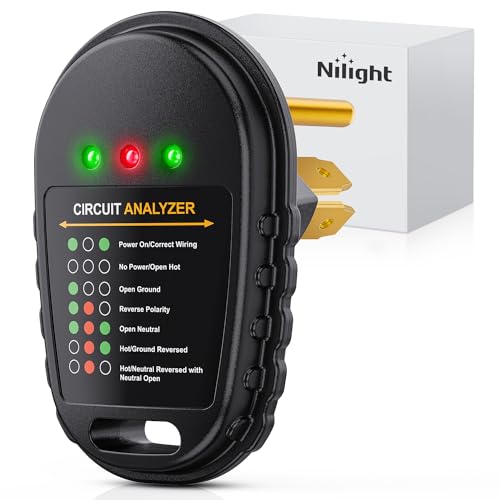
The Nilight tester takes a different angle from the surge-focused units on this list. It plugs into a 30 amp pedestal, lights up an LED pattern to show whether the wiring is correct, and that’s the whole mission. There is no joule rating, no MOV bank, nothing to absorb a spike. Think of it as a stethoscope for the pedestal before you connect anything expensive.
For someone who already owns a surge protector and wants a second-line diagnostic, or for travelers on a tight budget at well-maintained parks, this little tester fills a niche. The flame-retardant ABS housing shrugs off scuffs in a storage bin, and the NEMA TT-30P plug fits the same 30 amp outlets your shore cord uses.
Useful Highlights
- LED indicator reads pedestal wiring faults in seconds without any screen
- Pure copper internals maintain steady conductivity for a clean reading
- Durable ABS shell resists heat and flame at the plug connection
- Compact size stows in a small bay or glove compartment
- Compatible with most standard 30 amp RV outlet configurations
Points To Note
- Provides no surge absorption, so a voltage spike passes straight through to the RV
- Requires reading the LED code chart, which takes a minute to learn
Best Suited To
Travelers who already own surge protection and want a quick visual confirmation that the pedestal is wired correctly before plugging in.
A Better Fit Elsewhere
The Kohree RV Surge Protector 30 Amp 18000J handles both jobs in one unit for those who want surge protection and diagnostics combined.
The EyGde adapter lives in a different lane from the rest of this list. It is a dogbone adapter with a built-in surge protector, built for the specific scenario of plugging a 30 amp trailer into a standard household 15 amp outlet. Pre-cooling the fridge in the driveway before a trip, running lights overnight in the garage, that kind of thing. The 4200-joule rating is modest, but the use case is modest too.
Compared to a full-size surge protector, this is a niche tool, but a useful one. It does not convert voltage, so 110 stays 110 and the RV runs on its shore power setting as expected. For owners who occasionally park at home and want some protection from garage-circuit hiccups, it earns its place.
The Good Stuff
- Patented 4200-joule design built specifically for low-amperage household outlets
- 5-15P male to NEMA TT-30R female configuration fits standard garage outlets
- Compact adapter body stows in a kitchen drawer when not in use
- Built-in circuit analyzer flags miswired outlets before they reach the RV
- Handy for pre-trip fridge cooling without burning campground propane
Honest Caveats
- Only rated for 15 amp service, so high-draw appliances like rooftop AC should not run on this adapter
- Lower joule rating makes it unsuitable as the primary surge protector at a campground
Who Will Love This
Driveway campers and preppers who cool the fridge or charge batteries at home through a household outlet before hitting the road.
Consider Something Else When
The Kohree RV Surge Protector 30 Amp 14000J serves better as the everyday campground protector at a 30 amp pedestal.
The KIRFEIHT unit is the one I would reach for if the trailer sat outside through three seasons of rain, snow, and the occasional sprinkler overshoot. The IP68 waterproof cover on the housing is the standout feature here, sealing out dust and moisture that would corrode lesser units left on the pedestal year-round.
Underneath the sealed cover sits the familiar combination: 18,000-joule surge absorption and an LED diagnostic readout for pedestal wiring faults. Compared to the Kohree 18000J earlier in this list, the difference is environmental rather than electrical. Both absorb similar spikes; the KIRFEIHT simply keeps doing it after a season in the weather.
Practical Pluses
- IP68-rated cover seals out rain and dust for permanent outdoor mounting
- 18,000-joule capacity matches the top tier of 30 amp protectors
- LED display surfaces pedestal wiring errors before appliances power up
- Defends rooftop AC compressors against brownout damage on hot afternoons
- Reasonable for campground, storage lot, or seasonal site exposure
Points To Keep In Mind
- Heavier sealed housing adds weight at the pedestal connection point
- Higher cost than non-sealed units with similar joule ratings
Perfect Match For
Full-time RVers and seasonal site occupants who leave the rig connected outside through wet or freezing weather.
Swap It Out When
The Nilight 30 AMP RV Circuit Tester LED suits someone who needs diagnostic checks only and does not need sealed outdoor housing.
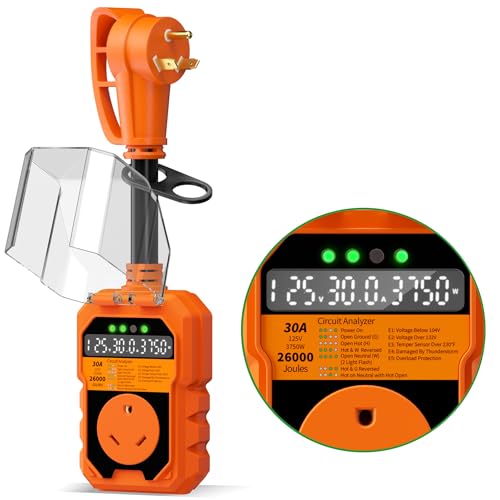
This is the 30 amp sibling to the 50 amp POWGRN earlier in the roundup, and it carries the same design philosophy: higher joule absorption than most competitors, automatic shutoff during faults, and manual reset once the pedestal recovers. At 26,000 joules it tops the typical campground range of 9,500 to 15,000 joules by a wide margin, which translates to more headroom against the kind of long, low-grade surges that wear out lesser protectors over time.
For someone camping at rural coast or mountain sites where the local grid has a reputation for instability, that headroom is the whole point. The trade-off is cost, but owners commonly report that the auto shutoff has caught a brownout before the AC compressor started drawing locked-rotor current, saving a service call.
What Works In Its Favor
- 26,000-joule rating significantly above the typical 9,500 to 15,000-joule range
- Auto shutoff reacts to low voltage and overheating before appliances are damaged
- Manual reset confirms pedestal conditions have stabilized before re-energizing
- All-mode protection covers every line in the circuit
- Fast response technology limits surge duration in the system
Some Limits To Know
- Premium price relative to 30 amp units with lower joule ratings
- Bulky housing takes up more space in a small storage bay
Who Should Grab It
Storm-country campers, full-timers, and remote-site travelers who want the most joule capacity available in a 30 amp format.
Reach For A Different Pick When
The Kohree RV Surge Protector 30 Amp 14000J suits someone at well-maintained suburban parks where the highest joule tier is unnecessary.
The Kohree 12000J is the entry point in the brand’s 30 amp family, aimed at first-time RV owners who want real protection at a more approachable price. It still reads pedestal wiring faults through diagnostic LEDs, covering the seven common failure modes from correct wiring to hot/ground reverse. The joule rating is lower than its siblings, but it is not stripped down.
For someone just starting out at modern RV resorts with recently serviced infrastructure, the 12000-joule ceiling handles typical disturbances well. Compared to the 18000J version at the top of this roundup, the trade-off is absorption margin against larger spikes, which most urban and suburban parks simply do not produce.
Advantages To Know
- 12,000-joule rating covers typical campground disturbances without overspending
- Diagnostic LEDs surface seven common pedestal wiring faults at a glance
- Lightweight housing is easy to grip and connect at awkward pedestal heights
- Affordable starting point for new RV owners building out their kit
- Same TT-30 plug format as the higher-joule Kohree models
Where It May Fall Short
- Lower joule ceiling means less margin against direct or sustained surges
- LED-only diagnostics require referencing a chart, which takes a moment to learn
Built With In Mind
First-time RV owners at modern, well-maintained parks who want basic surge protection and wiring diagnostics without a premium price.
Another Choice May Suit
The POWGRN 30 Amp RV Surge Protector 26000J is the better fit for full-timers who want the highest joule capacity and auto shutoff.
Choosing The Right 30 Amp Surge Protector For Your Rig
Joules And Why The Number Matters
The joule rating on an RV surge protector tells you how much energy the unit can absorb before it wears out and stops protecting. Think of it like the tread depth on a tire: more is better, and once it runs out, the protection is gone. Most campground-pedestal incidents sit in the 9,500 to 15,000-joule range, so anything in that neighborhood handles typical disturbances. The KIRFEIHT RV Surge Protector 30 Amp 18000J sits a comfortable step above that baseline for anyone who camps often or in storm-prone regions.
Auto Shutoff And Why It Helps
Auto shutoff separates the heavy hitters from the basic units. When the pedestal voltage drops too low or climbs too high, the protector disconnects the RV before the AC compressor or microwave inverter sees damaging current. Manual reset means the unit waits for a human to confirm the pedestal has recovered, which prevents the RV from cycling through repeated brownouts.
Form Factor And Daily Use
A surge protector lives outside at the pedestal, which means weight, grip, and weather resistance all matter. Sealed housings like the IP68 cover on the KIRFEIHT unit handle year-round outdoor placement, while lighter units are easier to swap between sites but benefit from a storage bin in transit. For driveway use, the EyGde 30A to 15A RV Adapter 4200J handles a much smaller use case with a much smaller housing.
Matching Protection To Your Rig
A popup camper at a managed resort with newer pedestals does not need the same joule ceiling as a fifth wheel in a remote state park with forty-year-old wiring. Match the protector to the worst campground you actually visit, not the best one.
Things Worth Knowing Before You Buy
Pitfalls Shoppers Hit
The most common mistake is grabbing a circuit tester and thinking it offers surge protection. The Nilight 30 AMP RV Circuit Tester LED is a diagnostic tool, not a protector, and a voltage spike will pass straight through to the RV. The second mistake is assuming joules last forever; once an MOV bank absorbs enough energy, the unit should be replaced. Buying the right amperage matters too, since a 50 amp protector on a 30 amp trailer, or vice versa, simply will not physically connect.
Where The Extra Money Goes
Higher-tier protectors add three things that cheaper units often skip. First, a higher joule rating, which is more margin against large surges. Second, an automatic shutoff that intervenes during low-voltage brownouts rather than just absorbing them. Third, sealed weather-resistant housings like the IP68 cover on the KIRFEIHT unit, which keep the internal components dry through extended outdoor exposure. For storm-country campers and full-timers, those three features tend to justify the step up.
Frequently Asked Questions
What does a joule rating actually mean?
A joule is a unit of energy, and the rating tells you how much surge energy the protector can absorb over its lifetime before it stops working. Higher numbers mean more headroom against large or repeated spikes.
Do I need a surge protector at a modern campground?
Yes. Modern infrastructure helps, but pedestal wiring still varies from site to site, and one miswired outlet can damage an RV’s electronics regardless of how new the rest of the park is.
What is auto shutoff and why does it matter?
Auto shutoff disconnects the RV from the pedestal when voltage drops or climbs outside a safe range. Without it, a brownout can damage the AC compressor before the surge protector absorbs anything.
Can I use a 30 amp protector on a 50 amp rig?
No, the plugs are physically different and the protector cannot handle the higher current draw of a 50 amp system. Use a protector matched to your rig’s amperage.
How long does an RV surge protector typically last?
It depends on how many surges it absorbs, but most units last several seasons of normal use. Replace it sooner if it takes a direct lightning hit or stops passing the diagnostic check.
Closing Remarks
A 30 amp surge protector is one of those things that looks optional until the first time a bad pedestal writes off an inverter or a fridge board. Match the protector to your rig’s amperage, your typical campground conditions, and the weather your storage setup faces, and it becomes the cheapest piece of insurance in the whole RV kit.
