

Households run on AA cells more than most people realize, from TV remotes and game controllers to flash units and wireless mice. I put this list together for anyone tired of tossing alkalines into the trash every few weeks. Rechargeables cost more up front, but they pay for themselves quickly, and the right charger turns the whole setup into something almost invisible.
The Essentials At A Glance

Eneloop 4th Gen AA NiMH Pre-Charged 2100 Times Rechargeable Battery, 4-Pack

Eneloop Panasonic BK-3MCCA16FA AA 2100 Cycle Ni-MH Pre-Charged Rechargeable Batteries, 16-Pack

BEVIGOR AA Rechargeable Batteries with Charger, 10-Pack 2800mAh NiMH
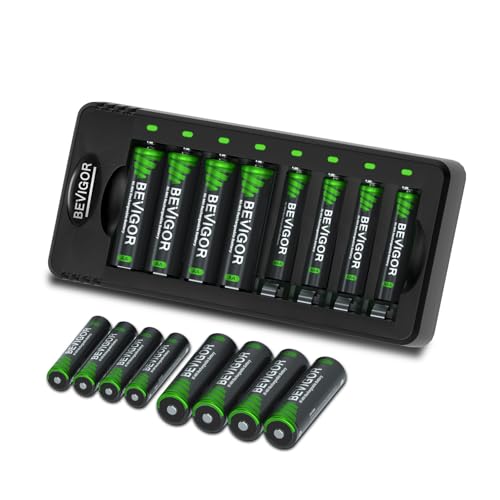
BEVIGOR NiMH AA AAA Battery Kit with Charger, 8AA + 8AAA

PHILIPS AA Lithium Rechargeable Batteries 1.5V 3000mWh, 8-Pack

BEVIGOR Rechargeable AA Batteries 24-Pack, 2800mAh NiMH

Eneloop CC55 Charger with AA/AAA Rechargeable Batteries

Eneloop CC55 Pro Charger with High-Capacity AA/AAA Rechargeable Batteries
The Strengths Of Each Pick
NiMH (nickel-metal hydride) cells are the workhorses of the rechargeable world, and Eneloop’s fourth-generation AA sits near the top of that category. The cells ship pre-charged by solar energy at the factory, which means they go straight into a remote or gamepad without waiting around. In my experience with these cells, the low self-discharge chemistry holds usable charge for months on the shelf.
Compared to the bulk 16-pack further down, this 4-pack is friendlier to first-timers who want to try the brand without committing. The package includes a plastic holder that doubles as storage, so loose cells don’t rattle around a junk drawer.
Bright Spots
- Recharge cycle count stretches into four figures, so a single set can outlast several generations of gadgets.
- Pre-charged by solar power at the factory, meaning real-world convenience right out of the package.
- Performs in colder conditions than many NiMH competitors, useful for outdoor sensors and trail cameras.
- Comes with a tidy holder that keeps paired cells together so you never mix a charged one with a spent one.
Trade Offs To Consider
- A 4-pack fills a couple of remotes but runs thin for households that burn through controller batteries quickly.
- No bundled charger, so shoppers need a compatible unit already or must buy one separately.
Key Specs
Whose Shelf It Belongs On
This set fits someone starting a rechargeable battery routine who wants a trusted brand without buying a charger they already own.
Consider Something Else When
Anyone running a house full of game controllers and toys should look at the Eneloop Panasonic BK-3MCCA16FA 16-Pack further down for a deeper spare-cell pool.
Sixteen pre-charged AA cells solves the spare-battery problem for a busy household in one shot. The Panasonic-made Eneloop line keeps the same low self-discharge chemistry as the smaller pack, so cells tucked in a drawer still hold useful voltage months later. That shelf-life angle is what sets these apart from older NiMH generations, which often arrived dead.
Where the 4-pack is a taster, this is the full meal. Cyclists running GPS units, parents powering kids’ toys, and anyone with a string of Xbox controllers all benefit from the depth of inventory. Same chemistry, more of it, ready to slot in the moment something dies.
What Pays Off
- Sixteen cells let you rotate charged and depleted pairs without ever scrambling for spares.
- Pre-charged and solar-powered at the factory, so they work straight out of the packaging.
- Long recharge cycle count keeps the cost-per-use low compared to disposables.
Points To Keep In Mind
- Still no bundled charger, which feels like a missed chance at this size.
- Storage becomes a real concern with sixteen loose cells unless a separate holder is bought.
- Capacity lands lower than the BEVIGOR 2800mAh option for very high-drain devices.
Built With In Mind
Households running multiple high-draw devices at once, from game controllers to flash units, will appreciate the depth of this 16-pack.
Look Elsewhere When
Anyone who also needs AAA cells should consider the BEVIGOR 8AA+8AAA kit, which covers both common sizes in a single bundle.
Where the Eneloop entries rely on existing chargers, this BEVIGOR kit bundles a USB-C input charger with ten 2800mAh cells, which is unusually high capacity for NiMH AA. The Type-C port is the standout: it pulls power from laptop bricks, power banks, and car adapters instead of forcing a wall outlet. Independent charging channels mean you can top off a single cell without committing the whole set.
Red and green LED indicators give at-a-glance status, and the automatic shut-off prevents the overcharging that slowly kills NiMH cells. Anyone whose household runs on USB-C laptops and modern power strips will appreciate skipping the dedicated wall wart entirely.
Real Benefits
- USB-C input simplifies travel charging and removes the hunt for an open outlet.
- Higher mAh rating than standard NiMH means longer runtime per charge in hungry devices.
- Individual charging slots let you swap cells in and out without waiting for a full set.
Practical Considerations
- Bundled charger only accepts AA and AAA, limiting future expansion to those sizes.
- Higher capacity sometimes translates to slower charge times per slot.
The Right Fit
Travel-heavy users and anyone with USB-C power bricks already in the rotation get the cleanest experience here.
Swap It Out When
Photographers wanting a dedicated fast charger with per-cell status lights should look at the Eneloop CC55 kit further down.
Most homes lean on both AA and AAA cells, and buying them separately gets old fast. This BEVIGOR kit ships eight of each size plus a charger with eight isolated channels, so mixed loads charge at the same time. LED indicators shift from red to green as cells fill, giving visual confirmation without an app or display.
The independent circuit design is the practical hook, since most bundled chargers handle cells in pairs. Drop in a single dying AAA from a TV remote without queuing up a full set. Up to 1,500 recharge cycles per cell makes the kit a long-term replacement for disposable shopping runs.
Standout Benefits
- Both common household sizes in one kit means one charger handles almost every handheld device.
- Independent charging channels avoid the common inconvenience of forcing even-numbered top-ups.
- Low self-discharge cells stay useful even after sitting unused in a drawer for stretches.
Honest Caveats
- Capacity lands below the BEVIGOR 2800mAh AA kit, so high-drain devices may need recharging sooner.
- Sixteen loose cells demand a storage solution to avoid mixing charged and empty pairs.
Feature Snapshot
Made For
Families juggling TV remotes, gamepads, and small electronics that all need different cell sizes get a tidy one-bag solution.
A Better Fit Elsewhere
Anyone prioritizing long runtime in high-drain gear should pick the BEVIGOR 2800mAh 10-pack for stronger AA capacity.
Lithium rechargeable AAs behave differently from NiMH cells, and that difference matters for certain electronics. Standard NiMH cells settle around 1.2V, which can confuse smart devices expecting a fresh alkaline’s 1.5V. These Philips lithium cells hold a steady 1.5V output across the discharge cycle, which is why some digital cameras and smart sensors run cleaner on them.
Energy is measured in milliwatt-hours here (mWh) rather than milliamp-hours (mAh), reflecting the higher voltage platform. For someone whose flash unit or trail camera has been finicky with regular rechargeables, the lithium chemistry often solves the brown-out problem that appears mid-burst.
A Few Strong Suits
- Constant 1.5V output keeps voltage-sensitive electronics running smoothly through the entire charge.
- Lithium chemistry holds more usable energy per cell than standard NiMH.
- Lighter weight than NiMH cells, useful for handheld gear carried for long stretches.
Less Ideal Details
- Requires a lithium-compatible charger; standard NiMH chargers are not interchangeable.
- Higher per-cell cost than NiMH options in the same range.
Feature Rundown
Best Suited To
Photographers, smart home owners, and anyone whose devices misbehave with regular NiMH will benefit most from the steady voltage curve.
Reach For A Different Pick When
Shoppers wanting the simplest universal solution should default to the Eneloop 4-pack, since NiMH cells work with most existing chargers already in homes.
Twenty-four cells is overkill for some homes, but for families with toy bins full of battery-hungry devices, it’s a relief. Each cell carries a 2800mAh rating, which is on the higher end for NiMH and keeps remote-control cars and gaming controllers running longer between swaps. Pre-charged at the factory, they’re usable the moment the package opens.
Up to 1,500 recharge cycles per cell means a single purchase can carry a household through years of school projects and Christmas mornings. The honest read is that without a dedicated storage case, keeping track of which cells are charged becomes a real chore.
The Case For It
- Twenty-four cells means a long stretch without scrambling for spares during gift season or power outages.
- Higher mAh capacity than standard NiMH cells translates to longer runtime per charge.
- Pre-charged and ready to use, no waiting around before the first deployment.
Trade-Offs To Consider
- No bundled charger, so a compatible unit is needed separately.
- Loose-cell storage quickly turns into a sorting problem without a third-party case.
Right Fit For
Parents managing a household of toys and controllers, or preppers stocking emergency gear, will get the most from the volume.
Not Your Match When
Anyone starting small should consider the Eneloop 4-pack instead, since a 24-cell bundle is overkill for a single remote or two.
The CC55 is one of the more thoughtful chargers in the Eneloop ecosystem, charging each cell individually rather than in pairs. The four colored LEDs communicate the charging state per slot: green for cells over 80% full, orange for the mid-range, and red for nearly empty. For someone who treats batteries as precision tools, that level of feedback matters.
Bundled with a mix of AA and AAA cells rated for up to 2,100 recharge cycles, this kit is built for households that have moved past disposable batteries entirely. The trade-off is four slots only, which bottlenecks anyone trying to refresh an entire army of controllers at once.
What It Does Well
- Individual charging channels avoid the wasted energy that paired chargers burn when one cell finishes first.
- Color-coded LED indicators give instant charge status without an app or display.
- Compatible with both standard Eneloop and higher-capacity Eneloop Pro cells.
Factors To Consider
- Only four charging slots, which limits how many cells can be refreshed simultaneously.
- AA capacity lands around 2000mAh typical, lower than the BEVIGOR 2800mAh cells.
Spec Overview
Who It Suits Best
Mixed-device households that want a polished, informative charger with a starter cell bundle will feel right at home with this kit.
Where Another Pick Suits Better
Anyone prioritizing per-cell capacity for high-drain flash work should consider the Eneloop Pro CC55 kit instead, which ships with 2500mAh cells.
Where the standard Eneloop cells land around 2000mAh, the Pro versions push to 2500mAh typical with a 2450mAh minimum. That extra capacity shows up most in photography flash units and high-drain audio gear that chew through standard rechargeables quickly. The same CC55 charger handles both standard and Pro cells, so upgrading from the previous kit is seamless.
The catch on Pro cells is fewer recharge cycles: up to 500 versus 2,100 on the standard line. For someone recharging flash batteries after every shoot, that lower cycle count is barely a footnote; for casual users, it matters more.
Where It Helps
- Higher mAh rating translates to noticeably longer runtime per charge in demanding devices.
- Same individual-channel CC55 charger as the standard kit, no learning curve.
- Color-coded LED indicators maintain consistent charging feedback across the line.
Points To Weigh
- Lower recharge cycle count than standard Eneloop cells, which matters for high-frequency users.
- Four charging slots remain the bottleneck for households trying to refresh many cells at once.
Quick Facts
Who Should Grab It
Photographers and content creators running flashes, audio recorders, or other high-drain gear benefit most from the Pro cell upgrade.
Another Choice May Suit
Casual users looking for the longest service life per cell should stick with the Eneloop CC55 standard kit, which cycles much further before wearing out.
What Matters Most Before Choosing Rechargeable Aa Batteries With Charger
Capacity and the mAh Question
Capacity on NiMH AA cells typically runs from about 2000mAh on standard Eneloop cells up to 2800mAh on higher-capacity competitors like the BEVIGOR entries in this list. Higher mAh means longer runtime per charge, which matters most for high-drain devices like flash units, game controllers, and motorized toys. Low-drain gadgets like TV remotes barely notice the difference, so chasing the highest number is not always worth the premium.
Lithium vs NiMH Chemistry
Lithium rechargeable AAs output a steady 1.5V, while NiMH cells settle around 1.2V. That voltage gap confuses some electronics expecting alkaline-like behavior, which is why smart sensors and certain cameras prefer lithium chemistry. NiMH remains the more affordable, broadly compatible option for most households, and lithium earns its premium when voltage-sensitive gear misbehaves on regular rechargeables.
Recharge Cycles and Long-Term Cost
Recharge cycle ratings range from 500 cycles on Eneloop Pro cells up to 2,100 on standard Eneloop and 1,500 on the BEVIGOR kits. A cycle is one full charge-then-discharge, so a 1,500-cycle cell that gets recharged weekly lasts years before wearing out. The honest math: spend more upfront on cells with higher cycle counts, and the cost per use drops below disposables within months.
Charger Features That Actually Matter
Independent charging channels let you top off single cells without pairing requirements. USB-C input on modern chargers like the BEVIGOR kit removes the hunt for an open wall outlet. LED indicators and automatic shut-off prevent the overcharging that slowly degrades NiMH cells over time.
Key Considerations Across These Picks
Where Shoppers Go Wrong
The most common mistake is buying high-capacity lithium AAs and then attempting to charge them in a NiMH-only charger. The chemistry differs enough that mismatched chargers either refuse to fire or damage the cells. Matching the charger to the cell chemistry is non-negotiable, especially with the lithium voltage pick in this list.
Another trap is mixing brands and ages in the same device. Old cells with reduced capacity drag down newer ones, and devices die sooner than expected. Pairing cells by age and brand keeps discharge rates matched, which extends the usable life of the whole set.
What The Higher Tier Buys
Premium cells like the Eneloop Pro line add capacity at the cost of cycle count, a trade-off that pays off only when devices demand more milliamp-hours per charge. Mid-tier kits bundle chargers with smart features like per-cell LEDs and USB-C input, which makes day-to-day ownership smoother than basic wall-wart models. The upgrade is worth it for households that rotate batteries weekly; for occasional use, basic bundles already do the job.
Frequently Asked Questions
How long do rechargeable AA batteries typically hold their charge on the shelf?
Low self-discharge cells like the Eneloop and BEVIGOR entries in this list retain most of their charge for years sitting idle. Older NiMH generations lost charge in weeks, but modern chemistry keeps them ready for months between uses.
Can I mix rechargeable and alkaline batteries in the same device?
No, mixing chemistries in a single device causes uneven discharge and can leak or damage the unit. Stick to one chemistry per device, and replace all cells at the same time when they wear out.
What is the difference between mAh and mWh ratings on AA batteries?
mAh measures charge capacity at a fixed voltage, while mWh measures actual energy delivered, accounting for the cell’s voltage. Lithium cells rated in mWh often appear lower in raw numbers but deliver more usable energy due to the higher voltage platform.
Do I need a special charger for lithium rechargeable AAs?
Yes, lithium rechargeable AAs require chargers designed for their specific voltage and chemistry profile. Standard NiMH chargers are not interchangeable and may damage lithium cells or fail to recognize them.
How do I know when a rechargeable AA has reached the end of its service life?
Cells that no longer hold meaningful charge, run time shrinks sharply, or self-discharge within days are past their useful life. Once a cell needs constant recharging to function in low-drain devices, recycling and replacement is the right move.
Closing Remarks
Rechargeable AA batteries pay back their cost quickly for any household that runs through more than a handful of disposables a year. The eight picks above cover the main profiles: starter packs, bulk stashes, mixed-size kits, lithium voltage stability, and smart chargers for demanding gear. Match the chemistry and capacity to the devices that matter most, and the rest falls into place.
