

I’ve spent more weekends than I’d like to admit under kitchen cabinets and behind media walls, watching a single mismatched power supply flicker an otherwise clean LED install. The right 12V supply keeps the lights steady, the dimmer smooth, and the wiring inspector off your back. This roundup covers the drivers and adapters I keep coming back to for tape lighting, accent puck fixtures, CCTV runs, and small 12V projects.
The Leading Options At A Glance
The Leading Options At A Glance

EMITEVER 60W 24V 5-in-1 Dimmable LED Driver

EMITEVER 60W 24V Triac Dimmable LED Driver

EMITEVER 60W 12V Dimmable LED Driver

EMITEVER 300W 24V 5-in-1 Dimmable LED Driver

DC 12V 5A 60W Switching Power Supply Adapter

EMITEVER 60W 24V Slim Triac Dimmable Driver
EMITEVER 60W 24V Dimmable LED Driver
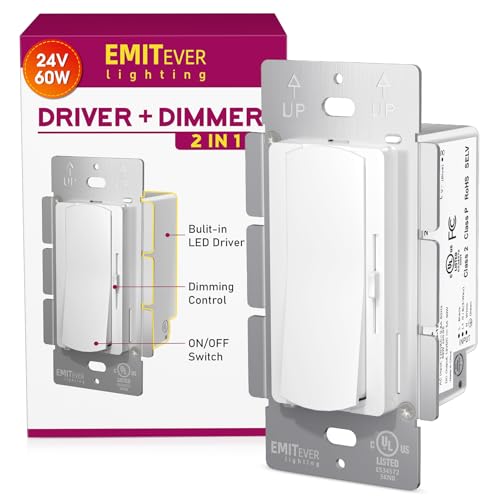
EMITEVER Dimmer Switch & 24V 60W Driver 2-in-1

inShareplus 12V 16.5A 200W LED Power Supply
Meet The Standout Selections
I think of this driver as a translator for older homes. It handles ELV (electronic low-voltage), MLV (magnetic low-voltage), TRIAC forward phase, 0–10V, 1–10V, 10V PWM (pulse-width modulation), and a potentiometer, all from a single box. That flexibility matters when the existing wall dimmer is from a previous decade and you don’t want to swap it out.
The wide 110–277V AC input range makes it useful in commercial spaces and remodels where mains voltage varies. Where the EMITEVER 60W 24V Triac Dimmable LED Driver is a focused tool, this one is a Swiss Army version for mixed setups.
A Few Strong Suits
- Seven dimming protocols in a single unit reduce the chance of buying the wrong model for your switch.
- Class 2 driver design keeps low-voltage runs safer for in-wall and cabinet installs.
- 120–277V input lets one unit serve studio apartments and larger commercial feeds alike.
- Compatible with widely used Lutron and Leviton receivers, so existing controls usually cooperate.
Worth Noting
- The feature density can overwhelm first-timers who only need basic on/off behavior.
- At low loads, owners commonly report minor flicker until the connected wattage climbs past roughly 5% of capacity.
Key Specs
Right Fit For
Retrofit jobs where the existing dimmer style is unknown and you want one driver to cover most possibilities.
Swap It Out When
The inShareplus 12V 16.5A 200W LED Power Supply fits better when you need 12V output rather than 24V, or much higher current for long tape runs.
Most dimmers in US homes are forward-phase TRIAC models, which chop the leading edge of the AC waveform to dim. This driver speaks that language directly with Lutron, Leviton, Legrand, and Cooper AH dimmers, so pairing usually goes smoothly.
The plastic housing feels less rugged than the metal-surrounded sibling later in the list, but the full-protection circuitry keeps operation steady in everyday residential settings. For most DIYers, this is the “just works” choice when the wall switch already exists.
The Practical Payoff
- Smooth 0–100% dim range without visible flicker at typical loads.
- Broad TRIAC dimmer compatibility reduces guesswork when matching an existing wall switch.
- Sized well for under-cabinet, cove, and accent LED projects.
Trade Offs
- Plastic housing means heat dissipation is more modest than metal-cased units.
- Some users report subtle flicker below very low loads, depending on the dimmer brand.
Made For
Homeowners replacing an existing TRIAC dimmer and wanting a compatible 24V driver without a controls overhaul.
A Better Fit Elsewhere
The EMITEVER 60W 24V 5-in-1 Dimmable LED Driver is the better call when you need multiple dimming protocols in one box.
Twelve-volt LED tape remains the most common format on store shelves, so a 12V dimmable driver like this one covers the largest pool of off-the-shelf strips. The metal-surrounded enclosure helps shed heat, which matters in enclosed cabinets or warm attic spaces.
It accepts 120V AC input and steps that down to a steady 12V DC, while remaining compatible with Lutron and Leviton dimmers running TRIAC, ELV, or MLV control modes. For a kitchen under-cabinet job, this driver feels like the right scale.
Key Advantages
- Metal housing improves thermal performance in tight, enclosed locations.
- Suitable for dry and damp environments, so it handles bathroom or covered outdoor runs.
- Plays well with mainstream dimmer brands, simplifying the parts list.
Things To Consider
- At 12V output, voltage drop becomes noticeable beyond roughly 16 feet, so larger projects need closer taps or higher-gauge wire.
- Warranty length is shorter than some premium 24V commercial units.
Quick Facts
Whose Shelf It Belongs On
Anyone wiring standard 12V LED tape in a kitchen, bath, or bar nook who wants dimming and a sturdier enclosure than plastic offers.
Consider Something Else When
The inShareplus 12V 16.5A 200W LED Power Supply fits better when you need higher current for long continuous runs or CCTV arrays.
When one driver must feed an entire media wall, a tray ceiling, or a small retail fit-out, the 300W rating gives breathing room. The 5-in-1 dimming covers TRIAC, ELV, MLV, 0–10V, and 1–10V paths, so installers can pick the control scheme that suits the building’s existing wiring.
It accepts 110–277V AC, which is helpful for mixed residential and light-commercial jobs. Compared with the smaller 60W version earlier in this list, this is a heavier, fan-cooled unit built for serious loads.
Notable Upsides
- 300W capacity handles long runs of 24V tape or several zones from one box.
- Five dimming protocols in one chassis simplify the controls decision.
- Premium commercial-grade construction supports daily, continuous-duty operation.
Room For Improvement
- Larger physical footprint means it needs dedicated space, not a hollow cabinet wall.
- Active cooling fans can be audible in quiet rooms, depending on placement.
Feature Snapshot
Who It Suits Best
Pros and serious DIYers running large 24V LED tape or accent systems across multiple zones.
Reach For A Different Pick When
The EMITEVER 60W 24V 5-in-1 Dimmable LED Driver is a smarter match for smaller rooms where 300W is overkill.
Some projects don’t need dimming. A CCTV camera cluster, a single-color LED strip behind a monitor, a 3D printer accessory, or a hobby electronics bench just needs steady 12V at up to 5 amps. This adapter covers that case directly without paying for dimmer circuitry you won’t use.
The aluminum case is vented to shed heat, and built-in protections cover over-temperature, short-circuit, over-voltage, and overload events. It’s an unfussy, utilitarian box that gets the job done.
Real Benefits
- Fanless, silent operation suits recording spaces or bedside installs.
- Multi-protection circuitry guards connected devices against common faults.
- Adjustable output trim (within roughly 10%) lets you fine-tune voltage-sensitive loads.
Honest Caveats
- No dimming support, so it isn’t a fit for mood lighting circuits.
- Build quality is more utilitarian than premium, so longevity depends on ventilation and load profile.
Best Suited To
Homeowners wiring CCTV cameras, simple LED strip accents, or low-power DC projects where dimming isn’t needed.
Where Another Pick Suits Better
The EMITEVER 60W 24V Slim Triac Dimmable Driver fits better when you want dimming plus a thinner profile for cabinet spaces.
Older, brick-shaped drivers are awkward to hide. This slim profile slips behind a toe kick, inside a shallow cabinet, or beside a junction box without forcing you to carve out extra depth. The UL listing helps when an inspector asks for documentation.
The PWM (pulse-width modulation) output keeps the color rendering consistent across the dim range, which matters for accent lighting where the color temperature shouldn’t drift as the lights come down. Compared with the larger EMITEVER 60W 24V Triac Dimmable LED Driver, this one trades bulk for a tighter install footprint.
Points In Its Favor
- Slim profile fits inside shallow cabinets and tight ceiling coffers.
- UL listing provides a recognized safety credential for residential work.
- PWM output preserves color index through the full dim range.
- Wide 100–277V input range covers most home and small commercial feeds.
Less Ideal Details
- Slim form factor can limit mounting orientations and ventilation in fully enclosed spaces.
- Lower 60W ceiling isn’t suitable for large-scale tape installations.
Perfect Match For
Retrofitting low-profile LED tape into existing cabinetry or shallow ceiling voids where depth is scarce.
Look Elsewhere When
The EMITEVER 300W 24V 5-in-1 Dimmable LED Driver is the smarter choice for higher-wattage, multi-zone commercial projects.
This driver is a quiet workhorse for everyday 24V tape lighting under cabinets, inside coves, or along toe kicks. It accepts 120V AC and steps that down to a steady 24V DC, while working with mainstream TRIAC, ELV, and MLV dimmer types.
The Class 2 rating caps output at safer energy levels, which can matter when the wiring runs through living space walls. Compared with the 5-in-1 model earlier, this one focuses on the most common control schemes rather than chasing every protocol.
Strengths Worth Knowing
- Class 2 rated for safer residential low-voltage wiring.
- Compatible with Lutron, Leviton, Legrand, and Cooper dimmers commonly installed in US homes.
- Full protection plastic housing simplifies mounting on combustible surfaces.
Points To Note
- Below 5% load, the output isn’t a flat 24V, which can produce flicker in very small installations.
- Plastic enclosure handles heat less efficiently than metal-clad drivers.
Who Should Grab It
First-time upgraders moving from a basic on/off LED tape setup to dimmable control with a standard wall dimmer.
Where A Sibling Pick Shines
The EMITEVER 60W 24V 5-in-1 Dimmable LED Driver fits better when you need broader protocol coverage beyond TRIAC, ELV, and MLV.
A traditional install needs two devices: a dimmer switch in the wall box and a remote driver somewhere nearby. This unit folds both into one wall-switch form factor, which means fewer parts to source and no driver tucked above the ceiling.
The compact size fits a standard junction box, and the glossy finish blends with most wall plates. It supports single-pole and 3-way circuit configurations, so it can replace an existing switch at one end of a stairwell without rewiring the other end.
A Favorable Mix
- Driver and dimmer combined in one box simplifies parts ordering.
- 3-way circuit support handles stair and hallway configurations.
- Compact dimensions free up space in shallow junction boxes.
- UL listed for residential safety review.
Where It May Fall Short
- Heat dissipation is more limited than remote-mounted drivers, so very long daily cycles can stress the unit.
- Single-driver wattage caps at 60W, ruling out larger multi-tape installations.
Feature Rundown
Built With In Mind
DIYers upgrading one switch location to dimmable 24V LED tape without running new low-voltage wiring through the wall.
Not Your Match When
The EMITEVER 60W 24V Slim Triac Dimmable Driver is a smarter fit when the dimmer switch already exists and you only need a slim remote unit.
Long runs of 12V tape or larger module arrays demand serious current. At 16.5 amps and 200 watts, this supply covers an entire room’s worth of accent lighting from a single feed. The metal-enclosed body manages heat better than the smaller plastic adapters, especially in enclosed cabinets.
Built-in protection covers overvoltage, overcurrent, overload, overheating, and short-circuit events, with automatic recovery after the fault clears. For large passive 12V installations without dimming needs, this is a sturdy backbone. Compare it to the slim EMITEVER 60W driver earlier, and the size and capacity difference is unmistakable.
What Makes Sense
- 16.5A output supports extensive 12V LED arrays from one box.
- Metal enclosure improves heat dissipation for continuous-duty use.
- Multi-fault protection with auto-recovery reduces service calls.
- Accepts 110–250V AC input for international-friendly flexibility.
Practical Considerations
- No dimming support, so it’s best paired with non-dimmed accent or task circuits.
- Manufacturer guidance recommends staying under about 85% of rated load for stable long-term performance.
- Heavier than typical 60W adapters, so mounting needs a sturdy surface.
The Right Fit
Installers powering long 12V tape runs, multiple lighting modules, or non-dimming DC projects across a whole space.
Skip It When
The EMITEVER 60W 24V 5-in-1 Dimmable LED Driver is the better match when dimming and protocol flexibility matter more than raw current capacity.
What To Weigh Before Choosing A 12V LED Power Supply
Match Voltage To Your Lights First
Every LED strip, module, or puck on the market runs at a specific voltage, most commonly 12V DC or 24V DC. Mixing a 24V supply with a 12V strip will burn the LEDs out almost instantly, while the reverse combination leaves the lights dim or unlit. The “DC” part is just as important as the number, because supplying AC to a DC-only device produces visible flicker and shortens the lifespan of the diodes. Before comparing wattage or dimming features, confirm the exact voltage and DC requirement printed on the existing tape or fixture.
Size Wattage With Real Headroom
Wattage is the spec people get wrong most often. If your LED tape pulls 40 watts at full brightness, choosing a 40W supply leaves no margin and runs the driver hot for its entire life. Most manufacturers recommend loading the supply to about 80% of its rated capacity to extend service life and reduce thermal stress. For a 40W load, a 50W or 60W driver is the practical minimum, and a 100W unit leaves more headroom for future expansion.
Decide Whether Dimming Is Part Of The Plan
Some drivers only feed constant full brightness, which suits CCTV runs, under-counter task strips, or workshop benches. Others include dimming circuitry compatible with TRIAC wall dimmers, 0–10V control panels, or PWM signal inputs. Dimming drivers cost slightly more and add a layer of complexity, but they unlock mood lighting, scenes, and energy savings. Decide this question before browsing, because the wrong driver either wastes the dimmer capability or forces you to swap a perfectly good supply later.
Think About Heat, Humidity, And Housing
Drivers generate heat, and the housing material changes how well that heat dissipates. Plastic cases are lighter and cheaper, but in enclosed cabinets or warm ceilings they tend to run hot. Metal-surrounded drivers shed heat more efficiently and tolerate longer duty cycles. Damp-location ratings matter for bathroom, garage, and covered outdoor runs, where condensation or splashes could otherwise damage internal circuitry.
Things Shoppers Overlook When Picking 12V LED Drivers
Common Buying Traps To Sidestep
The biggest mistake is buying a supply that matches the LED voltage but undersizes the wattage. A 30W load on a 30W driver looks fine on paper but leaves zero thermal margin, and the supply may fail within a year. Always plan for at least 20% extra capacity. The second trap is ignoring dimmer compatibility. TRIAC dimmers in particular sometimes need specific dimmer-driver pairings, and a mismatched pair produces flicker or audible buzzing that no spec sheet warns you about.
When Spending More Earns Its Keep
Higher-tier drivers usually bring three concrete upgrades: better heat dissipation through metal housings, broader dimming protocol support, and stronger protection circuitry that recovers automatically after a fault rather than failing outright. For a small bedside reading strip, a basic 60W plastic supply is fine. For an in-ceiling install that’s hard to reach, or a long tape run across a living room, the upgrade typically pays back in service life and fewer service interruptions.
