

I’ve lost count of how many DIY wiring jobs I’ve talked through with friends, and the same messy story comes up every time: a single battery post buried under ring terminals, zip ties holding things together, and one loose connection that nearly killed the whole system. A good bus bar fixes that almost instantly, turning chaos into something a person can actually service later. The trick is matching the block to the cables, the current draw, and where it lives. I’ve narrowed ten solid options to the most useful across automotive, marine, RV, and solar work.
The Lineup, Simplified

Joinfworld 12V 250A Power Distribution Block 4 x 3/8″ Studs

Joinfworld 12V 250A Power Distribution Block 4 x 5/16″ (M8) Studs

Joinfworld 400A Bus Bar Power Distribution Block 4 x 3/8″ Studs

Joinfworld 500A Bus Bar Waterproof Power Distribution Block with Cover
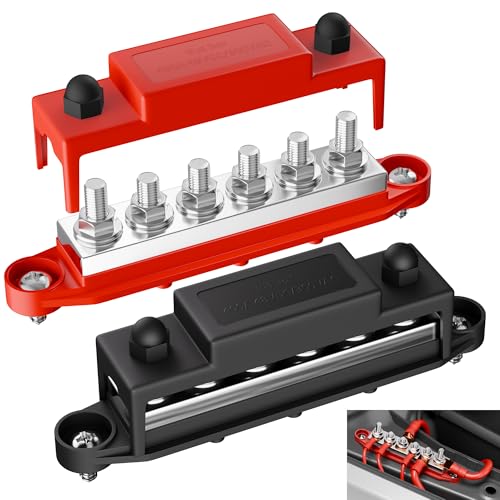
Joinfworld 400A Bus Bar Power Distribution Block 6 x 5/16″ (M8) Studs

Joinfworld 12V 3/8″ Single Stud Battery Post Junction Block

IZTOSS 300A Bus Bar Power Distribution Block with Cover
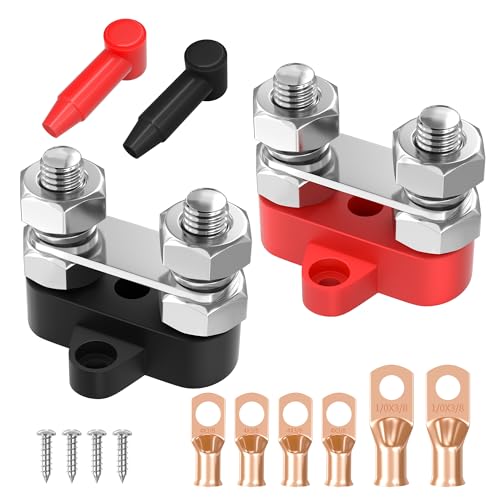
Joinfworld 12V 250A Power Distribution Block Dual 3/8″ Studs with Lugs

Joinfworld 12V 250A Power Distribution Block Dual 5/16″ (M8) Studs

Advance MCS Insulated Battery Power Junction Post Block 3/8″ Stud (Red & Black)
The Strengths Of Each Pick
I think of this block as the gateway drug for cleaner wiring. It ships as a matched red and black pair, so a person can rebuild their grounding scheme in one weekend without hunting for separate parts. The 4mm copper plate gives it a chunky, reassuring feel that handles typical automotive accessory loads without breaking a sweat.
For someone running a modest sound system, off-road lights, or a basic solar setup in a camper van, this is the kind of block that disappears into the install and just works. Owners commonly report that the studs accept standard 3/8″ ring terminals cleanly, and the nylon base keeps things isolated from the chassis.
Standout Benefits
- Matched positive and negative pair removes guesswork when ordering
- 250A continuous rating handles most car audio and lighting upgrades with margin
- Four 3/8″ studs per block give enough branching for accessories plus a feed wire
- Thicker copper plate resists heat buildup during sustained loads
Points To Note
- No protective cover, so exposed terminals in a wet engine bay may need extra sealing
- Stud spacing may feel tight when stacking large gauge ring lugs side by side
Whose Shelf It Belongs On
Right for first-time installers and weekend tinkerers running 12V accessories in cars, boats, or small solar arrays.
Look Elsewhere When
Shoppers pulling serious inverter loads should consider the Joinfworld 400A Bus Bar Power Distribution Block 4 x 3/8″ Studs for the extra current headroom.
The sibling to the first pick, this version trades the 3/8″ studs for the slightly smaller M8 (5/16″) standard. That detail matters more than it sounds: many marine panels, switch panels, and aftermarket fuse blocks ship with M8 ring terminals, so this block drops straight into those systems.
It uses the same 4mm copper plate and ships as a red-and-black pair, just like the previous option. For boat owners rebuilding a bilge wiring harness or RV folks consolidating grounds, the stud size alone often makes this the correct answer.
Strong Points
- M8 stud sizing matches common marine and RV panel hardware out of the box
- 250A rating suits mid-tier inverter and stereo setups
- Paired positive and negative reduces ordering confusion
- Solid copper plate resists loosening under vibration over time
Things To Consider
- M8 studs cap out below what heavy 1/0 gauge builds need, so high-current rigs outgrow it fast
- Open design lacks any kind of splash guard
Best Suited To
Marine and RV owners standardizing on M8 hardware who want a tidy distribution point near the battery.
Reach For A Different Pick When
Anyone pulling more than modest accessories through larger 3/8″ lugs should grab the Joinfworld 12V 250A Power Distribution Block 4 x 3/8″ Studs instead.
Where the first pick handled a typical sedan setup, this one steps up for serious current. The 8mm copper plate and stainless steel hardware are noticeably heavier in hand, and the 400A rating opens the door to larger inverters, winches, and house battery banks on overland builds.
I see this as the right call when a person has already maxed out a 250A block or is planning a 2000W-plus inverter from the start. Owners commonly report it stays cool even when feeding multiple accessory circuits simultaneously.
The Value In It
- 400A rating handles winches, inverters, and dual-battery setups
- Thicker 8mm copper plate reduces voltage drop across long cable runs
- Stainless steel studs and nuts resist corrosion in marine environments
- Accepts up to 48V DC, future-proofing for higher-voltage solar banks
Trade Offs
- Larger footprint than 250A blocks, so compact engine bays may need planning
- Heavier plate raises cost modestly over entry-level blocks
Quick Facts
Who It Suits Best
Overlanders, marine house-bank builders, and anyone running an inverter above 1500W.
Swap It Out When
Shoppers needing a splash-proof option should look at the Joinfworld 500A Bus Bar Waterproof Power Distribution Block with Cover.
This is the one I’d reach for if I were building a system that lives near the ocean or under a wet hood. The included protective cover shields the studs from accidental contact, road grime, and the occasional splash, which is a genuine safety upgrade over bare bus bars.
The mixed stud configuration (four M8 plus two M10 posts) lets a person combine smaller accessory feeds with one or two high-current runs. For complex marine switchboards and dual-battery vehicles, that flexibility is genuinely useful.
Benefits That Matter
- Protective cover reduces short-circuit risk in cramped or wet installs
- 500A rating handles the largest inverter and winch combinations
- Mixed M8 and M10 studs accept both accessory wires and main feed cables
- Works up to 48V DC and 300V AC for varied system voltages
Practical Considerations
- Cover adds bulk, so check clearance in tight battery trays
- Higher price reflects the heavy-duty rating and cover hardware
Feature Snapshot
Right Fit For
Boat owners and off-roaders running exposed engine bays where water and contact hazards are real.
Not Your Match When
Someone with a tight budget and dry install location may prefer the simpler Joinfworld 400A Bus Bar Power Distribution Block 4 x 3/8″ Studs.
More posts, same heavy-duty feel. Six M8 studs per block give a person room to land every accessory feed without stacking ring terminals on top of each other, which is a quiet quality-of-life improvement when a wiring project grows over time.
I think of this as the right choice when someone is running lighting circuits, a stereo, a fridge, and a charge controller all from the same battery side. The M8 sizing still works well with common marine and panel hardware.
The Good Stuff
- Six stud positions accommodate growing accessory lists without daisy chains
- 400A rating supports multi-branch systems with margin
- M8 hardware aligns with mainstream marine panel terminals
- Reinforced base resists stress when multiple heavy lugs are torqued down
Worth Noting
- Larger physical size than four-stud blocks, so plan mounting space
- Open design has no cover for splash-prone environments
Made For
Custom van builders and marine electricians juggling several circuits off one battery bank.
Consider Something Else When
Wet installs benefit more from the Joinfworld 500A Bus Bar Waterproof Power Distribution Block with Cover.
Sometimes the job does not need a multi-stud distribution block at all. This single-post junction block is essentially a cleaner version of the battery post itself, letting a person add one or two extra feeds without stacking on top of the original terminal.
It is the kind of part I keep recommending to friends with cramped engine bays where a full bus bar physically does not fit. The M10 single stud handles 250A continuous, which covers most accessory additions.
Useful Strengths
- Compact footprint fits where multi-stud blocks physically cannot
- Insulated base prevents accidental chassis shorts
- 250A rating supports typical accessory expansion projects
- Single M10 stud simplifies cable routing when branching is minimal
Honest Caveats
- Only one termination point per block, so multi-circuit rigs will quickly outgrow it
- No cover, so exposed installs need extra caution around splash zones
Core Details
Who Should Grab It
Anyone adding a single accessory feed in a tight bay, or relocating a battery ground point cleanly.
Skip It When
Shoppers planning more than two accessory branches will find the Joinfworld 12V 250A Power Distribution Block 4 x 3/8″ Studs more useful.
IZTOSS is a name I see less often than Joinfworld in this category, but this particular block deserves a spot. The 7mm copper plate lands right between the entry-level and heavy-duty options, and the included cover makes it friendlier for under-hood or bilge placement than most 300A competitors.
It is a sensible middle ground for someone who wants more than 250A but does not need to commit to the 400A-or-above tier.
Advantages To Know
- 300A rating bridges the gap between light-duty and full heavy-duty tiers
- Protective cover included for safer under-hood placement
- 7mm copper plate improves heat dissipation over thinner plates
- Stainless steel M8 studs resist corrosion in marine environments
Possible Compromises
- Four M8 studs may run short for very complex multi-branch builds
- Brand has a smaller accessory ecosystem than better-known names
Feature Rundown
Built With In Mind
Garage builders and weekend marine electricians wanting a covered mid-amp block without jumping to 400A pricing.
A Better Fit Elsewhere
Anyone needing six connection points for a complex build should consider the Joinfworld 400A Bus Bar Power Distribution Block 6 x 5/16″ (M8) Studs.
What I like about this pick is the inclusion of copper lugs right in the box. A lot of first-timers buy a bus bar and then realize they still need 1/0 and 6 AWG lugs, which means another order and another wait. This one solves that in a single purchase.
The dual-stud layout keeps things simpler than four-post blocks, which I appreciate for a small accessory setup. For a basic lighting or audio build, it is genuinely turnkey.
Practical Pluses
- Copper lugs included, so a person can wire it up the same day it arrives
- Dual 3/8″ studs simplify cable routing for small accessory setups
- Matched red and black pair removes guesswork for first-time installers
- 250A continuous rating suits most car audio and lighting projects
Soft Spots
- Only two termination points per polarity limits branching options
- Bundled lugs may not match every cable gauge a person owns
Perfect Match For
First-time installers who want one box with everything needed to wire up accessories cleanly.
Another Choice May Suit
Builders planning more than two circuits per side should grab the four-stud Joinfworld 12V 250A Power Distribution Block 4 x 3/8″ Studs.
This older Joinfworld design still earns its place for simpler jobs. The removable junction feature is a small but clever touch, letting a person use the base independently for some installs and add the bus bar when more posts are needed.
It runs at a slightly lower 200A continuous rating, so I would not push it hard, but for low-draw accessory work it is more than adequate and typically lands at a friendlier price than newer 250A blocks.
Everyday Wins
- Lower price point than many four-post alternatives
- Removable junction block adds setup flexibility
- M8 stud hardware is widely available at marine and RV suppliers
- Compact size works well in small electrical cabinets
Points To Keep In Mind
- 200A continuous rating runs below newer 250A blocks
- Two studs per side limits branching compared to four-stud options
Who Will Love This
Shoppers on a tighter budget who need only a couple of accessory feeds off the battery.
Where Another Pick Suits Better
Anyone needing higher current headroom should consider the IZTOSS 300A Bus Bar Power Distribution Block with Cover.
The last pick is the most old-school of the bunch, and that is part of its charm. It is a single insulated 3/8″ post molded into a composite base, meant for relocating a battery ground or adding a clean secondary termination point.
There is no multi-stud bus bar here, just a single post per color, and that is the point. Custom car builders relocating batteries to the trunk often need exactly this kind of clean, isolated termination point, not a full distribution block.
What It Does Well
- Insulated base reduces the risk of shorts when mounted to metal surfaces
- Stainless steel stud resists corrosion over time
- Simple two-piece design is hard to install incorrectly
- Ideal for battery relocation projects in custom vehicles
A Few Limitations
- Single post per polarity, so it is not a distribution block in the traditional sense
- Composite base may not feel as premium as metal-housed options
Right Fit For
Custom car and hot rod builders relocating batteries to the trunk or rear of the cabin.
Where A Sibling Pick Shines
Anyone needing multiple circuits off one battery should consider the Joinfworld 12V 250A Power Distribution Block 4 x 3/8″ Studs instead.
Matching The Right Block To Your Build
Choosing a battery terminal block comes down to three honest questions: how much current, how many cables, and how wet is the environment. A 250A block handles most car audio and lighting loads comfortably, while 400A and above earns its place when inverters or winches enter the picture. Stud size matters more than people expect, because mismatched ring terminals force adapters that add resistance and clutter.
Stud Size And Cable Fit
The two stud standards here, M8 (5/16″) and M10 (3/8″), cover most marine, RV, and automotive gear. Choosing the wrong size means buying different lugs, so match the block to whatever terminals are already on the cables.
Current Rating And Headroom
Continuous amperage ratings tell you where a block runs cool versus where it starts to cook. For sustained loads like an inverter, leaving 25 percent headroom above peak draw is a sensible rule of thumb, depending on cable length and ventilation.
Cover Or No Cover
Exposed engine bays, bilge areas, and off-road installs benefit from a protective cover. It costs a little more upfront but reduces the risk of short circuits from dropped tools or stray wrenches.
What To Watch Before You Click
Pitfalls Shoppers Hit
The most common mistake I see is buying a 250A block for a 2000W inverter and wondering why things run hot. Match the rating to peak draw, not average draw, and remember that continuous ratings assume good ventilation. Stud size mismatch is the second slip up, since adapters and shims create extra resistance points nobody wants.
Where The Extra Money Goes
Higher-tier blocks earn their price through thicker copper plates, stainless hardware, and often a protective cover. The copper plate alone makes a real difference in heat dissipation under sustained load. Stainless steel hardware matters in marine installs where plain steel would corrode within a season.
Frequently Asked Questions
What size battery terminal block do I need for a car audio system?
For a typical 1000W to 1500W amplifier setup, a 250A block handles the job with margin. Larger systems pushing 2000W or more benefit from a 400A block to keep temperatures down during long listening sessions.
Can I use a bus bar for both positive and negative connections?
Yes, and most installs do exactly that. Use a red-insulated block for positive and a black-insulated block for negative, mounted on non-conductive surfaces or with insulated bases to prevent accidental shorts.
Are waterproof bus bars really necessary?
In engine bays exposed to road splash, bilge areas, or any install where water might reach the studs, a covered block is a genuine safety upgrade. For dry, protected cabinets, an open design is perfectly serviceable.
How many studs do I actually need?
Count the cables landing at the battery plus any planned expansions. Four studs per side give room for accessories plus a main feed. Two studs work for very simple builds, while six is right for complex multi-circuit systems.
Will these work with lithium batteries?
The voltage and current ratings apply the same way regardless of battery chemistry. The blocks in this list all support 12V and 24V systems, with several rated up to 48V DC for larger lithium banks.
Final Verdict
A clean bus bar is one of those small upgrades that makes the rest of an electrical system easier to live with. Start by counting circuits and confirming stud size, then pick the current rating that matches the heaviest load with a little headroom. The right block is the one a person stops noticing because everything just works.
