

A loose battery cable can ruin an afternoon on the water, strand a weekend project, or leave a camper in the dark. Choosing the right battery connector terminals means matching wire gauge, stud size, and material to the actual job, whether that’s rewiring a trolling motor, upgrading a solar bank, or replacing corroded lugs on a daily driver. I put together this shortlist covering copper bare lugs, marine-grade tinned options, and multi-way distribution clamps so the fit matches the cable, the post, and the environment it lives in.
How The Shortlist Stacks Up

RED WOLF 1/0 Gauge Copper Ring Terminals 12 PCS
TKDMR 10 PCS 1/0 AWG Copper Battery Cable Lugs

SELTERM 25pcs 2 AWG Bare Copper Cable Lugs

Sanuke 10pcs 4 AWG Ring Terminals Lugs

TKDMR 10pcs 4 AWG Marine Grade Copper Lugs

Vgate 12-Way Lead Acid Terminal Clamps

Vgate 1/0 AWG Battery Terminals Clamp Pair

SELTERM 25pcs 4 AWG Marine Tinned Copper Lugs

Vgate 12-Way Multi-Size Terminal Connector
More Details On Our Top Picks
The RED WOLF 1/0 Gauge kit solves a common frustration on the workbench: not having the right stud size on hand. It ships with six 3/8″ and six 5/16″ bare copper lugs, covering the two stud sizes most likely to show up on automotive, marine, and solar setups.
Each pack also includes 12 pieces of 3:1 dual-wall adhesive heat shrink tubing in black and red, which means polarity stays obvious after the crimp. For anyone building a dual-battery rig, swapping an inverter feed, or rewiring a trailer, that combo saves a second trip to the parts drawer.
A Few Highlights
- Two stud sizes in one pack, eliminating guesswork when matching to existing hardware
- Bare annealed copper body delivers strong current flow for starter and inverter loads
- 3:1 shrink ratio tubing seals out moisture at the crimp joint, a common corrosion weak point
- Twelve-piece count works well for both positive and negative runs in a single project
Things To Consider
- Bare copper finish benefits from dielectric grease or shrink wrap in damp environments, otherwise the surface may patina over time
- 1/0 gauge only, so this kit is not the right fit for thinner 4 or 6 AWG accessory wiring
Right Fit For
Home mechanics and marine tinkerers running 1/0 gauge cable who want stud-size flexibility and color-coded heat shrink in one box.
Look Elsewhere When
Anyone working with 4 AWG wiring should reach for the Sanuke 10pcs 4 AWG Ring Terminals Lugs instead, which matches that gauge cleanly.
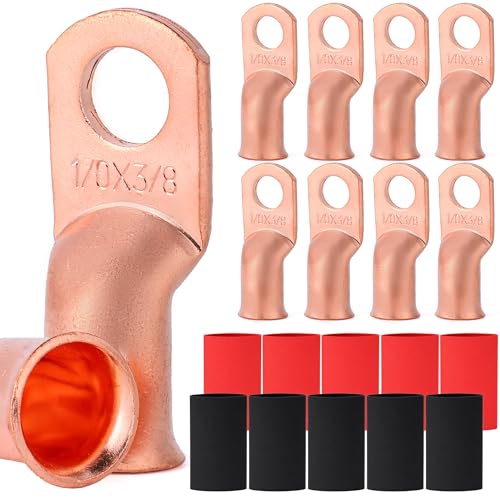
Where the RED WOLF kit leans on flexibility, the TKDMR 1/0 AWG set leans on sealing. Its 4:1 dual-wall adhesive heat shrink tubing has a higher shrink ratio than the 3:1 norm, which grips the insulation more tightly and bonds to the cable jacket when warmed. For high-amperage builds where resistance at the joint matters, that tighter seal translates to less exposed copper over time.
The pack includes ten bare copper ring terminals at the 3/8″ stud size, plus five black and five red shrink tubes. It fits well in a shop drawer for car audio, winch circuits, and inverter feeds on a camper build.
Useful Highlights
- 4:1 adhesive-lined shrink tubing forms a tighter, longer-lasting moisture seal
- Annealed copper core helps maintain low resistance under sustained load
- Color-coded tubes keep polarity straight during reassembly
- Closed-end barrel design simplifies a clean, even crimp with a standard hex tool
Points To Note
- Single stud size only (3/8″), so a 5/16″ project requires a different kit or adapter
- Bare copper, like the RED WOLF option, will oxidize in salty or wet environments without added protection
Who It Suits Best
DIYers running high-amperage 1/0 circuits in a dry engine bay or interior compartment who want a tight adhesive seal at the crimp.
Consider Something Else When
TKDMR’s own marine-grade 4 AWG set suits boaters better, since the tinned surface resists salt corrosion that bare copper cannot handle.
Twenty-five lugs in a single box make the SELTERM 2 AWG kit a shop staple rather than a one-off purchase. For anyone running multiple circuits, building a battery box, or stocking a service vehicle, that quantity removes the awkward moment of running short halfway through a job.
The 3/8″ stud opening covers most automotive and marine bus bar applications, and the heavy-duty bare copper construction handles the constant current that 2 AWG typically carries. SELTERM designs these with OEM-style high-temperature durability in mind.
Key Advantages
- 25-piece count covers a full wiring job with spares left for the next project
- 2 AWG size is a versatile middle-ground gauge for inverters, winches, and accessory runs
- 3/8″ stud fits common bus bars, battery posts, and ground blocks
Trade Offs
- Heat shrink tubing is not included, so that is a separate purchase for anyone wanting sealed joints
- Bare copper calls for dielectric grease in any environment where humidity or salt spray is present
Best Suited To
Shops and serious hobbyists who burn through lugs on multiple builds and want a reliable bulk supply at hand.
Not Your Match When
The SELTERM 25pcs 4 AWG Marine Tinned Copper Lugs make more sense for saltwater projects where the bare copper finish here would pit quickly.
Car audio installers reach for 4 AWG constantly, and the Sanuke set targets exactly that crowd. Each lug is stamped from annealed electrolytic-grade copper, the same stock found in pro-grade wiring kits, rather than copper-clad aluminum that some cheaper lugs use to cut cost.
Ten pieces ship with ten color-coded 3:1 adhesive shrink tubes, enough for a full amplifier install with a power, ground, and remote run. The 3/8″ (M10) stud hole matches most aftermarket distribution blocks and battery posts.
A Few Strong Suits
- Electrolytic-grade copper construction supports clean current flow at amplifier loads
- 3/8″ (M10) stud fits widely used distribution blocks and ground lugs
- Adhesive-lined shrink tubing seals cleanly around typical 4 AWG jacket diameters
Honest Caveats
- 10-piece count is tight for multi-amp builds, so plan ahead or grab a second pack
- 4 AWG only, with no 1/0 or 2 AWG variants in the same box
Feature Snapshot
Made For
Car audio installers and DIYers upgrading accessory circuits with 4 AWG cable who want a true copper lug rather than a copper-clad substitute.
Reach For A Different Pick When
RED WOLF 1/0 Gauge Copper Ring Terminals 12 PCS is the better call for anyone stepping up to a heavy inverter or winch circuit.
Tinned copper changes the equation on any job that touches water, and the TKDMR 4 AWG marine kit leans into that advantage. A thin tin coating over the annealed copper core resists the oxidation that eats bare copper in bilge, deck, and trailer-tongue environments.
Each pack holds ten closed-end lugs with 3/8″ stud openings, plus ten 3:1 adhesive shrink tubes split red and black. The setup covers a small trolling motor rewire or a complete accessory circuit on a pontoon.
Well-Handled Touches
- Tinned surface layer holds up to splash, spray, and humid storage
- Closed-end barrel accepts a clean hex crimp without flaring
- Heat shrink tubing included for a sealed, polarity-marked finish
Room For Improvement
- Not as widely stocked at local shops as bare copper, so replacement parts require online ordering
- 10-piece quantity limits larger multi-circuit jobs without buying a second pack
Whose Shelf It Belongs On
Boat owners and anglers rewiring trolling motors or bilge pumps who want corrosion resistance at every connection point.
Swap It Out When
SELTERM 25pcs 4 AWG Marine Tinned Copper Lugs fits saltwater use cases that demand the larger 25-piece pack and salt-spray testing.
Distribution clamps take a different approach than ring lugs. The Vgate 12-Way unit bolts directly onto a tapered lead-acid post and gives you twelve output points, six 2/0 AWG hole holders and six 8 mm threaded studs, so multiple accessory circuits can land in one spot.
For camper vans, houseboats, and off-grid solar banks, that consolidation matters. The body is machined from 6061 aluminum, which keeps weight low and resists corrosion under the hood or inside a battery box.
Everyday Perks
- Twelve connection points turn one battery post into a tidy distribution hub
- 6061 aluminum body stays light and shrugs off corrosion in marine and RV settings
- Works across 6V, 12V, 24V, 36V, and 48V lead-acid systems for flexibility across builds
- Hole holders and threaded studs accept cable lugs from 8 AWG up to 4/0 (XL) AWG
Practical Considerations
- Designed for tapered SAE top posts only, so flat or JIS pencil post setups need a different clamp
- Adding many conductors in one clamp makes the install tidier but reduces accessibility for troubleshooting later
Feature Snapshot
The Right Fit
Van lifers and off-grid builders running multiple accessory circuits off a single battery bank who want one clean landing point for every cable.
A Better Fit Elsewhere
The Vgate 12-Way Multi-Size Terminal Connector handles SAE/DIN/EN post types for mixed fleet vehicles, which this clamp does not support.
Not every project needs a twelve-way distribution hub. The Vgate clamp pair is the straightforward option for a tapered top post battery where the goal is simply upgrading the stock terminal to handle larger 1/0 welding cable.
It ships as a matched positive and negative set, machined from 6061 aluminum for corrosion resistance and light weight. Forklifts, trucks, motorcycles with oversized cable, and houseboats all fall into its wheelhouse.
Strengths Worth Knowing
- Paired positive and negative set simplifies a full post upgrade in one purchase
- Accepts 1/0 AWG welding cable and oversized 1/0 wire for high-current applications
- Aluminum construction reduces overall weight compared to brass equivalents
Factors To Consider
- Tapered SAE post fitment only, so side-terminal or JIS pencil post batteries need a different clamp
- Output count is limited compared to a multi-way distribution unit
Built With In Mind
Vehicle owners and fleet mechanics upgrading stock terminals on trucks, forklifts, or motorcycles that use 1/0 welding cable.
Where A Sibling Pick Shines
Vgate 12-Way Lead Acid Terminal Clamps is the smarter choice for anyone needing more than a primary connection point on the same battery.
SELTERM’s marine-grade 4 AWG lugs combine two of the most useful traits in this category: a tinned copper finish that shrugs off salt spray, and a 25-piece count that covers a full rewire with spares left over. The 5/16″ stud size pairs naturally with smaller marine bus bars and battery terminals.
OEM-style construction and salt-spray testing put these lugs in the bracket that serious boaters and offshore anglers reach for first.
Practical Advantages
- Tinned copper surface is rated for marine and outdoor exposure
- 5/16″ stud size matches common marine bus bars and terminal blocks
- 25-piece pack supports full-boat rewires without running short
- Annealed copper core keeps resistance low across sustained loads
Worth Bearing In Mind
- Heat shrink tubing is not included, so sealed joints require a separate purchase
- Tinned finish costs slightly more per lug than bare copper alternatives
Perfect Match For
Saltwater boaters and offshore anglers who rewire a full vessel at once and want lugs that survive the environment without constant re-crimping.
Skip It When
TKDMR 10pcs 4 AWG Marine Grade Copper Lugs is the lighter option for a small single-circuit job where a 25-piece pack is overkill.
The Vgate 12-Way Multi-Size connector expands on the standard 12-Way clamp with broader post compatibility. It fits SAE, DIN, and EN tapered top posts, which covers most lead-acid batteries sold globally, while keeping JIS pencil posts as the one exclusion.
Inside the housing you get four hole holders and eight threaded studs in 4mm, 6mm, and 8mm sizes, plus 2 AWG and 2/0 AWG openings. That range handles everything from a delicate accessory feed to a hefty inverter run on the same battery.
Advantages To Know
- SAE, DIN, and EN post compatibility covers most lead-acid batteries worldwide
- Mixed hole holder and stud sizes accept a wide range of cable gauges
- Compatible with AGM, GEL, WET, MF, and CA/CA lead-acid battery types
- Supports solar power banks, RVs, trucks, and motorcycles from one clamp
Possible Compromises
- JIS pencil post batteries require an adapter or a different clamp entirely
- Larger clamp footprint may not fit under tight factory battery covers
Core Details
Who Should Grab It
Fleet operators and DIYers with mixed vehicles who want one clamp that fits whatever lead-acid battery lands on the workbench.
Another Choice May Suit
Vgate 1/0 AWG Battery Terminals Clamp Pair is the cleaner pick for a simple post swap where distribution hardware is unnecessary.
Choosing the Right Battery Connector Terminals for Your Build
Wire gauge sets the starting point, since the wrong size either will not fit or will loosen over time. AWG, which stands for American Wire Gauge, runs from very thin (8 AWG) up through heavy cable (4/0 AWG), and lower numbers mean thicker conductors. A lug stamped for 4 AWG will not crimp cleanly onto 1/0 cable, and forcing it leads to high resistance at the joint.
Stud size matters just as much. Common automotive and marine setups use 5/16″, 3/8″, or 1/2″ studs, and the ring opening on the lug has to match exactly. A loose fit allows the cable to twist, which can crack the copper or fatigue the strands where they enter the barrel.
Material choice comes down to environment. Bare copper offers excellent conductivity for dry engine bays and indoor battery boxes, while tinned copper adds a corrosion-resistant layer for marine and outdoor use. For distribution clamps, machined aluminum keeps weight manageable on larger cable runs.
Insulation and sealing round out the decision. Adhesive-lined heat shrink tubing bonds to the cable jacket when warmed, sealing out the moisture that creeps into a poorly protected joint. For any install near a battery box vent, bilge, or outdoor junction, that sealing step is what separates a connection that lasts years from one that greens over in months.
Key Considerations Across These Picks
Where Shoppers Go Wrong
The most common slip up is matching lug to cable by eye rather than by gauge spec. A lug stamped for 2 AWG cannot safely carry a 4/0 AWG cable, even if it looks like it fits. Always cross-check the AWG marking on the lug against the cable before crimping.
Another trap is assuming all copper is the same. Copper-clad aluminum lugs cost less but carry less current and corrode faster at the joint. For any sustained load, whether an inverter or a winch, pure annealed copper is the safer pick.
What The Higher Tier Buys
Premium pricing on tinned and OEM-approved lugs covers the salt-spray testing, tighter annealing standards, and better plating consistency. For boats, off-grid solar banks, and any cable that lives outdoors, the upgrade pays off in fewer re-crimps. For a dry garage project running short bursts of load, the savings on a bare copper kit can make more sense.
Frequently Asked Questions
What gauge battery connector terminals do I need? Match the lug or clamp to the AWG rating printed on your cable, since a loose fit creates resistance and heat at the joint.
Are tinned copper lugs worth the extra cost? For marine, outdoor, or high-humidity installs, the tin layer dramatically slows corrosion and extends service life compared to bare copper.
Can I use the same terminal for both positive and negative posts? Most ring lugs and multi-way clamps are non-polarized, but heat shrink color-coding helps track polarity during reassembly.
What stud size do I need on my battery post? Most automotive top posts accept 3/8″ studs, while marine and smaller battery posts often use 5/16″; always confirm before ordering.
Do I need heat shrink tubing for battery connections? Adhesive-lined shrink tubing seals the crimp from moisture and strain, and it is strongly recommended for any joint near a battery box or outdoor location.
The Takeaway
The right battery connector terminal comes down to three honest matches: cable gauge to lug size, stud opening to your hardware, and material to the environment the connection lives in. Pick those first, and the rest of the choice follows.
