

I spend a lot of time around 12V and 24V electrical projects, from car audio installs to small solar arrays, and I keep coming back to the same lesson: a tidy bus bar saves hours of troubleshooting later. The right block turns a spaghetti bundle of ring terminals into something I can actually trace, inspect, and service.
If you’re wiring up a boat, RV, overlanding rig, or off-grid setup, a battery bus bar is the central junction where your batteries, alternators, solar controllers, and accessories all meet cleanly. I picked through ten solid options spanning tiny single-stud blocks up to heavy-duty 600A distribution units, so you can match the hardware to the current you’re moving, not the other way around.
The Main Contenders

DAIERTEK 12V Bus Bar 6 x 5/16″ (M8) Terminal Studs Power Distribution Block

DAIERTEK 12V 150A Mini Power Distribution Block 4 x 5/16″ Posts

DaierTek 300A 12V Marine Power Distribution Block 6 x 3/8″ (M10) Studs

IZTOSS 300A 12V Power Distribution Block 4 x 5/16″ Studs
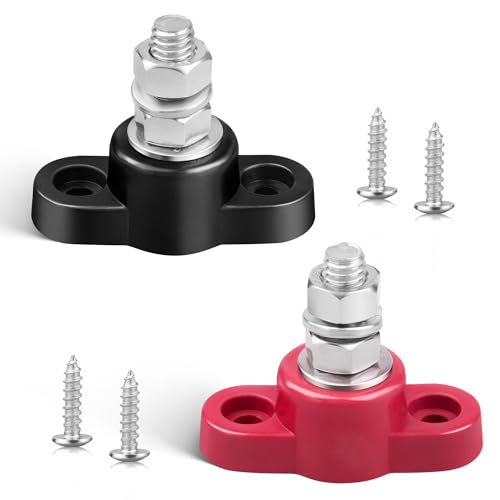
RED WOLF 12V 150A Power Distribution Block 5/16″ Single Stud Busbar

RVBOATPAT 12V 250A Marine Bus Bar 3/8″ Dual Studs with Lugs

RVBOATPAT 400A 12V Power Distribution Block 6 x 5/16″ (M8) Studs

RVBOATPAT 400A 12V Power Distribution Block 4 x M10 Studs and 6 Screws

600A Heavy-Duty Bus Bar (2-Pack) 4 M10 Studs and 8 Screws

RVBOATPAT 250A 12V Marine Bus Bar 2 x 5/16″ Threaded Studs
A Closer Look At Each Pick
This DAIERTEK block is the kind of unit I reach for when a build isn’t extreme but still needs six clean connection points. Six 5/16″ (M8) terminal studs per bar give me room for a battery feed, an alternator lead, a solar controller, and a few accessory circuits without stacking lugs on a single post. The pair ships with a positive (red) and negative (black) bar, which keeps polarity obvious during install.
Rated for 130A AC and 150A DC continuous at up to 48V DC, it covers most mid-sized automotive and solar work. The polycarbonate cover helps keep tools from shorting across posts during service, which is a small detail I appreciate. Compared with the smaller four-post DAIERTEK unit further down this list, this one trades a bit of footprint for noticeably more wiring headroom.
Key Advantages
- Six M8 posts handle several accessory loads without stacking terminals on a single stud
- Polycarbonate cover shields posts from accidental shorts during under-hood or bilge work
- Color-coded red and black pair makes polarity obvious for first-time installers
- 150A DC rating comfortably covers typical alternator, inverter, and solar controller feeds
Points To Note
- 5/16″ studs cap the wire gauge; very large 1/0 or 2/0 lugs may need the M10 variant instead
- Cover adds bulk, so plan mounting depth in shallow compartments
Best Suited To
Garage builders wiring a daily-driver audio upgrade or a small camper solar setup where six circuits per polarity is the sweet spot.
Skip It When
You’re running high-amperage inverter cabling above roughly 150A; the DaierTek 300A 12V Marine Power Distribution Block with M10 studs handles that workload more comfortably.
When the build is small and the space is tighter than I’d like, this mini DAIERTEK block fits where the six-post sibling simply won’t. Four 5/16″ (M8) studs per bar cover a battery feed plus three accessories, which is plenty for a simple auxiliary fuse panel or a compact trolling-motor circuit. The tin-plated copper bar, stainless hardware, and polycarbonate cover mirror the materials used on the bigger DAIERTEK model, just in a smaller envelope.
The 150A continuous DC rating handles mid-sized loads comfortably, and the nylon base insulates the studs from whatever surface you mount it to. Compared with the RED WOLF single-stud pick, this one trades two extra posts per bar for slightly more overall length, but you get a tidier install when feeding multiple accessories.
A Strong Showing
- Compact footprint fits where full-size blocks physically cannot mount
- Tin-plated copper resists corrosion in damp engine bays and bilge areas
- Stainless steel nuts and studs resist rust over years of marine exposure
- Snap-on polycarbonate cover blocks accidental contact during servicing
Trade Offs
- Only four posts per bar, so expansion requires adding a second block sooner
- Cover design may need care when fitting very thick heat-shrunk lugs side by side
Right Fit For
Compact electrical projects like a single-battery auxiliary feed in a small engine bay or a basic trolling-motor distribution point.
Not Your Match When
You need six or more circuits per polarity in a single block; the DAIERTEK 12V Bus Bar 6 x 5/16″ Terminal Studs distribution block handles that without stacking a second unit.
This is the bar I grab when the wire gauges start to feel substantial. Six 3/8″ (M10) terminal studs per bar accept the larger cable lugs that smaller M8 posts simply won’t fit, so 1/0 and 2/0 battery cables terminate cleanly. With a 300A continuous rating at up to 48V DC, it sits comfortably between the lighter DAIERTEK units and the 600A AMOMD flagship.
The red and black pair keeps polarity obvious during install, and the polycarbonate cover gives the same tool-short protection found on smaller DAIERTEK models. Compared with the IZTOSS 300A block, this one trades a sealed enclosure for heavier M10 hardware, which I tend to favor in dry engine bays where corrosion is less of a concern.
Features That Help
- M10 studs accept thick 1/0 and 2/0 lugs that smaller M8 posts reject
- 300A continuous DC rating handles inverter, winch, and large alternator feeds
- Color-coded red and black bars simplify polarity checks during install
- Protective cover reduces the chance of dropped-tool shorts across posts
Honest Caveats
- Heavier copper and larger studs add noticeable weight to the assembly
- Not sealed against water intrusion like the IZTOSS 300A Waterproof Bus bar Box
Key Product Details
Who Will Love This
Anyone running a serious inverter, large alternator, or winch circuit that needs M10 hardware rather than M8.
A Better Fit Elsewhere
The IZTOSS 300A 12V Power Distribution Block is the smarter call for installations exposed to spray and washdown.
The IZTOSS block stands out for one specific reason: the housing is sealed against the elements, which matters a lot on a boat trailer, in an open engine bay, or anywhere water finds its way in. The 7mm thickened copper plate gives it the same 300A continuous rating as the M10 DaierTek unit, while the four 5/16″ (M8) studs keep the overall size manageable.
Stainless steel studs and nuts round out a corrosion-resistant package, and the included cover protects against accidental shorts during service. Against the RVBOATPAT 400A block, this one trades raw post count and current headroom for a genuinely sealed enclosure, which is a fair swap in wet environments.
Strengths Worth Knowing
- Waterproof sealed enclosure handles spray, rain, and bilge moisture confidently
- 7mm copper plate gives a 300A continuous DC rating in a compact body
- Stainless hardware fights galvanic corrosion in salt-air environments
- Cover design shields posts during service work in cramped spaces
Things To Consider
- Only four M8 studs, so adding many accessories still requires a second block
- Sealed cover means slightly slower visual inspection during troubleshooting
Built With In Mind
Boats, RVs, and trailer builds where spray, condensation, or washdown reach the bus bar regularly.
Swap It Out When
You’re building a dry, high-circuit-count setup indoors; the RVBOATPAT 400A 12V Power Distribution Block 6 x 5/16″ gives you more posts in a similar footprint.
The RED WOLF pair takes a minimalist approach: one large 5/16″ (M8) stud per bar, sized to accept a beefy feed lug without forcing multiple thin wires onto the same post. For builds that just need a single clean distribution point, two of these blocks keep the wiring readable. Rated for 150A continuous current at 12V-48V DC, it covers the modest loads of an accessory feed or small inverter.
The trade-off shows up the moment you need more than one branch circuit on a polarity, at which point a multi-stud block becomes the easier choice. Compared with the DAIERTEK Mini block, this one gives you a heavier single termination at the cost of branch flexibility.
What Helps Most
- Single oversized stud accepts large ring lugs without stacking thin ring terminals
- 150A continuous DC rating covers typical accessory and small inverter feeds
- Simple two-block pair keeps wiring layouts easy to trace on inspection
- Useful when you want one dedicated feed point per polarity
Some Limits To Know
- Only one stud per bar means multiple accessory circuits require additional blocks
- Owners commonly report that the cover seal is best treated as splash-resistant rather than fully sealed
Feature Snapshot
Made For
Simple two-circuit setups like a battery feed plus a single accessory, or a primary junction for a small solar array.
Another Choice May Suit
The DAIERTEK Mini 12V 150A Power Distribution Block is the better pick when you need three or four branch circuits on one bar.
This RVBOATPAT kit solves a hassle I see constantly: you buy the bar, then realize you’re still missing the copper lugs to actually terminate your cables. The package ships with two 1/0 AWG lugs and four 6 AWG lugs, so you can hook up a battery feed and several smaller branches straight out of the box. Two 3/8″ (M10) studs per bar handle the heavy feed, while the smaller lugs serve the branches.
Rated for 250A continuous DC at up to 48V, the block handles most mid-sized marine and RV electrical setups comfortably. Compared with the bare DAIERTEK six-post unit, this one gives up some branch count but throws in the lug hardware, which is a fair trade for a first install.
What Works In Its Favor
- Included 1/0 and 6 AWG copper lugs remove a separate trip to the parts store
- 304 stainless steel studs resist corrosion in salt-air marine installs
- 250A continuous DC rating covers typical house-bank and inverter feeds
- Two M10 studs per bar accept large battery cables without stacking
Less Ideal Details
- Only two studs per bar, so accessory-heavy systems need additional distribution blocks
- Cover is functional, not sealed, so damp mounting locations warrant extra care
Feature Overview
Right Fit For
First-time installers who want the bar and the matching lugs in one purchase without sourcing parts separately.
Where Another Pick Suits Better
The RVBOATPAT 250A 12V Bus Bar with 2 x 5/16″ studs is the better fit when you’re working with smaller gauge wire throughout and don’t need M10 hardware.
The 400A continuous DC rating is the headline here, supported by a tinned thickened copper plate that pushes conductivity up and corrosion resistance out. Six 5/16″ (M8) studs per bar give you the same branch capacity as the six-post DAIERTEK unit while handling notably more current. For inverter-driven house banks or large solar arrays, that headroom buys peace of mind.
The pair ships in positive and negative with a protective cover to keep tool drops from bridging posts. Compared with the 600A AMOMD two-pack, this one has fewer secondary screw terminals but offers a more familiar six-post layout for installers who prefer that arrangement.
Bright Spots
- Tinned copper plate raises conductivity and fights oxidation over time
- 400A continuous DC rating handles inverter, alternator, and large solar feeds
- Six M8 posts let you run multiple branches per polarity without stacking
- Protective cover reduces accidental shorts during service work
Things To Weigh
- M8 studs cap the maximum cable gauge; very large 1/0 lugs need the M10 variant
- Owners commonly report that periodic retightening helps maintain low-resistance connections
Who Should Grab It
Builders wiring large inverter-fed systems, sizeable solar arrays, or any rig pushing the limits of a 12V or 24V house bank.
Consider Something Else When
You want a mixed stud plus screw array for varied accessory sizes; the RVBOATPAT 400A 12V Bus Bar with 4 M10 studs and 6 screws is a stronger fit.
This is the bar I look at when my circuit mix runs the gamut from heavy battery feeds down to small accessory leads. Four 3/8″ (M10) terminal studs handle the large-gauge cables, while six #10 screws accept the smaller ring or fork terminals common on lights, pumps, and electronics. That mix saves you from running a second smaller block just to feed accessories.
Backed by an 8mm tinned copper plate, the 400A continuous DC rating at up to 48V DC matches the other RVBOATPAT 400A model reviewed above. Against the six-M8 RVBOATPAT sibling, this one trades two heavy studs for six lighter terminals, which is the smarter layout when accessory count outpaces branch-circuit capacity.
Where It Excels
- Mixed M10 studs and #10 screws handle both heavy feeds and small accessories in one block
- 8mm tinned copper plate keeps voltage drop low across the bar
- 400A continuous DC rating covers inverter and large alternator loads
- Reduces the need for a second accessory-only distribution block
Where It Is Less Suited
- Only four heavy studs, so projects with many large-gauge feeds may want the six-M10 sibling
- More connection points mean more periodic torque checks over the life of the install
Perfect Match For
Mixed-load systems like an RV house bank feeding both inverter loads and a dozen smaller accessory circuits.
Where A Sibling Pick Shines
The RVBOATPAT 400A 12V Bus Bar 6 x 5/16″ studs is the better fit when you need many heavy-gauge terminations and few small accessories.
The AMOMD two-pack is the most ambitious block on this list, rated for 600A of continuous DC current with up to 48V DC or 300V AC headroom. The 128mm by 20mm nickel-plated copper bar sits at the heart of that rating, providing both low resistance and corrosion resistance for harsh environments. Four 3/8″ (M10) studs plus eight M4 screws give you ten terminations per bar, which is more than any other pick here.
The included cover and two-pack format make it a strong fit for larger builds where you want one block near the battery and another near the load center. Against the 400A RVBOATPAT mixed-terminal unit, this one ups both the current ceiling and the termination density at the cost of a larger footprint.
Notable Upsides
- 600A continuous DC rating covers the largest inverter and dual-alternator builds
- Ten terminations per bar reduce the need for additional accessory blocks
- Nickel-plated copper resists corrosion in marine and humid installs
- Two-pack format suits layouts that need separate positive and negative hubs in different spots
Trade-Offs To Consider
- Larger footprint than smaller blocks, so compact builds may struggle to fit it
- Higher current rating may be overkill for typical accessory-only systems
Core Details
Right Fit For
High-output builds running large inverters, dual alternators, or extensive accessory arrays where 600A headroom is genuinely needed.
A Better Fit Elsewhere
Mid-sized projects under 400A don’t need this much overhead; the RVBOATPAT 400A 12V Power Distribution Block 4 x M10 Studs and 6 Screws is the more sensible match.
The final RVBOATPAT unit on this list is a tidy two-stud design that targets routine RV and boat wiring rather than high-output builds. Two 5/16″ (M8) threaded studs per bar, all in 304 stainless steel, take the corrosion resistance up a notch over plated steel hardware. The 250A continuous DC rating at up to 48V covers typical house-bank feeds without overspec.
The pair ships with positive and ground bars plus a protective cover, which keeps the install straightforward. Against the M10 RVBOATPAT kit reviewed earlier, this one gives up the heavier stud size and the included copper lugs in exchange for simpler two-stud hardware that suits lighter gauge wiring throughout.
The Good Stuff
- 304 stainless steel studs fight corrosion in salt-air and humid environments
- 250A continuous DC rating covers typical RV and marine house-bank feeds
- Two-stud layout keeps wiring simple and easy to trace during service
- Color-coded pair simplifies polarity checks during initial install
Factors To Consider
- Only two studs per bar, so accessory-heavy systems need a second distribution block
- Cover is splash-resistant, so fully exposed mounts warrant extra sealing
Who Will Love This
Routine RV and small-boat wiring jobs that need reliable stainless hardware without the larger M10 footprint.
Reach For A Different Pick When
You’re feeding inverter loads with 1/0 or 2/0 cables; the RVBOATPAT 250A Marine Bus Bar with 3/8″ Dual Studs includes matching copper lugs for that scenario.
Choosing the Right Bus Bar for Your Setup
A battery bus bar is essentially a shared electrical node: a copper or tinned-copper strip with threaded studs or screws that lets multiple cables terminate at the same voltage potential without stacking ring terminals on a battery post. That shared-node design matters because stacking terminals leads to poor contact, corrosion between layers, and service headaches every time you need to disconnect one device.
Continuous current rating is the first number to match. Pick a bar rated comfortably above the highest sustained load your system will draw, including the inrush surge of large inverters or winches. A 150A bar covers typical accessory work, while 250A-400A handles most inverter-driven house banks. The 600A AMOMD unit is genuinely useful only when loads regularly push past 400A.
Stud size determines cable compatibility. M8 (5/16″) studs accept standard ring lugs on smaller wire gauges, while M10 (3/8″) studs are needed for 1/0 and 2/0 battery cables. For mixed systems, the RVBOATPAT unit with both M10 studs and #10 screws covers the widest range in a single block.
Material and sealing matter in harsh environments. Tinned or nickel-plated copper resists corrosion better than bare copper, and 304 stainless hardware fights rust in marine and outdoor installs. Sealed enclosures, like the IZTOSS 300A, are the right call for bilge areas, trailer wiring, and any spot exposed to direct spray.
Key Considerations Across These Picks
Traps First Timers Fall Into
The most common mistake is under-sizing the bar for future expansion. A four-post block seems plenty until you add a second accessory panel, an inverter, and a solar controller, then you’re stacking bars anyway. Sizing up one tier from your current count tends to save money later.
Another pitfall is mixing stud sizes without checking lug compatibility. A 1/0 lug won’t seat properly on an M8 stud, and forcing it creates a high-resistance joint that heats up under load. Match the lug to the stud, and confirm both are sized for the cable gauge before tightening.
Where The Extra Money Goes
Higher-tier bars earn their keep through thicker copper plates, higher current ratings, and corrosion-resistant plating. The 600A AMOMD unit, for example, uses a larger nickel-plated copper bar that handles current surges without significant voltage drop. For dry, low-load accessory systems, that overhead is wasted. For inverter-driven marine or off-grid builds, it’s the difference between a system that runs cool and one that runs hot.
Frequently Asked Questions
What size bus bar do I need for my battery bank?
Match the continuous current rating to your highest sustained load, including inverter surge. A 150A bar suits accessory-only systems, while 250A-400A handles most inverter-fed house banks. Sizing up one tier gives you room to expand.
Can I use a bus bar for both positive and negative connections?
Yes, the typical setup uses one bar for positive and a separate bar for negative, often color-coded red and black. Keeping them physically separate reduces the chance of a dropped tool bridging both polarities.
What is the difference between M8 and M10 studs on a bus bar?
M8 (5/16″) studs fit standard ring lugs on smaller wire gauges. M10 (3/8″) studs accept the larger lugs used on 1/0 and 2/0 battery and inverter cables. Choose the stud size based on the heaviest cable you plan to terminate.
Do I need a sealed bus bar for marine use?
In damp, bilge, or spray-exposed locations, a sealed enclosure like the IZTOSS 300A helps prevent corrosion on copper and steel hardware. In dry, protected compartments, an open block with a cover is usually enough.
How many terminals do I need on a bus bar?
Count your current branches and add two for future expansion. Six terminals per polarity is a comfortable starting point for most RV and marine builds, while four works for simple two-or-three-circuit setups.
The Takeaway
The right battery bus bar is the one that matches your current load, your cable gauges, and your environment without forcing compromises on any of the three. For most RV and marine accessory work, a 150A-250A M8 block covers the bases. For inverter-driven systems or large solar arrays, stepping up to 400A or 600A with M10 hardware gives you the headroom you actually need.
Measure twice, tighten to spec, and you’ll spend your time enjoying the build instead of chasing electrical gremlins.
