

A battery backup UPS sits between your gear and the wall, and most people only think about it after the lights flicker. I put together this list for home offices, media setups, and small server rooms where a short outage can mean lost work or rebooted gear. The picks below cover everyday desktop protection, active-PFC friendly sine wave models, compact standby units, rackmount options, and a couple of practical add-ons. I’ve grouped them by what they actually do well, with honest trade-offs so you can match capacity to your setup.
An Overview Of The Picks

CyberPower CP1500AVRLCD3 Intelligent LCD UPS
CyberPower CP1500PFCLCD PFC Sinewave UPS

CyberPower EC850LCD Ecologic UPS
Oeveo UPS Wall Mount 143

CyberPower ST425 Standby UPS

CyberPower ST625U Standby UPS

APC APCRBC123 Replacement Battery

CyberPower CP2000PFCRM2U Rackmount UPS

CyberPower OR500LCDRM1U 1U Rackmount UPS

CyberPower CP1500PFCRM2U Rackmount UPS
The Strengths Of Each Pick
The CP1500AVRLCD3 sits in that sweet spot where capacity meets usability. As a mini-tower unit with line-interactive topology, it adds Automatic Voltage Regulation (AVR), meaning it smooths out brownouts and small spikes without burning battery life on every wobble. That matters in older homes or rural areas where the power quality is unpredictable.
The color LCD on the front shows real-time load, battery level, and event logs, so you can diagnose problems without installing software. For a home office running a desktop, monitor, and networking gear, this gives breathing room to save work and shut down cleanly.
A Strong Showing
- LCD panel replaces guesswork with at-a-glance stats
- AVR protects connected gear without draining the battery
- Enough outlets for a full desk setup with accessories
- Tower shape drops neatly next to a PC or printer
- Line-interactive design balances protection and battery life
Honest Caveats
- Simulated sine wave output can bother some active PFC power supplies
- Tower footprint needs floor or shelf space
- Battery is sealed lead-acid, so owners commonly report a 3 to 5 year replacement cycle
Who It Suits Best
Anyone running a home office desktop, monitor, and router who wants clear status readouts and reliable AVR smoothing.
Skip It When
Your workstation uses active PFC power supplies; in that case the CyberPower CP1500PFCLCD PFC Sinewave UPS is the cleaner match.
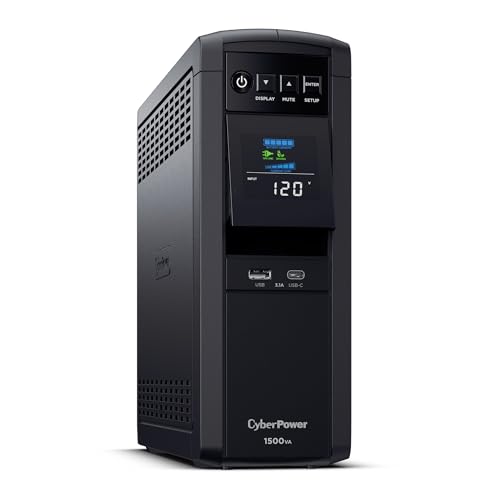
The CP1500PFCLCD takes the CP1500AVRLCD3’s foundation and swaps simulated sine wave output for true sine wave, which is what modern PCs with active power factor correction (PFC) actually want. Active PFC is a feature in many energy-efficient power supplies that shapes how the unit draws current. Simulated sine wave UPS units sometimes cause those PSUs to chatter, click, or shut down unexpectedly during a switchover.
The color multifunction display keeps the same friendly diagnostics as the AVR sibling, and the mini-tower shell still fits under a desk. Anyone with a recent gaming rig, workstation, or pro desktop will see cleaner handoffs during outages.
Benefits That Matter
- Pure sine wave output plays nicely with active PFC hardware
- AVR smooths small fluctuations before they hit the battery
- LCD confirms load and battery status in real time
- Mini-tower shape fits next to standard PC cases
Points To Note
- Costs more than the simulated sine wave equivalent for the same VA rating
- Battery is the same sealed lead-acid type, so expect periodic swaps
- Fan runs more often during heavy loads, depending on your environment
Feature Snapshot
Right Fit For
Users with modern PCs, workstations, or audio gear running active PFC power supplies who need clean switchover behavior.
Look Elsewhere When
You only need to protect a router and modem; the CyberPower ST425 Standby UPS handles that workload at a smaller scale.
The EC850LCD takes a different angle from the larger CP-series towers. It’s a compact standby UPS, so it only switches to battery when the wall power actually fails, and it has an Ecologic mode that shuts off peripherals when your computer sleeps. Over a year of idle hours, that can noticeably cut phantom draw.
The LCD readout is smaller than the bigger siblings, but the unit still shows input voltage, battery capacity, and load. For a single desktop, monitor, and cable modem, this is a tidy fit.
The Good Stuff
- Ecologic mode reduces wasted standby power
- LCD keeps the basics visible without software
- Compact shell slips onto a shelf or small desk
- Simulated sine wave is fine for most non-PFC desktops
Things To Consider
- Simulated sine wave is not ideal for active PFC supplies
- Standby topology means no AVR smoothing during brownouts
- Smaller VA rating, so heavy multi-monitor setups will drain it fast
Best Suited To
Energy-conscious shoppers protecting a single PC, monitor, and networking gear in a home or dorm setting.
A Better Fit Elsewhere
Your setup includes active PFC hardware; the CyberPower CP1500PFCLCD PFC Sinewave UPS handles that cleanly.
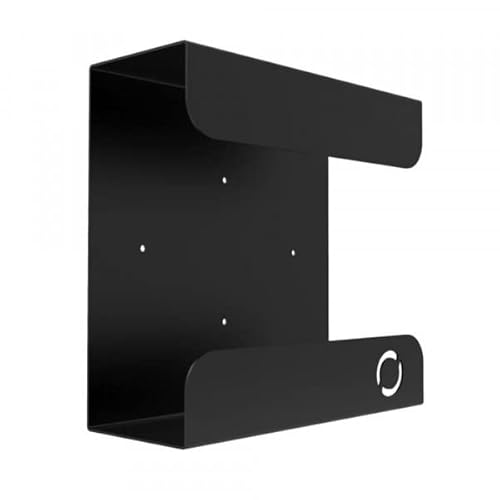
UPS units are heavy, oddly shaped, and tend to live on the floor where they collect dust. The Oeveo UPS Wall Mount 143 is a simple steel bracket that gets the box off the ground and onto a wall stud. It’s compatible with common APC and CyberPower footprints, and the flat black powder coat finish blends into utility spaces.
Mounting hardware comes in the box, and the bracket holds up to 70 lbs, which covers most mid-sized tower UPS models. For a garage, basement, or wiring closet, this is one of those small upgrades that makes daily life cleaner.
A Few Strong Suits
- 70 lb weight capacity covers most tower UPS units
- Flat black finish hides scuffs and dust
- Compatible with popular APC and CyberPower models
- Mounting hardware included out of the box
Room For Improvement
- Single-unit mount; multi-packs cost more
- Requires wall studs or solid backing for safe installation
Feature Rundown
Whose Shelf It Belongs On
Homeowners and shop owners who want their UPS off the floor and out from underfoot in a garage or utility room.
Reach For A Different Pick When
You actually need battery backup itself; the CyberPower ST625U Standby UPS adds power protection at a similar small-footprint scale.
The ST425 is the kind of UPS most people picture when they hear “battery backup.” It’s a small standby unit (meaning it waits for an outage before kicking in), aimed at routers, modems, and entry-level desktops. Plug it in, connect your gear, and forget about it.
It’s a sensible match for internet-only setups where the goal is keeping the Wi-Fi alive through short blips, or letting a basic PC shut down cleanly. No LCD, no AVR, no sine wave debate, just simple surge protection and battery handoff.
What Helps Most
- Compact size fits on a shelf or behind a desk
- Straightforward plug-and-play setup
- Enough runtime to save work and shut down
- Surge protection for lightning and grid events
Honest Caveats
- No AVR, so brownouts pass straight through to your gear
- Simulated sine wave is not a fit for active PFC hardware
- Smaller VA rating means heavy loads drain it quickly
Built With In Mind
Anyone protecting a cable modem, router, and entry-level PC from short outages and surge events.
Not Your Match When
You want status readouts or AVR smoothing; the CyberPower CP1500AVRLCD3 Intelligent LCD UPS covers both.
The ST625U is essentially the ST425’s bigger sibling, with a slightly higher VA rating and a USB charging port on the front. That front port is more useful than it sounds, because it lets you top off a phone during an outage without burning one of the rear outlets.
It still uses standby topology and simulated sine wave output, so it’s best for simpler electronics rather than active PFC workstations. For a dorm, small apartment, or bedside setup, it’s an easy recommendation.
Strong Points
- Front USB port adds convenience during outages
- Compact footprint for tight desks
- Higher VA than the ST425 for slightly longer runtime
- Surge and battery protection in one unit
Points To Note
- Simulated sine wave limits compatibility with active PFC supplies
- No AVR for brownout protection
Feature Snapshot
Who Will Love This
Students, apartment dwellers, and anyone protecting a simple entertainment or work-from-home setup in a small space.
Where A Sibling Pick Shines
You need active PFC support; the CyberPower CP1500PFCLCD PFC Sinewave UPS is purpose-built for that.
Every UPS has a battery that eventually wears out, and the APCRBC123 is APC’s own replacement cartridge for SMT750RM2UC and BX1350M units. Sealed lead-acid UPS batteries (the most common UPS battery type, often called VRLA for valve-regulated lead-acid) typically last 3 to 5 years depending on heat and discharge cycles.
Swapping in a genuine APC cartridge is the cleanest way to bring an existing unit back to its original runtime and protection behavior. Off-brand cells sometimes fit, but the smart battery communication that APC relies on is happiest with a genuine cartridge.
Points In Its Favor
- APC-branded for proper communication with the host UPS
- Restores the unit to factory runtime specs
- VRLA sealed design requires no maintenance
- Known fitment for SMT750RM2UC and BX1350M models
Worth Noting
- Only fits specific APC models, not a universal replacement
- Old battery must be recycled properly
Feature Rundown
Perfect Match For
Owners of an aging APC SMT750RM2UC or BX1350M who want to restore runtime without replacing the whole UPS.
Swap It Out When
You don’t already own a compatible APC unit; in that case start fresh with a CyberPower CP1500AVRLCD3 Intelligent LCD UPS.
The CP2000PFCRM2U moves up the ladder into rackmount territory with a 2U form factor (meaning it takes up 2 rack units, roughly 3.5 inches of vertical space in a standard 19-inch rack). It pairs true sine wave output with Automatic Voltage Regulation, which makes it well suited to security systems, A/V components, and networking gear that uses active PFC supplies.
For a homelab, a small server closet, or a wall-mounted rack in an office, this gives the kind of headroom that a tower UPS can’t. You get AVR smoothing, EMI/RFI noise filtering (which blocks electromagnetic and radio-frequency interference from creeping into sensitive audio or network gear), and rack-friendly mounting.
Everyday Perks
- Pure sine wave output for active PFC hardware
- AVR corrects minor fluctuations without using battery
- EMI/RFI filtering helps sensitive A/V and network gear
- 2U rackmount design fits standard 19-inch racks
Less Ideal Details
- Higher capacity comes with a heavier chassis and louder cooling
- Rack ears or shelf required for proper mounting
Made For
IT pros and A/V integrators running security, networking, or audio gear in a rack that needs true sine wave protection.
Consider Something Else When
Your load is light and 1U is enough; the CyberPower OR500LCDRM1U Smart App LCD UPS fits that niche at a lower capacity point.
The OR500LCDRM1U slides into just 1U of rack space, which matters when your rack is already crowded with switches, patch panels, and a small server. It uses line-interactive topology with simulated sine wave output, plus AVR to keep small voltage swings from reaching your gear.
The LCD and Smart App connectivity make remote monitoring straightforward in a wiring closet where you don’t want to climb behind the rack to check status. For non-PFC department servers, workstations, and network gear, it does the job without taking up extra rack units.
What It Does Well
- 1U form factor leaves room for switches and patch panels
- AVR smooths brownouts and small surges
- LCD provides status at a glance
- Smart App support helps with remote monitoring
Things To Weigh
- Simulated sine wave is not ideal for active PFC supplies
- 500 VA rating is on the lighter side for larger servers
Feature Card
The Right Fit
Network admins and homelab owners protecting switches, routers, and small servers in a packed 1U-friendly rack.
Wrong Turns To Avoid
You need active PFC support or higher capacity; the CyberPower CP1500PFCRM2U PFC Sinewave UPS covers both with a true sine wave output.
The CP1500PFCRM2U brings true sine wave output and AVR into a 2U rackmount body, making it a flexible middle-ground option for mixed racks with audio, security, and networking gear. Compared with the smaller OR500LCDRM1U, you get the active-PFC-friendly output and a notably higher capacity.
For homelab racks that combine a switch, a small NAS, and a security NVR, this is a sensible step up without jumping to a heavy 2000 VA unit. The EMI/RFI filtering adds a layer of protection for analog audio gear that picks up noise easily.
Useful Highlights
- Pure sine wave output for active PFC hardware
- AVR for minor voltage swings
- EMI/RFI noise filtering for sensitive gear
- 2U rackmount fits most standard racks
Trade Offs
- Heavier than 1U alternatives
- Rack ears or shelf required for safe mounting
Who Should Grab It
Homelab owners and small-office IT folks running mixed gear that needs true sine wave protection in a single rack-friendly unit.
Where Another Pick Suits Better
You don’t actually need a rack form factor; the CyberPower CP1500PFCLCD PFC Sinewave UPS offers the same sine wave behavior in a tower.
What To Weigh Before Choosing A Battery Backup Ups
A UPS is only as useful as the match between its capacity and your load. Start by adding up the watts your gear actually draws at typical use, then pick a UPS rated comfortably above that number. Running a UPS at 80% or higher of its rating shortens battery life and runtime, while leaving too much headroom means you paid for capacity you don’t use.
Next, think about waveform. Pure sine wave output (a smooth, rounded alternating current, the same shape the grid delivers) is the safest match for any active PFC power supply and for sensitive audio gear. Simulated sine wave is fine for older desktops, routers, and basic electronics, but it can produce audible buzz or unexpected shutdowns on newer PFC hardware.
Then look at topology. Standby units are simple and affordable, kicking in only during an outage. Line-interactive UPS units add AVR, which is a circuit that nudges low or high voltage back toward normal without draining the battery. For most homes and small offices, AVR is the meaningful upgrade, and it costs less than jumping to online double-conversion UPS systems (which regenerate power continuously, ideal for data centers and medical gear but usually overkill for home setups).
Finally, consider runtime and form factor. A small standby UPS might give a router 30 to 60 minutes; a 1500 VA line-interactive unit can power a desktop and monitor for 5 to 10 minutes, which is usually enough to save work and shut down cleanly. Tower UPS units fit under desks, while rackmount models slide into server racks using 1U or 2U of vertical space.
Key Considerations Across These Picks
Mistakes Worth Dodging
The most common slip-up is sizing by outlet count instead of by load. A UPS with 8 outlets doesn’t help if its VA rating is too small for the gear you plug in. Another trap is ignoring waveform compatibility; plugging an active PFC workstation into a simulated sine wave UPS can cause the PSU to drop out the moment the unit switches to battery.
A third pitfall is forgetting that UPS batteries wear out. Sealed lead-acid cells typically last 3 to 5 years depending on temperature and discharge cycles, so a replacement plan matters, especially for critical gear. Skipping the AVR feature to save a few dollars is also tempting, but it leaves your gear exposed to brownouts that won’t trigger battery mode but still stress hardware over time.
When Paying More Pays Off
Higher-tier models in this category generally add three things: pure sine wave output, AVR, and larger battery capacity. Pure sine wave is worth the upgrade for any active PFC power supply, and AVR is worth it anywhere the grid is flaky. Larger capacity matters when the goal is more than just a graceful shutdown, for example keeping a NAS or security system alive through a multi-hour outage.
The upgrade also tends to buy quieter cooling, more outlet spacing for bulky plugs, and LCD or app-based monitoring, all of which make ownership easier day to day. For most shoppers, the middle tier is the sweet spot: pure sine wave plus AVR in a 1500 VA class unit is enough for a full home office, and it scales nicely when the rest of the rack comes along.
Frequently Asked Questions
How long will a UPS keep my desktop running during an outage?
It depends on the load. A typical 1500 VA line-interactive UPS will power a desktop, monitor, and small accessories for roughly 5 to 10 minutes at full draw. That’s enough to save work and shut down, not enough to keep working through a long outage.
Do I really need pure sine wave for my PC?
If your power supply is active PFC, yes. Active PFC supplies expect a smooth waveform, and simulated sine wave UPS units can cause them to click or shut off unexpectedly during switchover. For non-PFC gear, simulated sine wave is fine.
What’s the difference between standby and line-interactive topology?
Standby UPS units only kick in during an actual outage. Line-interactive units add AVR, which is a circuit that corrects small voltage swings before they reach battery mode. AVR matters in areas with brownouts or fluctuating voltage, because it protects gear without wearing down the battery.
How often do UPS batteries need to be replaced?
Most sealed lead-acid UPS batteries last 3 to 5 years depending on heat, discharge depth, and how often the unit cycles. Higher temperatures and frequent full discharges shorten that window, so a cool, ventilated location helps.
Can a UPS protect against lightning strikes?
It can help with surges and smaller spikes, but a direct lightning hit is beyond what any consumer UPS is designed to handle. For full lightning protection, you also want a whole-home surge protector at the electrical panel.
Final Verdict
The right battery backup UPS depends on what you’re protecting and where it lives. Home offices with modern PCs do well with the CyberPower CP1500PFCLCD for its pure sine wave output, while simple router and modem setups are happier with the CyberPower ST425 or ST625U. Rack-based systems call for the OR500LCDRM1U, CP1500PFCRM2U, or CP2000PFCRM2U depending on capacity and sine wave needs, and a wall mount from Oeveo keeps the unit off the floor. Pick the unit that matches your gear, give it some headroom, and you’ve covered the most common cause of lost work at home.
