

Propane gas generators make sense when you want backup power that feels less fussy than a gasoline-only setup. You get a cleaner storage story, easier fuel swapping on dual-fuel models, and a practical way to keep a fridge, lights, or RV essentials running during outages or weekend trips. The right pick depends on how much wattage you need, how portable the unit must be, and whether remote start or transfer-switch readiness matters in your routine.
Quick Look At The Shortlist

Westinghouse 2550 Peak Watt Portable Inverter Generator

Westinghouse 4000 Peak Watt Dual Fuel Portable Inverter Generator

Oxseryn Power Equipment 4400 Watts Inverter Generator

AIVOLT 4300W Dual Fuel Inverter Generator

DuroMax XP13000HXT 13,000-Watt 500cc Tri Fuel Portable Generator

Westinghouse 4650 Peak Watt Dual Fuel Portable Generator

DuroStar DS13000MX 13,000-Watt 500cc Dual Fuel Portable Generator
Westinghouse 4650 Peak Watt Dual Fuel Portable Generator
More Details On Our Top Picks
For camping, tailgates, and lighter emergency needs, this Westinghouse sits in a very approachable zone. The inverter design means the engine output is conditioned into steadier household-style power, which matters when you’re feeding sensitive electronics or a small RV setup. The 30A RV outlet helps it fit cleaner into travel use, while the compact build keeps storage less awkward than a full-size standby unit.
The trade-off is obvious: 2550 peak watts suits modest loads, not whole-home coverage. That makes it a smart match for people who want a portable propane-capable unit without hauling around extra bulk they’ll rarely use. It feels like the most straightforward entry point in this group, especially beside the larger Westinghouse and DuroMax models.
Strong Points
- Small enough for easier loading and storage.
- Inverter output suits electronics and RV essentials.
- 30A RV outlet supports travel-focused use.
- Dual-fuel flexibility broadens fuel planning.
Things To Consider
- Output ceiling fits lighter household loads.
- You may outgrow it fast in a larger home.
- Portable gear still needs routine cleaning and dry storage.
Feature Snapshot
Who It Suits Best
Travelers, weekend campers, and apartment dwellers with limited storage space will get the most from this size.
Where A Sibling Pick Shines
Westinghouse 4000 Peak Watt Dual Fuel Portable Inverter Generator suits you better for remote-start convenience and a stronger buffer for home backup.
Remote electric start pushes this Westinghouse into a more convenient tier than the smaller 2550-watt model. That matters in a driveway, at a cabin, or during a storm night when you’d rather skip extra pulling and get power going with less hassle. The dual-fuel setup also gives you propane flexibility without forcing you to give up gasoline backup.
Compared with Item 1, this one gives you more breathing room for larger essentials while staying portable enough for regular handling. The CO sensor and RV-ready framing make it feel purpose-built for mixed home and travel use, though it still stops well short of a heavy backup machine. For many households, that middle-ground size is the sweet spot.
What We Like
- Remote start saves a step during rough weather.
- Dual-fuel setup gives you fuel flexibility.
- RV-ready layout suits camping and backup use.
- Inverter design helps with sensitive devices.
- Better output cushion than the 2550-watt model.
Worth Noting
- Still not built for a whole-house load.
- Remote systems add one more feature to maintain.
- Weight and size call for sensible storage space.
At A Glance
Built With In Mind
It suits you best for cabin backup, RV travel, and home use where remote start matters.
Look Elsewhere When
DuroMax XP13000HXT 13,000-Watt 500cc Tri Fuel Portable Generator fits you better for larger homes that need much more output.
The Oxseryn takes a different path from the inverter-style Westinghouse units, with an open-frame layout that usually appeals to people who care more about straightforward utility than compact storage. ECO mode, which trims engine output to match lighter demand, helps reduce unnecessary strain during smaller loads. In a garage, workshop, or backup role, that combination makes sense for people who want usable power without a lot of extra polish.
The honest read is that open-frame generators tend to feel less refined than enclosed inverter models, especially near a patio or camp area. Still, the 4400-watt class gives you a useful middle ground for outages and home support, and it stands apart from Item 1 by aiming less at quiet travel and more at simple output. That makes it a sensible value-minded choice for practical setups.
Upsides
- Open-frame design keeps the structure straightforward.
- ECO mode can ease fuel use at lighter loads.
- Good fit for backup and workshop roles.
- 4400 watts offers more room than small travel units.
Minor Gripes
- Open-frame style usually brings more noise exposure.
- Less travel-friendly than enclosed inverter picks.
- Outdoor storage and cleaning need regular attention.
Core Details
Who Will Love This
You’ll like this most for garage backup, jobsite support, or a utility-first home setup.
Swap It Out When
Westinghouse 4000 Peak Watt Dual Fuel Portable Inverter Generator suits you better for quieter use and fuel flexibility.
This AIVOLT aims squarely at mixed-use households that want quieter operation and easier handling. The wheels kit helps once the generator is in motion, and the remote or electric start setup makes it friendlier than pull-only designs for storm prep or campsite mornings. Its propane runtime figure is especially relevant for people who plan longer stretches away from a gas station.
Compared with the smaller Westinghouse units, you get a more mobility-minded package here, though the 64-lb figure still means you’ll want a clear path and a sensible storage spot. CO auto-shutoff and parallel readiness round out the feature set, so it fits a family garage, camper, or backup corner without feeling bare-bones. The trade-off is that more features usually means a bit more to keep track of.
Bright Spots
- Quietness level is suited to camps and neighborhoods.
- Remote and electric start make startup easier.
- Wheels help with rolling storage and repositioning.
- Propane runtime supports longer off-grid stretches.
- Parallel-ready design leaves room to expand later.
Small Caveats
- Weight still calls for careful moving.
- More features can mean more upkeep.
- Parallel use depends on compatible gear.
Details At A Glance
Best Suited To
You’ll get the most from this one in RV sites, home backup corners, and family camping setups.
Another Choice May Suit
Westinghouse 2550 Peak Watt Portable Inverter Generator fits you better for lighter hauling and simpler storage.
This DuroMax is aimed at serious backup needs, not casual patio power. The tri-fuel design matters because propane, gasoline, and natural gas each bring a different storage or hookup advantage, so you can work around what’s available during an outage. In a larger home, that flexibility can feel less like a feature and more like the whole point.
Compared with the 4000-watt and 4300-watt picks, this one lives in a much heavier duty tier, and the trade-off is size, weight, and setup complexity. A CO alert is included, which is useful in a practical sense, but this still belongs in a setup where you’re prepared to manage a larger machine. It’s a strong fit for people who want to think bigger than travel use and RV-only support.
Reasons To Buy
- Tri-fuel flexibility gives you more fuel paths.
- Very high output suits large backup demands.
- CO alert adds a useful safety cue.
- Better fit for multi-appliance home coverage.
Points To Note
- Large machines take more floor space.
- Setup and fueling are less casual than smaller units.
- Routine upkeep matters more with a bigger engine.
Technical Sheet
Whose Shelf It Belongs On
You should look here for whole-home backup planning, larger properties, and users comfortable with a bigger generator.
Skip It When
Westinghouse 4650 Peak Watt Dual Fuel Portable Generator fits you better for simpler handling and lower footprint.
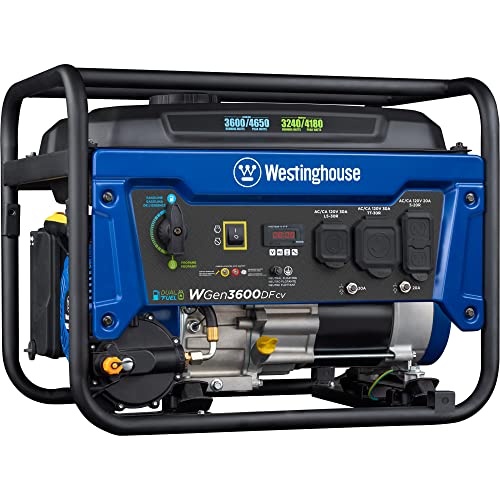
This Westinghouse lands in a practical middle zone for households that want a manageable generator with a few helpful comforts. Remote electric start and auto choke reduce the friction around startup, which is handy in cold weather or during a hurried outage. The 30A RV outlet adds flexibility, so the same unit can cover travel duty and home essentials without feeling overbuilt.
Its trade-off is familiar: you gain convenience and dual-fuel flexibility, but you do not get the huge output of the DuroMax 13,000-watt machines. That makes it a calmer choice for people who want steady support for appliances and basics rather than a large-scale backup system. The CO sensor is a sensible extra, especially for users who value simple protection cues.
Highlights
- Remote electric start keeps startup easy.
- Auto choke helps with colder starts.
- RV-ready outlet expands use beyond home backup.
- Dual-fuel setup gives you fuel flexibility.
- Mid-size footprint suits garages and sheds.
Softer Spots
- Doesn’t match the output of larger units.
- Storage still needs room in a garage or shed.
- Portable generators need regular maintenance habits.
Feature Rundown
Right Fit For
You’ll appreciate this most for routine outages, camper use, and households that want easy startup.
Reach For A Different Pick When
DuroStar DS13000MX 13,000-Watt 500cc Dual Fuel Portable Generator suits you better for transfer-switch planning and larger backup loads.
Transfer-switch readiness puts this DuroStar in a more serious home-backup lane than the smaller portable picks. That matters for households that want a generator to integrate into a planned outage setup instead of sitting on the sidelines as a temporary power source. Remote electric start also helps reduce friction, especially when bad weather already makes everything else more annoying.
Compared with Item 5’s tri-fuel flexibility, this model keeps to dual-fuel power but still serves a much larger role than the mid-size Westinghouse units. The practical trade-off is that bigger capacity usually means more machine to store, maintain, and move, so it suits committed backup planning more than casual weekend use. For that use case, though, it feels very well aligned.
Best Bits
- Transfer-switch readiness supports planned home backup.
- Remote electric start keeps use simpler.
- Large output suits more demanding households.
- Dual-fuel support gives you fuel flexibility.
Areas To Watch
- Large backup units need ample storage room.
- Heavier hardware takes more effort to position.
- Regular maintenance matters with this much engine capacity.
Core Details
The Right Fit
You’re looking at this for serious outage planning, transfer-switch setups, and larger properties.
Where Shoppers Go Wrong
Westinghouse 4650 Peak Watt Dual Fuel Portable Generator fits better when you want a smaller, easier-to-handle machine.
This Westinghouse keeps the same useful 4650-watt class but strips the setup down a bit, which can be a nice thing in a garage or RV compartment. The 30A outlet gives you the travel connection you want, while the CO sensor adds a meaningful layer of awareness for everyday use. For people who value a cleaner, simpler layout, that restraint is part of the appeal.
Compared with Item 6, you lose remote electric start and auto choke, so startup takes a little more direct effort. The upside is a more straightforward package that still covers a wide range of practical outage and travel needs. It sits between the compact 2550-watt option and the heavier 13,000-watt machines in a way that feels easy to understand.
Positives
- Balanced size for home and RV use.
- 30A outlet supports common travel hookups.
- CO sensor adds useful safety awareness.
- Less complex than remote-start models.
Room For Improvement
- No remote start here.
- Manual startup asks for a little more effort.
- Regular fuel and storage upkeep still apply.
Quick Facts
Who Should Grab It
You’ll like this most for balanced home backup, RV use, and simple operation.
Skip It When
Westinghouse 4650 Peak Watt Dual Fuel Portable Generator with remote electric start fits you better if startup convenience matters most.
How To Choose The Right Propane Gas Generators
Match Output To Real Loads
Start with the appliances and devices you actually want to keep running. A 2550-watt unit can cover lighter travel needs, while the 13,000-watt machines are built for far larger home backup plans.
Peak watts tell you about startup headroom, while running needs are about what stays on after the motor starts. That difference matters because a fridge, sump pump, or air conditioner can ask for more at startup than during steady operation.
Choose the smallest unit that still leaves breathing room, since oversized gear usually brings more weight and storage burden. That’s where the middle class of 4000 to 4650 watts often feels useful for typical households.
Decide How Much Convenience You Want
Remote electric start, auto choke, and wheels are not small comforts when the generator sits in a shed or garage. They help most during storms, late arrivals, or campsite setups where you want less effort before the power comes on.
Propane and dual-fuel layouts also change the experience because fuel storage gets easier to manage. Propane stores differently from gasoline, and tri-fuel adds natural gas into the mix for homes with that connection already in place.
The catch is that every extra convenience feature adds something to maintain, inspect, or learn. If you want the simplest routine, a stripped-down model can feel calmer day to day.
Check The Fit For Home, RV, Or Work Use
RV-ready 30A outlets matter for campers because they let the generator plug into a travel setup more cleanly. Transfer-switch readiness matters for homes that want a planned backup connection rather than a loose extension-cord setup.
Open-frame models tend to suit utility-first spaces like garages and worksites, while enclosed inverter styles feel more appropriate near campsites or neighborhoods. Noise level matters too, especially around close quarters, so a quieter unit can be worth the extra thought.
Think about storage just as seriously as output. A generator that fits your floor space, lifting ability, and maintenance routine will usually feel better after the first season than a bigger unit that only looks stronger on paper.
Things Worth Knowing First
Mistakes Worth Dodging
Many people size up from the wrong starting point and end up with a generator that is awkward to move and larger than needed. A better approach is to list the devices you plan to power, then choose from there.
Another common miss is overlooking start style. Remote start and electric start reduce hassle, while pull-start units keep things simpler but ask a little more from you.
The Upgrade Payoff
Higher-tier models usually cost more because they bring stronger output, easier startup features, better mobility hardware, and broader fuel flexibility. In this category, those upgrades show up fast during storm prep, long RV stays, and larger household outages.
Paying up makes sense when the generator will carry more than basics. It also makes sense when your setup depends on transfer-switch integration, natural gas compatibility, or long runtime on propane.
Frequently Asked Questions
What size propane gas generator works for a home?
A small house can often get by with a mid-size unit, while larger homes need much more output. The right size depends on the appliances you want to keep on, not just the home’s square footage.
Is dual-fuel better than gas only?
Dual-fuel gives you more flexibility because you can switch between gasoline and propane. That helps a lot during storage planning or outages, though it also adds another system to maintain.
Are inverter generators worth it for camping?
Yes, especially around electronics, RV hookups, and tighter camping areas. Inverter models usually suit quieter, more stable power needs better than open-frame units.
Do you need remote start on a generator?
Remote start is not required, but it’s a real convenience in rough weather or when the unit sits farther from the house. It matters most for people who value easier startup over a lower-feature layout.
What is a CO sensor on a generator?
A CO sensor is a built-in feature that watches for carbon monoxide conditions and can trigger shutdown behavior. It’s a useful safety-related feature, especially for home backup and RV use.
Closing Thoughts
The best propane gas generator for you comes down to how much power you need, how often you’ll move it, and how much startup convenience matters in real life. The compact Westinghouse works well for travel and lighter backup, while the DuroMax and DuroStar models step into serious home coverage. For most households, the middle-size Westinghouse and AIVOLT units strike the nicest balance between portability and useful output. Choose the one that fits your space and routine, and the rest tends to follow naturally.
