

A tangled nest of extension cords behind a workbench is annoying. A power strip that pops every time the saw kicks on is worse. The right wall-mounted surge protector quietly fixes both, giving tools and home-office gear a safe, organized place to plug in. I pulled together ten options that balance outlet count, cord length, and surge protection for real shops, garages, and entertainment centers.
The Lineup, Simplified

CCCEI 12 Gauge Extension Cord with Multiple Outlets, 50FT

CCCEI 12 Gauge Extension Cord with Multiple Outlets, 100FT

CCCEI Heavy Duty Surge Protector with USB Ports, 6FT

NANOLAKE Surge Protector Power Strip 18 Outlets, 4800J

CCCEI Magnetic Heavy Duty Surge Protector, Orange, 6FT

CCCEI 12 Gauge Heavy Duty Power Strip with GFCI, 8 Ports
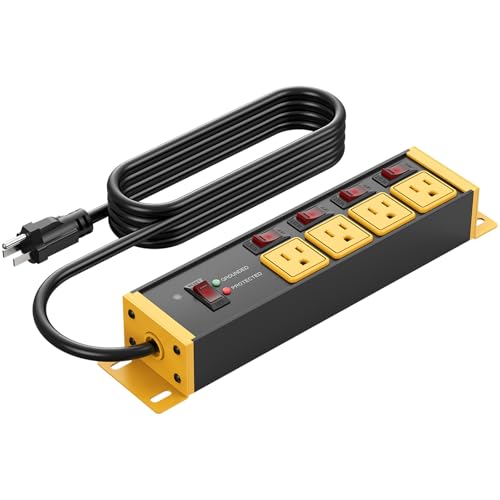
CCCEI 12 Gauge Heavy Duty Surge Protector, Yellow, 6FT

CCCEI 2-Pack 12 Gauge Heavy Duty Power Strip, 8 Ports

Amazon Basics 16-Outlet Metal Surge Protector, 600J
CCCEI Heavy Duty GFCI Surge Protector with Individual Switches
Inside Each Recommended Option
Fifty feet of reach is the sweet spot for most two-car garages. The CCCEI 12 Gauge extension cord handles that distance without throttling power, using a thick 12-gauge wire that stays cool even when a table saw and dust collector share the same circuit. The flat 3-prong plug sits flush against the wall, so furniture or shelving can sit close without bending the cord sharply.
Eight outlets line up along the strip, paired with a single master switch and a built-in circuit breaker. Overload protection cuts power automatically if the combined draw climbs past the rated capacity. You may find the master-only switch limiting if you prefer per-outlet control, which is where other picks in this list step in.
Useful Strengths
- 50-foot reach covers most standard garages without an extra extension
- 12-gauge wire keeps voltage steady under heavy tool loads
- Flat plug sits close to the wall for tight outlet spaces
- Eight outlets handle a typical shop’s tool cluster
- Circuit breaker trips automatically under overload
Points To Note
- Single master switch means every outlet powers on together
- Yellow cord is highly visible, which is good for safety but may clash with cleaner home setups
Who It Suits Best
Garage hobbyists and DIYers running a small cluster of 15-amp tools from a single wall outlet.
A Better Fit Elsewhere
Shop owners wanting per-outlet control should look at the CCCEI 12 Gauge Heavy Duty Surge Protector (Item 7) instead.
Double the reach of the 50-foot version, the 100-foot CCCEI handles sprawling yards and detached workshops where the nearest outlet feels like a hike. The 12-gauge wire is heavy, so the cord has real substance. You will not mistake this for a light indoor strip. Eight outlets at the head unit still give the same multi-tool capacity as the shorter sibling.
Like Item 1, this strip uses a single master switch rather than individual outlet controls. The flat 5-15P plug helps in tight outlet boxes behind furniture or rail-mounted electrical panels. Long runs of 12-gauge cord can be awkward to coil neatly, which is the honest trade-off for the extra reach.
The Practical Payoff
- 100-foot reach powers distant sheds and large outdoor work zones
- Same eight-outlet cluster as the 50-foot model
- Flat 3-prong plug fits tight outlet recesses
- 12-gauge wire prevents voltage drop on long runs
Trade-Offs
- Single master switch offers no per-outlet control
- Heavy cord is bulky to coil and store when not in use
- 100 feet of cable can be overkill for standard garages
Feature Snapshot
Made For
Property owners running power to far corners of a yard, barn, or detached workshop.
Consider Something Else When
Anyone working in a standard two-car garage will find the 50-foot CCCEI (Item 1) easier to manage.
This strip bridges the workshop and the desk. The CCCEI USB-equipped model carries the same 12-gauge robustness as the long-reach siblings, but adds two USB-C ports and one USB-A port for charging phones, tablets, and laptops without bulky adapters. Four AC outlets sit alongside the USB bank, each with its own switch plus a master switch on top.
Per-outlet switching is the standout feature here, letting you kill a monitor or printer without touching anything else. The 6-foot cord is short for garage duty but ideal for a home office or media console. Grounded 3-prong protection covers both AC and USB outputs, so the charger brick for a laptop stays protected too.
What Helps Most
- Two USB-C and one USB-A port cut down on wall-wart clutter
- Individual switches for each AC outlet plus a master
- 12-gauge 6-foot cord handles typical desk runs easily
Small Caveats
- Only four AC outlets limits tool-heavy shop use
- Black housing shows dust more than the yellow shop models
Whose Shelf It Belongs On
Remote workers and home-office users who want surge protection and device charging in one wall-mounted unit.
Skip It When
Workshops needing eight or more AC outlets should consider the CCCEI 8-Port GFCI strip (Item 6) instead.
Joules measure how much spike energy a surge protector can absorb before it wears out. The NANOLAKE packs a hefty 4800-joule rating, which is the headline feature for anyone protecting a home theater, gaming PC, or full office setup. Eighteen AC outlets plus four USB ports (two USB-A, two USB-C with PD20W) cover virtually every plug in a media cabinet.
The 10-foot flat plug gives flexibility for placement along a baseboard or behind a media unit. LED indicators on the body confirm grounded and protected status at a glance. For workshop use, this strip is overkill on joules and short on the 12-gauge cord toughness, but for electronics, it earns its place.
What Pays Off
- 4800-joule rating absorbs large spikes from grid fluctuations
- Eighteen AC outlets fit bulky plugs without blocking neighbors
- PD20W USB-C charges laptops and phones fast
- 10-foot cord and flat plug simplify placement
Worth Bearing In Mind
- Long body requires ample wall or shelf space for mounting
- Higher joule rating is wasted on simple lamp-and-fan setups
Quick Facts
The Right Fit
Home theater enthusiasts and gamers who plug in a TV, console, soundbar, and PC into one protected strip.
Not Your Match When
Shop users running heavy 15-amp saws and compressors are better served by the CCCEI 12-gauge workshop strips (Items 1, 6, or 7).
Built-in magnets on the back change how this strip lives on a wall. The CCCEI magnetic model snaps onto any iron surface, meaning tool chests, steel shelving, and metal workbenches become instant mounting spots without drilling or screws. Four outlets sit along the front with individual switches and a master on top.
The 12-gauge 6-foot cord handles typical shop loads without overheating. Grounded 3-prong construction and overload protection cover the standard safety baseline. The trade-off shows up on drywall or wood, where the magnet simply will not hold, so this pick is for metal-rich workshops only.
Useful Touches
- Magnetic back attaches to steel surfaces with no hardware
- Individual outlet switches save energy on idle tools
- Orange housing is easy to spot in a busy shop
A Few Limitations
- Magnets do not hold on drywall, wood, or plastic surfaces
- Only four outlets limits larger tool clusters
Best Suited To
Metal-shop owners with steel toolboxes or workbenches who want repositionable outlet access.
Look Elsewhere When
Drywall-mounted shops should choose the wall-mount CCCEI 8-Port GFCI strip (Item 6) instead.
GFCI (Ground Fault Circuit Interrupter) protection cuts power instantly if current leaks through moisture or a person, which makes the CCCEI GFCI strip a smart choice for basements, outdoor-adjacent outlets, and damp garages. Eight outlets share a single 20-amp switch, and the 12-gauge cord stays cool under load.
The grey housing blends into utility spaces better than the bright yellow models. Overload and ground fault protection run together, doubling the safety net. The honest read is that GFCI is unnecessary on a dry indoor workbench, so this is a targeted pick for moisture-prone spots.
Bright Spots
- Built-in GFCI protection trips fast on ground faults
- Eight outlets handle larger tool or appliance clusters
- Grey housing looks neutral in finished spaces
Less Ideal Details
- Single switch means all eight outlets power on together
- GFCI adds modest cost versus non-GFCI siblings
Who Should Grab It
Homeowners with basement workshops, garage sinks, or any setup where water and electricity might meet.
Swap It Out When
Dry indoor shops can save cost with the standard CCCEI 8-port strip (Item 8) and skip the GFCI feature.
Four outlets is a small number, but each one gets its own 20-amp switch on the CCCEI 6-foot model. That changes how a workshop runs: a vacuum can stay plugged in permanently while a sander gets its own kill switch. The 12-gauge cord stays cool under sustained draw, and the wall-mount design sits flush against studs or plywood.
5-20R and 6-20R outlet types accept both standard and high-amperage plugs. The 3-prong NEMA 5-15P input plug fits standard wall outlets. Bright yellow housing improves visibility in dim basements and shop corners.
What It Does Well
- Per-outlet 20-amp switches cut power without unplugging
- 5-20R and 6-20R receptacles accept high-amp plugs
- Wall-mountable with keyhole slots on the back
Honest Caveats
- Only four outlets for a full shop may feel limiting
- Yellow color stands out in finished living spaces
Perfect Match For
Shop owners with a tight cluster of always-on and intermittent tools who want granular power control.
Reach For A Different Pick When
Multi-tool workshops needing eight outlets should choose the CCCEI 8-port strip (Item 8) instead.
Two strips in one package solve a common shop problem: power is rarely concentrated in one corner. The CCCEI 2-Pack gives eight outlets per strip for sixteen total, with each unit rated for sustained 15-amp loads without overheating. Grey housing is neutral enough for finished spaces.
Wall-mount keyholes on each strip let you spread outlets across two benches or two rooms. The 12-gauge 6-foot cords handle typical 125-220V draws. For a single-bench user, sixteen outlets is overcapacity, so this lands best with multi-zone layouts.
Real-World Strengths
- Sixteen outlets across two strips cover whole workshops
- Wall-mount keyholes fit standard spacing on studs or plywood
- 12-gauge cords handle sustained heavy loads
Practical Considerations
- Two strips is excessive for a small desk or single-bench setup
- Bulk packaging takes up more shelf space at delivery
Feature Rundown
Who Will Love This
Multi-bench workshop owners who want matched strips in different zones without buying separately.
Where A Sibling Pick Shines
Single-room setups get by with one of the 8-port single strips (Item 6) and save on packaging.
An aluminum housing sets the Amazon Basics 16-outlet strip apart from the plastic-bodied options in this list. Metal dissipates heat better and shrugs off the bumps of a busy AV rack or server closet. Sixteen wide-spaced outlets (2.6-inch centers) fit chunky power bricks without blocking neighbors.
The 600-joule rating is modest compared to the NANOLAKE’s 4800J, but for clean indoor power with occasional small spikes, it handles the job. Mounting holes on the back let you screw the strip into a rack shelf or wall. An LED indicator confirms surge protection is active.
Benefits That Matter
- Aluminum body resists dents, drops, and shop wear
- Wide-spaced outlets handle bulky power bricks cleanly
- Mounting holes simplify rack or wall installation
Where It May Fall Short
- 600-joule rating is light for areas with frequent grid spikes
- Metal body adds weight versus plastic alternatives
Built With In Mind
AV enthusiasts and home-server owners who want a rack-friendly strip that mounts cleanly and runs cool.
Another Choice May Suit
Homeowners in storm-prone areas should consider the NANOLAKE 4800J (Item 4) for stronger surge absorption.
The CCCEI GFCI switched model layers two safety features that rarely show up together: ground fault protection and individual 20-amp switches per outlet. That combination suits spaces with intermittent moisture like garage kitchens, laundry-adjacent workshops, and basement bars. Four outlets may look small, but each switch gives precise control.
The 12-gauge 6-foot cord handles sustained load without overheating, and the NEMA 5-15P plug fits standard outlets. Yellow housing keeps the strip visible on crowded countertops. You may find the four-outlet count tight for a full appliance cluster, which is the honest trade-off.
What Stands Out
- GFCI plus per-outlet switches in a single wall-mount unit
- 20-amp switches handle heavier appliance startup draws
- Cool-running 12-gauge cord under full operation
Trade-Offs To Consider
- Only four outlets limits larger tool clusters
- GFCI is redundant on dry, code-compliant indoor circuits
At A Glance
Made For
Garage kitchens, basement wet bars, and laundry rooms where ground fault protection and outlet-level switching both matter.
Not Your Match When
Dry shops needing more outlets should consider the CCCEI 8-port GFCI strip (Item 6) for greater capacity.
What To Weigh Before Choosing Wall Mount Surge Protectors
Cord Gauge And Length Matter More Than Outlet Count
A 12-gauge cord is thicker than the common 14-gauge found in indoor strips, which keeps voltage steady under heavy tool loads and runs cooler over distance. Gauge describes wire thickness: lower numbers mean thicker wire and less resistance. For runs beyond 25 feet, 12-gauge is the practical floor. Short 6-foot cords work fine on a desk or workbench, but a garage far from the breaker panel often needs 25 to 100 feet.
Outlet Count Versus Per-Outlet Switching
Eight outlets look generous until they all share one switch. Tools left in standby still draw power, and a master-only switch forces you to choose between unplugging and wasting energy. Strips with individual switches trade outlet count for granular control. Workshops with mixed always-on and intermittent tools benefit from switching; entertainment centers with always-on gear do not need it.
Surge Protection Ratings And Joule Counts
A joule rating tells you how much spike energy the protector absorbs before it wears out. Higher joules mean longer protective life, especially in storm-prone areas or buildings with older wiring. For a basic lamp and fan setup, 600 joules is fine. For a home theater with a TV, receiver, and gaming console, look for 2000 joules or more.
Key Considerations Across These Picks
Pitfalls Shoppers Hit
Mounting location is the most common slip-up. Shoppers buy a strip with the right outlets, then realize the chosen wall spot blocks a door or sits behind planned shelving. Measure twice and confirm the strip’s footprint clears the surrounding space. Another trap is ignoring the plug shape. Standard plugs stick out 1.5 inches from the wall, while flat plugs sit nearly flush. Behind furniture, the flat-plug models save real space.
What Separates Premium From Basic
Premium surge strips layer three protections that budget models skip: higher joule ratings, GFCI ground fault interruption, and metal housings that dissipate heat. Higher joules extend the strip’s useful life under repeated small spikes. GFCI matters in any space where water and outlets might meet. Metal bodies cost more but last longer in hot AV racks or busy workshops. The upgrade is worth it when the gear being protected costs many times more than the strip itself.
Frequently Asked Questions
What Is A Surge Protector’s Joule Rating?
A joule rating measures how much energy the surge protector can absorb before its internal components wear out. Higher joules mean longer protection life. For sensitive electronics like TVs or computers, 1000 joules or more is a sensible floor.
Can Wall Mount Surge Protectors Handle Power Tools?
Yes, as long as the cord gauge is 12 or lower and the combined tool draw stays under the rated amperage. Most 12-gauge strips in this list handle 15 amps continuously, which covers table saws, miter saws, and most shop vacuums.
Do I Need GFCI Protection On A Surge Protector?
GFCI (Ground Fault Circuit Interrupter) protection cuts power instantly if current leaks through water or a person. It matters in damp basements, garages with sinks, outdoor-adjacent outlets, and garage kitchens. In a dry indoor office, standard surge protection is usually enough.
How Many Outlets Do I Actually Need?
Count the devices you plan to plug in, then add two for future growth. Eight outlets is a flexible sweet spot for most workshops, while a desk with a laptop, monitor, and phone charger gets by with four to six.
What Is The Difference Between A Surge Protector And A Power Strip?
A power strip adds outlets but does not necessarily protect against voltage spikes. A surge protector includes components that absorb spike energy and divert it away from connected devices. Look for an explicit joule rating to confirm surge protection is present.
Closing Remarks
The right wall mount surge protector disappears into the background: tools power on, devices charge, and the cord stays out of the way. Match the cord length to your space, the outlet count to your gear, and the joule rating to what you cannot afford to replace. Each pick on this list earns its place in a specific kind of room, and the right one depends less on spec sheets than on how you actually use your shop, desk, or entertainment center.
