

V mount batteries have quietly become the heartbeat of mobile video production, powering everything from cinema cameras to on-location LED panels. I put this list together for shooters tired of swapping cells mid-interview, run-and-gun filmmakers who need fast turnaround between takes, and content creators who want one battery that handles camera, monitor, and accessories at once. Every pick here has been chosen for a specific reason, so you can match the right cell to the kind of work you actually do, rather than the spec sheet you wish you had.
The Leading Options At A Glance

SMALLRIG VB99 SE Mini V-Mount Battery (PD65W)

SMALLRIG VB99 Mini V-Mount Battery (PD100W)

Blackmagic Design V-Mount Battery Plate for URSA
ZGCINE V99 Pro V-Mount Battery (PD100W)

SMALLRIG VB99 Pro Mini V-Mount Battery
REYTRIC 95Wh V Mount/V-Lock Battery with D-Tap

NEEWER PS099E Mini V Mount Battery (PD65W)
K&F CONCEPT V Mount Battery 99Wh PD100W

K&F CONCEPT V Mount Battery 99Wh PD100W 6700mAh
The Strengths Of Each Pick
The SMALLRIG VB99 SE is the kind of battery that disappears into your kit bag without leaving a dent in the airline weight budget. Its 99Wh capacity sits right under the common carry-on ceiling, which matters for shooters flying between gigs with cameras, monitors, and lights packed tight. I like it as a first mini V-mount for anyone stepping up from NP-F cells.
For day-to-day work it pulls double duty as a charger for your laptop or phone, so a drained MacBook mid-edit doesn’t end a session. The 65W USB-C port covers most field workflows, though hungry cinema cameras may want the higher-wattage VB99 in slot 2 below.
Real Benefits
- 99Wh capacity clears the under-100Wh airline limit for carry-on travel.
- 65W bi-directional USB-C PD handles laptops, phones, and camera power in one port.
- Compact housing suits small camera cages and gimbal builds where bulk hurts balance.
- Plays well with other SMALLRIG accessories for a tidy unified ecosystem.
Things To Consider
- 65W tops out below some high-draw cinema camera bodies, so heavier rigs may tap out early.
- Owners commonly report the included cable being short for rig-mounted use, so a longer right-angle USB-C is a sensible add-on.
Key Specs
Who It Suits Best
Solo shooters and travel-heavy videographers who want one compact cell that flies commercially and tops up a laptop in a hotel room.
A Better Fit Elsewhere
Studios running power-hungry cinema cameras for long takes will be better served by the SMALLRIG VB99 Pro, which doubles the USB-C headroom.
Step up from the VB99 SE and you land on the original VB99, which pushes the same 99Wh cell to a 100W ceiling through its USB-C PD 3.0 port. That extra headroom matters once you start running a full-frame mirrorless body alongside a 7-inch monitor and a small on-camera light. The trade-off shows up in charge speed: a 100W GaN brick fills it in about two hours.
For multi-device production rigs, the port layout is the real win, with USB-C, USB-A, dual DC outputs, BP, and a D-Tap connection. It plays nicely with Sony, Canon, and Nikon bodies, and the form factor is small enough to stay out of the way on a handheld cage.
Strengths Worth Knowing
- 100W bi-directional USB-C PD 3.0 covers laptops and high-draw cameras through one port.
- Six output options, including D-Tap, BP, USB-C, USB-A, and dual DC barrels, handle stacked rigs.
- 99Wh capacity stays under common airline carry-on limits for traveling crews.
- Wide camera compatibility across Sony, Canon, and Nikon ecosystems out of the box.
Worth Noting
- Reaching 100W input requires a GaN charger that supports the protocol, which is often a separate purchase.
- The cell is heavier than the SE version, and on small gimbals you may notice the extra mass on long takes.
Feature Snapshot
Made For
Multi-device production crews who need a single 99Wh cell that drives a camera, monitor, and accessories without splitting the load across packs.
Reach For A Different Pick When
Travelers chasing the lowest possible weight should consider the SMALLRIG VB99 SE from slot 1, which trims the wattage but shaves size.
The Blackmagic Design V-Mount Battery Plate is a category-different entry on this list, because it is not a battery at all. It is the adapter that lets a standard V-lock cell snap onto a Blackmagic URSA camera, which ships configured for its own battery interface. For URSA owners, that one piece unlocks the entire third-party V-mount ecosystem.
For crews already invested in V-lock batteries, it is the missing link that removes the need to keep a separate pool of URSA-branded cells. For anyone running a different camera system, it has limited appeal, which is exactly why it earns its own slot rather than blending in with the VB99 picks above.
Useful Touches
- Native fit for Blackmagic URSA cameras without third-party workarounds.
- Unlocks a huge range of V-lock batteries, including every other pick on this list, for URSA shooters.
- Mounts directly to the camera body, keeping the rig footprint clean.
Trade Offs
- It is a plate, not a battery, so it adds no power on its own and only matters alongside a separate V-lock cell.
- Use is essentially limited to compatible Blackmagic URSA camera bodies, so it is a poor fit for general shooters.
Best Suited To
URSA owners who already own V-lock batteries from other shoots and want to skip proprietary packs altogether.
Skip It When
Anyone running Sony, Canon, or Nikon mirrorless bodies should skip this entirely and grab a ready-to-go battery like the SMALLRIG VB99 Pro from slot 5.
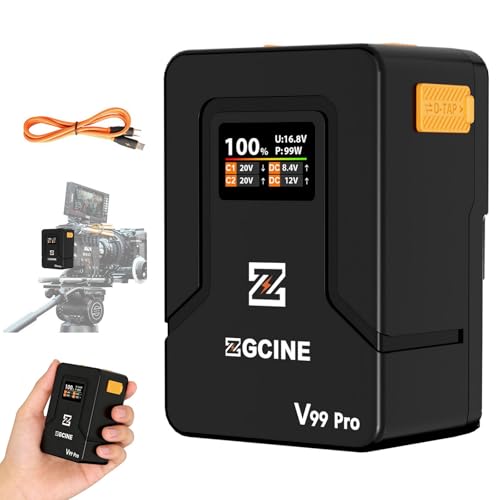
The ZGCINE V99 Pro is the battery to grab when waiting on a charge is the thing slowing you down. With a 100W USB-C PD input, it claims a full refill in around 1.5 hours, which is meaningfully faster than the two hours of the standard VB99 in slot 2. For one-day commercial shoots that means less time hunting for outlets between setups.
It is also generous on inputs, supporting D-Tap and BP charging as alternatives when USB-C is tied up powering a laptop. For traveling creators, the 99Wh capacity still lands within airline carry-on rules, so the speed advantage does not come at the cost of a flight-friendly rating.
Noteworthy Benefits
- 100W USB-C PD input refills the cell in about 1.5 hours, the fastest in this lineup.
- Alternate D-Tap and BP charging paths keep the battery useful when USB-C is occupied.
- 99Wh capacity holds the line on common airline carry-on limits for flying crews.
- On-set flexibility means fewer dead-battery interruptions during long interview days.
Points To Keep In Mind
- Reaching the 1.5-hour claim requires a 100W-capable USB-C charger, which is not always in a standard kit.
- The brand is less established than SMALLRIG or K&F CONCEPT, so long-term support depends on the retailer.
Quick Facts
Whose Shelf It Belongs On
Working videographers who run tight turnaround days and would rather refill a battery in 90 minutes than hunt for wall outlets between locations.
Where Another Pick Suits Better
Shooters who value a longer track record and broader ecosystem support will be more comfortable with the SMALLRIG VB99 from slot 2.
The SMALLRIG VB99 Pro takes the brand’s mini V-mount formula and trims the case down to roughly 4.2 by 2.9 by 2.2 inches, which is small enough to ride on a camera cage without throwing off balance. Inside that footprint sits the same 99Wh, 6800mAh cell found in the SE and standard VB99, but the Pro adds a second USB-C port for simultaneous charging and accessory power.
For cage-mounted rig builds and gimbal work, the dual USB-C layout is the headline feature, letting you run a monitor off one port while fast-charging the battery through the other. Charging the cell itself needs a PD-protocol charger, and a 100W GaN brick refills it in about 2.5 hours.
Positive Takeaways
- Two USB-C ports enable charging the battery while powering a connected accessory at the same time.
- Palm-sized housing fits comfortably on small cages, gimbals, and handheld rigs.
- 99Wh capacity keeps the cell within typical airline carry-on limits for traveling shooters.
- USB-C1 port handles 100W input for fast top-ups with a compatible GaN charger.
Minor Gripes
- Owners commonly report that the supplied cable is short, so a longer right-angle USB-C helps on rigged builds.
- For D-Tap charging the input voltage must stay under 16.8V, which is worth flagging before plugging in third-party chargers.
Right Fit For
Cage-mounted and gimbal shooters who want maximum port density in the smallest possible V-mount footprint.
Look Elsewhere When
Travelers who want the absolute lowest weight should compare against the SMALLRIG VB99 SE from slot 1, which trims the second USB-C port to save grams.
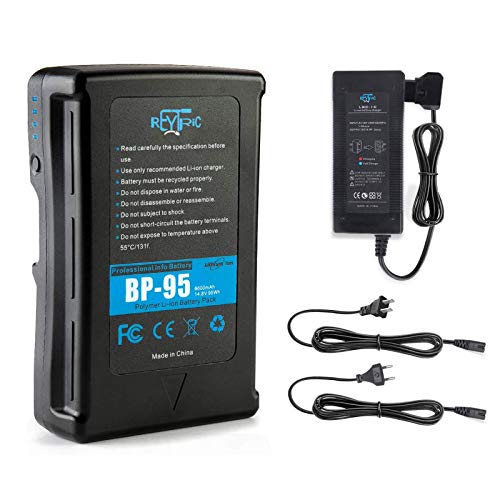
The REYTRIC 95Wh is the practical, no-frills brick for crews who just need reliable power for studio and ENG work. Its 6600mAh polymer lithium cell runs at 14.8V, which is the standard V-mount voltage that pairs with cameras like the Blackmagic URSA Mini and RED Epic without adapters.
What sets this option apart is the bundled kit: a D-Tap output charger and a D-Tap cable come in the box, so a first-time V-mount owner can start shooting without buying extras. For news crews and documentary teams, that all-in-one approach is a meaningful cost saver.
Features That Help
- 95Wh capacity sits just under common airline carry-on thresholds, useful for travel day shoots.
- Bundled D-Tap charger and cable remove the need for separate accessory purchases.
- Polymer lithium chemistry aims for a long service life similar to original-brand V-mount cells.
- Broad compatibility with Sony, Canon, and Blackmagic camera lines using standard V-lock plates.
Honest Caveats
- There are no USB-C PD ports, so powering a laptop or phone means carrying a separate battery bank.
- Compared with newer mini V-mounts, the brick is heavier and bulkier, which shows up on handheld gimbal work.
Spec Overview
Who Will Love This
ENG crews, indie studios, and first-time V-mount adopters who want a complete starter kit without chasing accessories across multiple orders.
A Better Fit Elsewhere
Run-and-gun shooters craving a smaller, USB-C-equipped cell should pivot to the SMALLRIG VB99 Pro from slot 5.
The NEEWER PS099E is the option I lean toward when the on-camera readout matters as much as the wattage. The OLED display shows remaining capacity and output status in real time, which removes a lot of the guesswork that comes with V-mount batteries in the field. For Blackmagic Pocket 4K and 6K shooters, the PS099E was built with those rigs in mind.
At 6800mAh and 99Wh, it sits in the same capacity tier as the SMALLRIG VB99 line, but it distinguishes itself with a particularly wide port array, including dual USB-A, USB-C, D-Tap, BP, and dual DC outputs. For users running a camera plus an LED video light, that spread is a real workday advantage.
Benefits That Matter
- OLED display gives an at-a-glance read on remaining capacity and current draw during shoots.
- Broad port array covers USB-A, USB-C, D-Tap, BP, and dual DC outputs for mixed rigs.
- 99Wh capacity stays under common airline carry-on caps for travel-heavy creators.
- Native compatibility with Blackmagic Pocket 4K and 6K camera lines simplifies setup.
Soft Spots
- 65W USB-C PD tops out below the 100W offered by SMALLRIG’s VB99 and the ZGCINE V99 Pro.
- Reaching a full charge takes up to three hours with a 16.8V D-Tap charger, slower than PD 100W options.
Perfect Match For
Run-and-gun Blackmagic Pocket shooters who want a real-time readout and broad accessory ports in one mini V-mount body.
Not Your Match When
High-draw cinema setups that need 100W USB-C should look at the ZGCINE V99 Pro from slot 4 instead.
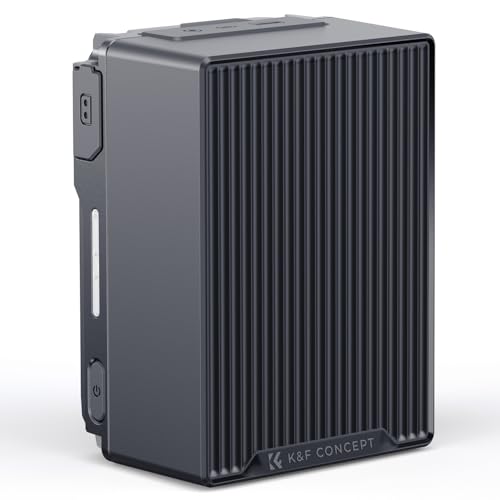
The K&F CONCEPT 99Wh PD100W earns its slot with an unusually generous D-Tap count: two D-Tap ports let you run a monitor and an on-camera light at the same time without splitting accessories across batteries. For crews stacking accessories, that two-port layout is a quiet productivity win that most competitors only match with adapters.
Capacity sits at 6700mAh and 14.8V, which is standard V-mount territory, and the 100W bi-directional USB-C PD keeps the cell fast to refill between setups. Compared with the SMALLRIG VB99 from slot 2, the headline difference is the second D-Tap port, which is the kind of detail that matters once your rig grows beyond a camera and a monitor.
A Few Highlights
- Two D-Tap ports let you power a monitor and a light simultaneously from one battery.
- 100W bi-directional USB-C PD refills the cell quickly with a compatible GaN charger.
- 99Wh capacity keeps the battery within typical airline carry-on allowances for working travelers.
- Full port spread covers cameras, camcorders, monitors, and LED panels from one source.
Potential Drawbacks
- Two D-Tap ports pull more cable clutter, so a short D-Tap cable set is worth budgeting for.
- K&F CONCEPT accessories are not as widespread as SMALLRIG or NEEWER ecosystems, so spares may take longer to source.
Built With In Mind
Multi-accessory rigs running a camera, monitor, and on-camera light from a single V-mount, where two D-Tap cables are easier than a splitter.
Swap It Out When
Shooters who value dual USB-C over dual D-Tap will be more comfortable with the SMALLRIG VB99 Pro from slot 5.
The second K&F CONCEPT entry on the list leans into USB-C count, with two USB-C ports sitting alongside a USB-A, a 12V DC barrel, BP, and a D-Tap. The combined spread is the widest of any pick here, which makes this a natural hub for hybrid kits that mix modern USB-C accessories with legacy DC-powered monitors.
Capacity is the standard 99Wh at 6700mAh and 14.8V, and the 100W USB-C PD keeps refill times competitive with the rest of the 100W crowd. For traveling creators who want one cell that handles a phone, a laptop, and a camera without juggling adapters, this is a tidy answer.
A Strong Showing
- Two USB-C ports, plus USB-A, 12V DC, BP, and D-Tap, cover the widest mix of modern and legacy accessories.
- 100W bi-directional USB-C PD enables fast top-ups with a GaN charger and high-watt device power.
- 99Wh capacity aligns with common airline carry-on rules for cross-border shoots.
- Single-battery hub design cuts the count of cells and cables in a travel kit.
Where It Is Less Suited
- Only one D-Tap port, so stacked monitor-and-light rigs may need the dual D-Tap version in slot 8.
- Owners commonly report the OLED-style readouts as basic, so precise percentage monitoring requires a quick port check.
Who Should Grab It
Travel-heavy hybrid shooters running a mix of USB-C laptops and DC-powered monitors who want a single hub battery.
Another Choice May Suit
Monitor-and-light stack shooters will be better served by the dual D-Tap K&F CONCEPT version in slot 8.
What Actually Matters When Picking A V Mount Battery
Capacity is the headline number, and the reason almost every pick on this list sits at 99Wh is simple: that figure stays just under the common airline threshold for carry-on baggage. For anyone flying between gigs, going over 100Wh usually means checking the battery or leaving it at home. Run-and-gun crews who never leave the ground have more flexibility, but the 99Wh ceiling is still the sweet spot for most cinema camera bodies.
USB-C PD wattage is the next detail to weigh, since it shapes both how fast the cell refills and how much it can deliver to a laptop or hungry camera body. A 65W port is plenty for mirrorless rigs and phones, while 100W is the more useful ceiling for cinema bodies, MacBooks, and anything that draws serious current. For accessories, the port spread matters: D-Tap, BP, and DC barrel outputs are still common on cinema monitors and lights, so a battery with too few legacy ports can leave you reaching for adapters.
Form factor is the detail that gets ignored until you are balancing a gimbal at arm’s length. Mini V-mounts from SMALLRIG, NEEWER, and K&F CONCEPT shave enough bulk to ride on a cage, while older brick-style batteries like the REYTRIC in slot 6 are better on studio stands and ENG rigs. The honest read is that the right shape depends entirely on whether you are handheld or static.
Smart Considerations Before You Buy
Common Shopping Slip Ups
The most frequent mistake is buying a 100W-rated battery and then charging it with a 30W phone brick, which turns the advertised two-hour refill into a six-hour wait. Wattage is a two-way street, and the charger needs to match the cell’s input ceiling. Another trap is grabbing a V-lock battery without checking plate compatibility: the Blackmagic Design plate in slot 3 is a perfect example of how a missing adapter can sideline an otherwise good purchase.
Owners also commonly report underestimating how quickly a 99Wh cell drains when powering a full rig. For long interview days or documentary shoots, one battery is rarely enough, so budgeting for two or three cells from the start usually beats scrambling for a fast-charge option later.
When Paying More Pays Off
The step up from a basic 95Wh brick to a 100W PD mini V-mount shows up in three places: charge time, port density, and weight. Faster PD input means shorter gaps between setups. A wider port spread means fewer adapters cluttering the rig. And a smaller housing means a real difference in handheld fatigue over a long day. The premium tier is essentially a productivity tax, and for working professionals, that tax usually pays for itself within a few shoots.
Frequently Asked Questions
What is a V mount battery? A V mount battery is a standardized power cell, also called V-lock, that snaps into compatible plates on cinema cameras, monitors, and lights. The V-shaped locking mechanism is the industry standard for professional video production.
Can I fly with a V mount battery? Most airlines allow V mount batteries up to 100Wh in carry-on luggage, and every pick on this list sits at or below that ceiling. Batteries between 100Wh and 160Wh usually require airline approval, and anything above 160Wh is generally not permitted in the cabin.
How long does a 99Wh V mount battery last? Runtime depends on the camera and accessories, but a typical full-frame mirrorless body drawing around 30W will run for roughly three hours from a 99Wh cell. Adding a 7-inch monitor and an on-camera light cuts that figure noticeably.
What is USB-C PD on a V mount battery? USB-C PD, or Power Delivery, is a fast-charging standard that lets the battery both receive high-wattage input and deliver power to laptops, phones, and modern cameras through a single USB-C cable. Higher PD wattage means faster charging and more headroom for power-hungry devices.
Do I need a special charger for V mount batteries? It depends on the model. Some batteries charge only through a D-Tap charger, while modern mini V-mounts accept USB-C PD input from any compatible GaN charger. For best results, match the charger’s wattage to the battery’s stated input ceiling.
Wrap Up
The right V mount battery really comes down to how you shoot, whether that means a travel-ready 99Wh cell, a 100W fast-charge workhorse, or a specialty plate for a specific camera body. Match the capacity to your travel plans, the wattage to your power draw, and the port spread to your accessory list, and the rest tends to fall into place.
