

One bad power spike can quietly take out a pricey TV and everything plugged into it, from a soundbar to a streaming box to a gaming console. A good surge protector is the cheapest insurance in your entertainment center, and it only works if you pick the right one for your gear and your room.
I put together this list to help anyone sort through the noise, whether you’re building a simple living room setup or wiring a full home theater. Each pick below leans on real-world scenarios like apartment walls with two-prong outlets, open-concept layouts with long cable runs, or a single wall outlet behind a media console where everything competes for space.
The Lineup, Simplified

CCCEI 12 Gauge Long Extension Cord, Yellow, 50FT

TROND Power Strip Surge Protector 3ft

Eaton Tripp Lite TLP1208TELTV Surge Protector

DEWENWILS 6-Outlet Surge Protector, 10FT
CCCEI 12 Gauge Heavy Duty Surge Protector, 6FT

CCCEI Magnetic Heavy Duty Surge Protector
Treybair Appliance Voltage Stabilizer Surge Protector

Treybair 1800J Single Outlet Surge Protector
Treybair Smart Voltage Stabilizer Surge Protector

Treybair Surge Protector with USB Type-C and LED
Inside Each Recommended Option
The CCCEI 50-foot extension cord is built for setups where the nearest outlet is across the room or in the next room over. It carries a 12-gauge wire (a thicker conductor that handles higher current over long distances without voltage drop) and lists a 15-amp, 125-volt, 1875-watt rating, which is the maximum a standard household circuit can deliver. The high-visibility yellow jacket also helps prevent trip hazards in busy rooms or temporary event setups.
With eight grounded outlets and a dedicated breaker switch, it gives you room to plug in a TV, soundbar, substation, lamp, and a couple of accessories from a single wall outlet. Compared to the more compact picks later on this list, it trades portability and a sleek look for sheer reach and capacity, so it lands best in basements, garages, or open living spaces where you actually need every foot of cord.
Features That Help
- 50-foot reach solves outlet-distance problems in long rooms or split-level layouts
- Eight grounded outlets let you centralize power for a full entertainment cluster
- Built-in circuit breaker protects the strip from overload and lets you reset fast
- 12-gauge wire stays cool under heavier loads at full extension length
Things To Consider
- Bulk and weight make it awkward for tight entertainment centers
- Yellow jacket shows dust and scuffs in living areas more than black cords
- No USB ports means phone and tablet charging still needs a separate brick
Who It Suits Best
Anyone running a media setup far from a wall outlet, or anyone staging a temporary entertainment space like a basement gym or rec room, will find the reach genuinely useful.
Where Another Pick Suits Better
The TROND power strip is a smarter call for a small bedside or desk where USB charging matters more than reach.
TROND’s 3-foot wall-mountable strip is the quiet workhorse of the list. It carries an ETL safety certification (a third-party testing mark recognized in North America), and it splits a single wall outlet into five grounded AC outlets, two USB-A ports, and two USB-C ports. Total power tops out at 1875W / 125V / 15A, which is the standard household ceiling.
The USB-C ports each support up to 3A while the USB-A ports handle 2.4A, so a modern phone charges fast without a separate brick. Compared to the long-reach CCCEI that opened the list, this one trades reach for a tidy footprint, and it works well behind a TV stand, on a nightstand, or mounted under a desk. Owners commonly report that the rotating plug is the feature they end up using most.
Where It Helps
- Five AC outlets plus four USB ports handle a full bedside or desk setup
- Rotating plug lets the strip sit flush against furniture in tight spots
- Wall-mountable design keeps cords off the floor and easier to vacuum around
- USB-C at 3A speeds up charging for newer phones and small tablets
Worth Noting
- 3-foot cord is short when the only outlet lives behind a couch or shelf
- USB ports share total output, so charging four devices at once slows each one down
Made For
Anyone who wants a tidy charging station for a TV, soundbar, phone, and tablet in one compact block, without a mess of wall adapters.
Consider Something Else When
The DEWENWILS is a better fit for entertainment centers with bulky power supplies because of its wider outlet spacing.
The Tripp Lite TLP1208TELTV is built for a true home theater stack, the kind with a TV, AV receiver, cable box, streaming device, and a landline or modem. It packs twelve outlets, four of them spaced wider to fit bulky transformers, and supports 2160 joules of surge absorption (a joule rating measures how much spike energy the protector can absorb before wearing out, so higher numbers mean longer life under frequent small surges). The package also bundles a 6-foot coax cable and a 6-foot RJ11 phone cable, which is rare at this level.
An 8-foot cord with a flat plug lets the strip slide behind low-profile furniture, while the dedicated phone and coax ports guard your signal lines from the same surges that threaten your AC gear. Where the TROND focuses on a tidy desk, this Tripp Lite focuses on comprehensive home theater protection, and that difference shows up the moment you start plugging in cable boxes and satellite receivers.
Practical Advantages
- 2160-joule rating covers years of small surges before wearing out
- Twelve outlets, with four wide-spaced for AC adapters, run a full rack
- Coax and phone line protection shield cable, satellite, and modem feeds
- 8-foot cord plus flat plug fits tight entertainment centers and low shelves
Trade Offs
- Long strip length can crowd shallow media cabinets
- Extra phone and coax jacks only matter if you still use those connections
Feature Snapshot
Best Suited To
Anyone running a multi-component setup with cable, satellite, or a landline, where a single point of failure could take out the whole stack.
Not Your Match When
For a small bedroom TV with one streaming stick, the TROND covers the same surge needs in a smaller footprint.
DEWENWILS built this six-outlet strip with entertainment centers in mind. It carries a UL safety listing, a 15-amp / 120-volt / 1800-watt rating, and a 500-joule surge rating. The 10-foot cord is generous for media consoles that sit a few feet from the wall, and the low-profile flat plug slides behind couches and bed frames without sticking out.
The wide-spaced outlets are the quiet win: chunky AC adapters for streaming boxes and smart speakers no longer block the neighboring socket. A 15-amp fused switch sits at one end for easy resets. Compared to the TROND, this DEWENWILS trades USB ports for longer reach and wider spacing, which is exactly the trade-off most living room setups want.
Strong Points
- 10-foot cord reaches outlets across most living rooms without extensions
- Wide outlet spacing handles bulky wall warts without blocking neighbors
- Flat plug keeps furniture close to the wall
- UL listing and fused switch add a layer of recognized safety and easy reset
Honest Caveats
- 500-joule rating is modest for areas with frequent lightning storms
- No USB ports means phones still need their own wall adapters
Right Fit For
Living rooms and dens with a wall-mounted TV and a media console that need long reach and room for big plugs, without paying for cable line protection they don’t use.
Look Elsewhere When
For setups with a cable box and modem, the Tripp Lite TLP1208TELTV brings coax protection and more outlets.
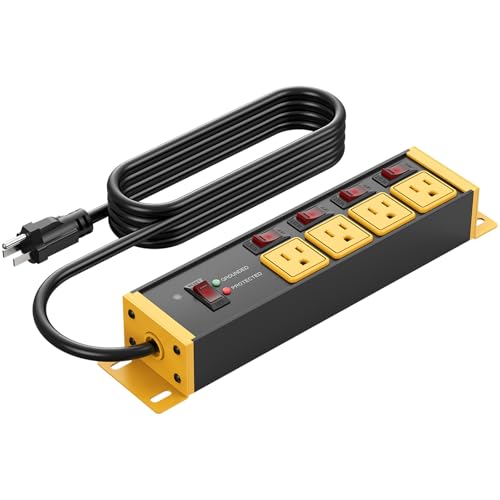
This CCCEI strip is built for serious loads. It carries 12-gauge wire, a 6-foot cord, and an interesting twist: the outlets are rated for 20 amps (5-20R and 6-20R), with a standard 5-15P plug on the wall end. That means it can feed high-draw tools and appliances, and each of its four outlets has its own 20-amp breaker switch for independent control.
Compared to the longer 50-foot CCCEI earlier on this list, this one is shorter, heavier, and aimed at a workshop bench, a maker table, or a prosumer audio stack. The wall-mount design helps it live on a pegboard or under a workbench, and the per-port switches are a real convenience when one tool finishes and you want to leave the others running.
Advantages To Know
- 20A outlets handle heavier tools and amplifiers without tripping common 15A circuits
- Per-outlet breaker switches cut power to one device without disturbing the others
- 12-gauge wire keeps voltage steady under sustained heavy loads
- Wall-mountable body fits shop pegboards and under-bench installs
Points To Keep In Mind
- Four outlets is fewer than most living room strips
- 20A rating only helps when paired with a circuit that can actually deliver it
Feature Card
Who Should Grab It
Workshop owners, prosumer audio enthusiasts, and anyone running a high-draw appliance like a space heater or laser engraver at a single bench.
A Better Fit Elsewhere
For a TV and console setup, the DEWENWILS gives better outlet spacing and a longer cord for the same general use.
The magnetic CCCEI strip is the most distinctive design on this list. A magnet built into the back grips iron surfaces, so the strip hangs on a tool cabinet, a steel shelf, or the side of a metal workbench instead of living on the floor. It still carries 12-gauge wire, four outlets, and a master switch plus per-outlet switches, with a 15A / 125V / 1875W rating.
Where the 50-foot CCCEI earlier is about reach and the 6-foot CCCEI is about raw amperage, this one is about placement. In a garage or shop with exposed metal framing, the strip stays where you left it instead of sliding under a car or behind a stack of lumber. The trade-off is that the magnet only helps if your environment has steel nearby.
Standout Benefits
- Magnetic back grips toolboxes and steel shelving without screws or straps
- Master switch plus per-outlet switches give flexible control
- 12-gauge wire handles the same loads as a wired-in outlet
- Orange body stays visible against most garage and shop backgrounds
Softer Spots
- Magnet only attaches to ferrous (iron-containing) surfaces like steel, not aluminum or wood
- Bright orange clashes with finished living spaces
Quick Facts
Perfect Match For
Garage workshops, metal sheds, and anyone with steel shelving who wants outlets at eye level instead of on the floor.
Skip It When
For a wood-framed living room with no steel nearby, the magnet does nothing useful and the TROND is a quieter choice.
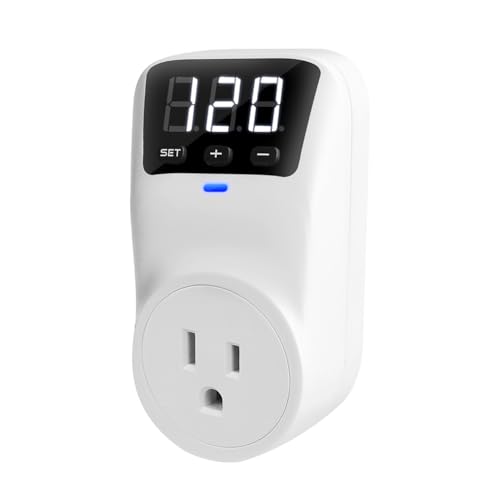
Treybair’s stabilizer is built for homes where the power itself is unstable, not just the occasional spike. It actively corrects over- and under-voltage, spikes, and outages, watching the line and switching to safe behavior when it drifts outside the 80V to 140V range. The fireproof UL94V-1 housing (a plastic grade that self-extinguishes within seconds of flame exposure) addresses one of the quieter risks in older appliance protection.
Unlike the multi-outlet strips earlier on this list, this is a wall-mounted single-outlet device, so it sits behind a single appliance rather than powering a whole stack. It fits naturally into kitchens, garages, and living areas where refrigerators, freezers, or older TVs face brownouts (brief voltage drops that stress compressors and motors) on a regular basis.
Positive Takeaways
- Voltage correction defends against under- and over-voltage, not just spikes
- UL94V-1 fireproof housing reduces ignition risk during electrical faults
- Custom voltage range of 80V to 140V adapts to local grid quirks
- Wall-mount design hides behind appliances without taking floor space
Less Ideal Details
- Single outlet means you cannot run a TV and a soundbar from one unit
- Active correction is overkill on a stable grid where basic surge protection would do
Whose Shelf It Belongs On
Anyone with frequent brownouts or rural-grid quirks protecting a refrigerator, freezer, or expensive single appliance they cannot easily replace.
Reach For A Different Pick When
For a living room with multiple devices on one strip, the Tripp Lite covers the same basic surge needs with twelve outlets.
Treybair’s single-outlet model focuses on one job and does it with extra margin. The 1800-joule rating is high for a single-outlet device, and it supports 15 amps at 1800 watts, which is the limit of a standard US household outlet. An audible alarm tells you when protection has been triggered or compromised, which is rare on a strip at this size.
Voltage cut-off and delay recovery guard against under-voltage (below roughly 90V) and over-voltage (above roughly 130V), protecting compressors in fridges and freezers that hate both. Compared to the multi-outlet stabilizer earlier on this list, this one drops the LCD and active monitoring in favor of a louder warning and a simpler install.
The Practical Payoff
- 1800-joule rating absorbs heavy spikes from lightning-adjacent areas
- Audible alarm alerts when protection has been spent and a replacement is due
- Delay recovery waits before restoring power, protecting compressor-driven appliances
- Single-outlet wall-mount form factor plugs in without extra cord mess
Practical Considerations
- Audible alarm can be startling in a quiet bedroom if a fault trips
- One outlet means no built-in flexibility for adjacent gear
Built With In Mind
Homeowners with a single high-value appliance like a refrigerator, freezer, or desktop PC tower who want a clear audible signal when protection wears out.
Swap It Out When
For setups where multiple devices share protection and LCD monitoring would be useful, the Treybair Smart model below covers more ground.
Treybair’s HLP02 smart model adds live voltage monitoring to the same fireproof, wall-mounted design. It defends against over- and under-voltage, surges, spikes, dips, and outages, while an industrial-grade polymer housing adds another layer of thermal safety. The real-time readout tells you what your wall is doing, so you can stop guessing whether that flicker was the TV or the grid.
Like the other Treybair units, it works inside an 80V to 140V custom range. Compared to the basic Treybair single-outlet model, this one trades the audible alarm for a visual display and smarter monitoring, which is a quieter fit for living rooms and home offices where beeping at midnight would be unwelcome.
Practical Pluses
- Real-time voltage display removes guesswork during brownouts and spikes
- Fireproof industrial-grade polymer housing handles heat stress
- Custom 80V to 140V range adapts to unstable rural or aging-grid areas
- Wall-mount form factor sits behind the appliance without clutter
Things To Weigh
- Higher internal complexity may matter more in tech-heavy environments than in a basic kitchen
- Single outlet means pairing it with another strip for multi-device setups
Core Details
Who Will Love This
Prosumers and tech-comfortable homeowners who want to see their grid health at a glance while protecting a heavy appliance or TV.
Another Choice May Suit
For a household that would rather hear an alarm than read a screen, the Treybair 1800J model is the more obvious pick.
Treybair rounds out the list with a hybrid design that mixes traditional surge protection with voltage correction and USB-C charging. The LED display gives the same real-time voltage readout as the smart model earlier, while the fireproof UL94V-1 housing matches the rest of the Treybair line. The USB-C port handles modern phones, tablets, and small laptops without a separate wall brick.
Where the other Treybair units focus on one heavy appliance, this one fits the middle ground: a TV plus a soundbar plus a phone or tablet, all in one compact box. It is the most flexible Treybair on this list for mixed living spaces that include both electronics and small appliances, though it costs more than a basic strip.
Useful Strengths
- Combines USB-C charging with voltage correction in one device
- LED voltage monitoring keeps you aware of grid conditions in real time
- Fireproof UL94V-1 housing reduces ignition risk
- 80V to 140V custom range handles unstable grids
Some Limits To Know
- One USB-C port limits simultaneous device charging
- Combined feature set commands a higher price than a basic surge strip
The Right Fit
Anyone with a TV setup and a USB-C laptop or tablet who wants surge protection and voltage correction in the same wall-mounted box.
Where A Sibling Pick Shines
For a pure entertainment stack without USB needs, the Tripp Lite TLP1208TELTV handles more outlets and signal-line protection.
Factors To Consider When Choosing Tv Surge Protectors
Joules and What They Mean for Daily Use
Joules measure how much spike energy a surge protector can absorb before its internal components wear out. A 500-joule strip handles small everyday surges from HVAC cycles and refrigerator kicks, while 1800 joules or more is the right range for homes that see frequent storms or unreliable grid conditions. The honest read is that higher joules last longer, but they only matter when paired with the right number of outlets and the right cable type.
Outlets, Spacing, and Cord Length
The right outlet count depends on what you actually plug in, not what you might someday plug in. Wide spacing between outlets prevents bulky AC adapters from blocking neighbors, and cord length decides whether you can put the strip where you want it or whether it lives annoyingly close to the wall. Measure from your wall outlet to the center of your media console before committing to a 3-foot or 10-foot cord.
Signal-Line Protection and Specialized Designs
A TV setup that includes a cable box, satellite receiver, or landline modem can be hit by surges coming through the coax or phone line, not just the AC outlet. A strip with built-in coax and RJ11 protection covers that path in one device. For workshop and garage use, magnetic mounting and 20A outlets solve placement problems a regular strip cannot.
Key Considerations Across These Picks
Common Shopping Slip Ups
The most common mistake is choosing a strip by outlet count alone, ignoring joule rating and signal-line protection. A six-outlet strip with 500 joules feels safe in a living room, but during a real lightning event it can wear out in a single season. The other frequent miss is treating all surge protectors as interchangeable: a wall-mount single-outlet stabilizer and a 12-outlet strip protect completely different setups, and choosing the wrong one leaves part of the stack exposed.
Where The Extra Money Goes
Higher-tier models on this list earn their cost through higher joule absorption, active voltage correction, fireproof housings, and signal-line protection. For most apartments on a stable grid, a mid-tier strip with 1000 to 2000 joules is plenty, and the upgrade to a stabilizer or smart monitor only matters when brownouts and grid swings are already part of daily life. Spend up when the protected gear is expensive to replace, not when you simply want more outlets.
Frequently Asked Questions
How many joules do I need for a TV surge protector?
For a basic living room TV with a soundbar and a streaming box, around 1000 to 2000 joules is a comfortable range. If you live in an area with frequent thunderstorms or unreliable power, lean toward 2000 joules or higher for longer protection life.
Should I plug a surge protector into another surge protector?
Daisy-chaining surge protectors is not recommended, because stacked strips can exceed the amp rating of a single wall outlet and create a hidden fire risk. A single strip with enough outlets is always the safer choice.
How long does a surge protector actually last?
Most surge protectors wear out gradually as they absorb spikes, which is why a higher joule rating means a longer service life. In storm-prone homes, replacing the strip every two to three years is a sensible habit, while stable-grid households can often go longer.
Do I need special protection for cable or satellite lines?
If your setup includes a cable box, satellite receiver, or a coax-fed modem, yes. Surges can ride the coax line into your gear even when the AC outlet is protected, so a strip with coax protection closes that path in one device.
Can a surge protector also fix low voltage?
Standard surge strips cannot correct under-voltage or brownouts. For that, you need an active voltage stabilizer, which monitors the line and cuts or corrects power when it drifts outside a safe range.
Bottom Line
The right surge protector depends less on a brand and more on your room, your gear, and your local power quality. Match joule rating to your grid reality, outlet count to what you actually plug in, and cord length to where the strip needs to live. Start with the picks above, then refine based on whether your priority is reach, USB convenience, home theater coverage, or active voltage stabilization.
